Paper commentary
Predicting, Fast and Slow: SSD Already Knows Which Guess Is Wrong
A lookup table of recent read outcomes spots an SSD controller's wrong guesses
- Problem Uncertainty estimators, the suggested fix for Heimdall's wrong slow calls, cannot find those wrong guesses. Nine of them do no better than a coin, because Heimdall's errors come from bias.
- Method The authors replace learned doubt with a 4,096-entry table of how the drive's recent reads came back. It needs no training and takes 21 ns a decision.
- Results The table reaches 0.68 median AUROC versus 0.52 for the best estimator.
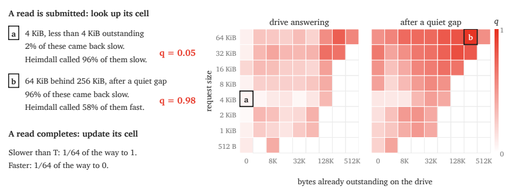
Figure 2 . The table after three minutes of one held-out trace, an MSR Cambridge media-server volume, for reads submitted with nothing outstanding for longer than 𝑇, the knee of the first minute’s read latencies. Sizes and backlogs are classes one power of two wide, named by their lower edge. Blank cells saw fewer than 20 reads. Slow reads are large reads behind a backlog, more so just after the drive has gone quiet. Heimdall’s twelve inputs carry neither the backlog in bytes nor the quiet.
Original paper · CC BY 4.0 · Philipp Bogdan · Predicting, Fast and Slow: SSD Already Knows Which Guess Is Wrong · Original paper figure · Extracted the figure area from page 2 of the original PDF.Where uncertainty estimators stall
Heimdall is a learned controller that places a small neural network in front of each SSD in a replicated pair. When that network guesses slow, the read goes to the other drive. For microsecond budgets, they recommend distance from the training data, calling it the only viable option. Their evidence is latency: a 56 to 57% cut at p99.9.
That evidence says nothing about whether distance finds Heimdall's wrong guesses, and Gohil et al. didn't measure it. A read counts as slow when its latency passes the knee of the replay's read-latency distribution. A guess is wrong when the read lands on the other side of that knee, the binary fast-or-slow task Gohil et al. describe.
Nine estimators compete, and three families come from Gohil et al.: distance, conformal scores and a Bayesian network [6]. The other four are standard: the network's margin, an ensemble [7], deep nearest neighbours [8] and trust score [9]. None of them finds the wrong guesses, with median AUROCs from 0.46 to 0.52 on 57 held-out traces. Figure 1 plots one dot per held-out trace, and the nine estimators sit close to a coin.
Applied the way Gohil et al. apply it, Euclidean distance flags inputs beyond the 90th percentile of the training distances. Those traces are ones where a median 42% of Heimdall's guesses are wrong.
The wrong guesses are a bias
Heimdall calls slow on a median 52% of reads across the 57 held-out traces, while a median 30% of reads actually come back slow. The errors point one way, toward slow calls, so the problem looks more like a bias than like uncertainty. Of 4 KiB reads with less than 4 KiB outstanding, 2% came back slow, yet Heimdall called 96% of them slow.
That count reaches a median AUROC of 0.60, beating all nine estimators, whose medians run from 0.46 to 0.52. The bias is partly taught, because Heimdall trains on period labels that mark whole stretches of a trace as slow. Those labels mark a median 53% of the scored reads as slow, where a median 30% come back slow.
Our reimplementation reproduces that to within 0.5 points, with labels and features identical row for row. Once deployed, the network sees only the last three completed I/Os, so it meets futures it never trained on.
A table of recent read outcomes
The table indexes each read by four things known at submission: its size, the bytes outstanding, the age of the oldest request, and recent quiet. Those four quantities are split into 32, 16, 4 and 2 classes, which gives 4,096 entries, each starting at 1/2.
Otherwise the entry moves 1/64 of the way to 0. T is the knee of the first minute's latencies, so the table needs no training and no labels. A fast guess is suspect in proportion to q. A slow guess is suspect in proportion to 1 − q. The table keeps learning from every completion, while the network and the nine estimators stay frozen after the first minute.
The cell for a 4 KiB read with less than 4 KiB outstanding holds q = 0.05. Of these reads, 2% came back slow, while Heimdall called 96% of them slow. The cell for 64 KiB behind 256 KiB after a quiet gap holds q = 0.98. There 96% came back slow, but Heimdall called 58% of them fast. Large reads queued behind a backlog are where slow reads cluster, especially right after a quiet spell.
On the 57 held-out traces the table ranks Heimdall's wrong guesses at a median AUROC of 0.68. It beats the best of the nine on 50 of the 57 traces, though only 16 traces reach 0.80. Among reads Heimdall admits as fast, the table scores 0.61 against 0.47 to 0.55 for the nine. It costs 21ns a decision, close to Euclidean distance's 19ns.
How the table ranks wrong guesses
The table ranks Heimdall's wrong guesses at a median AUROC of 0.68 across the 57 held-out traces. It beats the best of the nine, chosen per trace with hindsight, on 50 of the 57 traces. The lead is modest, since only 16 traces reach 0.80. Among reads Heimdall admits as fast, the table scores 0.61. The nine estimators score 0.47 to 0.55 on that subset, and the table stays level with the best of them.
A single running count of slow reads reaches a median AUROC of 0.60, which beats all nine estimators.
Judged by Heimdall's period labels instead of each read's latency, the table is close to a coin at 0.52. The two distances fall to 0.47 and 0.51, so distance fails under both labelings. The authors take this to mean the table tracks what reads did, rather than what the labels say. On those same twelve traces, the table reaches 0.83.
As a forecast that a read will be slow, the table's q reaches a median AUROC of 0.63. Heimdall's output reaches 0.55 on the same forecast, and the table is ahead on 47 of the 57 traces. Euclidean distance takes 19ns, while a fixed-point copy of Heimdall's inference takes 1.7µs.
Does the tail referee the guesses
Gohil et al. justified distance with latency, so the authors tested the tail metric directly. Gohil et al. reported a 56 to 57% cut at p99.9, but they didn't measure whether distance picks out Heimdall's wrong guesses.
On six trace pairs run on two identical NVMe drives, the better of two distances leaves p99.9 within 9% of the table's result at the median round. That gap holds on every pair, so the distances don't lag the table by much. Figure 3 plots each pair's p99.9, and the choices barely separate.
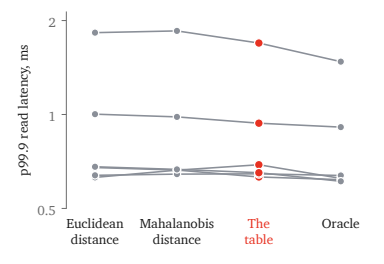
Figure 3 .Whoever picks the reads, the tail barely moves. Each line is one of six trace pairs on two identical NVMe drives, with hedging on: its p99.9 read latency, the median over rounds, when the guesses to distrust are chosen by a distance, by the table, or by an oracle told which were wrong in an earlier re- play.
Original paper · CC BY 4.0The reported cut isn't reproduced, because the authors rebuilt Gohil et al.'s distances and ran them without hedging. Part of any cut needs no model, since Heimdall's artefact ships a hedging baseline with no model. Heimdall's paper credits hedging with shorter tail latencies above p99.
So the tail can't referee the estimators, because it barely moves whichever method picks the reads. The authors advise checking that an uncertainty estimator finds the wrong guesses, read by read, before adding it to a learned controller.
Limits of the evidence
The 57 held-out traces come from the busiest stretches of 38 volumes. The traces come from the UMass collections and from MSR Cambridge. Each trace was replayed once on a WD_BLACK SN770, at its recorded pace or eight times faster. The tail results rest on a different rig: two identical enterprise NVMe drives, six trace pairs and five rounds.
The table's ranking lead is modest, with a median AUROC of 0.68 across the 57 held-out traces. Only 16 of the 57 traces reach a median AUROC of 0.80. Among reads Heimdall admits as fast, the table scores 0.61 against 0.47 to 0.55 for the nine estimators. The table's advantage there is smaller, because most of its lead came from the bias.
The three Gohil et al. families were rebuilt from their description: distance, conformal scores and a Bayesian network. Two other hedging decisions used controllers that the authors trained on each request's own outcome. On one of those decisions the table trails the network's margin, and on the other it leads narrowly. The table takes 21ns a decision, while Euclidean distance takes 19ns and Heimdall's inference takes 1.7µs.
The tail comparison used hedging, with a copy sent once a read passes the 98th percentile of the first minute's latencies.
Paper info
- Authors
- Philipp Bogdan
- Venue
- arXiv · Preprint
- First published
- 2026-11-14
- Added
- 2026-11-17
- Updated
- 2026-11-14
- Version
- v1
- arXiv
- 2611.19457
- Category
- cs.OS · cs.LG · cs.PF
- Original paper terms
- CC BY 4.0
- What we show
- Paper info, commentary and permitted figures from the original paper
AI commentary is a separate explanation from the original paper and may contain errors. The original paper and figures follow each source's terms of use and any rights noted separately.
Abstract
Heimdall, a learned controller, calls slow on 52% of an SSD's reads when 30% are slow. Uncertainty estimators, the remedy prescribed for its wrong guesses, cannot find them: nine of them do no better than a coin. The drive can. On one trace, 2% of the reads of 4 to 8 KiB that found less than 4 KiB outstanding while the drive was answering came back slow, and Heimdall called 96% of them slow. A 4,096-entry table of how the drive's recent reads came back, untrained and 21 ns a decision, ranks the wrong guesses at a median AUROC of 0.68 on 57 held-out traces, where the nine sit at 0.46 to 0.52, and it predicts slow reads better than Heimdall itself.
Quote from the paper
Philipp Bogdan (2026). Predicting, Fast and Slow: SSD Already Knows Which Guess Is Wrong. arXiv:2611.19457v1. https://arxiv.org/abs/2611.19457v1
BibTeX
@misc{bogdan2026predicting,
  title = {{Predicting, Fast and Slow: SSD Already Knows Which Guess Is Wrong}},
  author = {Philipp Bogdan},
  year = {2026},
  eprint = {2611.19457},
  archivePrefix = {arXiv},
  url = {https://arxiv.org/abs/2611.19457v1}
}