Paper commentary
Earlybird: Predictive Streaming Speech Recognition in 29M Parameters
Earlybird predicts words in streaming speech before speakers finish them
- Problem Streaming speech recognizers show each word only after the speaker finishes it, typically 90 to 400 ms later. A voice agent loses that time before it can start a search or plan a reply.
- Method Earlybird is a 29M-parameter streaming recognizer trained on audio cut at random points. It is asked to predict each word that is due by the cut, plus the next two words.
- Results On LibriSpeech test-clean, the median word is predicted 90 ms before the speaker finishes it. Released streaming models get it 90 to 400 ms after it ends.
Why waiting for word ends costs time
A streaming recognizer shows each word only after the speaker has finished saying it, so the text reaches a voice agent late. On clean audiobook speech, released streaming models show a word 90 to 400 ms after it ends. For a voice agent, that lag is time it could have used to start a search or plan a reply while the speaker still talks.
Listeners don't wait for a word to end before they recognize it, since most words can be identified from their first few phonemes in context. Earlybird answers that question by putting the prediction inside a small streaming recognizer.
Earlier systems already use partial output, but they don't target the word before it ends. Schwarz et al. predict whole utterances from partial ones, and both approaches depend on how early and how stable that partial text is. FastEmit and LocalAgreement shorten the delay toward the end of a word instead of before it.
It also reports calibration and stability alongside earliness, which the earlier work doesn't measure in the same way.
Predicting words from partial audio
A word is due when its start plus half its length, capped at 50 ms of heard audio, or its end minus a 300 ms lead, whichever is later.
Because targets at later cuts extend targets at earlier cuts, the model never learns to write a word it will later remove.
A teacher loss from the original Moonshine Tiny is applied only at token positions where the teacher's top choice matches the label. Where the teacher is wrong or unsure, applying the loss would spread probability over several words, so the authors skip those positions.
Training draws on LibriSpeech, People's Speech and synthetic Kokoro speech, sampled with weights 1:3:3:3:1. Real transcripts are kept only when the teacher Moonshine Medium writes exactly the reference words. The model is trained with a learning rate of 5×10 −5 for the first streaming-cut stage of 10k steps.
Starting from Moonshine streaming Tiny
Earlybird begins with Moonshine streaming Tiny, a 34M-parameter encoder-decoder that takes in 80 ms audio chunks. The authors shrink its vocabulary to 19,007 tokens, keeping those that appear in their training transcripts. They also keep every single-character token, so the model can still spell out any word. Dropping most of the vocabulary brings the model down to 29M parameters.
That check includes TED-LIUM and Earnings-22, which the original never saw in training. Earlybird drops that hold-back and decodes the full transcript at every step.
Moonshine Tiny also acts as a teacher through a distillation loss during training. The loss applies only at token positions where the teacher's top choice matches the label. Applying the loss at every position made the guessed words less decisive, spread over several candidates. The first stage runs 10k steps of streaming-cut training after the vocabulary cut, at a learning rate of 5×10 −5.
Every stage of the schedule keeps the distillation term.
Each training example cuts the utterance at a random 80 ms step, so the model sees partly spoken words. A short word is due once 50 ms of it has been heard.
Due times and the target at each cut
A word's due time is set from its forced-aligned start and end times, and it decides when the word enters the training target. Earlybird takes the aligned start time s_i and end time e_i for each word w_i from a forced aligner. The due time τ_i is the larger of two terms: s_i plus the smaller of half the word length and h, and e_i minus ℓ.
The lead ℓ is 300 ms and the minimum heard audio h is 50 ms.
For an ordinary word, the second term sets the due time, so the word is due 300 ms before it ends. A short word becomes due once at most 50 ms of its audio has been heard, which is the first term taking over. Short words therefore get less lead time than the 300 ms that ordinary words get.
Each training example cuts the utterance at a random 80 ms step t, and the target holds every word whose due time is at most t.
Teacher distillation and the four training stages
Moonshine Tiny acts as the teacher, and its distillation loss counts only where its top choice matches the label. Applying the loss at every position makes the guessed words less decisive, because their probability spreads over several candidates.
Earlybird trains first on LibriSpeech, with 960 h of audio and Montreal Forced Aligner word times. People's Speech clean adds about 300 h, with word times from a wav2vec 2.0 CTC aligner. About 25 h of Kokoro speech adds exact word times, since its phoneme durations fix them. The three sets are sampled with weights 1:3:3:3:1, while the first stage uses only the four real sets at 1:3:3:3.
Moonshine Medium works as a filter, keeping a real transcript only when it writes exactly the reference words. Earlybird uses no non-commercial corpora for training.
The second stage runs 20k steps of prefix training with two guessed words, at the same learning rate.
The paper doesn't report a run that drops the KD term from any stage.
Padding frames and the 4-bit release
Padding frames let the model complete a word as though the talker could have paused there. The frames use no future audio, so the model stays streaming.
Quantization-aware training brings the weights to 4 bits, while the audio front end stays at 8 bits. The 4-bit weights file is 16.8 MB, or 17.6 MB with the trimmed tokenizer and configuration. This quantization stage runs for 5k steps at a learning rate of 2×10 −5, after the padding frames stage.
On the eight Open ASR Leaderboard sets, the 4-bit release averages 12.6 WER against 11.4 at full precision. Quantization costs 1.2 points of mean WER on these sets, which is more than on the authors' own test sets. Against Whistle at 12.2, the 4-bit release wins on five sets and loses on three.
The authors note that their subsets are small, which limits how far these single measurements reach. They didn't test quantization at other bit widths in these passages.
How the harness measures latency
The harness feeds each recognizer audio in order in 80 ms chunks and logs every change to its on-screen text against the audio clock. No processing time is added for any model, so the numbers reflect what each model decides to output rather than how fast the hardware runs it. A reference word counts as predicted from the first moment it is spelled correctly in the right place and stays put.
Word latency measures that moment relative to the word's acoustic end, so a negative value means the model wrote the word before the speaker finished it.
Revisions count the words a model takes back, divided by the number of spoken words. Table 1 lists revisions on LibriSpeech clean: Earlybird at 1.29, Moonshine Tiny at 2.07, Whistle at 0.16 and Whisper base at 0.39. The harness scores WER on the final transcript, while confidence is scored with expected calibration error over 10 equal-width bins.
Unless stated otherwise, Earlybird results use the full-precision model, and the 4-bit release appears in Tables 3 and 5.
Moonshine Tiny runs with its official streaming runtime in quantized form. Whistle, with 55M parameters and 16.9 MB, runs in the Cactus engine's live mode. Whisper tiny.en (39M) and small.en (244M) run the same way, but only for accuracy and for LibriSpeech clean.
Table 1 uses 67 utterances for LibriSpeech clean and synthetic, and 150 for the other four sets.
Words predicted before they end
On the same 67 utterances, the Moonshine Tiny runtime's median sits at +270 ms. Whistle's median is +400 ms, and Whisper base's median is +90 ms. Table 1 repeats this comparison across six test sets. In every row, Earlybird's median is the most negative of the four systems.
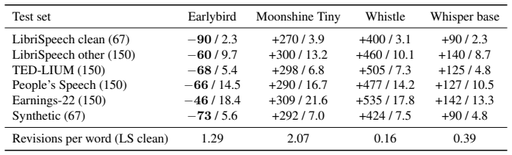
Table 1 : Median word latency in ms relative to the end of the word (negative is before) / WER %, on the same utterances for every model within a set (count in parentheses). Revisions are words taken back per spoken word.
Original paper · CC BY 4.0 · Sahil Mahendrakar · Earlybird: Predictive Streaming Speech Recognition in 29M Parameters · Original paper figure · Extracted the figure area from page 5 of the original PDF.The subsets are small, so the authors checked whether the medians hold on full test sets. Earlybird's median word latency is −90 ms on all 2,620 LibriSpeech clean utterances. On all 1,155 TED-LIUM utterances, it is −67 ms, while the Moonshine Tiny runtime reaches +296 ms on the same set. The p95 word latency on LibriSpeech clean is +80 ms for Earlybird, +520 ms for Moonshine Tiny and +925 ms for Whistle.
Bigger Whisper models don't get words earlier: tiny.en gives +110 ms, base.en +90 ms and small.en +80 ms.
The median hides how many words arrive early, so Table 2 counts words predicted correctly before they end and left unchanged afterwards. That earliness has a cost in revisions: Earlybird takes back 1.3 words per spoken word, against 2.1 for Moonshine Tiny.
Accuracy on the Open ASR sets
The 4-bit Earlybird release averages 12.6 WER on the eight English Open ASR sets, against 12.2 for Whistle. Over those sets it wins on five, and it loses on VoxPopuli, LibriSpeech other and Earnings-22. Because the gap is small, the authors call this a rough tie.
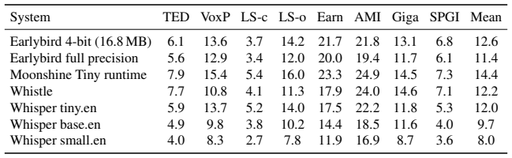
Table 3 : WER (%) on the eight English sets of the Open ASR Leaderboard, scored with its normalizer, every system on the same clips (TED-LIUM in full; about 200 clips of each other set, because Whistle runs at about real time per CPU core). Final transcripts, not streaming timing.
Original paper · CC BY 4.0At full precision, Earlybird averages 11.4 across the same clips, against 14.4 for the Moonshine Tiny runtime. It beats the Moonshine Tiny runtime on all eight sets, not only on the average. The full-set averages are 11.7 at full precision and 12.7 at 4 bits.
Whisper base's TED-LIUM score of 4.87 matches its published entry, which the authors use to check the scoring. Moonshine Tiny's leaderboard entry of 12.0 uses full-precision weights, while the official runtime scores 14.4 here. Full-precision Earlybird is slightly more accurate than Whisper tiny.en, which scores 12.0 on these clips. The 4-bit release is slightly less accurate than Whisper tiny.en on the same clips.
Whisper small.en reaches 8.0, the lowest mean WER in Table 3.
Earliness against larger models
Nemotron 0.6B is the purpose-built streaming model in this comparison, at 464 MB at int8. On the same 67 utterances, its median word latency is +230 ms, so its words arrive after the speaker finishes them.
Parakeet TDT 0.6B v2 is an offline model about 70 times Earlybird's size, and the authors re-decode it every 240 ms. On 150 other utterances, Parakeet reaches −10 ms, while Earlybird reaches −80 ms on those same clips. Parakeet's error rate is about half of Earlybird's, so the larger model gives up earliness for accuracy in these runs. This comparison mixes conditions, because the −90 ms figure for Earlybird on LibriSpeech clean uses a different set of utterances.
Table 1 puts Earlybird at −90 ms on LibriSpeech clean, against +270 ms for Moonshine Tiny, +400 ms for Whistle and +90 ms for Whisper base. Earlybird predicts the median word 160 to 200 ms sooner than Whisper base on all six sets. Size doesn't buy earliness for re-decoded Whisper, with median latency of +110 ms for tiny.en, +90 ms for base.en and +80 ms for small.en.
Each Whisper re-run hears a little more audio, because the model re-decodes all audio so far every 0.48 s.
On full test sets the medians hold, with −90 ms across all 2,620 LibriSpeech clean utterances.
Revisions, noise and CPU cost
Showing words early means some of them get taken back, and that is the price of this design. On LibriSpeech clean, Earlybird revises 1.29 words per spoken word. In the same setting, the Moonshine Tiny runtime revises 2.07, while Whistle revises 0.16 and Whisper base 0.39. On spontaneous or noisy speech the paper reports 2 to 6 revisions per word, which is far more churn than on audiobooks.
The authors list this as a limitation, because models that wait take fewer words back.
Table 4 tests Earlybird on 150 LibriSpeech test-clean utterances with white noise and chatter added. Earlybird stays the earliest model at every noise level, and it is more accurate than Moonshine Tiny throughout. Background speech hurts it most: at 10 dB its WER is 32.0%, against 8.9% for Whisper base.
The CPU test runs on one thread of an Intel Xeon Platinum 8488C. Earlybird takes 39 ms on average per 80 ms step, with a p95 of 64 ms. Moonshine Tiny, decoded the same way, takes 47 ms per step. That makes Earlybird about twice as fast as real time, since each step covers 80 ms of audio. The harness adds no processing time for any model, so this timing is kept apart from the latency numbers.
Whether the confidence can be trusted
Guessed words get their confidence the same way, and the model applies no temperature scaling or other calibration step. Calibration is measured with expected calibration error (ECE) over 10 equal-width bins.
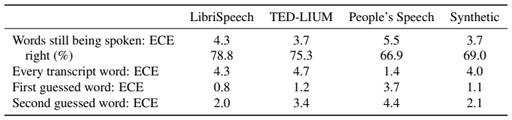
Table 6 : Expected calibration error (points, 10 bins) of Earlybird’s raw confidence. No calibration step is applied.
Original paper · CC BY 4.0The hardest case is a word the speaker has not finished, and that is where the authors check the raw confidence. For those words the ECE stays between 3.7 and 5.5 points across the test sets. An agent can only act on an early word if it knows how far to trust that word. Words output at confidence 0.9 or higher are right 91 to 96% of the time.
Guessed next words are calibrated more tightly, with an ECE of 0.8 to 3.7. Guesses are rare, though: at confidence 0.5 or above, only 12 to 16% of words are guessed right before they end.
Calibration gets worse on spoken commands from SLURP, a set outside the training domain. On SLURP, the ECE for words still being spoken rises to 8.8. The authors state that Earlybird is English only and that its calibration degrades on out-of-domain command speech. They didn't test a calibration step on SLURP, so the raw confidence is the only signal reported there.
Where the method falls short
Accuracy is where Earlybird trails a larger baseline, Whisper base, which the paper describes as 2.5 times larger.
Showing words early costs revisions, which are words the model takes back after displaying them. On LibriSpeech clean, Earlybird revises 1.29 words per spoken word, against 2.07 for Moonshine Tiny and 0.16 for Whistle. On spontaneous or noisy speech, the paper reports 2 to 6 revisions per word. Outputting words early means the model takes more words back than models that wait.
Guessed words are rare, since only 12 to 16% of guesses at confidence 0.5 or higher are right before they end. Most early words therefore come from the transcript itself, not from the guess. The synthetic set gives exact times, and its results agree with the aligned sets.
The model is English only, and the authors didn't test it on other languages. Calibration degrades on out-of-domain command speech, so the confidence can't be trusted there without checking. On SLURP, the ECE for words still being spoken is 8.8, against 3.7 to 5.5 on the other sets.
Paper info
- Authors
- Sahil Mahendrakar
- Venue
- arXiv · Preprint
- First published
- 2026-11-10
- Added
- 2026-11-12
- Updated
- 2026-11-10
- Version
- v1
- arXiv
- 2611.14421
- Category
- cs.SD · cs.CL · eess.AS
- Original paper terms
- CC BY 4.0
- What we show
- Paper info, commentary and permitted figures from the original paper
AI commentary is a separate explanation from the original paper and may contain errors. The original paper and figures follow each source's terms of use and any rights noted separately.
Abstract
Streaming speech recognizers output a word only after the speaker has finished it, typically 90-400 ms later. For a voice agent every millisecond counts: the sooner the words are outputted, the sooner the agent can start a search or plan its reply. We present Earlybird, a 29M-parameter streaming recognizer (16.8 MB at 4 bits). Earlybird learns from audio cut off at random points, including partway through a word, and is asked to predict every word that is due by then in full, plus a guess of the next two words. Its raw token probabilities give a confidence for every word including the one still being spoken. On clean audiobook speech (LibriSpeech test-clean), the median word is predicted correctly 90 ms before the speaker finishes it, while released streaming models get it 90 to 400 ms after it ends. Earlybird is the earliest on all six test sets we time, covering audiobooks, TED talks, public speech, earnings calls, and synthetic speech. On the same audiobooks, 69% of words are predicted correctly before they end, against 3-25% for the other models. For words still being spoken, confidence is calibrated, with an expected calibration error (ECE) of 3.7 to 5.5. On the eight English Open ASR Leaderboard sets, it is more accurate than Moonshine Tiny on every set and roughly ties Whistle, a model of the same size.
Quote from the paper
Sahil Mahendrakar (2026). Earlybird: Predictive Streaming Speech Recognition in 29M Parameters. arXiv:2611.14421v1. https://arxiv.org/abs/2611.14421v1
BibTeX
@misc{mahendrakar2026earlybird,
  title = {{Earlybird: Predictive Streaming Speech Recognition in 29M Parameters}},
  author = {Sahil Mahendrakar},
  year = {2026},
  eprint = {2611.14421},
  archivePrefix = {arXiv},
  url = {https://arxiv.org/abs/2611.14421v1}
}