Paper commentary
What Matters for Cross-Modal Alignment
- Problem Zero-pair alignment of frozen image and text encoders works on COCO but fails on the other four datasets, including 3D CT and chest radiographs.
- Method A ridge map fitted on a few image–text pairs locates the shared subspace and orients it, a GW-loss rule picks the signs, and a per-finding report classifier scores the mapped images.
- Results LightAlign with 200 CT-RATE pairs reached 0.754 AUROC, above CT-CLIP at 0.733, which was trained end to end.
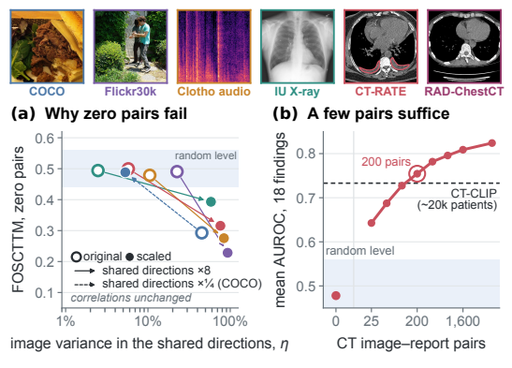
Figure 1 . A large variance share is necessary for zero-pair alignment, and 200 pairs outperform an end-to-end model. Top: one held-out example per dataset, framed in its marker color (CT: one axial slice).(a)Each marker is one dataset (open: before, filled: after scaling the shared directions eight-fold at unchanged canonical correlations); horizontal: mean fraction η of image variance in the shared directions; vertical: FOSCTTM, lower is better (shaded: random level). Scaling the shared directions aligns all four failing datasets (solid arrows, after sign correction; each combination in Fig. 3); shrinking them on COCO to a quarter breaks the alignment (dashed arrow).(b)Mean AUROC over 18 findings on the 3,002 test scans vs. pair count (red curve; ring: 200 pairs, both encoders frozen); dashed line: CT-CLIP, trained end to end on the image–report pairs of about 20,000 patients without finding labels.
Original paper · CC BY 4.0 · Yipeng Sun, Jiajun Wang, Siyuan Mei, Yan Xia, Siming Bayer, Vincent Christlein, Andreas Maier · What Matters for Cross-Modal Alignment · Original paper figure · Extracted the figure area from page 2 of the original PDF.Why zero-pair alignment fails on medical data
Wasserstein Procrustes fits an orthogonal map between frozen image and text embeddings without any paired examples, and earlier work reports that it coarsely aligns natural images. Here it is tested on five datasets across four modalities: COCO and Flickr30k for natural images, Clotho for environmental audio, IU X-ray for 2D chest radiographs and CT-RATE for 3D CT.
Alignment is scored with FOSCTTM, where 0 is a perfect match and 0.5 is chance. Only COCO aligns, reaching 0.012, while on CT all 56 tested encoder–text combinations fall between 0.440 and 0.536. The failure is puzzling because CT features are strongly related: the leading canonical correlation for matched image and report features of validation patients is 0.87.
Similarity measures such as CKA can predict whether alignment will succeed, but they do not explain the cause, suggest a fix, pick an encoder or say how many pairs to collect. That gap motivates the mechanistic analysis.
Variance share as a necessary condition
The first condition is localization of the shared subspace, which is measured by the variance share η, the fraction of image feature variance lying in the shared directions. Unscaled shared directions explain 0.5–10.5 % of image variance on CT, and the smallest chest radiograph share is 0.02–0.035.
The reverse test points the same way. Shrinking the shared directions on COCO to a quarter raises FOSCTTM from 0.293 to 0.488, whereas shrinking random directions with the same share degrades it to only 0.395.
The scaled experiments use oracle signs on Flickr30k, Clotho and IU X-ray and GW-based sign selection on CT, so the scaling result is read together with the sign rule used on each dataset.
Sign orientation through the GW loss
Scaling locates the subspace but does not orient it. For VoxelFM patch with Qwen3.5-4B, the subspace overlap rises from 0.035–0.044 to 0.691–0.767 on every seed, yet mean AUROC stays at 0.462 because three of five seeds are mirrored. Real features are skewed: 75–100 % of the top image principal components lie outside the Gaussian 99 % band of excess kurtosis.
On every seed the mirrored map has the higher GW loss, with 0.070–0.078 against 0.059–0.063 for the correct map. In one split the values are 0.082 for the mirror and 0.066 for the correct direction. Choosing each sign by GW loss, with no pairs, raises the mean AUROC of the three mirrored CT seeds from 0.35 to 0.69. That is above the 0.636 obtained with oracle signs taken from paired test correlations.
Under that symmetrization, sign correction falls from 4 of 4 mirrored seeds to 1 of 3, which the authors read as evidence that skewness drives the correction.
How many pairs localization needs
Random-matrix theory gives the threshold \(n^\star = d(1+1/r)\): a direction with squared canonical correlation \(r\) in \(d\) principal components is detectable only when the number of pairs exceeds this value.
Four of the five pilots select VoxelFM, at most 0.0011 AUROC below the best encoder.
LightAlign: ridge map plus report classifier
Text reports are handled separately. A report classifier is one logistic regression per finding, fitted on frozen text features of unpaired training reports with standardized features and an L2 penalty with C = 1. At run time a new scan is passed through the ridge map, and the classifier scores each finding on the mapped image features.
Both encoders stay frozen. The main CT configuration uses VoxelFM block 11 and the middle layer of Qwen3.5-9B, while the ridge map and the classifier are the only fitted components.
Results on CT-RATE, RAD-ChestCT and CheXpert
With all 5,994 training pairs, LightAlign reaches 0.824 AUROC, above 0.816 for COLIPRI. That COLIPRI figure is a zero-shot score re-evaluated in another work, and the authors did not run COLIPRI.
On the out-of-distribution RAD-ChestCT, the CT-RATE map and classifier are applied unchanged. With 100 CT-RATE pairs AUROC is 0.636, above CT-CLIP at 0.629. With all pairs AUROC rises to 0.724, which matches HLIP at 0.723.
The same CheXpert setting with all 19,858 pairs gives MCC 0.431 and F1 0.513, against CheXzero at 0.523 and 0.606 and KAD at 0.589 and 0.646, both trained on about 377k MIMIC-CXR pairs.
Image encoder versus text model
A two-way decomposition over the 15 by 8 grid of CT encoder and text model means at 1,600 pairs gives the image encoder 99.0 % of the AUROC variance and the text model 0.7 %. The order reverses for the zero-shot prompt, where the text model accounts for 89.6 % of the variance.
On captions the text model dominates, explaining 98.5 % on Flickr30k. A 110M text embedding model, CXR-BERT on CT and MPNet elsewhere, matches or outperforms Qwen3.5-27B in every dataset.
Limits of the evidence
The COLIPRI score is quoted from another work's re-evaluation, and its supervised probe result of 0.862 is quoted from its authors; the study did not run COLIPRI. The CheXpert result is reported against models trained on MIMIC-CXR, while with all 19,858 pairs the report classifier trails CheXzero and KAD on MCC and F1.
The scaling result depends on the sign rule used per dataset: oracle signs on Flickr30k, Clotho and IU X-ray, and GW selection on CT. The CT orientation gain rests on three mirrored seeds, moving mean AUROC from 0.35 to 0.69.
Paper info
- Authors
- Yipeng Sun, Jiajun Wang, Siyuan Mei, Yan Xia, Siming Bayer, Vincent Christlein, Andreas Maier
- Venue
- arXiv · Preprint
- First published
- 2026-11-15
- Added
- 2026-11-17
- Updated
- 2026-11-15
- Version
- v1
- arXiv
- 2611.20000
- Category
- cs.CV · cs.AI
- Original paper terms
- CC BY 4.0
- What we show
- Paper info, commentary and permitted figures from the original paper
AI commentary is a separate explanation from the original paper and may contain errors. The original paper and figures follow each source's terms of use and any rights noted separately.
Abstract
The Platonic Representation Hypothesis posits that models trained on different modalities converge toward a shared representation. Related work aligns frozen image and text encoders on natural images without paired data. We test zero-pair alignment on five datasets across four modalities: natural images, environmental audio, chest radiographs, and 3D computed tomography (CT). It succeeds only on COCO and fails on the other four. We analyze the failures and find that alignment must first locate the subspace where the modalities co-vary and then orient the mapping within it. Consistent with previous studies, medical imaging is the hardest case: its shared subspace carries the smallest fraction of the variance. When this fraction is small, alignment needs image-text pairs, and random-matrix theory predicts how many pairs are needed. These findings motivate LightAlign: a few pairs let a ridge regression between two frozen encoders locate and orient the mapping simultaneously, and a classifier fitted only on report text then predicts findings from the mapped images. On 3D CT, LightAlign surpasses models trained end to end on image-report pairs without finding-level labels: with only 200 pairs, LightAlign outperforms CT-CLIP on CT-RATE (0.754 vs. 0.733 AUROC), and with only 100 CT-RATE pairs, it does so on RAD-ChestCT, an out-of-distribution dataset from a different hospital. On CheXpert, it reaches 0.862 mean AUROC with only about 5% as many pairs as models trained on MIMIC-CXR.
Quote from the paper
Yipeng Sun, Jiajun Wang, Siyuan Mei, Yan Xia, Siming Bayer, Vincent Christlein, Andreas Maier (2026). What Matters for Cross-Modal Alignment. arXiv:2611.20000v1. https://arxiv.org/abs/2611.20000v1
BibTeX
@misc{sun2026what,
  title = {{What Matters for Cross-Modal Alignment}},
  author = {Yipeng Sun and Jiajun Wang and Siyuan Mei and Yan Xia and Siming Bayer and Vincent Christlein and Andreas Maier},
  year = {2026},
  eprint = {2611.20000},
  archivePrefix = {arXiv},
  url = {https://arxiv.org/abs/2611.20000v1}
}