Paper commentary
Enforcing Symmetries on Pre-trained ML Models for Physics
Post-hoc symmetry averaging extends to non-compact groups but rarely beats training symmetric models
- Problem Group averaging works for compact symmetry groups, but non-compact groups such as unit rescalings have no normalized Haar measure. Averaging over them therefore has no canonical definition and can diverge.
- Method The Weyl unitarian trick complexifies the space and extends the predictor, so the average runs over a compact real form instead of the non-compact group. Unlike standard averaging, it needs no normalized measure over the non-compact group.
- Results On the unit-rescaling classifier under small unit shifts, the Weyl projection kept KL at 0.138, while the baseline rose to 10.26.
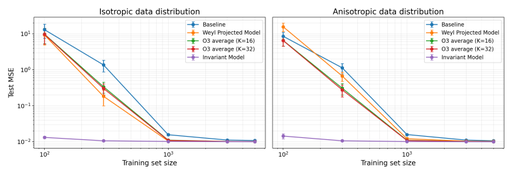
Figure 3 : Test MSE for the baseline polynomial, its exact Weyl projection, the finite spatial O(3) average, and the Gram-feature invariant baseline. Both axes are logarithmic.
Original paper · CC BY 4.0 · Wenjie Zhou, Valentino F. Foit, David W. Hogg, Soledad Villar · Enforcing Symmetries on Pre-trained ML Models for Physics · Original paper figure · Extracted the figure area from page 18 of the original PDF.Why averaging stops being canonical off compact groups
Post-hoc averaging over a symmetry group leaves the trained weights untouched and changes only the outputs. For compact groups, the normalized Haar measure makes this average canonical and yields the Reynolds projection. The trouble starts when the group is non-compact, as with unit rescalings and Lorentz boosts. So the question is whether the compact argument survives that change, or whether a different kind of averaging is needed.
The first obstacle is the measure itself. For a locally compact group, the Haar measure exists, but it has finite total mass only if the group is compact. So for a non-compact group, the integral over the group is not a normalized average and typically diverges. A weight or a finite window avoids divergence, but it doesn't give a canonical Reynolds projection.
The weight picks a preferred region of the group, which the group action shifts, so the result isn't an exactly equivariant predictor.
The second obstacle concerns the data distribution. A trained model is typically reliable only near the support of its training distribution, which is bounded. So averaging over such orbits asks the model to predict far outside what it has seen. The third obstacle is statistical. Even with an invariant distribution, a group average doesn't in general coincide with the L2(µ) orthogonal projection, and the projection depends on the chosen distribution.
Reynolds averaging on compact groups
Reynolds averaging runs the trained model on transformed copies of an input, undoes each transformation on the output, and averages the results. For a finite group this is a plain sum divided by the group order, written as (Q_G f)(x) = (1/|G|) times the sum of psi(g^-1) f(phi(g)x). For a compact group the sum becomes an integral against the normalized Haar probability measure lambda, so the averaging needs no extra weighting.
Here phi is the input action, psi is the output action, and lambda is the normalized Haar probability measure.
The averaged predictor is exactly equivariant, because right invariance of the Haar measure lets the group element h shift through the integral. Because the averaging is an orthogonal projection when the data distribution mu is invariant and the induced action is unitary, Reynolds averaging equals the L2(mu) projection onto the equivariant subspace.
Under squared loss with an equivariant target, the risk gap R(f) minus R(Q_G f) equals the squared L2(mu) distance between f and its average. So averaging can't raise squared risk, and it lowers the risk strictly whenever f has a nonzero non-equivariant part.
Averaging pretrained Well surrogates
The authors take pretrained surrogate models released with The Well and compare each with its group-averaged version. The surrogates are CNextU-Net models, chosen for their consistent performance across the datasets. Error is measured with VRMSE, and values near or above 1 signal poor performance, worse than predicting the constant mean. The averages use only one random group element per time step (n=1), and the authors observe significant improvements even at that setting.
Group averaging adds no computational cost at test time, which is why the small-group case matters in practice.
On active matter, the rollout loss in Table 1 fell from 10.81 for the baseline to 7.012 for the D4 average. Figure 2 plots the per-step losses of the concentration predictions, with translations under T2 applied once per step. Figure 1 shows the averaged model staying closer to the simulation at early and late times on active matter and gray scott.
The authors note that the best averaging group depends on the model and the dataset. The loss grows toward 1 at late times for all models, so the gain fades as the rollout continues.
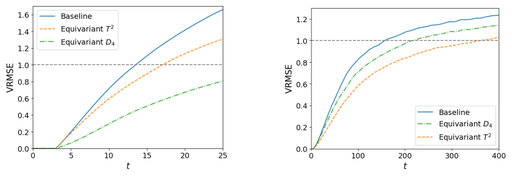
Figure 2 : Losses for the concentration predictions. In both cases the translations ofT 2 are performed with a single (n= 1) random translation per time step.
Original paper · CC BY 4.0The shear flow dataset shows no gain, because its initial conditions break the symmetry even though the equations and boundary conditions keep it. So the benefit depends on whether the training data respects the symmetry that the averaging imposes. The authors don't report a gain on the shear flow dataset under any averaging group. This compact-group result sets up the next question: how averaging behaves when the group is non-compact.
Complexifying to reach a compact form
The Weyl unitarian trick gets around the missing normalized Haar measure by complexifying the space, so a non-compact group and a compact one sit inside the same complex group. Take a Laurent polynomial under positive scaling: the trick extends it from R× to C× using the same formula. The circle T averages every power x^a to zero except a=0, so only the constant term c0 survives.
The symmetry is carried by the real form R>0, while the averaging runs over the compact circle T, which is the other real form.
Holomorphic functions are rigid: their values on a suitable slice determine them. Passing to complex inputs brings that rigidity, so invariance imposed over the compact subgroup extends to the whole complexified group. The general construction needs a complex reductive group with a non-compact real form and a compact real form, and the predictor must extend to an algebraic family.
For Lorentz transformations the compact form isn't visible in the original coordinates, so the authors first rotate time into Wick coordinates.
With S = diag(i,1,...,1), conjugation by S maps the complex Lorentz group onto the complex orthogonal group O_C(d), and O(d) becomes the compact real form. The Wick map W(p) = Sp turns Lorentz transformations into complex orthogonal ones, and Minkowski products into the bilinear form on C^d. Averaging the complexified scalar predictor over O(d) gives a function H_F(q(u)) of the quadratic form alone.
Restricting back to the real slice gives (Q_L f)(p) = H_F(s(p)), a real-valued and O(1,d-1)-invariant polynomial, where s(p) is the Minkowski invariant.
Unit-rescaling regression and classification: which projection survives a units change
The unit-rescaling experiment asks which post-hoc projection keeps its predictions stable when the unit system of the inputs changes. The regression target is a force built from density, viscosity, speed, area and length, with the unit-weight vector (1, 1, -2). The classification label is the regime Re above or below 1, and its logit is a function of Re.
The baseline is a ridge or l2-penalized logistic model on features, 10 of them units-invariant and 250 non-invariant. The Weyl projection zeroes the coefficients of the non-invariant features, so it keeps only the invariant part of the baseline. The frame average reuses the fitted baseline on four canonicalized inputs, one for each choice of three variables set to one.
Training and testing both on fixed units, the baseline regression NRMSE is 0.0164. The Weyl-projected regression NRMSE rises to 0.0806, so the Weyl projection costs in-distribution accuracy. Frame averaging with m=4 reaches 2.11±1.26 under fixed units, since its accuracy depends on how well the frozen predictor handles the canonicalized inputs.
Table 2 lists NRMSE and KL for each method under fixed and transformed unit conditions.
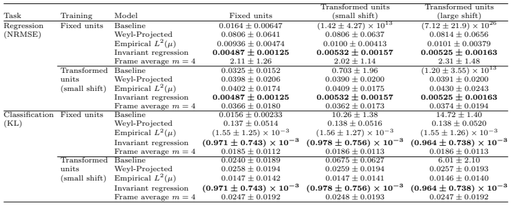
Table 2 : Regression uses NRMSE and classification uses expected Bernoulli KL; lower is better. Here, training a new invariant model gives the best result in all cases.
Original paper · CC BY 4.0For classification, the baseline KL is 0.0156 on fixed units, and the Weyl projection raises it to 0.137. Under small unit shifts the baseline KL rises to 10.26, while the Weyl projection stays at 0.138. The Weyl projection's value is robustness, because the non-invariant terms of the baseline transform incorrectly when the units change. Frame averaging shows the same robustness with an accuracy tradeoff, and it performs poorly on the fixed-unit regression baseline.
The empirical L2(µ) projection gives a regression NRMSE of 0.00936±0.00474 under fixed units, which is below the baseline value of 0.0164.
Lorentz rollouts with boost and frame averages
The Lorentz rollout experiment starts from a driven double-well system that is mapped into pairs of Lorentz vectors. The surrogate is a fully connected network with three hidden layers of width 128 and 39 812 parameters. It maps a window of k = 8 consecutive states to the increment of the two Lorentz vectors. The network is trained on all 2.1 × 10⁶ windows with a mean-squared loss on the normalized increments.
The boost average samples Gaussian-weighted boosts with eight Gauss-Hermite nodes, so it isn't exactly equivariant. The inversion average uses the finite group of time and space inversions, which is an exact group average. The rest-frame frame average boosts the input into its rest frame and averages over the inversions. The extended frame average adds boosts to the inversions in the rest frame and costs 16 network evaluations.
Table 3 shows the rollout loss over 15 errors: the baseline scored 0.1497, the inversion average 0.0786, and the extended frame average 0.0313. At one step, the baseline loss was 0.0018 and the extended frame average's loss was 0.0003. The authors report that combining boost averaging with the frame average gives the best results. Error is measured in the rest frame of the true trajectory, and trajectories that escape to infinity are excluded.
Jet tagging with beam-axis and boost averages
The jet-tagging experiments use two classifiers, ParticleNet-Lite and a degree-three polynomial classifier built from permutation-invariant aggregates. The polynomial classifier keeps explicit dependence on the azimuthal coordinate, so it isolates the effect of post-training SO(2) averaging. Its logit is also polynomial in the four-momenta, which places it in the function class where the Weyl projection is defined.
SO(3) averaging rotates each jet in space while holding the laboratory beam axis fixed. Because arbitrary rotations don't preserve the saved-jet distribution, the SO(3) average serves as a deliberate symmetry-mismatch control. Bounded boost averaging draws rapidities from N(0, 0.3^2) truncated to |ρ| ≤ 0.3, so it gives windowed test-time averages rather than Reynolds projections.
The collider-aligned frame average removes the jet azimuth and longitudinal rapidity, then averages over residual reflections to make the predictor invariant under beam-axis rotations and boosts.
SO(3) averaging dropped accuracy to 0.799649±0.001650, with 5804.3±121.5 jets becoming correct-to-incorrect changes counted in N+− of 10880.8±408.2. SO(2) averaging left accuracy at 0.825032±0.000295, so the beam-axis average changed almost no predictions. The collider-aligned frame average gave 0.825078±0.000308, within the spread of the baseline runs.
Performance follows how well the imposed transformation matches the collider setup.
The exact Weyl projection collapses the 816-coefficient hypothesis class onto an 18-dimensional invariant subspace. That projected model saturates within a few hundred examples, then stops improving. The unprojected baseline overtakes the projection in AUC between 8,192 and 16,384 examples, while at 30% quark efficiency the projection stays at or above the baseline.
Figure 5 shows the ROC AUC and background rejection for this classifier across training-set sizes.
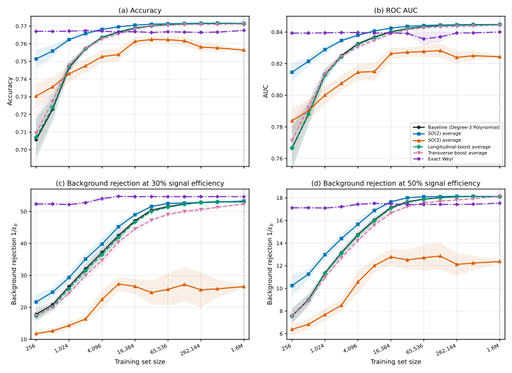
Figure 5 : ROC AUC and background rejection at quark efficiencies of 30% and 50% for the degree- three polynomial classifier.
Original paper · CC BY 4.0Limitations of post-hoc symmetrization for non-compact groups
The Weyl construction covers polynomial and suitably holomorphic predictors, so black-box neural networks sit outside it. It also doesn't inherit the compact-group risk guarantee, because it enforces the symmetry exactly without minimizing error under a data distribution. Frame averaging is exact in its transformation law, but it carries no risk guarantee either.
The boost averages are windowed and not exactly equivariant, because the Gaussian weight over the non-compact boost group is a choice. The inversion average, by contrast, is an exact finite group average over the subgroup of time and space inversions. The boost results depend on the Gaussian widths of 0.3 and 0.4, which the authors chose on the validation set.
The Lorentz rollout test uses one trained network on one synthetic system, so these results don't show how the methods behave on other systems.
Frame averaging cost substantial accuracy for the fixed-unit regression, with NRMSE near 2.1 compared with 0.0164 for the baseline. The empirical L2 projection improved on the baseline in most tested combinations of unit shift, task and training regime. The Weyl projection raised the in-distribution risk for both tasks, so it isn't a universal accuracy improvement.
Paper info
- Authors
- Wenjie Zhou, Valentino F. Foit, David W. Hogg, Soledad Villar
- Venue
- arXiv · Preprint
- First published
- 2026-11-6
- Added
- 2026-11-9
- Updated
- 2026-11-6
- Version
- v1
- arXiv
- 2611.08992
- Category
- cs.LG · physics.comp-ph · stat.ML
- Original paper terms
- CC BY 4.0
- What we show
- Paper info, commentary and permitted figures from the original paper
AI commentary is a separate explanation from the original paper and may contain errors. The original paper and figures follow each source's terms of use and any rights noted separately.
Abstract
Post-hoc group averaging (or test-time augmentation) is a simple way to impose symmetry on a trained predictor without changing its architecture or retraining it. For finite and compact groups, averaging over a normalized Haar measure on the group gives the Reynolds operator: a canonical projection onto invariant or equivariant predictors with known non-increasing risk guarantees under certain assumptions. This paper provides numerical experiments on physics emulation models that demonstrate the effectiveness of the approach in this setting. We then extend this framework to non-compact group symmetries. For non-compact groups, the Haar measure cannot be normalized, so group averaging cannot be defined in the same way. We replace it with three alternatives: the Weyl unitary trick (which requires complexifying the space and extending the predictor), a data-dependent orthogonal projection (which involves a non-trivial optimization on the space of invariant or equivariant functions), and a frame averaging approach (which involves mapping each point to a set of orbit representatives). We illustrate the constructions theoretically and empirically on the unit-rescaling group and the Lorentz group. Our results show that in the non-compact case, the Weyl trick and frame averaging do not provide a consistent improvement over the baseline, except where the test data is out-of-distribution (an orders-of-magnitude improvement in this case) and, for the Weyl trick, in low-data regimes. The orthogonal projection can provide improvements in-distribution and out-of-distribution. We also observe that models trained directly on invariant features matched or beat the projection of an unconstrained one. We conclude that post-hoc symmetrization extends to non-compact groups, but it does not consistently outperform training a symmetric model.
Quote from the paper
Wenjie Zhou, Valentino F. Foit, David W. Hogg, Soledad Villar (2026). Enforcing Symmetries on Pre-trained ML Models for Physics. arXiv:2611.08992v1. https://arxiv.org/abs/2611.08992v1
BibTeX
@misc{zhou2026enforcing,
  title = {{Enforcing Symmetries on Pre-trained ML Models for Physics}},
  author = {Wenjie Zhou and Valentino F. Foit and David W. Hogg and Soledad Villar},
  year = {2026},
  eprint = {2611.08992},
  archivePrefix = {arXiv},
  url = {https://arxiv.org/abs/2611.08992v1}
}