Paper commentary
Goodhart in the Planner: Sampling-Based Control Exploits Rewards Learned from Human Preferences
Sampling-based robot planners can exploit learned preference rewards
- Problem Robots now pick actions by searching against reward models learned from human preferences. Until now nobody had measured how much such a planner exploits its scorer, so harder search can lower the true return.
- Method MPPI samples plans around a cloned policy and weights them by a learned scorer. The paper's chi-squared rule gives zero weight to plans below a threshold, and its temperature is calibrated from 100 oracle-ranked proposal pairs.
- Results Harder search cut true return on HalfCheetah from 480 to 262. On drawer-open with human labels, the planner opened the drawer in 0 of 20 runs, against 10 of 10 for the cloned policy.
Why a learned reward is risky to plan against
Reward models learned from human preferences now sit inside model-predictive control, and robot foundation models pick the candidate action a learned verifier likes best. Robot planners differ in several ways, so that known result doesn't transfer directly. The regularizer is implicit in the proposals, and the plan is re-optimized at every step.
How much such a planner exploits its scorer had not been measured before this work.
The authors study Model Predictive Path Integral control (MPPI) with proposals drawn around a policy cloned from the labelled data. That cloned policy plays the planning analogue of the reference model in RLHF. A Bradley–Terry scorer, trained from preference labels, ranks the sampled plans. The planner uses the true simulator, so a failure can't come from a learned dynamics model.
Every failure is therefore attributable to the scorer itself. The scorer is a two-layer MLP trained on segment pairs with the Bradley–Terry likelihood, with 10% of pairs held out. A tie, marked as "can't tell", becomes a target of 1/2, meaning indifference between the two segments.
Agreement with the true ranking on decided pairs doesn't make a scorer safe to plan against. Manipulation tasks use Meta-World drawer-open, plate-slide and window-open with mocap position control.
Sampling plans around a cloned policy
The key idea is to let a cloned policy play the reference role that the reference model plays in RLHF. The planner samples many action sequences around that policy's plan, scores each one with the learned scorer, and executes a weighted average of them. Each sample is \( A_i = \mathrm{clip}(U + \epsilon_i) \) with \( \epsilon_i \sim \mathcal{N}(0,\sigma^2 I) \), where U is the cloned policy's closed-loop plan.
The defaults are N = 256 samples, a horizon of H = 20, and noise σ = 0.5.
A plan's learned return is the sum of the scorer's per-step outputs over the horizon, and that sum is all the weights see. Standard MPPI sets \( w_i \propto \exp(\hat J_i/\lambda) \), the solution of a KL-regularized objective in which λ plays the role of the RLHF coefficient β. A smaller λ puts more weight on the top-scored plans, and in the limit the planner becomes best-of-N over plans.
The χ2 rule, Tsallis-divergence MPPI, uses \( w_i \propto \max(0, \hat J_i - c) \) with c set by λ, so plans below the threshold get zero weight. The executed action is the weighted average of the plans, not one plan drawn from the weights.
Uniform weights give the planner without search, which the authors call uniform averaging. The scorer is a two-layer MLP trained on segment pairs with the Bradley–Terry likelihood, with 10% of pairs held out. Locomotion uses HalfCheetah-v5 and Hopper-v5 with Uni-RLHF crowd-sourced labels. The manipulation tasks are Meta-World drawer-open, plate-slide and window-open, labelled synthetically or blind by the two authors.
What the weights can certify
The planner's move is measured by s(p), the χ2 distance from the uniform weights on the proposals. Lemma 1 bounds the gap between true and scorer-reported gain by |∆(p) − ∆̂(p)| ≤ σe s(p). Here σe is the spread of the scorer's mistake across the proposals, so an error shared by all proposals changes no weights and costs nothing.
Theorem 2 says that if σ is at least σq(Ĵ), no plan distribution guarantees a gain. Below that threshold, χ2 MPPI with weights max(0, (Ĵ − c)/λ) at a temperature λ⋆ with λ⋆ s(pλ⋆) = σ maximizes the guarantee, and the maximum is positive. The scale of J is set by a least-squares rescaling onto Ĵ, which gives σe = σq(Ĵ)√(1 − ρq²).
Hard exponential search has its own guarantee, max Ĵ − Eq Ĵ − σ√(N−1), which falls as the sample count grows. If the top score's margin grows more slowly than √N, as it does for Gaussian scores, that guarantee tends to minus infinity for every σ > 0. Proposition 5 gives the derivative of true return in η = 1/λ as the covariance of true and learned returns under the weights.
Near the proposals, true return changes to first order as √2 ρq σq(J) d in the distance d = √KL.
MPPI executes the weighted average of the plans, not a plan drawn from p, so the guarantee carries over only up to the spread of the kept plans. Proposition 6 adds the per-step terms over an episode, so the return splits exactly into selection gains, prices of noise, averaging terms and horizon gaps.
Harder search lowers true return
Harder MPPI search lowers true return on HalfCheetah with the crowd-sourced scorer. True return falls from 480 at λ = 3 to 262 at λ = 0.01, while the cloned policy run directly scores 412. Uniform averaging, which applies no search, scores 233 on the same task. The perfect scorer, which uses the true reward, moves the other way, rising from 867 to 1,010 as search hardens.
Blind human labels on 300 pairs give the starkest result on the drawer. The gentlest search matches uniform averaging at 851, with 20 of 20 runs successful. Both authors' labels on 500 pairs don't fare better, reaching 246 at λ = 0.01 with 0 of 10 runs.
On plate-slide, where the cloned policy already succeeds every time, every synthetic-label scorer loses ground under harder search. Return falls from 950 to 436 with 500 labels and from 977 to 319 with 2,000 labels. Human labels lose less: one author's 300 labels keep 1,066 (10/10) at hard search. The same pairs with synthetic labels reach 499 (8/10) under hard search.
Window-open runs the other way, because search helps at every label budget. Return is 295 without search and 375 to 392 at λ = 0.01. So exploitation depends on the task as well as on the scorer and the search strength.
Return tracks the distance moved
The authors plot every single-scorer MPPI cell against d, the square root of the KL between the planner's weights and its proposals. A two-parameter curve, ΔJ = a d − b d², passes through uniform averaging at d = 0 and fits each task. The fit reaches R² of 0.79 to 0.99 over 7 to 11 cells per task. The Figure 1 curves show the same pattern, with uniform averaging and the cloned policy run directly as reference lines.
The χ² cells mostly fall on the curve that the exponential cells define. At equal distance moved, the two rules give similar true return, so the authors call this an approximate collapse within each task rather than a law. The advantage of χ² weights at a fixed temperature is therefore mostly that they move less, since they reach the same return at a shorter distance.
The slope reads −507, −382, −250, −2 and +99 for 200, 300, 500, 1,000 and 2,000 labels. The authors fit this trend as roughly linear in log n, at +630 per decade, and it crosses zero near 1,200 labels.
Why held-out checks miss the exploitation
A scorer can look excellent on its labels and still rank the planner's own proposals poorly, and the human-label drawer scorer is the clearest case. High agreement on decided pairs therefore says little about whether the scorer is a safe planning target.
What matters for the planner is how the scorer ranks its own proposals, and that ranking can look very different from held-out accuracy. Yet it ranks the planner's proposals with ρq = 0.10, so the checks that look fine never warn about it. The hopper scorer shows the reverse pattern: a per-step correlation of only 0.08 on the data, but ρq = 0.76 on proposals.
Dropping 55 random pairs leaves the drawer result at 672 (6/10), close to ordering every pair by true return at 640 (6/10). Keeping only the decided pairs in true order never opens the drawer, whether ties stay as indifference (268) or are dropped (233).
Recorded episodes show where the planner goes wrong with each label set. With synthetic labels the arm parks in an unvisited corner that the scorer rates very highly. With human labels the arm pulls about 10 cm short of the handle. A linear fit of each scorer's per-step output on four state features explains the human-label gap: the penalty on hand-handle distance is only −0.16, against −0.40 to −0.49 with synthetic labels.
Figure 2 shows one drawer start under three planners, with uniform averaging opening the drawer at a true return of 857.
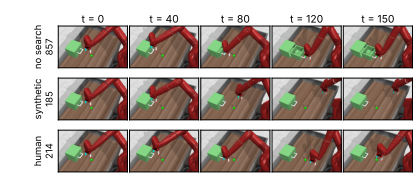
Figure 2 .One drawer start under three planners (true returns). Uniform averaging opens the drawer. Standard MPPI (λ= 0.01 ) on the 500-label scorer lifts the hand into a part of the workspace the data never visited; on the human-label scorer (λ= 0.1 ) it pulls in front of the handle without touching it.
Original paper · CC BY 4.0 · Soovadeep Bakshi, Apurba Bose · Goodhart in the Planner: Sampling-Based Control Exploits Rewards Learned from Human Preferences · Original paper figure · Extracted the figure area from page 5 of the original PDF.Which fixes help, and where
No single fix wins everywhere, so Table 1 compares the fixes at hard search. On HalfCheetah, χ2 weights on the ensemble mean scored 485, compared to 262 for standard MPPI. On Hopper, the same χ2 weights on the ensemble mean scored 448, versus 356 for standard MPPI.
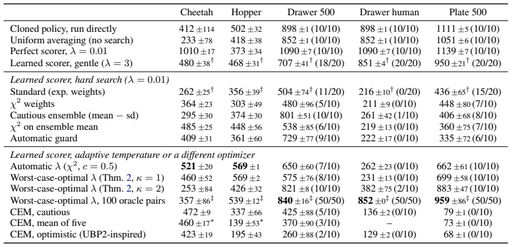
Table 1 .True return at hard search, mean ± standard error over 10 runs per cell († 20, ∗ 5); successes over runs in parentheses on the arm. ‡ Mean ± standard deviation across five independent 100-pair calibration sets ranked by true return (an oracle), drawn on start states the evaluation never uses, each calibrating its own controller (Table 6). Bold: best learned-scorer method per column (the calibrated temperature on the arm, the automatic one on the walkers).
Original paper · CC BY 4.0The ranking reverses on the drawer with synthetic labels, where the cautious ensemble restores 801 at 10 of 10. Here χ2 weights don't help, scoring 480 against 504 for standard MPPI. The authors read this as the ensemble disagreement finding states that the scorers overrate, while the same disagreement is absent where the planner chases noise.
The calibrated worst-case-optimal rule is the safest fix tested, though it needs an oracle that a deployed robot lacks. Its five calibration sets scored 818 to 852 on the drawer and 806 to 1,013 on plate-slide, succeeding in all 50 runs of each. The cloned policy run directly scored 898 on the drawer and 1,111 on plate-slide, while hard search on the same five scorers reached 611 (8/10) and 351 (6/10).
With human labels every set declined to search, scoring 852 under uniform averaging. The rule pays for caution on window-open, scoring 309 to 318 against 392 for standard MPPI.
With human labels, every fix that searches hard fails, reaching at best 382 with 2 of 10 successes. Calibrated from one author's comparisons, the rule trusted that author's scorer, with ρ̂ = 0.63, and opened the drawer in 5 of 10 runs at 574. Corrected for ties, that author's ρ̂ fell to 0.36, and the rule scored 822 with 10 of 10 successes.
The UBP2-inspired optimistic CEM planner is the strongest optimizer with the perfect scorer, at 1,244 on HalfCheetah. It is also the most exploited on the arm, scoring 68 to 79 on plate-slide with no successes. Labelling the planner's own trajectories, with 250 new pairs in a 500-label drawer budget, lifted standard MPPI at hard search to 834 (8/10), compared to 504 (11/20).
The cautious ensemble reached 975 (10/10) with that budget, level with 2,000 offline labels.
Best-of-N with a learned verifier
Best-of-N is the second place where the authors test whether a learned scorer can be trusted to choose actions. They wrap it around a state-based verifier trained on 500 or 2,000 synthetic pairs over perturbed actions. A perfect verifier keeps the clean action's return for every N, which gives a ceiling for the comparison.
With the verifier, one noisy action scores 755 on the drawer, with 44/50 successes, and 878 on plate-slide, also 44/50. These are the verifiers' ten starts, and the clean action scores 898 on the drawer and 1,111 on plate-slide. On plate-slide, N = 4 falls below one noisy action, at 723 with 26/50 successes.
From N = 16, both tasks fall well below one noisy action, reaching 530 on the drawer and 375 on plate-slide. The drawer drops to 388 with 14/50 successes at N = 1,024. Plate-slide drops to 143 with 0/50 successes at the same N. Selection with a 500-pair verifier therefore makes things worse as the number of candidates grows.
The verifier's quality changes the result, because with 2,000 pairs selection beats one noisy action at every N. Here the drawer ranges from 817 to 895 and plate-slide from 977 to 1,061. So for this verifier, the label budget decides whether selection helps at all.
Limits of the simulated setup
The results come from simulated tasks, and the scorers are small MLPs on state, so they don't show what a physical robot would do. Planning uses the true MuJoCo dynamics, which isolates the reward but leaves out errors from a learned dynamics model. Because every failure is attributed to the scorer, the paper can't say how much extra exploitation a learned dynamics model would add.
Most cells have 10 runs, which limits how precisely each cell's return is measured. Most calibration pairs are ranked by true return or by a simulated labeller, which is an oracle a deployed robot doesn't have. The only exception is the 100 comparisons from two people, and the best-of-N verifiers use synthetic labels.
The guarantee of Theorem 6 covers only the selection terms, so the other per-step terms are measured rather than certified.
For practitioners, the authors treat temperature, sample count and elite fraction as an optimization budget set by the scorer's quality on the planner's own proposals.
Paper info
- Authors
- Soovadeep Bakshi, Apurba Bose
- Venue
- arXiv · Preprint
- First published
- 2026-11-6
- Added
- 2026-11-9
- Updated
- 2026-11-6
- Version
- v1
- arXiv
- 2611.09670
- Category
- cs.RO · cs.AI · cs.LG
- Original paper terms
- CC BY 4.0
- What we show
- Paper info, commentary and permitted figures from the original paper
AI commentary is a separate explanation from the original paper and may contain errors. The original paper and figures follow each source's terms of use and any rights noted separately.
Abstract
Robots increasingly choose actions by searching against a reward model learned from human preferences, in model-predictive control or best-of-$N$ selection; we measure what this does to the true objective. On HalfCheetah and Hopper with crowd-sourced labels, and on Meta-World drawer-open and plate-slide with synthetic labels and blind labels from the two authors, harder MPPI search cuts true return by up to 76%: with human labels the drawer opens in 0 of 20 runs against 10 of 10 for the cloned policy the planner starts from, while held-out label accuracy stays at 0.75-0.97. On plate-slide human labels are exploited less than synthetic ones, and on window-open search helps. True return roughly follows how far the planner's weights move from its proposals ($\sqrt{\mathrm{KL}}$) for both weighting rules we test, and best-of-$N$ with a verifier from synthetic labels falls below a single noisy action. We prove that $χ^2$-regularized MPPI at a temperature set by the scorer's error spread on the proposals is worst-case optimal, that no positive gain can be certified once that spread exceeds the scorer's own, and that an episode's return splits exactly into per-step terms, of which the guarantee covers the selection terms. Calibrated from 100 proposal pairs ranked by true return (an oracle) on start states the evaluation never uses, this rule is the safest fix we test: with each of five independent sets it succeeds in every arm run and keeps on average 86-94% of the cloned policy's return on plate-slide and drawer-open, though it is cautious where search helps. Calibration from a person's comparisons cannot detect a bias the scorer learned from that person; correcting for the pairs people cannot tell apart, or a second person, limits the damage.
Quote from the paper
Soovadeep Bakshi, Apurba Bose (2026). Goodhart in the Planner: Sampling-Based Control Exploits Rewards Learned from Human Preferences. arXiv:2611.09670v1. https://arxiv.org/abs/2611.09670v1
BibTeX
@misc{bakshi2026goodhart,
  title = {{Goodhart in the Planner: Sampling-Based Control Exploits Rewards Learned from Human Preferences}},
  author = {Soovadeep Bakshi and Apurba Bose},
  year = {2026},
  eprint = {2611.09670},
  archivePrefix = {arXiv},
  url = {https://arxiv.org/abs/2611.09670v1}
}