Paper commentary
PhysioWave-T: Token-Efficient Wavelet Foundation Models for Biosignals
Dynamic scale folding keeps wavelet analysis at a fixed token count
- Problem Feeding every wavelet band to a Transformer multiplies the token count, so cost grows with channels, window length and decomposition depth. EEG montages make this worse, and forcing one fixed layout drops acquisition-specific information.
- Method PhysioWave-T folds the J+1 wavelet bands back into one signal before tokenization, so each channel yields S tokens instead of (J+1)S. Route-specific front ends and channel-name embeddings let one Transformer per modality handle diverse montages.
- Results Scale folding cuts Transformer latency by 4.0 to 7.2 times and peak memory by 6.8 to 12.7 times over scale expansion without accuracy loss.
Why wavelet tokens get expensive
Wavelet decompositions suit non-stationary biosignals, but feeding every scale to a Transformer carries a steep quadratic cost. Channel density, window duration and decomposition depth all lengthen that sequence, so the cost grows along several axes at once.
The authors' earlier PhysioWave gave every wavelet band its own token row. Each encoder also stayed tied to one fixed input layout, and this limit bites hardest for EEG, where montages vary and dense arrays multiply tokens. Forcing every recording into one layout avoids the problem, but channel selection, padding and resampling discard acquisition-specific information.
Folding the scales before tokenization
Dynamic scale folding merges the J+1 wavelet bands into one signal before any tokens are formed. It then folds those J+1 bands back into a single signal with the shape of the input, C × T. Fixed-duration patches of that folded signal become tokens, and channel-name and position embeddings are added to them. With S patches per channel, the Transformer sees C×S tokens instead of (J+1)CS.
Decomposition depth therefore adds content to each token rather than length to the sequence.
The fold weights come from subband statistics and are refined by learned synthesis filters. Because folding has no channel-specific parameters, it transfers unchanged across montages. A new configuration needs only a lightweight front end and any new sensor names added to the vocabulary. Channel count and sampling rate pick a route-specific front end, while one Transformer stays shared across the modality.
Figure 1 lays out the route selection, the wavelet front end and the two reconstruction heads.
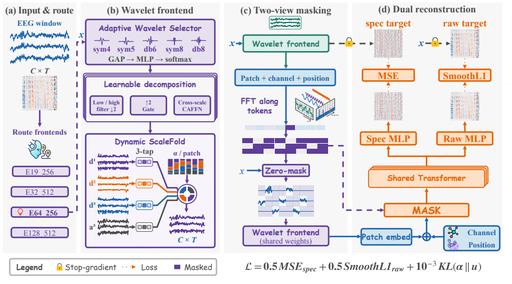
Fig. 1 . Overview of PhysioWave-T, shown for EEG. (a) Channel count and sampling rate select a route-specific front end. (b) Adaptive wavelet decomposition and dynamic scale folding produce one C × T signal. (c) Spectral importance of clean-view tokens selects masked patches, zeroed before the online front end. (d) A shared Transformer and two MLP heads reconstruct raw and folded-wavelet patches against stop-gradient targets.
Original paper · CC BY 4.0 · Yanlong Chen, Simone Benatti, Luca Benini, Cuntai Guan, Yawei Li · PhysioWave-T: Token-Efficient Wavelet Foundation Models for Biosignals · Original paper figure · Extracted the figure area from page 3 of the original PDF.The authors keep the scale-folding saving tied to the number of channels and to dense EEG arrays. On the 128-channel route, folding cut peak memory from about 32 GB to 2.5 GB per batch. Across four EEG routes, folding reduced Transformer latency by 4.0–7.2× and peak memory by 6.8–12.7× over scale expansion.
How a front end folds the bands
Each front end keeps M learnable analysis-filter pairs, each with K taps per channel. The pairs start from named wavelets such as db6 and sym4 and are optimized during pre-training.
Each level filters the approximation into a low-pass and a high-pass branch, then decimates both by two. A per-channel gate then blends the current-level detail and approximation with the upsampled result from the next level. The gate comes from multi-head attention over pooled channel statistics and a sigmoid, so it can differ by channel and by input.
The authors say this learned blend reduces the artifacts that naive upsampling would introduce.
The folding weights are predicted from local subband statistics and then refined through learned synthesis filters. The fold combines the J+1 bands back into one signal with the shape of the input. Each patch then receives a learned channel-name embedding and a sinusoidal position embedding before the Transformer. Which front end runs is decided from acquisition metadata at run time, not by learned token routing.
What the pre-training objective and channel names learn
Pre-training masks 70 % of patches and asks the shared model to rebuild two targets, a raw-signal target and a folded-wavelet target. For each route, the authors select the validation window with median NMSE before masking 70 % of its patches. One shared backbone serves all four route-specific front ends, so the same weights reconstruct signals from 19-channel TUEG to 128-channel HBN.
The TUEG channel is the hardest case, with r = 0.52, although its window-level correlation is 0.79. The authors read this as reconstruction difficulty varying across channels within one recording. Corpora are sampled with probability P(d) ∝ n_d^0.5, so large datasets don't dominate pre-training. Training uses a 70 % mask ratio and AdamW, with the EEG encoder trained for 60 epochs.
Channel names carry no electrode coordinates, yet the trained name embeddings track scalp geometry. The untrained table shows ρ = 0.01, so the association comes from training rather than from the table's initialization. After name shuffling, the same neighbours lie 84 to 88° apart, so the learned geometry depends on correct names. Because volume conduction makes neighbouring electrodes record overlapping source mixtures, raw-signal pre-training can recover topology from names alone.
Under full fine-tuning, the readout changes matter less, because the backbone can already make its tokens linearly separable. The channel-encoding ablation shows the benefit of correct identity comes from scalp geometry, not from added capacity.
EEG benchmark against four baselines
The benchmark asks whether the PhysioWave-T EEG encoder beats earlier EEG models on three standard tasks. The authors follow EEGPT's exact evaluation protocol for five-stage sleep staging on Sleep-EDFx, target detection on PhysioNet-P300, and error-related negativity detection on KaggleERN. Baseline results are cited directly from EEGPT's study, while the PhysioWave-T rows are three-seed means.
On Sleep-EDFx, the Fpz-Cz and Pz-Oz derivations run at 100 Hz, a rate that matches no pre-training route or vocabulary entry. So the front end and both channel embeddings are learned during downstream adaptation. Even so, fine-tuned PhysioWave-T raises kappa from 0.686 to 0.737 over EEGPT. Weighted F1 rises from 76.5 % to 80.9 % over the same EEGPT baseline.
The scratch model alone reaches a kappa of 0.736, which suggests the multiscale front end suits sleep staging by itself.
On KaggleERN, PhysioWave-T improves balanced accuracy by 3.3 points over EEGPT. Kappa improves by 0.018 on the same task, and this balanced-accuracy gain is the largest of the three tasks.
Cost of folding against scale expansion
Dynamic scale folding keeps the Transformer at C×S tokens, where scale expansion would use (J+1)×C×S. In the EEG ablation, the dynamic fold scores 0.3 points higher on average than scale expansion while using about a quarter of the tokens. Scale expansion gives the Transformer every subband as a separate token row at four times the sequence length.
The accuracy gap depends on how the scales are combined, not on compression alone.
A static uniform fold drops the four-metric average by 1.6 points and falls 1.3 points below scale expansion. Of that 1.6-point gap, the learned synthesis filters account for 0.7 points and the data-dependent weights α for the remaining 0.9.
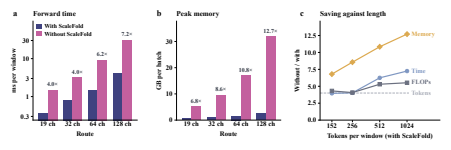
Fig. 8 . EEG encoder efficiency on one A100 in bf16, averaged over three seeds. (a) Latency per window. (b) Peak memory per batch. (c) Savings versus token count.
Original paper · CC BY 4.0On one A100 in bf16, with matched route-specific batch sizes, folding cuts Transformer latency by 4.0–7.2× across the four EEG routes. Peak memory falls by 6.8–12.7× and FLOPs by 4.3–5.5× on the same routes. Memory shrinks more than FLOPs because attention maps grow quadratically with sequence length and dominate activation memory. On the 128-channel route, a batch drops from about 32 GB to 2.5 GB in this profiling setup.
These profiling batches differ from the 26 GB pre-training peak the authors report for 128-channel EEG.
When pre-training and channel identity matter
Pre-training helps most when the downstream task is hard, and KaggleERN shows this clearly. The authors attribute this to error-related negativity being a brief, low-amplitude deflection that four-second clinical pre-training doesn't isolate on its own. On PhysioNet-P300, the frozen encoder stays within one balanced-accuracy point of full fine-tuning.
Pre-training also helps under label scarcity, and the gain is largest for KaggleERN. With 10 % of KaggleERN labels, the pre-trained encoder beats a scratch model trained on all labels by 0.8 balanced-accuracy points. With 25 % of labels the margins widen to 2.6 and 3.8 points. Matched scratch training at 10 % labels loses 8.7 points on average, against 4.8 points for the pre-trained encoder.
Channel identity is the second question, and the ablation removes it in two ways. Dropping the channel-encoding gate lowers the four-metric average by 1.8 points. Shuffling channel names lowers it by 2.1 points, which is a larger loss than removing the encoding. The authors read this as wrong spatial information hurting more than none, since the shuffled model keeps the same embedding parameters.
Missing electrodes test how far the channel vocabulary carries when the montage shrinks. Dropping 25 % of electrodes at test time lowers the average score by 2.1 points, and dropping 50 % lowers it by 4.2 points. With a quarter of electrodes missing, KaggleERN balanced accuracy stays at 60.4 %, above EEGPT with the full montage at 58.4 %.
Fusing modalities with reliability scores
RALF replaces the fixed per-modality weights of PhysioWave with weights computed for every window. Each encoder's token sequence is reduced to four summary tokens by an attention pool with q = 4 learnable queries. Eight learnable fusion tokens then attend to the concatenated summaries through two cross-attention layers before pooling and classification.
Figure 6 shows the EEG, ECG and EMG encoders feeding these fusion tokens, with the reliability weights applied to the output.
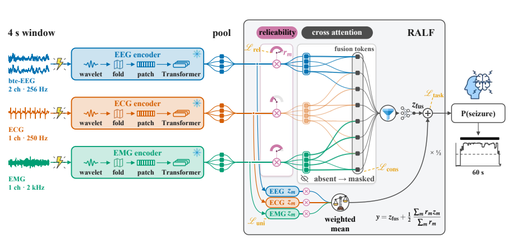
Fig. 6 . Reliability-aware latent fusion (RALF) of 4-s EEG, ECG, and EMG windows. Reliability scores gate tokens and weight unimodal predictions. Orange symbols denote training losses; the trace shows seizure probability over a 60-s test excerpt with a 0.5 threshold.
Original paper · CC BY 4.0A sigmoid head predicts a reliability score r_m in (0, 1) for each modality from its summary tokens. That score gates the modality's attention keys and values, so reliability shapes the cross-modal interaction itself. The same score also weights the modality's unimodal logits in a residual term, which is normalized by the sum of the weights.
The sampled severity sigma_m defines a reliability target of 1 minus sigma_m, which supervises the score directly. Random modality dropping creates a subset view, and training encourages its prediction to agree with the full-set prediction. The objective adds the fused cross-entropy, a 0.2-weighted sum of unimodal cross-entropies, a squared reliability regression term, and a symmetric KL between the two views.
Seizure detection with fused modalities
RALF first reduces each encoder's token sequence to four summary tokens with an attention pool that has four learnable queries. Eight learnable fusion tokens then attend to the concatenated summaries through two cross-attention layers before pooling and classification. Each modality's sigmoid head predicts a reliability score that gates its attention keys and values and weights its unimodal logits.
During training, each modality is corrupted with probability 0.5, and the reliability target is 1 minus the sampled severity.
That result beats 0.372 for weighted-logit fusion, so RALF gains over the simpler rule. The concatenation baseline reaches 0.347 on the same metric. All six RALF training variants beat both fusion baselines whenever EEG and ECG are jointly present, at 0.384 to 0.414.
The sensitivity figures at 11 false alarms per hour don't agree across the paper. The introduction gives 78.9 % for RALF, while the EEG-only encoder sits at 61.4 %. The abstract and the results section give 74.4 % for RALF instead.
On clean inputs, RALF assigns 0.92, 0.85 and 0.91 to EEG, ECG and EMG. Heavy corruptions that remove signal, such as bad channels and EMG noise, push reliability to 0.24 to 0.33. ECG noise costs 0.004 AUPRC. EMG dropout or noise leaves AUPRC at the clean value of 0.399.
Limits of the evidence
The corruptions in the fusion study are synthetic, so the reliability results come from simulated degradation rather than real sensor faults. The authors name prospective recordings with natural sensor failures as a next step, alongside joint multimodal pre-training. RALF uses encoders that were pre-trained independently, so the fusion gains don't come from joint multimodal pre-training.
New routes for modalities such as photoplethysmography remain untested in this work.
The abstract gives RALF's sensitivity at 11 false alarms per hour as 74.4 %, while the introduction gives 78.9 %. The paper doesn't explain why these two sensitivity figures differ. The fusion results section also gives 78.9 % for weighted-logit fusion, so the same figure appears for two different methods.
The efficiency numbers come from profiling with matched batch sizes, which the authors say differ from the pre-training memory. The EEG baselines for BENDR, BIOT, LaBraM, and EEGPT come from the EEGPT study rather than from reruns in this paper. Quoted baselines keep the original studies' aggregation, so they aren't averaged over this paper's three seeds.
The ablation values are means over three seeds, but the passages don't report the spread across those seeds. They didn't test the frozen fusion encoders under natural noise, only under the synthetic corruptions.
Paper info
- Authors
- Yanlong Chen, Simone Benatti, Luca Benini, Cuntai Guan, Yawei Li
- Venue
- arXiv · Preprint
- First published
- 2026-11-6
- Added
- 2026-11-9
- Updated
- 2026-11-6
- Version
- v1
- arXiv
- 2611.08969
- Category
- cs.AI
- Original paper terms
- CC BY 4.0
- What we show
- Paper info, commentary and permitted figures from the original paper
AI commentary is a separate explanation from the original paper and may contain errors. The original paper and figures follow each source's terms of use and any rights noted separately.
Abstract
We present PhysioWave-T, a token-efficient wavelet foundation model family for EEG, ECG, and sEMG. Dynamic scale folding recombines J+1 wavelet subbands prior to tokenization, compressing sequence length from (J+1)CS to CS tokens for J levels, C channels, and S temporal patches. Route-specific front ends and learned channel-name embeddings allow one Transformer per modality to handle diverse montages and sampling rates, while unseen setups reuse the backbone via lightweight adapters. We pre-train a 30M-parameter EEG model on over 15M windows (19--128 channels), alongside ECG (30M) and sEMG (12M) encoders. Across four EEG routes, scale folding cuts Transformer latency by 4.0--7.2x and peak memory by 6.8--12.7x over scale expansion without accuracy loss. Our EEG encoder leads 8 of 9 metrics against BENDR, BIOT, LaBraM, and EEGPT, and surpasses LUNA-L on wearable seizure detection with fewer parameters. Reliability-aware latent fusion (RALF) further integrates summary tokens from independently pre-trained encoders via sample-adaptive weights. On SeizeIT2, RALF raises event sensitivity at 11 false alarms/h from 61.4% to 74.4% and window AUPRC from 0.321 to 0.399 over the best unimodal baseline, outperforming weighted-logit and concatenation fusion across all variants. PhysioWave-T also achieves state-of-the-art sEMG accuracies and top macro-F1 on PTB-XL Super and Chapman-Shaoxing. Code and models: https://github.com/ForeverBlue816/PhysioWave.
Quote from the paper
Yanlong Chen, Simone Benatti, Luca Benini, Cuntai Guan, Yawei Li (2026). PhysioWave-T: Token-Efficient Wavelet Foundation Models for Biosignals. arXiv:2611.08969v1. https://arxiv.org/abs/2611.08969v1
BibTeX
@misc{chen2026physiowave,
  title = {{PhysioWave-T: Token-Efficient Wavelet Foundation Models for Biosignals}},
  author = {Yanlong Chen and Simone Benatti and Luca Benini and Cuntai Guan and Yawei Li},
  year = {2026},
  eprint = {2611.08969},
  archivePrefix = {arXiv},
  url = {https://arxiv.org/abs/2611.08969v1}
}