Paper commentary
Aspect-wise Pairwise Tournaments for Test-Time Selection
Aspect-wise pairwise tournaments pick better test-time answers than per-candidate scoring
- Problem Best-of-n sampling works, but picking the best candidate is hard. Judging each candidate alone misses the subtle differences that separate right answers from wrong ones.
- Method APT runs a single elimination tournament where each matchup is decided by votes from several aspect verifiers. Instead of scoring candidates one at a time, each verifier compares two solutions along its own aspect.
- Results APT has the top score in 14 of 15 generator-domain pairs. On Chess Optimality with Gemini-3.1-Pro, it scored 0.166 pawns, compared to 0.056 for BoN-MAV.
Why picking one candidate is hard
Best-of-n sampling has a simple recipe: a model draws several solutions and keeps only one. It lifts LLM performance without additional training, as the cited prior work on this setting shows. Generating candidates is cheap now, so the hard step is deciding which candidate counts as best. Scoring each candidate alone needs a concrete standard of quality, which is hard to write down outside one's own expertise.
Two solutions can each sound plausible when read alone, yet the errors that separate right from wrong often surface only when they sit side by side.
More samples don't guarantee a better pick, because majority-vote accuracy can decline on tasks that mix easy and hard queries. Verifier false positives can also limit how much accuracy resampling can recover. Verification stays difficult even when LLM judges or trained generative verifiers score the responses. The authors therefore focus on the judgments used to select candidates instead of the number of candidates.
Aspect-specific pairwise verification is their proposed approach to this selection problem.
The authors borrow from human decision-making, where people rarely rank options by scoring each one in isolation. An optometrist shows a patient lenses side by side and asks which is better, instead of asking for a prescription directly. Comparison still gets harder as options grow complex, so a hiring committee weighs two finalists on technical depth, then communication, then experience.
A verifier that compares along several axes stays robust, because different conditions fail in different places.
Comparing by aspect as the core idea
The core idea is that a verifier compares two candidates and judges them along one aspect at a time. The authors take this from ordinary decisions, like an optometrist showing a patient two lenses side by side. A hiring committee works the same way, weighing finalists on technical depth, then communication, then experience. Comparison brings out the differences that separate right from wrong, even when each solution sounds plausible alone.
Each aspect verifier is an off-the-shelf LLM prompted to check one property of a solution. In Lifshitz et al. (2025), each verifier scores one candidate and returns a binary approval. Different conditions fail in different places, so a verifier that compares along several axes survives a mistake on one of them.
The experiments add a conciseness aspect on AIME and HMMT, with its weight w set between 0 and 3. Going from w = 0 to w = 3 cut the average selected solution length by 13% for Gemini-3.1-Pro and 16% for GPT-5.2 on AIME. BoN-MAV uses the same aspect verifiers and base models as APT, so comparing the two isolates the effect of pairwise structure.
How one matchup and the bracket run
A single matchup in APT starts with a judge that sees two candidate solutions together and returns the index of the preferred one, or abstains. Abstaining can also save tokens or thinking cost, since the judge doesn't have to invent a preference it doesn't hold. LLM judges tend to favor the candidate placed first in the prompt, so APT queries each comparison in both orders.
A preference survives only when both orderings agree, and when they disagree the winner is picked uniformly at random.
In Lifshitz et al. (2025), by contrast, each verifier scores one candidate and returns a binary approval. Figure 2 shows one HMMT matchup in which five GPT-5-mini aspect verifiers read two solutions. Solution A counts 8 arrangements and misses the factor for distinct rotations, and four of the five verifiers prefer Solution B. The authors argue that this counting error is easy to miss in a binary check but becomes visible when the two strategies sit side by side.
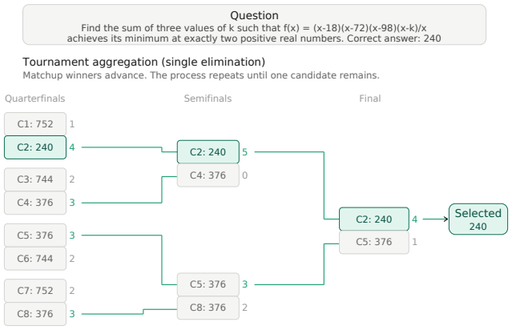
Figure 3 :Tournament aggregation for candidate selection.Given 8 candidate solutions, a single elimination tournament selects the final output. At each matchup, aspect verifiers compare both solutions and the candidate preferred by the majority advances. The full tournament requires onlyn− 1matchups, comparable in total verifier queries to binary approval methods which requirenindependent evaluations.
Original paper · CC BY 4.0 · Hannah Guan, Yilun Du · Aspect-wise Pairwise Tournaments for Test-Time Selection · Original paper figure · Extracted the figure area from page 6 of the original PDF.Each verifier's vote counts toward the candidate it prefers, and abstentions count toward neither side. The matchup winner is the candidate with more votes, so a plurality of the expressed preferences decides it rather than a strict majority of all verifiers. If the two candidates tie, including the case where every verifier abstains, the winner is chosen uniformly at random.
The bracket then pairs the candidates and advances each matchup winner until one candidate remains. A single elimination bracket over n candidates needs exactly n minus 1 matchups, the most compute-efficient format the authors compare. Figure 3 shows an 8-candidate bracket in which the aspect verifiers decide each matchup.
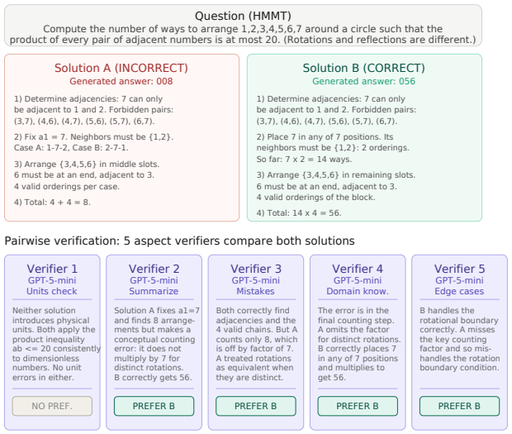
Figure 2 :Multi-aspect pairwise verification for a single matchup.Two candidate solutions are compared by five aspect verifiers. Solution A finds 8 valid arrangements but fails to account for distinct rotations; Solution B correctly multiplies by 7 positions to get 56. Each verifier reads both full solutions and selects the one it judges to be better along its assigned aspect. Four of five verifiers identify Solution A’s counting error and prefer Solution B, while the units check verifier finds no meaningful difference. This illustrates the core advantage of pairwise verification: the rotation counting error in Solution A is subtle enough that it might be missed under independent binary evaluation, but becomes salient when a verifier can directly compare the two counting strategies side by side.
Original paper · CC BY 4.0The bracket's weak point is that a strong candidate can be eliminated early by drawing a difficult matchup. The authors find this rarely matters in practice, and they check it in Appendix A.7. APT runs three steps: it generates n candidates, compares each matchup with m aspect verifiers, and returns the tournament winner. The selected output is written as SingleElim over the candidates and the verifier set M.
Generation runs in parallel because candidates are sampled independently, and each bracket round can run its verifiers and matchups in parallel. The number of candidates n and the number of verifiers m are the two knobs that scale test-time compute.
Does APT beat the baselines?
The authors sample n = 8 candidates per problem from three generators and compare APT with Self-Consistency, BoN-RM and BoN-MAV. The benchmarks are AIME with 150 problems, HMMT with 93 problems, and HLE and Chess Validity with 300 problems each.
APT has the top score in 14 of the 15 generator-domain pairs. On Chess Optimality with Gemini-3.1-Pro, APT scored 0.166 pawns, compared to 0.056 for BoN-MAV. The authors read the largest gains on this open-ended task as a sign that combining several aspects with pairwise comparison yields a more well-rounded judgment when no single answer exists.
Gains are smaller where accuracy is already high, such as Gemini-3.1-Pro on AIME and Chess Validity, where the authors say there is little room left to improve. On HLE the authors say the gains are limited by how many valid solutions the generator produces.
In the weak-to-strong setting, GPT-5-mini verifiers judge GPT-5.2 solutions, and APT still improves on the baselines. The authors suggest that a weaker verifier can still tell which of two solutions is better even when it cannot judge one solution in isolation.
In the self-improvement setting, the same small model serves as generator and aspect verifier. On Chess Optimality with Gemini-2.5-Flash, APT scored 0.086, compared to 0.035 for Self-Consistency and 0.047 for BoN-MAV. Across both small models the authors report that APT had the top score in every setting of Table 2. The authors also report a 95% paired-bootstrap interval for some APT-over-BoN-MAV cells, while Qwen3-8B was not tested in that analysis.
Steering selection with a user-added aspect
A user can add one aspect verifier to the existing panel and set how heavily its vote counts. Each matchup in this setup is decided by a weighted vote, and the existing verifiers keep weight 1. The new aspect takes a weight w from 0 to 3, and w = 0 reproduces standard APT. The authors add conciseness on AIME and HMMT, and aggressiveness on Chess Optimality.
They reuse the 8 candidates from the main experiments, so steering needs no new generation.
Conciseness is scored by the token length of the selected solution. Aggressiveness is scored by whether the selected move is a check or a capture, found by parsing the move against the board. Going from w = 0 to w = 3, the average selected AIME solution gets 13% shorter for Gemini-3.1-Pro and 16% shorter for GPT-5.2. On HMMT, the same change shortens the selected solution by 8% and 14%.
Figure 4 plots these curves against the weight for each setting.
Measured against the best value in each pool, w = 3 closes 36 to 79% of the gap on the math tasks. On chess, the same weight closes 57 to 61% of the gap.
The existing verifiers still vote on correctness, so the new aspect chooses among answers already judged correct. The authors read this as little cost to correctness when steering toward conciseness. Because each aspect is a natural-language prompt, steering needs no retraining of verifiers. This section tests only the two aspects named above.
Is the gain from aspects or from extra judgments?
The PV-1 variant keeps APT's tournament, position-bias handling, and base verifier model, but swaps the aspect vote for one generic judgment per matchup. PV-5 matches APT's verification budget, because PV-1 alone uses fewer verifier calls than APT's m = 5 verifiers.
Table 3 compares APT with PV-1 and PV-5 at n = 8, using Gemini-2.5-Flash and GPT-5-mini as verifiers. The authors read this as evidence that the diversity of criteria contributes more than the extra samples. Five draws from one generic judge can share correlated errors, whereas five verifiers along different axes can spread their errors.
When verifiers are removed one at a time, accuracy falls as the verifier count drops for APT and BoN-MAV on all five datasets. The aspects therefore contribute complementary signal, and performance doesn't rely on any single aspect. Across candidate counts from 1 to 16, APT is at or above both baselines in nearly every generator-dataset pair.
The exceptions are Gemini-3.1-Pro on Chess Validity and GPT-5.2 on Chess Optimality. In several cases, such as Gemini-3.1-Pro on HLE, the gap widens as n grows rather than closing.
Limits of the evidence and the cost of tournaments
Every generator and verifier in the main study comes from one model family. The Qwen3-8B setting, which pairs with GPT-5-mini verifiers, gives a partial cross-family check. Swapping verifier families would test the cross-family case directly, and the authors didn't run that swap. Most of the evaluation covers domains with verifiable answers.
The Chess Optimality results hint that these open-ended tasks are where accuracy and steering gains may matter most.
APT needs no training, but the tournament still adds inference cost. With n candidates and k aspect verifiers, APT issues 2(n-1)k verifications. Each comparison runs in both orderings, so the position-bias check doubles the queries. These verifications cost roughly 2(n-1)k(p + 2s) input tokens, where p is prompt length and s is mean solution length.
When solutions are much longer than prompts, APT can cost up to about four times BoN-MAV in input tokens.
Latency is a separate cost, because BoN-MAV runs its verifications in one parallel batch. APT's tournament rounds must run sequentially, which makes it slower. Candidate generation stays parallel, since each candidate is sampled independently.
Paper info
- Authors
- Hannah Guan, Yilun Du
- Venue
- arXiv · Preprint
- First published
- 2026-11-5
- Added
- 2026-11-9
- Updated
- 2026-11-5
- Version
- v1
- arXiv
- 2611.08640
- Category
- cs.AI
- Original paper terms
- CC BY 4.0
- What we show
- Paper info, commentary and permitted figures from the original paper
AI commentary is a separate explanation from the original paper and may contain errors. The original paper and figures follow each source's terms of use and any rights noted separately.
Abstract
Scaling test-time compute has proven highly effective at improving LLM reasoning. A popular method is best-of-n sampling, where a model generates many candidate solutions and one is selected. This motivates the question: how can we select the best candidate? When humans make choices, we find it more natural to compare two options than judge each in isolation. Additionally, when the options become complex, we like to judge the options one aspect at a time, such as comparing two job candidates on experience, communication, etc. In the test-time setting, candidate solutions should be judged in the same way. Here we introduce Aspect-wise Pairwise Tournaments (APT), which verifies by comparison and compares by aspect. Each matchup of a single elimination tournament is decided by a vote over multiple off-the-shelf aspect verifiers, each expressing a pairwise preference along its own aspect. Across five domains and three generator LLMs, APT improves over binary multi-aspect approval, self-consistency and reward model verification, with the largest gains on open-ended tasks. We find that both components matter; neither binary approval over the same aspects nor a generic pairwise judge at a matched budget matches APT. Because aspects are specified in natural language, APT also lets users steer selection toward properties they care about, better aligning with user preferences without needing to regenerate solutions. No component is trained, so APT transfers to new domains by simply rewriting prompts.
Quote from the paper
Hannah Guan, Yilun Du (2026). Aspect-wise Pairwise Tournaments for Test-Time Selection. arXiv:2611.08640v1. https://arxiv.org/abs/2611.08640v1
BibTeX
@misc{guan2026aspect,
  title = {{Aspect-wise Pairwise Tournaments for Test-Time Selection}},
  author = {Hannah Guan and Yilun Du},
  year = {2026},
  eprint = {2611.08640},
  archivePrefix = {arXiv},
  url = {https://arxiv.org/abs/2611.08640v1}
}