Paper commentary
Learning Whom to Trust About the Unseen: Source Credibility and Reliability Transfer in Language Models
Language models trust a source's record for natural causes, not spiritual ones
- Problem Source ratings reduce a track record to one score, so they can't say which new claims it bears on.
- Method The authors give two fictional informants different river forecast records, then compare how much each one's endorsement shifts credence in matched natural and spiritual claims.
- Results Five models gave the reliable informant an 18.2 to 30.3 point credence edge on natural causes, versus -0.1 to 5.8 points on spiritual causes.
Where a track record stops helping
Models must weigh testimony about things nobody in the exchange can check, so the authors ask what a track record establishes in that case. They split the judgment in two: how reliable a source has been, and what that reliability says about the claim the listener faces now. The second judgment matters most when nothing else can confirm the claim, and Study 3 isolates it.
Source-level ratings don't answer it, because a rating says nothing about which claims the track record bears on.
The design gives two fictional informants, Oren and Teo, a twenty-week log of river forecasts, with one right on 18 weeks and the other on 10. Eight matched pairs of causal claims then concern the same village event, once with a natural cause and once with a spiritual agent. Each claim is endorsed by the stronger-record informant, the weaker-record informant, or nobody, and no feedback about the hidden cause is given.
Models rate each claim's likelihood on a 0 to 100 scale, and the source contrast is the strong-endorsed credence minus the weak-endorsed credence. The no-endorsement condition supplies a baseline, so each source's shift can be read separately.
Five models carry the record to natural causes, with contrasts from 18.2 to 30.3 points, while spiritual contrasts run only from −0.1 to 5.8.
Source identity and expert ignorance
Study 1 reruns the Einstein-effect paradigm, in which the same obscure statement is attributed either to a scientist or to a spiritual guru. Humans favored the scientist by 0.64 points on the seven-point scale, but all six models, in both formats, put the spiritual leader ahead on the original statements. The direct-format gap is largest in the two open-weight models, with Qwen at -4.60 and Llama at -3.92.
The authors then rewrote the statements with physics vocabulary, and that flipped most cells toward the scientist. Ten of twelve model-by-format cells then favored the scientist, Sonnet in the direct format was tied, and Llama in the direct format still leaned toward the spiritual leader. This points to the fit between a role and the content it is quoted as saying, rather than a fixed preference for either role.
The authors note that semantic plausibility and stylistic associations could produce the same pattern, and two statements per content set make this a demonstration rather than a survey.
Study 2 adapts Davoodi and Lombrozo's test of what an expert's admission of ignorance does to confidence. Part A has participants state a confidence, then project it after a trusted expert calls the mechanism unknown or a mystery. Participant-conditioned model estimates run from -0.40 to -0.94, compared to -0.10 for humans, and direct-format estimates run from -0.12 to -0.42.
The authors read this as models exaggerating the human asymmetry when they answer as a participant and shrinking it when they answer as themselves. No-expert controls moved between -0.13 and +0.11, so the declines come from the expert's answer rather than from asking twice.
The river-village test
Study 3 is built around Harrow, a fictional river village with two informants, Oren and Teo. Each target prompt carries the full log, so the test checks whether a model uses supplied evidence instead of improving across calls. Oren and Teo forecast binary river-level outcomes over a twenty-week log, where one is right on 18 weeks and the other on 10.
The generator balances outcomes and predictions, switches which name holds the stronger record, and runs two history orders.
The targets are eight matched pairs of causal claims about one village event each, with one member giving a natural cause and the other a spiritual agent. Models give a 0 to 100 credence that each claim is true, and the source contrast D is the strong-endorsement credence minus the weak-endorsement credence. The no-endorsement condition supplies a baseline, so each source's shift can be read separately.
The second factor is the informant's own account of how they forecast, with three levels. A no-cue condition says nothing about method, and a natural-intuition condition appears only in extension runs. Because the cue is the informant's own claim, it doesn't count as independent evidence that the method works.
Conditions without a record test names and competence cues alone, so the generator summarizes identical no-history prompts by name. Models may reason briefly before the final answer in Study 3. Same-task diagnostics ask about new river forecasts and cover five models, because Sonnet has no run.
Reading the contrast and the interaction
The source contrast D is the credence under the stronger informant's endorsement minus the credence under the weaker one. Models rate each claim's likelihood of being true on a 0 to 100 scale, so D is read in points. The no-endorsement condition supplies a baseline, so each informant's shift can be read on its own. The pair-level analysis computes each matched pair's strong-weak contrast first, then averages the eight pairs, so every pair counts equally.
Qwen's three missing outputs make this equal-pair summary differ slightly from the pooled one, at 18.3 against 18.2 for the natural no-cue mean.
A gap in D between natural and spiritual claims shows where the record reaches, but it doesn't show whether the cue changes the answer. The primary interaction I takes the spiritual-minus-natural contrast under the spiritual cue and subtracts the same contrast under measurement. A positive I can come from a larger spiritual contrast, a smaller natural contrast, or both, so the authors report the simple changes alongside it.
That design yields 2,400 valid outputs for each model except Qwen, which has 2,397. Across the five transferring models, natural-cause D runs from 18.2 to 30.3 points, while spiritual-cause D runs from -0.1 to 5.8. Relative to measurement, the spiritual cue lowers the natural contrast in every model by about 5 to 19 points. That positive I reflects a shrinking natural contrast, since the spiritual contrast did not grow.
Does the record reach natural causes?
Study 3 first asks whether the models use the supplied river record at all, on new river forecasts. Five models with diagnostic runs give the stronger informant's forecast more credence, by 15.5 points for Llama up to 41.5 for Qwen. Each of these models chooses the stronger informant in 96 to 100% of deference trials. Recall of the record is imperfect, with the stronger informant's recalled count running from 14.25 for GPT-5 to 18.00 for Qwen.
The true count is 18, so the models track the record closely enough to shape a nearby judgment.
Spiritual-cause contrasts stay small, from -0.1 to 5.8 points, against spiritual baselines from 0.0 to 7.0. Sonnet's natural-cause contrast is 22.7 points, and it has no same-task run to compare against. Haiku shows 24.5 points for natural causes but only 0.3 points for spiritual causes.
GPT-5 and Qwen show it on six pairs, and Llama shows it on four. Dropping any single pair leaves the mean difference positive for every transferring model. Across those leave-one-pair-out checks, the five transferring models' means stay between 13.6 and 26.6 points. Figure 1 places each pair's natural-minus-spiritual contrast beside the equal-pair means.
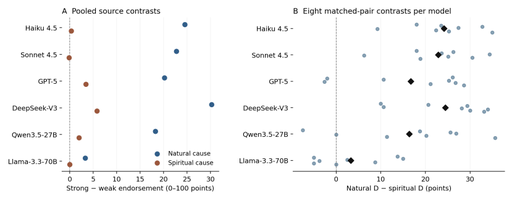
Figure 1 . Study 3 source contrasts and pair-level sensitivity. Left, pooled strong-minus-weak source contrasts with the record and no competence cue. Right, each dot is one matched pair’s natural-minus-spiritual contrast; diamonds are equal-pair means.
Original paper · CC BY 4.0 · Ruijia Guan · Learning Whom to Trust About the Unseen: Source Credibility and Reliability Transfer in Language Models · Original paper figure · Extracted the figure area from page 8 of the original PDF.What a competence cue does to the record's reach
The spiritual cue has the reliable informant attribute forecasts to spiritual guidance, where the measurement cue attributes them to a marked post in the water. Each spiritual result is read against the measurement cue, which serves as the matched comparison in the same design. DeepSeek-V3 shows the largest drop, falling from 23.2 to 4.3 on natural claims.
The spiritual-claim contrast doesn't rise to match that loss.
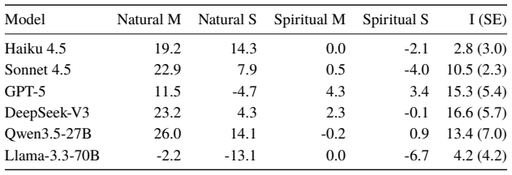
Table 4 . Source contrasts when the competence sentence is attached to the stronger informant. M denotes measurement and S spiritual guidance. The last column is the difference-in-differences 𝐼 with its mixed-model standard error. Pooled cells and fitted coefficients can differ slightly under missingness.
Original paper · CC BY 4.0The interaction I is positive in all six models, so the spiritual-minus-natural gap widens under the spiritual cue. It exceeds twice its standard error in Sonnet, GPT-5, and DeepSeek. The authors decompose it because the positive sign comes from a shrinking natural contrast, not a growing spiritual one. A single coefficient would hide that loss and read as a gain on spiritual claims.
For Llama it raises that baseline from 0.3 to 21.2, while Qwen stays near zero. So a model can find spiritual causes more plausible yet give the informant no extra weight on them. Models may read the cue as a sign of limited causal understanding, an unconfirmed claim, or a worldview that discounts the informant elsewhere.
The animist frame changes perspective and ontology together, and it runs without a competence cue. In that frame, Haiku shows natural and spiritual contrasts of 25.0 and 4.6. GPT-5 shows 25.9 and 9.2 in the same frame.
Relevance or prior credence in spiritual claims
Two accounts fit the data, and they make different predictions about the same gap.
The developmental literature supports relevance as at least part of the story, because children restrict expertise to its domain. Children also discount informants whose accuracy had the wrong provenance, which matches the pattern the authors see in the models. The present data can't apportion the two accounts, so the authors don't claim either one as the cause.
It may instead be the model's answer to what the score is evidence for.
The competence cue offers a parallel, because a stated basis of competence changes trust separately from the record itself. The spiritual competence sentence raised the no-endorsement baseline for spiritual causes from 7.0 to 29.8 in DeepSeek and from 0.3 to 21.2 in Llama. Qwen's spiritual baseline stayed near zero, moving only from 0.0 to 0.1.
Baseline acceptance and the weight given to a record are separate quantities, so a higher baseline alone doesn't predict more transfer.
Within a stipulated world, one informant earns a record that establishes access to natural causes, and another earns a record that establishes access to spiritual ones. The identical target claims are then tested under each informant. If transfer follows the relevance of the record, the relevance account gains direct support. Parametric interventions on a model's spiritual baseline could then test whether raising it changes transfer.
Where the results stop
Study 1 uses only two statements per content set, so it shows a pattern rather than surveying statement types. Study 3 rests on eight matched pairs and two history orders, which limits how far its pair-level results travel. The screening rule asked for no-endorsement baselines between 20 and 80 for both members of a pair in Haiku and GPT-5.
Part B and the animist frame cover only Haiku and GPT-5, while the Study 2 controls cover three models. A manipulation check on Haiku read the natural and spiritual items as intended and unrelated to the river. The same check rated the competence sentences as unclear, so the reading of the spiritual cue remains uncertain. The stronger informant's recalled count ranged from 14.25 for GPT-5 to 18.00 for Qwen, against a true count of 18.
Caching makes repeated participant-linked outputs less independent, so those rows don't count as separate stochastic samples. API names don't pin immutable model snapshots, so a rerun may not reproduce these exact models. Qwen's three missing outputs make its pooled and pair-level means differ slightly.
The human reference comes from Davoodi and Lombrozo's participants, who were largely Christian Americans, so it reflects one cultural context. Numerical credence is one readout of acceptance, and the paper doesn't measure what a model would say, recommend, or do with it. The next step reproduces the behavioral contrasts on an exact open-weight checkpoint before any intervention on a model's spiritual baseline.
Paper info
- Authors
- Ruijia Guan
- Venue
- arXiv · Preprint
- First published
- 2026-11-6
- Added
- 2026-11-9
- Updated
- 2026-11-6
- Version
- v1
- arXiv
- 2611.08855
- Category
- cs.AI
- Original paper terms
- CC BY 4.0
- What we show
- Paper info, commentary and permitted figures from the original paper
AI commentary is a separate explanation from the original paper and may contain errors. The original paper and figures follow each source's terms of use and any rights noted separately.
Abstract
A source who has been right before deserves attention, but about what? We ask how far a demonstrated record of reliability travels in language models when the new claim cannot be checked, and whether the answer depends on the kind of claim. Three behavioral studies across six models approach the question from three angles. Study 1 adapts the Einstein-effect paradigm and finds that models, unlike the human sample, favor a spiritual leader over a scientist for the same obscure statement, and that the preference largely reverses when the statement is reworded in the vocabulary of physics. Study 2 adapts a paradigm in which a trusted expert calls a scientific or religious explanation unknown or a mystery; models reproduce the human domain asymmetry in exaggerated form. Study 3, the central test, gives two fictional informants different records on checkable river forecasts and then has them endorse matched claims about hidden natural and spiritual causes of the same village events. Most models carry the record to natural causes and barely at all to spiritual ones; one model transfers it weakly to either. Telling the model that the reliable informant forecasts by spiritual guidance rather than by measurement lowers that informant's influence on natural claims in every model and produces no comparable gain on spiritual claims in any. Demonstrated reliability thus has a scope in these models, and the account a source gives of how they came to be reliable can narrow it. Whether this reflects a judgment about relevance or the low prior credence of spiritual claims is the question the design leaves open, and we outline the experiment that would settle it.
Quote from the paper
Ruijia Guan (2026). Learning Whom to Trust About the Unseen: Source Credibility and Reliability Transfer in Language Models. arXiv:2611.08855v1. https://arxiv.org/abs/2611.08855v1
BibTeX
@misc{guan2026learning,
  title = {{Learning Whom to Trust About the Unseen: Source Credibility and Reliability Transfer in Language Models}},
  author = {Ruijia Guan},
  year = {2026},
  eprint = {2611.08855},
  archivePrefix = {arXiv},
  url = {https://arxiv.org/abs/2611.08855v1}
}