Paper commentary
AtariBench: Evaluating Spatiotemporal Reasoning of Vision-Language Models in Atari Gameplay
Benchmark shows vision-language models struggle to act on fast-changing Atari game screens
- Problem Most VLM benchmarks use static or turn-based tasks, so they miss whether models can turn a continuous visual stream into timely decisions. Models could be scored well without reacting to the current frame.
- Method AtariBench has VLMs play 20 Atari 2600 games in closed loop. Each decision comes from a high-temporal-resolution gameplay stream, and the game waits while the model thinks.
- Results Models often fail to infer object motion and direction. Motion accuracy ranges from 47.0% to 74.0% across model settings, while perception accuracy reaches up to 100.0%.
Why static benchmarks miss fast action
Vision-language models handle static scene understanding well, but most evaluations stay on static or turn-based tasks. That focus hides whether a model can turn a continuous visual stream into a timely decision. The authors split the missing abilities into three dimensions: spatiotemporal physics, sequential decision-making, and visual grounding.
Spatiotemporal physics covers object trajectory, distance, and velocity, while visual grounding asks the model to act on the present state. Their central worry is that a model can lean on historical text or static priors instead of the current frame.
Static benchmarks don't force a model to react while the scene keeps changing. AtariBench instead puts models in closed-loop play, where each decision comes from a high-temporal-resolution gameplay stream. Other vision-to-action frameworks, such as those built on open-ended strategy, can hide the basic reasoning failures the authors want to isolate.
Image-based planning benchmarks also leave out continuous video dynamics.
Atari games offer a middle ground, because their rules stay simple while objects move fast. That timescale is why the authors chose a high observation and control frequency. AtariBench uses 20 Atari 2600 games and decouples fast in-game dynamics from the model's wall-clock inference speed. Because the game waits while the model thinks, the test isolates reasoning about the screen rather than raw response speed.
The games were chosen so that each one requires motion perception rather than static scene understanding alone. Fixed 30-second runs also standardize the interaction budget and reduce variance. Our experiments reveal that models often fail to infer object motion and direction, which the paper reports as the main gap.
A paused game and a fixed action rate
The core idea is to freeze the game during each model call and then replay the chosen actions at a fixed rate. AtariBench runs on the Arcade Learning Environment through Gymnasium, which gives every game the same step interface. Each gaming environment exposes a standardized step API that takes an integer action_id and returns an RGB frame, a reward, termination flags, and metadata.
Figure 1 shows the loop: the harness assembles the game instructions, the interaction history and the current frame into a prompt.
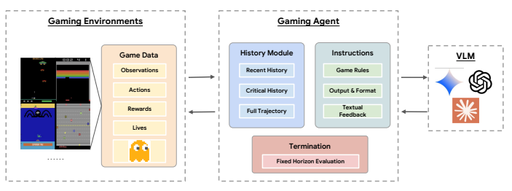
Figure 1 : Workflow of AtariBench. At each turn, the harness assembles game instructions, interac- tion history, and the current frame into a prompt; the VLM returns a thought and an action sequence, which is executed in ALE, and the resulting frames and feedback are added to the history.
Original paper · CC BY 4.0 · Mingjia Huo, Yao Fu, Bo Chang, Yaqing Wang, Dawei Zhu, Dylan Zhang, Xinyang Yi, Lichan Hong, Ed H. Chi, Hao Zhang, Jiaxi Tang · AtariBench: Evaluating Spatiotemporal Reasoning of Vision-Language Models in Atari Gameplay · Original paper figure · Extracted the figure area from page 3 of the original PDF.ALE defines 18 discrete actions, formed from horizontal, vertical and firing commands. Each game exposes only the subset it needs, so Breakout disables vertical actions. The harness gives the model the full action set and the game-specific meaning of each action in the prompt. ALE runs at 30 FPS, and the harness repeats each chosen action for three frames, which gives a 10 Hz control rate.
Sticky actions are disabled, so the same action has the same effect and the run has less randomness.
Each run lasts a fixed 30-second window, and the game resets at once after an early game over. Under life-based termination, a small survival instruction could change both episode length and reward. The fixed window standardizes the interaction budget and reduces variance, which is why the authors adopted it. The authors also say the window mitigates prompt-sensitive performance variation that makes spatial-reasoning measurement harder.
How each prompt is built
The harness covers only what closed-loop play needs: task instructions, memory, environment feedback, output parsing and termination handling. Each prompt holds a game-specific instruction block, the historical context with the current frame, and the VLM output schema. The default structured_history mode gives each prompt the current frame together with two curated memories rather than the full transcript.
The second is a reward-history buffer that keeps the most recent R clips producing non-zero reward, with R = 3 by default.
Each clip covers one completed model turn and stores the starting frame, the list of proposed actions, and the resulting frames in action order. Pairing one frame with each executed action gives the model compact temporal evidence of what it did and what followed. The recent-history buffer supports short-horizon continuity, while the reward-history buffer highlights sparse events that reveal mechanics and strategy.
The append_only mode keeps the full trajectory, the way a human-chatbot exchange does. They chose structured_history as the default because they observed repetitive action sequences under append_only prompting. After each executed action, the pipeline adds a short textual line when a salient event occurs, such as a positive or negative score or a lost life.
The model writes a short thought followed by 1 to 10 actions, and the harness validates them against the game's action map and runs them in order. An invalid output falls back to a no-op, and the raw response is kept for later analysis.
Which games separate the models
The authors check each game with three separability criteria before they trust its scores. The first criterion asks whether the best VLM setting beats random play, with a positive mean-reward gap, a pooled-SD effect size d of at least 0.8, and q below 0.05 from a two-group ANOVA. This top-bottom contrast helps when only a few models find the right behavior while the rest stay similarly weak.
The third criterion runs a one-way ANOVA across all settings, including random play, and requires q below 0.05 and η2 of at least 0.14. Benjamini–Hochberg correction is applied across the 20 games for the first and third criteria, not for the second.
The η2 value measures the fraction of observed score variance that comes from differences between settings. Under this rule, all 20 retained games are separable, with 18 strongly separable and 2 weakly separable. Figure 4 shows the per-game effect sizes and the pass matrix for these three criteria.
Figure 3 ranks each setting per game, and the authors order its rows by average rank. Raw reward values for these games are reported in Appendix B.1, so readers can check reward gaps directly. Game-specific RL agents rank first on 14 of the 16 games with public Sample Factory checkpoints, with an average rank of 1.19. That gap suggests the tested VLMs still trail specialized policies, though the comparison covers only those 16 games.
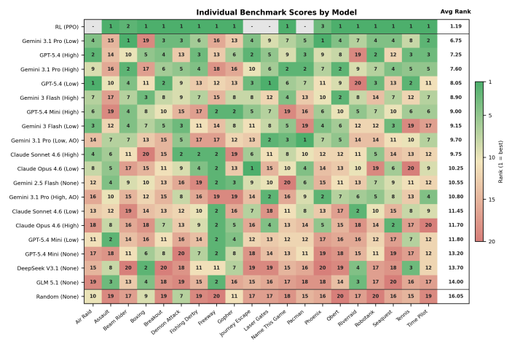
Figure 3 : Model performance ranks across the 20 AtariBench games used in the main analysis, including the standard structured-history settings and the Gemini 3.1 Pro append-only (AO) settings. Game-specific RL agents and a random-action baseline are also included. Rows are ordered by average per-game rank; raw reward values are reported in Appendix B.1.
Original paper · CC BY 4.0Diagnostic questions by skill
The diagnostic set holds 60 closed-choice question variants over ten games, and each question is asked five times. Perception accuracy ranges from 61.0% to 100.0% across model settings, motion accuracy from 47.0% to 74.0%, and decision accuracy from 48.0% to 94.0%. Since the spread is wide across models, the table separates the settings more on some skills than on others.
Each sample pairs a short frame sequence from a real benchmark trajectory with a small set of closed-choice questions. The authors split the questions into four groups: detection, spatial reasoning, motion comprehension, and decision making. Motion questions use a timestamped frame sequence, asking whether a target moves left or right or whether a line moves up-left, down-left, or stays still.
Most VLMs score higher on perception than on motion, which fits the authors' view that motion comprehension is a major challenge. For example, Gemini 2.5 Flash (off) reaches 88.0% on perception but only 51.0% on motion. Gemini 3.1 Pro (low) reaches 100.0% on perception and 69.0% on motion, which still leaves a gap. Because the motion questions use a sequence of frames, a model that reads only the latest frame can miss direction.
GPT-5.4 at low reasoning reaches 86.3% overall, the highest overall score in the table. GPT-5.4 scores 94.0% on decision questions at low reasoning, and 83.0% at high reasoning. Higher reasoning doesn't consistently help, since GPT-5.4 falls from 86.3% at low to 82.3% at high. Gemini 3 Flash moves from 83.3% at low to 81.3% at high, so the same pattern appears there.
The authors use this diagnostic set as a controlled check, separate from the gameplay-level VLM-judge analysis. They don't use the diagnostic accuracy alone to rank models, since the judge analysis covers a larger sample.
Stale text, stale frames and stalled actions
Interaction history can pull a model away from the current frame, and the paper measures this on spatial-relation errors. With only the current frame, the spatial error rate drops to 10.7%. The exact McNemar p of 0.0386 on these paired cases is the authors' evidence that history interferes with grounding. They conclude that additional interaction history is not necessarily beneficial, which doesn't follow from the paired test alone.
Text-history overreliance means a model acts on earlier feedback instead of what the current frame shows. Earlier feedback can become stale as the game evolves, which is the failure the judge detects. In the Assault example, GPT-5.4 Mini reads an earlier positive-score notice as proof that recent upward shots are hitting.
For Gemini 2.5 Flash (off) on Breakout, noop-only decisions account for 48.8% of turns under append-only prompting. Under structured-history prompting, the same setting produces noop-only decisions on 0.7% of turns. Figure 13 shows a Breakout trace where the model repeats noop actions despite new frames and feedback. Across Gemini 2.5 Flash, Gemini 2.5 Pro and Gemini 3 Flash, appending the full history usually does not beat the structured baseline on Air Raid, Pacman and Phoenix.
Does textual feedback help?
The authors removed reward, life-loss and reset notices while keeping visual history, action labels and the clip-selection mechanism. They picked one game from each of four genres: Breakout, Air Raid, Pacman and Fishing Derby. Two models were tested, Gemini 3.1 Pro (low) and Gemini 2.5 Flash (off), with ten seeds per setting. Scores are reported as mean ± SE over those ten seeds, so each cell in the ablation table carries its own spread.
On Fishing Derby the same model fell from -9.0 with feedback to -11.8 without it. The paired bootstrap 95% intervals excluded zero for these two differences, and no multiple-comparison correction was applied. Air Raid and Pacman did not separate the two conditions for this model, so the benefit shows up on two games only.
For Gemini 3.1 Pro, no significant difference appeared in any of the four games. Fishing Derby moved from -8.4 with feedback to -8.6 without it, a gap the authors treat as noise. The benefit therefore looks specific to the weaker model rather than to the stronger one.
The authors explain the Breakout effect through the reasoning traces of Gemini 2.5 Flash. Without feedback, the weaker model can stall after losing a ball, because it fails to press start to serve the next one. Figure 8 shows the life-loss notice making the reset explicit, and the model then selects start.
What the judge can and cannot say
The judge's failure counts come from a small, deliberately narrow sample, so they carry limited weight. Claude Opus 4.6 (low), GPT-5.4 (high), and Gemini 3.1 Pro (low) were studied, one run per model-game pair. For each pair the run whose score was closest to the median was selected, and five decision turns at least five turns apart were sampled.
That yields 100 turns per model, and turn selection doesn't condition on reward or life loss. The judge found 106 failures among 300 sampled turns, a rate of 35.3%. The judge is GPT-5.6-Sol with high reasoning, and model identity and reasoning-setting labels are hidden from it.
The judge's accuracy on the controlled diagnostic set is the main check on its reliability. It reached 93.0% accuracy, with 279 of 300 responses matching the labels. On that set it scored 88.0% on perception, 93.0% on motion, and 98.0% on decision, with 100 responses per category. A no-observable-failure label only means the evidence doesn't support an error; it doesn't establish optimal play.
The judge also gets post-action frames and environment feedback, which the diagnostic questions didn't provide.
The authors say attribution stays model-assisted, because the judge can misread visual evidence. An agent's stated rationale also need not fully explain its action, so the judge can't read intent cleanly. A penalty alone doesn't establish a model error, so the judge checks observable evidence first. They also don't measure the causal effect of each failure on total reward.
With only five turns from one run per pair, the results are descriptive and shouldn't rank models. They also shouldn't be used to estimate failure rates across all benchmark trajectories.
The ablation evidence behind the harness choices is narrow, which limits how far the paper's conclusions travel. The textual feedback ablation covers only four games and two models, Gemini 3.1 Pro (low) and Gemini 2.5 Flash (off). The harness is intentionally simple, and the authors state that stronger harnesses may improve absolute scores.
Paper info
- Authors
- Mingjia Huo, Yao Fu, Bo Chang, Yaqing Wang, Dawei Zhu, Dylan Zhang, Xinyang Yi, Lichan Hong, Ed H. Chi, Hao Zhang, Jiaxi Tang
- Venue
- arXiv · Preprint
- First published
- 2026-11-5
- Added
- 2026-11-9
- Updated
- 2026-11-5
- Version
- v1
- arXiv
- 2611.08755
- Category
- cs.CV · cs.AI
- Original paper terms
- CC BY 4.0
- What we show
- Paper info, commentary and permitted figures from the original paper
AI commentary is a separate explanation from the original paper and may contain errors. The original paper and figures follow each source's terms of use and any rights noted separately.
Abstract
Vision-Language Models (VLMs) have achieved strong performance on static visual understanding benchmarks, yet their ability to act in dynamic environments remains less well understood. We introduce AtariBench, a controlled benchmark that evaluates VLMs across 20 Atari 2600 games, requiring models to make sequential decisions from high-temporal-resolution gameplay streams. By decoupling fast in-game dynamics from wall-clock inference speed, AtariBench focuses on whether models can perceive rapid visual state changes, reason over spatiotemporal dynamics, and ground actions in the current observation. Our experiments reveal substantial limitations in state-of-the-art VLMs: models often fail to infer object motion and direction, exhibit brittle sequential decision-making, and over-rely on textual interaction history despite newly appended visual feedback. We further introduce a separability analysis to identify which in-game scores provide reliable signals of model competence, and use the benchmark to study how memory design and prompting strategies affect performance. Overall, AtariBench exposes a persistent gap between passive visual perception and active decision-making, providing a lightweight and rigorous testbed for developing VLMs that can reason and act in dynamic environments.
Quote from the paper
Mingjia Huo, Yao Fu, Bo Chang, Yaqing Wang, Dawei Zhu, Dylan Zhang, Xinyang Yi, Lichan Hong, Ed H. Chi, Hao Zhang, Jiaxi Tang (2026). AtariBench: Evaluating Spatiotemporal Reasoning of Vision-Language Models in Atari Gameplay. arXiv:2611.08755v1. https://arxiv.org/abs/2611.08755v1
BibTeX
@misc{huo2026ataribench,
  title = {{AtariBench: Evaluating Spatiotemporal Reasoning of Vision-Language Models in Atari Gameplay}},
  author = {Mingjia Huo and Yao Fu and Bo Chang and Yaqing Wang and Dawei Zhu and Dylan Zhang and Xinyang Yi and Lichan Hong and Ed H. Chi and Hao Zhang and Jiaxi Tang},
  year = {2026},
  eprint = {2611.08755},
  archivePrefix = {arXiv},
  url = {https://arxiv.org/abs/2611.08755v1}
}