Paper commentary
ChainFlow: Few-Step Latent Flow Matching for Speculative Decoding
ChainFlow drafts tokens by transporting hidden-state latents in one flow step
- Problem Parallel drafters predict each position alone, so they ignore dependencies between drafted tokens and need patches afterwards. Autoregressive drafters avoid this but their drafting cost grows with draft length.
- Method ChainFlow moves extrapolated latents to future states in one step.
- Results On Qwen3.5 models at matched drafter size, the 8×4 tree runs 1.39 times faster than EAGLE-3 on English in vLLM.
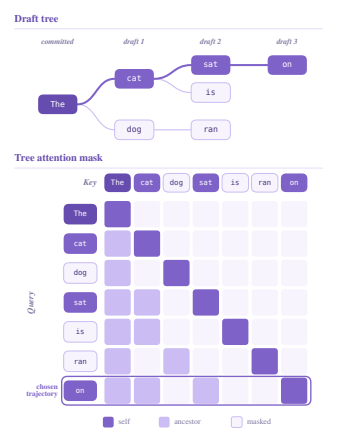
Figure 3 . Tree drafting and attention mask (illustrative). Each draft token attends only to itself and its ancestors, so all branches are verified in one target pass.
Original paper · CC BY 4.0 · Selim Aktas, Yusuf Erdem Erdem, Ahmed Zeer, Himmet Toprak Kesgin, Muzaffer Kaan Yuce, Mehmet Fatih Amasyali · ChainFlow: Few-Step Latent Flow Matching for Speculative Decoding · Original paper figure · Extracted the figure area from page 5 of the original PDF.Why parallel and sequential drafters both stall
Speculative decoding lets a cheap drafter propose tokens that the target checks in one parallel pass. Per-token latency comes out as L = (T_draft + T_verify) / τ, where τ counts the tokens accepted per cycle. A drafter therefore has to keep its own cost low while pushing τ up. Those two goals pull in different directions.
Autoregressive drafters such as EAGLE-3 condition each token on the previous one and reach high τ. Their drafting cost grows with draft length, so they must stay shallow. Drafting can take 20 to 40% of inference time.
Each round starts from mask embeddings or noise, which carry no information about the target's next states. Coherence is patched back afterwards with n-gram scores, recurrent correction heads or parent-conditioned trees.
Yet the target's own recent hidden trajectory already indicates where its next states lie. A drafter seeded from that trajectory only has to transport an estimate onto the future states. ChainFlow does this in latent space: a variational autoencoder compresses the final hidden states, and a flow network moves the next 8 latents in one Euler step.
Transporting latents from the target's trajectory
ChainFlow moves an estimate of the next latents onto the true future latents, instead of generating the whole block from noise. The drafter reads the target's hidden states as cross-attention memory, so it uses them without being embedded in the target.
A transformer VAE maps target hidden states to a latent with \(z=\mathrm{Enc}_\phi(h)\), and decodes back with \(\hat h=\mathrm{Dec}_\psi(z)\). Because the flow's cost scales with the latent width rather than the hidden size, one network design serves every target size.
For encoded context \(c\) and encoded future states \(z_1\), the rectified-flow path is \(z_s=(1-s)z_0+s z_1\) for \(s\in[0,1]\). The velocity network \(v_\theta\) regresses the constant velocity \(z_1-z_0\), giving the loss \(\mathbb{E}_s\|v_\theta(z_s,s,c)-(z_1-z_0)\|^2\). The source \(z_0\) is not Gaussian noise. Each draft position \(i\) starts from \(z^{(i)}_0=z_t+i(z_t-z_{t-1})\), a linear extrapolation of the last two context latents.
The authors argue that the recent trajectory is a good guide, which keeps the path nearly straight and the transport brief.
The velocity network is two chunk experts, each handling four consecutive draft positions, and both run on every draft. Each expert stacks 8 pre-norm blocks with 8 heads, and every block combines causal self-attention over draft positions with cross-attention to the context. The update is \(z \leftarrow z+\frac{1}{N}v_\theta(z,s,c)\), with N = 2 during training and N = 1 when served.
Because a draft costs N network evaluations regardless of K, all 8 positions come from one forward pass.
Restoring token dependence and building the draft tree
Two corrections then add dependence on the prefix, and each position's distribution is \(p_\theta(x_i\mid x_{<i})=\mathrm{softmax}(W[\hat h_i+r_\omega(x_{i-p:i-1})]+U_2U_1[x_{i-1}])\). The path head sums per-offset projections of the frozen embeddings of the last \(p=8\) parent tokens, then passes the sum through a small MLP. Its output layer starts at zero, so training begins from the marginal flow.
The Markov head is a rank-256 factorised first-order transition bias that conditions each position on the token just before it.
Scoring every candidate against the full vocabulary would dominate draft time, so the candidate set is a shortlist of 62,642 tokens from the training corpus. A first matrix product over the shortlist selects a shared set of M = 8192 candidate ids, and the corrections are evaluated only on those rows. This limits what the drafter can propose, but a missing token only lowers acceptance and never changes the target's output.
A beam search over these distributions emits either a chain of length 3 or a tree of shape \(W_b\times D\). The headline 8×4 tree keeps the best 8 nodes at each of 4 depths, which gives 32 draft nodes. The target verifies a tree in one pass under an ancestor mask, so each root-to-node path is checked as if it were a separate chain. Tree verification needs forked recurrent state for Qwen3.5's linear-attention layers and supports greedy decoding only.
The training loss is \(\mathcal{L}=0.2\mathcal{L}_{flow}+0.25\mathcal{L}_{hid}+0.3\mathcal{L}_{CE}+0.3\mathcal{L}_{cov}+0.15\mathcal{L}_{acc}+0.5\mathcal{L}_{rec}\). The acceptance term is \(-\sum_i\gamma^i\prod_{j\le i}p_\theta(x^\star_j\mid x^\star_{<j})\) with \(\gamma=0.8\), a differentiable surrogate for the expected accepted length.
Speedups over EAGLE-3 and DFlash
The ChainFlow 8×4 tree runs 1.39 times faster than EAGLE-3 and 1.11 times faster than DFlash on English at matched drafter size. The authors measured these ratios on one NVIDIA B300 with vLLM 0.31.0, at batch one and with greedy decoding. The tree leads DFlash in every domain, and its smallest margin comes on translation, at 1.39× against 1.38×.
The chain needs no engine change and reaches 1.23×, so it trails both baselines. Tree verification raises the acceptance length from 2.01 for the chain to 2.78. The authors tie these gains to predictability: code and math gain most, while translation gains least.
Scaling the target from 4B to 27B keeps tree acceptance between 2.66 and 2.78. Over the same range, the flow takes 0.30 to 0.38 ms per draft, while the autoregressive step grows from 3.1 ms to 11.2 ms. The authors attribute the larger gain at 27B to the autoregressive step growing while the flow barely changes.
At 27B, the tree reaches 3.23× on math, the highest per-domain value in Table 4. At 4B, translation is lowest at 1.39×, while math reaches 2.67×. Parallel drafters stay flat or rise along the block, whereas EAGLE-3 declines, most clearly on Turkish. On English, the chain's curve runs flat but slightly below both baselines, so its lower τ reflects a lower per-position level.
Adapting ChainFlow to new languages
ChainFlow starts each new language from the English drafter and continues training with the same objective. After adaptation, the tree speedup reaches 1.81× at 4B, 1.87× at 9B and 2.25× at 27B. German and French are added in the same sequence, and ChainFlow gains most in each new language. Figure 5 compares offline decoding speedups for ChainFlow, DFlash and EAGLE-3 across the adaptation stages.
English performance drops slightly for all three methods, so that drop doesn't separate them.
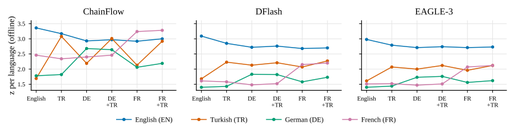
Figure 5 . Effect of language adaptation on offline decoding speedup (z) for ChainFlow (tree mode), DFlash, and EAGLE-3. Adapting to new languages improves their decoding speedups, with ChainFlow achieving the largest gains, while English performance declines slightly across all three methods.
Original paper · CC BY 4.0Adapting without replay carries a cost, because each later language pushes earlier gains out. Adding German without replay erases most of the Turkish gain. That loss is five to nine times larger than the loss seen for the baselines.
Part of the lead comes from the candidate head, which uses a per-language shortlist. The shortlist covers nearly all Turkish evaluation tokens. The baselines' frozen English vocabulary covers only about three in five of those tokens. On French, where this gap is smallest, the gain is still the largest. So the vocabulary gap doesn't account for the whole lead.
What the design ablations isolate
These ablations use the Qwen3.5-0.8B target, K = 4 draft positions and GSM8K, a smaller setting than the main results. A flow with context only reaches τ 2.68 at speedup 0.96×, and adding the Markov head raises τ to 2.93 with speedup 1.01×. The autoregressive drafter reaches τ 3.21 but only 1.00× speedup in the same table. The authors read this as feedback closing part of the gap to an autoregressive drafter inside one flow pass.
Four experts reach a validation plateau of about 0.99 and two experts about 1.00, relative to the 2×4 setting. Two experts reach 90% of the plateau in about 85 epochs and four in about 80, so the authors kept two experts.
Starting from noise, the drafter needs about 57 epochs to reach 90% of the plateau, while extrapolation needs about 20. At one Euler step, noise gives τ 1.97, repeating the last latent gives 2.58 and extrapolation gives 2.49. At two steps, noise rises to 2.55 and extrapolation gives 2.53, so the last two sources don't separate at this scale.
Figure 6 plots training loss and validation expected acceptance for the three initializations.
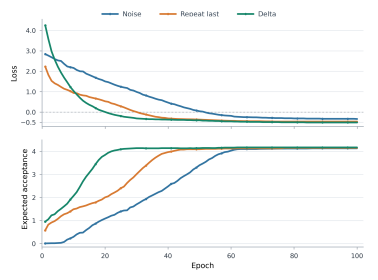
Figure 6 . Training loss (top) and validation expected acceptance (bottom) across epochs for three initializations: noise, last-latent repetition, and trajectory extrapolation (Delta).
Original paper · CC BY 4.0In the capacity sweeps, wider experts improve acceptance, a larger FFN multiplier adds little, and longer contexts lower acceptance. Wider or deeper trees raise τ, but every extra node costs search and verification time, so the authors favour the compact 8×4 tree.
Where the speedup narrows under concurrency
Concurrency is the real test of whether speculation still pays when many requests share one target. Table 9 reports output tokens per second relative to autoregressive decoding at Qwen3.5-4B for 1, 4, 8, 16, 64 and 128 concurrent requests. The ChainFlow tree starts at 1.85 with one request, then drops to 1.12 at four and 0.94 at eight. At 128 requests, the ChainFlow tree reaches 0.45, below plain autoregressive decoding.
EAGLE-3 and DFlash verify only K+1 positions per request, so they keep a gain at every level. At 128 requests, EAGLE-3 reaches 1.06 and DFlash reaches 1.14.
Beyond that batch, plain autoregressive decoding is faster. The main results use batch one unless stated, so this batch cutoff is a separate test.
Limits and open questions
The VAE latent is a trade-off, because a compact latent keeps the flow cheap to train and run. That compact latent may lose information the drafter needs to rebuild the target's hidden states. Such a loss would cap acceptance, so the compression level directly limits the speedup. A larger latent could help, but it would slow drafting, since the flow's cost follows the latent width.
The authors haven't characterised where that balance lies.
All experiments use Qwen3.5 targets, whose hybrid attention needed engine-specific state handling. Transfer to other model families is therefore untested, and the authors list it as open. Tree verification needs forked recurrent state for the linear-attention layers of Qwen3.5. That same path supports greedy decoding only, so sampled decoding falls outside the tree setting.
In both chain and tree modes, a token is emitted only when the target's own logits select it, up to fp16 ties.
Each serving configuration fixes its draft length and tree topology. The decode-batch cutoff turns speculation off under load, but it doesn't change how many tokens are proposed. At Qwen3.5-4B, the ChainFlow tree speedup falls from 1.85 at one request to 0.94 at eight. Budget-aware methods such as BASTION and EAGLE-4 adapt draft trees to confidence or execution cost, and the authors leave adding that to ChainFlow as future work.
The served numbers come from one NVIDIA B300 GPU running vLLM 0.31.0 with greedy decoding. The headline gains of 39% over EAGLE-3 and 11% over DFlash hold at matched drafter size and training data.
Paper info
- Authors
- Selim Aktas, Yusuf Erdem Erdem, Ahmed Zeer, Himmet Toprak Kesgin, Muzaffer Kaan Yuce, Mehmet Fatih Amasyali
- Venue
- arXiv · Preprint
- First published
- 2026-11-5
- Added
- 2026-11-9
- Updated
- 2026-11-5
- Version
- v1
- arXiv
- 2611.08669
- Category
- cs.AI · cs.CL
- Original paper terms
- CC BY 4.0
- What we show
- Paper info, commentary and permitted figures from the original paper
AI commentary is a separate explanation from the original paper and may contain errors. The original paper and figures follow each source's terms of use and any rights noted separately.
Abstract
Speculative decoding has become a standard way to accelerate LLM inference: a lightweight drafter proposes tokens that the target verifies in one parallel pass. Existing drafters face trade-offs that limits their speedups: autoregressive drafters generate tokens one at a time, so drafting cost grows with draft length, while diffusion drafters generate tokens in parallel but predict each position independently, ignoring inter-token dependencies. We introduce ChainFlow, a new speculative decoding paradigm and the first flow-matching drafter conditioned on the target's hidden states. ChainFlow treats drafting as a short transport over hidden states, needing one or two flow steps instead of the many denoising steps of generation from noise. A variational autoencoder compresses these states so drafting cost barely grows with target size, lightweight feedback heads restore inter-token dependencies, and tree drafting raises acceptance. On Qwen3.5 models, at matched drafter size and training data, ChainFlow outperforms EAGLE-3 and DFlash in vLLM by 39% and 11%, respectively. These gains further widen as drafters are adapted to new languages sequentially. Our ablations cover drafter design and concurrent serving, and we open-source our code and drafter models.
Quote from the paper
Selim Aktas, Yusuf Erdem Erdem, Ahmed Zeer, Himmet Toprak Kesgin, Muzaffer Kaan Yuce, Mehmet Fatih Amasyali (2026). ChainFlow: Few-Step Latent Flow Matching for Speculative Decoding. arXiv:2611.08669v1. https://arxiv.org/abs/2611.08669v1
BibTeX
@misc{aktas2026chainflow,
  title = {{ChainFlow: Few-Step Latent Flow Matching for Speculative Decoding}},
  author = {Selim Aktas and Yusuf Erdem Erdem and Ahmed Zeer and Himmet Toprak Kesgin and Muzaffer Kaan Yuce and Mehmet Fatih Amasyali},
  year = {2026},
  eprint = {2611.08669},
  archivePrefix = {arXiv},
  url = {https://arxiv.org/abs/2611.08669v1}
}