Paper commentary
Training Stability under Adaptive Curricula
Weight clipping and HL-Gauss keep RL students trainable under adaptive curricula
- Problem Adaptive curricula can keep prioritizing levels the learner can no longer learn from. Prior work studied how curricula are built, but not whether the student stays trainable under the distributions they produce.
- Method WC+HL pairs weight clipping, which limits parameter growth, with HL-Gauss, which predicts values as categories instead of a single scalar. The curriculum rule stays unchanged.
- Results On Small, the baseline's return declined past two billion steps while WC+HL kept improving through five billion interactions.
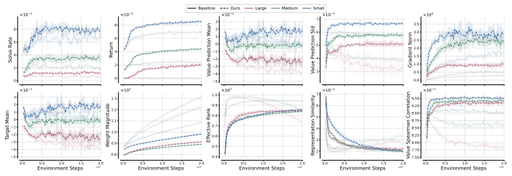
Figure 6 :Training stabilization improves performance and mitigates learner degradation. Across environment complexities, WC+HL controls parameter growth while maintaining strong learning signals, preserves value–return ordering, and mitigates late representation degradation in the more challenging settings. These changes accompany consistently higher solve rates and returns.
Original paper · CC BY 4.0 · Johan Obando-Ceron, Walter Mayor, Michael Dennis, Aaron Courville, Pablo Samuel Castro · Training Stability under Adaptive Curricula · Original paper figure · Extracted the figure area from page 6 of the original PDF.Why a student's trainability matters
Unsupervised Environment Design trains deep RL agents on environment distributions that change throughout training. Most work in this area has concentrated on building better curricula. This paper asks the complementary question: does the student stay trainable under the distributions those curricula produce? The question matters because adaptive UED closes a feedback loop, in which the student's updates decide which environments come next.
Deep RL is already non-stationary, since policy updates change the state–action occupancy distribution. Bootstrapped targets also move, because value estimates and, in actor–critic methods, the policy keep evolving. PPO's clipped surrogate limits large likelihood-ratio changes, but it doesn't stabilize the critic targets or the network representations across optimization phases.
The curriculum update pk+1 = C(pk, Hk+1) draws on the training history the student generates, so the student shapes its own future data.
The authors compare PLR, which adapts level selection with student-dependent priorities, against domain randomization, which samples from a fixed distribution. Both methods run for 2B environment steps, with 5 seeds per method, and the authors report the interquartile mean. That gap doesn't show that adaptive replay causes degradation, only that higher return and weaker diagnostics can coexist.
The curriculum may keep assigning high priority to levels after the student's ability to benefit from them has declined. The authors therefore propose learner trainability as a design principle that complements curriculum construction in UED.
Stabilizing the learner while the curriculum stays fixed
The Stabilized learner keeps the PLR curriculum rule unchanged and changes only how the student is optimized. Weight clipping (WC) constrains parameter magnitudes, which targets the parameter growth seen during training. Together, the two interventions form WC+HL, which the authors adopt as a practical configuration rather than the global optimum.
They didn't search for an exhaustive stabilization recipe, only for whether specific pathologies can be mitigated.
The student is a PPO actor-critic, and its critic regresses trajectory-based value targets with a squared loss. Each iteration, the student update maps the current parameters and batch to new parameters, while the curriculum update maps its distribution and training history to a new distribution. Because the curriculum reads student-generated statistics, a change in the learner alters the next batch of levels.
WC+HL keeps parameter growth under control across all three complexity levels, while gradient norms stay substantial. The intervention doesn't stabilize the critic by shrinking its outputs, and prediction dispersion stays closer to its starting level. Rank correlation between predicted values and returns stays stronger and more stable for WC+HL in Small, Medium, and Large.
In Large and Medium, the baseline's feature alignment rises late in training, whereas WC+HL keeps similarity lower. WC+HL also mitigates the late decline in effective rank that the baseline shows in Large.
Under the same PLR rule, WC+HL produces lower PVL scores across complexity levels, because replay priorities come from student value statistics. Learnability changes non-uniformly: it stays broadly comparable in Small, rises in Medium, and falls late in Large. Episode lengths become shorter, particularly in Small and Medium, while shape counts remain similar.
Where PLR's learner and priorities drift as complexity grows
Performance drops as complexity rises, while parameter magnitudes grow in every configuration and most in Large. Gradient norms also rise with complexity, but they are largest in Small, so gradient size alone doesn't explain the performance ordering.
The critic is the clearer signal: rank correlation between value predictions and returns weakens most in Large. The authors read these as one coherent pattern of degradation, which doesn't identify a single cause.
Learnability is defined as \(L_{\text{learn}}(\ell) = p_\ell(1-p_\ell)\), where \(p_\ell\) is the estimated solve probability, so it peaks at 0.5. Positive Value Loss, by contrast, accumulates positive value-prediction errors and acts as a regret proxy that PLR uses for replay. Mean learnability is highest in Small, while PVL stays elevated in Medium and especially Large.
This mismatch is clearest in Large, where PLR keeps high priority despite low learnability and solve rate. The authors link this to the regret stagnation reported by Beukman et al. (2026), but they don't establish irreducible regret in Kinetix.
Which interventions help under PLR
The authors screened interventions aimed at parameter scale, value-target sensitivity, and representation quality, without seeking an exhaustive recipe. Weight decay and HL-Gauss also provided improvements over baseline in that initial screen. Other interventions gave smaller or less consistent gains, so regularization alone didn't guarantee better learning.
WC constrains parameter magnitudes, which directly targets the parameter growth seen during training, while HL replaces scalar value regression with categorical prediction.
The factorial ablation shows that the two interventions respond differently to environment complexity. On Small, both interventions improve performance individually, and WC+HL achieves the highest final sampled return with strong solve rates. In Large, WC produces a substantial improvement in sampled return over the baseline, while HL alone provides more modest gains.
WC+HL achieves similarly strong performance to WC and substantially exceeds both the baseline and HL alone. The authors read these findings as a sign that controlling parameter growth matters most in the more challenging configurations.
Adding HL doesn't consistently improve upon WC alone, so the authors don't claim a consistent synergistic benefit. WC+HL stays strong across Small, Medium, and Large without substantial degradation relative to WC. The authors selected WC+HL as a practical stabilization configuration, and they don't claim it is globally optimal. Next, the authors test whether the gains come with better learner diagnostics and whether they generalize beyond PLR.
How stabilization changes the critic and representations
WC+HL doesn't stabilize the critic by simply shrinking its outputs, and the paper checks this directly against the value predictions.
The more informative check compares predicted values with empirical returns through rank correlation. So the critic keeps the relative ordering of outcomes better under WC+HL throughout training.
Representation dynamics change as well, although the effect differs by environment complexity. WC+HL mitigates this late-training decline and keeps effective rank more stable throughout training. In Large and Medium, the baseline's feature alignment rises in later training, while WC+HL keeps representation similarity lower.
Effective rank doesn't track returns across configurations. In Small and Medium, WC+HL reaches higher returns while showing lower effective rank than the baseline near the end of training. So higher effective rank alone doesn't consistently mean better performance. The authors argue that how representation structure evolves over training may be more telling than rank considered in isolation.
How the curriculum changes under the same PLR rule
WC+HL lowers the PVL scores across complexity levels, even though the PLR rule stays exactly the same. PLR computes its replay priorities from student-dependent value statistics, so the same rule sees different signals from a more trainable student. As a result, the replay order shifts toward different levels once the learner changes.
Learnability doesn't move uniformly across complexity levels. It stays broadly comparable in Small, increases in Medium, and decreases late in Large. Stabilization therefore doesn't simply push the curriculum toward uniformly more learnable levels.
The realized environments keep broadly comparable structural complexity under stabilization. Shape counts remain similar, and joint counts are comparable or higher. Thruster counts change only moderately, while episode lengths become shorter, particularly in Small and Medium.
The authors read this as stabilization making the generated levels more useful as a learning signal for the student. They don't read it as the levels becoming structurally simpler, since the measured structure stays comparable. The takeaway is that learner-side changes reshape the curriculum even when the curriculum rule is unchanged.
Training longer and with fewer parallel environments
Extra interaction only helps while the learner turns experience into better behavior, so the authors extended PLR on Small from two to five billion interactions. Past the original two-billion-step budget, the baseline's return declines while its weight magnitude keeps rising. Its value-outcome correspondence stays weak, and its effective rank deteriorates over the same extra training.
The Stabilized learner keeps its solve rate and keeps gaining return through five billion interactions. It also preserves value ordering and representation rank, so the gap between the two learners widens past two billion steps.
Recent work reports that larger PPO rollout batches can prevent a learning stagnation in open-ended Kinetix training. Performance, value ordering, and effective rank improve as parallelism rises up to the default 2048 environments. Moving to 4096 environments adds little additional gain. With only 128 environments, WC+HL substantially raises solve rate and return on Small over the baseline.
It also keeps controlling parameter growth and representation degradation at that low parallelism.
Rollout scaling and learner stabilization look complementary, because the gains from parallelism eventually saturate.
Transfer across mechanisms, complexity and distribution shifts
The authors tested WC+HL beyond PLR by applying it to domain randomization, SFL and ACCEL. These mechanisms build their training distributions differently, so the test checks whether the gain depends on PLR's replay rule. WC+HL yields consistent gains in solve rate and return across these mechanisms and Kinetix complexity levels. The gains are not specific to PLR's replay rule, although their magnitude varies across curriculum mechanisms.
The authors also checked transfer across task complexity, using agents trained on Small, Medium or Large environments. Figure 11 shows zero-shot sampled return for every training and evaluation pairing.
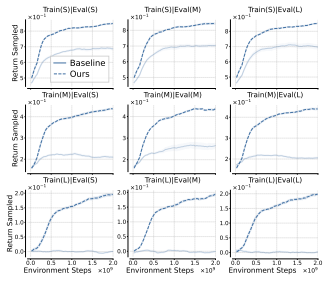
Figure 11 :Generalization to randomly gen- erated tasks.Zero-shot sampled return across training and evaluation complexities.
Original paper · CC BY 4.0The final test uses sequential distribution shifts, where PLR is trained on Small, then Medium, then Small. The optimizer state and PLR buffer are kept across transitions for both learners. Performance is measured continuously on the Medium human-designed holdout set. Both learners use the same replay and retention protocol, so extra rehearsal doesn't explain the difference.
The authors interpret this as improved retention, not a full continual-learning characterization.
Limitations and open questions
The evidence covers Kinetix and PPO only, so the findings don't yet reach other environments or policy-gradient methods. The authors chose WC+HL as a practical stabilization configuration, and they don't claim it is globally optimal. Weight clipping and HL-Gauss are not claimed to be uniquely effective, so other interventions could match or beat them.
The ablation found that adding HL doesn't consistently improve upon WC alone.
The retention test uses only the Medium holdout set, so it can't separate forgetting, interference and loss of plasticity. The authors interpret that experiment as evidence of improved retention, not as a full continual-learning characterization. Parameter growth and representation structure accompany the gains, but the results don't establish that they cause them.
Adaptive stabilization and broader validation remain open directions for future work.
Paper info
- Authors
- Johan Obando-Ceron, Walter Mayor, Michael Dennis, Aaron Courville, Pablo Samuel Castro
- Venue
- arXiv · Preprint
- First published
- 2026-11-5
- Added
- 2026-11-9
- Updated
- 2026-11-5
- Version
- v1
- arXiv
- 2611.08787
- Category
- cs.LG · cs.AI
- Original paper terms
- CC BY 4.0
- What we show
- Paper info, commentary and permitted figures from the original paper
AI commentary is a separate explanation from the original paper and may contain errors. The original paper and figures follow each source's terms of use and any rights noted separately.
Abstract
Unsupervised Environment Design (UED) approaches train reinforcement learning (RL) agents on diverse curricula that may evolve with their capabilities. While prior work has largely focused on how these curricula are constructed, we study whether their students remain trainable under the resulting distributions. Across multiple UED mechanisms, environment complexities, and extended training horizons, we identify recurring learner-side pathologies, including parameter growth, degraded value--outcome ordering, and loss of representational diversity, that accompany stagnation and performance degradation. These findings connect limitations in UED to optimization failures previously identified in conventional deep RL, while showing how adaptive curricula couple the learner's optimization state to its future training distribution. Controlled interventions show that mitigating selected pathologies improves learning. Stabilizing the learner improves long-horizon performance and zero-shot generalization without changing the curriculum rule or increasing environment interaction. Our results establish learner trainability as a complementary design principle for UED. Effective curricula require students that remain capable of learning from the distributions they produce.
Quote from the paper
Johan Obando-Ceron, Walter Mayor, Michael Dennis, Aaron Courville, Pablo Samuel Castro (2026). Training Stability under Adaptive Curricula. arXiv:2611.08787v1. https://arxiv.org/abs/2611.08787v1
BibTeX
@misc{obandoceron2026training,
  title = {{Training Stability under Adaptive Curricula}},
  author = {Johan Obando-Ceron and Walter Mayor and Michael Dennis and Aaron Courville and Pablo Samuel Castro},
  year = {2026},
  eprint = {2611.08787},
  archivePrefix = {arXiv},
  url = {https://arxiv.org/abs/2611.08787v1}
}