Paper commentary
Flexible Intensities Matter: A Comprehensive Re-evaluation of Hawkes Processes and Neural Temporal Point Processes
Flexible Hawkes processes close the gap with neural temporal point process models
- Problem Earlier claims that neural TPPs beat Hawkes processes compared flexible neural models with Hawkes processes in their most restricted form. Those Hawkes models used constant baselines and fixed exponential kernels, so the comparison was lopsided.
- Method The authors give Hawkes processes spline baselines, spline kernels and inhibition. They then compare these models with neural TPPs on five benchmarks and two medical datasets.
- Results On UK Biobank, Spline/Spline Hawkes trails NeuralSplineTPP by 0.07 nats in joint log-likelihood. On MIMIC-IV, neural TPPs keep a lead of 0.45 nats.
Why the neural-versus-Hawkes gap looked large
Earlier comparisons reported that neural TPPs beat Hawkes baselines, sometimes by substantial margins. The neural models in these comparisons had far more flexible components, so the contest was lopsided. Those modeling choices severely limit the expressiveness of the Hawkes process.
The evaluation also covered only a narrow range of domains and left out health data entirely. That matters because event histories such as diagnoses and procedures are exactly the kind of sequence TPPs are meant to model. The authors therefore redid the comparison under one protocol, on five standard benchmark datasets and two medical tasks.
The medical tasks are disease histories from the UK Biobank, with 1,257 disease types. The second medical task uses ICU records from MIMIC-IV, with 117 event types.
The authors also note that Hawkes baselines were benchmarked too narrowly in prior work. Bosser and Ben Taieb [2023] and Lin et al. [2025] did not consider flexible Hawkes kernels.
Giving Hawkes processes flexible parts
The Hawkes model keeps its additive structure, but its fixed pieces are replaced by learned splines. A Hawkes intensity is a baseline plus the sum of kernel responses from all past events. The classical version uses a constant baseline and an exponential kernel, which allows an analytical cumulative intensity. The spline version uses a spline baseline that stays constant beyond its last knot.
The spline Hawkes variants therefore keep the cumulative intensity in closed form while gaining flexibility.
The inhibitive variant lets past events suppress a type, which a non-negative kernel cannot do. The authors tie this ability to the Taxi data, whose types alternate between pick-up and drop-off. On the neural side, a history encoder maps the history to a context vector, and an output head projects it to an intensity. Encoders include recurrent networks such as RMTPP and NHP, and attention-based architectures such as THP, SAHP and AttNHP.
NeuralSplineTPP keeps a Transformer encoder with a spline intensity head, so it retains a closed-form cumulative intensity.
Exact sampling inverts the cumulative intensity against a unit exponential draw. Inversion needs no upper bound on the intensity, unlike Ogata's thinning, which is unbiased whenever the cumulative intensity can be evaluated. The intensity-free mixture model, IntensityFree, serves as a density-based baseline instead.
Splitting the log-likelihood into time and type
The likelihood of an observed sequence sums the log intensity at each observed event and subtracts the integrated total intensity over the window. Maximizing it pushes intensity up at the observed event times while keeping it low everywhere else. The integral term acts as a normalizer, penalizing high intensity at all times rather than only at events.
The per-event score can be written as a product of a time density and a conditional type probability.
The time term log p(t) uses the next-event time density, which sums the joint density over all event types. That marginal density has the familiar form of a hazard times a survival term, so it depends on the cumulative intensity. The type term log p(d|t) uses the ratio of one type's intensity to the total intensity at the observed time.
The authors call the two terms log p(t) and log p(d|t), and they answer different questions. The time term asks when the next event happens, while the type term asks which type it is. Separating them lets the study ask whether extra flexibility helps timing, typing, or both. The authors use this split as the lens for every benchmark result that follows.
Benchmark results and the knot sweep
On the five standard datasets, the best Hawkes variant closes the gap to the softplus-headed neural TPPs. Once Hawkes processes get spline baselines, spline kernels and inhibition, they match or beat THP, SAHP and NHP in joint log-likelihood on all five datasets. Inhib. Spline/Spline Hawkes is the best model on Retweet, with a joint log-likelihood of −2.09.
On StackOverflow and Taobao, Spline/Spline Hawkes ties with NeuralSplineTPP at the displayed precision.
NeuralSplineTPP outperforms THP, SAHP, NeuralConstTPP and NHP by a considerable margin. It ties with SAHP on StackOverflow, so the spline head looks like the decisive factor among the Transformer models. IntensityFree falls behind on Retweet, where it reaches −4.45 joint log-likelihood. Inhibition helped on Taxi, Retweet and Amazon, but it hurt on Taobao.
The authors attribute the Taobao drop to harder optimization of the numerically integrated inhibitive models.
The knot sweep raised the time term by 0.9 to 1.6 nats on Retweet and Amazon as K grew from 10 to 400. This held for both NeuralSplineTPP and Spline/Spline Hawkes, while the time term stayed flat on the other datasets. The type term did not improve on any dataset in that sweep, so extra flexibility mainly sharpened the timing of events. Scoring by the probability of the recorded time bin removes the gain on Retweet, because its integer time stamps let a continuous density place narrow peaks on the grid.
The sweep used 20,000 training steps in runs separate from the reported ones, so its values differ from the main tables.
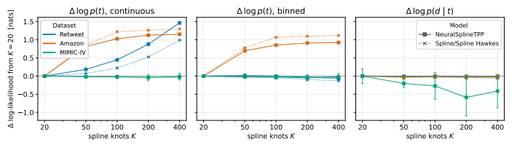
Figure 2 : Flexibility acts on the time density. Change in per-event test log-likelihood (nats) vs. spline knot count K (relative to K=20), forNeuralSplineTPP(intensity-head knots) andSpline/Spline Hawkes(kernel knots), on three datasets (all datasets in Tables 22 and 19).Left:the continuous time term logp(t) increases with K on Retweet and Amazon.Middle:scored by the probability of the recorded time bin (Retweet: 1, Amazon: 0.01, MIMIC-IV: 1 min), it increases only on Amazon. Right:the type-conditional termlogp(d|t)does not improve withK.
Original paper · CC BY 4.0 · Hendrik Mehrtens, Florian Buettner, Oliver Stegle · Flexible Intensities Matter: A Comprehensive Re-evaluation of Hawkes Processes and Neural Temporal Point Processes · Original paper figure · Extracted the figure area from page 9 of the original PDF.Disease histories and ICU stays
On UK Biobank, Spline/Spline Hawkes trails NeuralSplineTPP by 0.07 nats in joint log-likelihood and by 0.08 percentage points in time-conditional accuracy. The UKB task is a simplified setting that leaves out the sex and lifestyle covariates, and it evaluates only next-event likelihood and accuracy. The authors did not evaluate inhibitive Hawkes processes on UKB, and NHP did not converge there.
Flexible Hawkes processes therefore stay a strong and interpretable baseline on this data, though the authors don't evaluate long-horizon generation.
On MIMIC-IV, the picture changes: NeuralSplineTPP leads the best Hawkes variant by 0.45 nats in joint log-likelihood. NeuralSplineTPP reaches a time-conditional accuracy of 38.3%, compared to 33.5% for Inhib. Spline/Spline Hawkes, the most accurate Hawkes variant. THP and NeuralSplineTPP reach the best type terms, at −2.36 and −2.39. On the other events, NeuralSplineTPP and Spline/Spline Hawkes differ by only 0.02 nats in the type term, and Spline/Spline Hawkes has the higher time term.
A non-stationary Spline/Spline Hawkes lowers joint log-likelihood by 0.12 nats at best. That variant widens the gap to NeuralSplineTPP to 0.57 nats, from 0.45 nats. So within-stay drift doesn't explain the MIMIC-IV lead.
Limits of the evidence
The study covers Poisson and Hawkes processes and the listed neural TPPs, while Cox-type, flow, diffusion and state-space models are out of scope. Limitations also include the scope of the evaluation: the authors evaluate autoregressive next-event prediction only, not long-horizon simulation or planning. Calibration is checked for only four models with a closed-form cumulative intensity.
The conclusions rest on seven datasets, and the authors expect other domains could favour neural models more strongly. Their aim is a fair comparison of TPP families rather than state-of-the-art forecasting for electronic health records.
On UK Biobank, the authors did not evaluate inhibitive Hawkes processes, so rare inhibitive effects remain possible there. The task also leaves out the sex and lifestyle covariates, so the small gap is read as a dataset-level result only. The authors therefore cannot rule out rare inhibitive effects in the disease histories.
Integer time stamps on Retweet let a continuous density reach an unbounded time likelihood, so dequantization or discrete-time models are needed. Simultaneous events remain a problem for continuous-time TPP models, which require discretized time, set-valued marks, or a tie-breaking strategy. The authors dequantize simultaneous events and don't model them as sets.
RMSE and the marginal metrics need numerical integration over the next-event time, and RMSE is sensitive to this on heavy-tailed datasets such as Retweet. Knot placement may also favour the neural model, because NeuralSplineTPP places its knots on time since the last event while the Hawkes spline kernels are anchored at each trigger.
Access restrictions mean the authors release neither the UKB-derived data nor the UKB-trained models and logs. On MIMIC-IV, the authors use only a subset of the values, so the task is an evaluation of TPP modeling rather than a medically relevant forecasting model. Additional markers such as device readouts and laboratory values would need more specialized models, which the authors left out of scope.
Paper info
- Authors
- Hendrik Mehrtens, Florian Buettner, Oliver Stegle
- Venue
- arXiv · Preprint
- First published
- 2026-11-4
- Added
- 2026-11-6
- Updated
- 2026-11-4
- Version
- v1
- arXiv
- 2611.06348
- Category
- cs.LG · stat.ML
- Original paper terms
- CC BY 4.0
- What we show
- Paper info, commentary and permitted figures from the original paper
AI commentary is a separate explanation from the original paper and may contain errors. The original paper and figures follow each source's terms of use and any rights noted separately.
Abstract
Temporal point processes (TPPs) are the canonical framework for event sequence data, with applications spanning seismology, social media, and electronic health records. Recently, neural TPPs have been reported to substantially outperform classical TPPs, such as Hawkes processes, but these comparisons pitted flexible neural models against Hawkes processes in their most restricted form, and did not consider large-scale medical data. Here, we revisit this comparison through a systematic evaluation of Poisson and Hawkes processes of increasing flexibility against neural TPPs, on five established benchmark datasets and on two large-scale medical evaluation tasks derived from UK Biobank disease histories and MIMIC-IV ICU records, under autoregressive next-event prediction. First, the previously reported gap between Hawkes processes and neural TPPs largely disappears once Hawkes processes are equipped with flexible, learnable baselines and kernels. Second, the flexibility of the intensity parametrization also limits prior neural TPPs: a Transformer with a spline-based intensity head outperforms previous intensity-based neural TPPs and is on par with the intensity-free model. Decomposing the log-likelihood into a time term $\log p(t)$ and a type term $\log p(d \mid t)$, we find that this flexibility advantage lies almost entirely in the time density: more flexibility does not improve the type term. On these benchmarks, the gains of neural TPPs thus lie mostly in modeling when events occur, not which. Third, our results underscore the value of complex datasets for evaluating TPPs: only on the MIMIC-IV ICU records do neural TPPs retain an advantage in the type term. Our results inform both future method development and model choice. We release our framework, TorchPP, as an open-source package with consistent implementations of classical and neural TPPs.
Quote from the paper
Hendrik Mehrtens, Florian Buettner, Oliver Stegle (2026). Flexible Intensities Matter: A Comprehensive Re-evaluation of Hawkes Processes and Neural Temporal Point Processes. arXiv:2611.06348v1. https://arxiv.org/abs/2611.06348v1
BibTeX
@misc{mehrtens2026flexible,
  title = {{Flexible Intensities Matter: A Comprehensive Re-evaluation of Hawkes Processes and Neural Temporal Point Processes}},
  author = {Hendrik Mehrtens and Florian Buettner and Oliver Stegle},
  year = {2026},
  eprint = {2611.06348},
  archivePrefix = {arXiv},
  url = {https://arxiv.org/abs/2611.06348v1}
}