Paper commentary
Evidence-Aligned Benchmarking and Learning for Medical Video Language Models
MedEvidU audits medical video benchmarks and trains models to watch the video
- Problem Medical video models can score well on benchmarks without using the video. Clip position and leaky prompts or metrics reveal answers, and a fine-tuned model memorizes its training questions.
- Method MedEvidU audits benchmarks and gives each queried frame its own tokens. Label-matched question resampling adds unseen questions about the same recordings, in a final epoch and in reinforcement learning.
- Results The 4B model's grounding IoU rose from 30.4 to 44.4, above a supervised 27B model. At an unseen hospital, instrument grounding rose from 33.9 to 72.5.
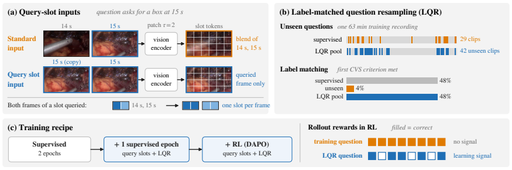
Figure 2 .Evidence-aligned learning.(a) Query-slot inputs fill the queried frame’s token slot with that frame; a slot with two queried frames is split. (b) LQR draws unseen questions from the training recordings and matches their label distribution. (c) Both enter the final supervised epoch and reinforcement learning.
Original paper · CC BY 4.0 · Zhongpai Gao, Anwesa Choudhuri, Meng Zheng, Benjamin Planche, Terrence Chen, Ziyan Wu · Evidence-Aligned Benchmarking and Learning for Medical Video Language Models · Original paper figure · Extracted the figure area from page 5 of the original PDF.Benchmarks that a video-free answer can pass
A benchmark score can rise without the model using the video at all, because prompts and metrics leak the answer. Clip position alone gave the correct MultiBypass140 step in 37% of questions, compared to 7% for the most frequent step. Some prompts also list only a few candidate labels, which rules out most wrong answers without any video.
On the metric side, a constant never-met answer scored 66.4 on the standard CVS trajectory metric, above every trained model. Temporal F1 gives full credit to an empty answer for the 30% of temporal questions with empty references, so answering none scored 35.9 on the curated test.
The authors respond with MedVidBench-v2, which covers 34 tasks from 18 datasets and 2,676 recordings. They audit each prompt and metric by checking whether an answer given without video scores near a trained model. Presence and localization are reported separately, and trajectories are scored with class-balanced accuracy. The blind-window test cuts each test recording into fixed-length windows from a random offset, without looking at where events lie.
That test contains 8,292 questions.
Why a queried frame shares tokens with its neighbor
The authors' fix is a query-slot input: the other frame of the slot is replaced with a copy of the queried frame, so the slot encodes that frame alone. The encoder then treats the slot the way it would a still image, which is the input the question is about.
If both frames of a slot are queried, the slot is split into two, each holding one frame under its own timestamp, which affects 13% of grounding questions. The authors apply the rule to grounding, frame-level CVS and scene-graph questions, and leave motion questions with their frame pairs, since the pair shows the motion.
Grounding also gets twice the pixel budget per frame, and the authors analyse this separately from the slot change. The authors expect the change to matter for encoders that merge consecutive frames, while encoders that embed frames separately should not need it.
Why memorized training questions stop teaching
After fine-tuning, the model answered 95% of its training multiple-choice questions correctly, compared to 76% of unseen questions about the same recordings. In RL, a memorized question tends to earn the same reward for every sampled answer, so it gives no gradient. Only 14% of training questions produced both correct and incorrect sampled answers, compared to 28% of unseen questions.
DAPO skips questions whose sampled answers all earn the same reward, but it can't make new informative questions. LQR supplies those questions from the training recordings, using the same tasks and label vocabulary. Two sources feed the pool: unsampled questions from the training recordings, and re-windowed clips made by the benchmark's question generators at new time offsets.
Unseen questions have different answer statistics, so LQR has to keep the training answer distribution in place.
Three training stages and the RL step
The recipe starts from Qwen3.5-4B, whose language-model weights are fine-tuned for two epochs on MedVidBench-v2 while the vision encoder stays frozen. A 27B model follows the same stages.
RL then uses rewards computed by the benchmark's own parser and metric for each task. Because the rewards are the audited metrics, the shortcuts from the audit earn no reward.
Answers to questions with rare reference classes get a larger weight in the update, to offset class imbalance.
Grounding and blind-window gains over the SFT baseline
The full 4B recipe raised grounding IoU from 30.4 to 44.4 over the SFT baseline trained for the same three epochs. Timed-caption F1 rose by 2.6, and caption quality went from 73.9 to 75.0. Choice, set, ordered and component scores stayed within two points of the baseline, so the localization gain didn't come at a recognition cost.
On blind windows, presence rose from 81.2 to 86.7 and localization F1 from 49.6 to 57.7. The 4B model scored 44.4 grounding IoU, compared to 42.7 for the 27B SFT baseline, with an interval of 0.4 to 2.8. Its blind-window presence was 86.7, compared to 83.1 for the 27B baseline. Compared to the MedGRPO recipe on the 4B SFT baseline, the full recipe gained 11.8 grounding points.
On the original MedVidBench test, whose prompts the model never saw, the final 4B model scored 31.8 grounding IoU, compared to 24.4 for the backbone trained on MedVidBench.
Which change produces the grounding gain
At the standard pixel budget, query-slot inputs raised grounding by 6.4 points over the baseline, with an interval of 5.6 to 7.1. Using them only at inference still added 3.3 points, so part of the gain needs no training. Doubling pixels with standard inputs added 1.0 grounding IoU, whereas with slots the same doubling added 2.1. The authors read the gain as coming from showing the queried frame, not from more pixels.
Removing the clip and keeping only the queried frames improved the SFT baseline by 2.2 points on the curated test. The frame-only baseline scored 32.7 on the curated test, compared to 41.5 for the slot-trained model. Keeping the clip adds 1.8 points for the final model, so the surrounding video still helps once the queried frame is in place.
Swapping in the LQR pool in the third epoch added 2.3 temporal F1 points and 2.1 PhaKIR grounding points, and raised blind-window presence from 81.2 to 82.7. RL added 2.4 grounding points and 2.0 timed-caption F1 points. On blind windows RL added 3.9 presence points and 7.4 localization F1 points.
Unseen hospitals and the 27B comparison
Training on MedVidBench-v2 transferred to hospitals that contributed no training data. The full recipe raised PhaKIR grounding from 33.9 to 72.5, compared to 42.0 for the 27B SFT baseline.
The split differs from some official source splits, so these numbers can't be compared with those reported on the source splits.
With standard inputs the 27B SFT baseline led the 4B model by 12.3 grounding points, 42.7 compared to 30.4. Query slots and the LQR epoch raised 27B grounding to 53.1, and RL raised it to 53.9. At unseen hospitals the 27B model scored 75.2 PhaKIR grounding IoU, compared to 72.5 for the final 4B model.
Limits of the slot rule and the evidence
Query-slot inputs were applied only to questions that name their frames: grounding, frame-level CVS and scene-graph questions. Questions that leave the frame implicit were not tested, and the authors leave them as future work. Adding recordings paired with clinical reports is also future work.
Running the same checkpoint twice moved family scores by about one point, so the authors treat smaller differences as ties. Intervals come from resampling whole recordings 1,000 times.
Paper info
- Authors
- Zhongpai Gao, Anwesa Choudhuri, Meng Zheng, Benjamin Planche, Terrence Chen, Ziyan Wu
- Venue
- arXiv · Preprint
- First published
- 2026-11-25
- Added
- 2026-11-26
- Updated
- 2026-11-25
- Version
- v1
- arXiv
- 2611.34465
- Category
- cs.CV
- Original paper terms
- CC BY 4.0
- What we show
- Paper info, commentary and permitted figures from the original paper
AI commentary is a separate explanation from the original paper and may contain errors. The original paper and figures follow each source's terms of use and any rights noted separately.
Abstract
A medical video language model should answer from the visual evidence its question asks about. We find three places where this breaks down and address each with an approach we call MedEvidU. First, benchmarks reward answers that ignore the video: on one dataset, the position of a clip within its recording predicts the surgical step in 37% of questions, and a constant answer beats every trained model on a standard safety-assessment metric. We build MedVidBench-v2, 34 tasks from 18 surgical and clinical video datasets, in which prompts and metrics are audited with answers given without video, and which tests unseen hospitals and windows cut blindly from whole recordings. Second, common video encoders merge consecutive frames into shared tokens, so a question about one frame is answered from a blend of two. Query-slot inputs give each queried frame its own tokens at almost no extra cost. Third, a fine-tuned model has memorized its training questions, which leaves little to learn from. Label-matched question resampling (LQR) adds unseen questions about the same recordings while keeping the answer distribution fixed, in a final supervised epoch and in reinforcement learning. Together, these raise the grounding IoU of a 4B model from 30.4 to 44.4, above a supervised 27B model, and instrument grounding at an unseen hospital from 33.9 to 72.5. On blindly cut windows, event-presence accuracy improves by 5.5 points and localization F1 by 8.1 points. Project page: https://gaozhongpai.github.io/MedEvidU/
Quote from the paper
Zhongpai Gao, Anwesa Choudhuri, Meng Zheng, Benjamin Planche, Terrence Chen, Ziyan Wu (2026). Evidence-Aligned Benchmarking and Learning for Medical Video Language Models. arXiv:2611.34465v1. https://arxiv.org/abs/2611.34465v1
BibTeX
@misc{gao2026evidence,
  title = {{Evidence-Aligned Benchmarking and Learning for Medical Video Language Models}},
  author = {Zhongpai Gao and Anwesa Choudhuri and Meng Zheng and Benjamin Planche and Terrence Chen and Ziyan Wu},
  year = {2026},
  eprint = {2611.34465},
  archivePrefix = {arXiv},
  url = {https://arxiv.org/abs/2611.34465v1}
}