Paper commentary
Grading Executable Legal Rules Against Independent Records: Transitional Provisions and Korean SME Status
- Problem Executable legal rules are usually graded against answers written by the person who wrote the rule, so agreement can reflect a shared reading rather than a correct reading of the law.
- Method Grades rules written from Korean SME provisions against firm-year status disclosed by listed companies, and compares each reference rule with that independent key as of each date.
- Results The reference rule agrees with disclosed status on 0.891 of 10,901 firm-years, and the 2014 addendum accounts for most of the gain from transitional provisions.
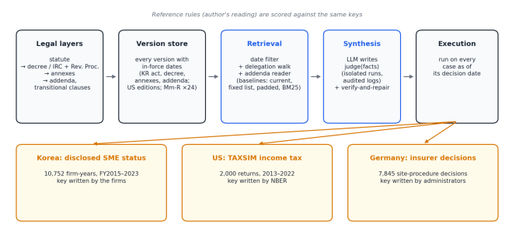
Fig. 1 The test bed. Each case is decided as of its own date from a store of every version of the governing texts; rules written by an LLM, and the author’s reference rules, are scored against keys that the author did not write.
Original paper · CC BY 4.0 · Bae, Jinhyung · Grading Executable Legal Rules Against Independent Records: Transitional Provisions and Korean SME Status · Original paper figure · Extracted the figure area from page 4 of the original PDF.Why grading against the author's reading falls short
Korean SME status shows the difficulty. Whether a firm was an SME on a given date depends on several layers of law, and a transitional addendum changes the answer for a fixed window.
The study asks three questions about the written rule: how far it explains an independent key, which layer carries the date, and whether the key supports the author's reading of the contested addendum. A second question concerns LLM-written rules: whether the conclusion about which retrieval condition is better changes when the key replaces the reference rule as the standard.
How the test bed grades rules
Every result is scored against two references, and the difference between them does most of the work.
The answer key records what decision-makers actually did, without reference to that reading. Agreement with it shows whether a rule reproduces practice.
The central key is 10,901 firm-years of SME status across FY2015 to FY2023, drawn from the disclosures of 1,677 firms.
The Korean SME layers and the 2014 addendum
Deciding SME status in Korea draws on the statute, the enforcement decree, the decree's annexes and the addenda, each with its own role. Consolidated texts keep old addenda at the foot of the decree, so a current text still shows an addendum whose effect ended long ago. A reader must therefore work out whether an addendum is live on a given date.
How far the reference rule matches disclosed status
The reference rule agrees with disclosed SME status on 0.891 of firm-years, with a 95% interval of 0.879–0.903 when firms are resampled. Table 6 adds the parts of the rule one at a time. The rule with Annex 1 and the grace period, but no addendum, reaches 87.8%. Adding the 2014 transitional addendum under reading (b) gives 88.9%, and adding the once-only grace rule gives 89.1%.
Against the first row, modelling the 2014 addendum together with the once-only rule raises agreement by 0.013 over all years and by 0.051 in FY2015–2017, when the addendum was in force. The addendum alone accounts for 1.1 points of the gain.
The authors read this as the date entering the status through a transitional measure, mainly outside the main statutory text.
Transitional rules and status-fixing versus the annex amounts
Membership in a business group designated by the Korea Fair Trade Commission accounts for 124 of the 1,183 disagreements, from 333 firm-years of 76 firms.
The grace-start convention and the readings of the 2014 addendum
To check the choice on held-out firms, firms were split into halves. In the split fixed before the run, the choice half picked the earlier start.
Firms on the (a) side repeat word for word the SME sentence they wrote while the deeming applied, and none of them links grace or the addendum to status. The authors take this as reporting inertia, and they keep both readings because no official interpretation settles the question.
Retrieval conditions for LLM-written rules
Gemini 3.8 Flash wrote the main runs, and Claude Opus 5.5, Claude Haiku 5.5 and GPT-OSS 120B answered the same 343 prompts in a later run. The conditions differ in which provisions a model receives, from a fixed list to a date-correct list and retrieval with delegation, and a no-law condition.
In the pre-registered comparison, none of the retrieval conditions came out better across the four models.
Gemini's fixed-list functions read the pre-2015 status input. Removing that input lowers their agreement with the reference rule from 0.851 to 0.478 on subset A.
The verify-and-repair loop checks functions against properties the author derived before the loop ran, and it returns violating functions to the model for at most two rounds without answer-key values. In the first repair round, 10 of 20 property checks failing before the round fell to 0 after it, with no new violations.
A threshold baseline in German minimum volumes
The German comparison case covers 7,845 site–procedure–years with 24 rule versions. Because 92% of decisions grant entitlement, the study scores balanced accuracy, which averages the recall of grants and the recall of denials.
The threshold rule reaches a balanced accuracy of 0.880 averaged over years, against 0.500 for a constant prediction. Its plain accuracy is lower than the constant's, because the gap lies among sites that fall below the threshold without an exception.
Limits of the key and of the reading
Disclosed status is the firm's own judgment, not a legal ground truth, so part of the 11% disagreement may be error in the disclosures rather than in the rule. Firms can misread the law, repeat an earlier statement, or state a status without a certificate, and these errors cannot be separated from rule error without the certificates.
The corrections turned a close split on the addendum into the lean to (b), so label errors matter where few cases decide a question.
The grace start was chosen after looking at the key, and the split-sample check is the only held-out test of that choice.
Paper info
- Authors
- Bae, Jinhyung
- Venue
- arXiv · Preprint
- First published
- 2026-11-18
- Added
- 2026-11-20
- Updated
- 2026-11-18
- Version
- v1
- arXiv
- 2611.24055
- Category
- cs.CL · cs.AI
- Original paper terms
- CC BY 4.0
- What we show
- Paper info, commentary and permitted figures from the original paper
AI commentary is a separate explanation from the original paper and may contain errors. The original paper and figures follow each source's terms of use and any rights noted separately.
Abstract
Laws are increasingly turned into programs that decide cases, such as whether a firm was a small or medium enterprise (SME) on a given date, and large language models (LLMs) now write them. The programs are usually graded against answers written by someone who read the same law, so a program can score well by sharing the grader's reading rather than by getting the law right. LexTemporis grades them instead against records of what actually happened: 10,901 firm-years of SME status disclosed by Korean listed companies, with every version of the governing rules. An appendix adds comparison cases from US income tax and German hospital minimum volumes. The date changes outcomes mainly through provisions outside the main statutory text: one transitional provision raises agreement with the disclosures from 83-86% to 89-90%. The disclosures also test the author's reading of a contested provision, favouring it in 130 of 189 firm-years where readings diverge. Four LLMs wrote the rules, given different selections of the law. A pre-registered comparison finds no condition better across all four models. In exploratory analyses, supplying the right provisions looks better graded against the author's reading than against the records: the advantage shrinks for three models (for one, to between a quarter and three-fifths of its size), and per firm-year it is several times larger where the author's reading is wrong, partly by construction, since there reproducing that reading more faithfully must lose. Grading legal programs against the grader's own reading can overstate how well they work.
Quote from the paper
Bae, Jinhyung (2026). Grading Executable Legal Rules Against Independent Records: Transitional Provisions and Korean SME Status. arXiv:2611.24055v1. https://arxiv.org/abs/2611.24055v1
BibTeX
@misc{jinhyung2026grading,
  title = {{Grading Executable Legal Rules Against Independent Records: Transitional Provisions and Korean SME Status}},
  author = {Bae, Jinhyung},
  year = {2026},
  eprint = {2611.24055},
  archivePrefix = {arXiv},
  url = {https://arxiv.org/abs/2611.24055v1}
}