Paper commentary
English Calibration Erodes Lithuanian in Expert-Pruned Mixture-of-Experts Language Models
English calibration drops Lithuanian accuracy in pruned mixture-of-experts language models
- Problem Expert pruning removes MoE experts using scores from English calibration text. Those scores may miss experts that other languages need, and nobody had tested this for Lithuanian.
- Method REAP scores each expert on a calibration set and removes the lowest scorers. The authors calibrate it on English, Lithuanian or mixed text, then prune four MoE models at 25% or 50%.
- Results At 25% pruning, English calibration cut Lithuanian Belebele accuracy by a median of 21.4 points, against 1.7 points for English. Lithuanian calibration removed most of that loss.
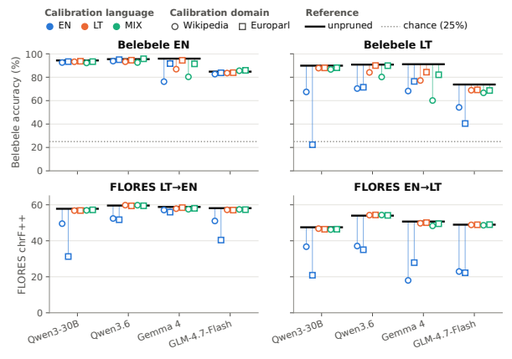
Figure 1 : At 25% expert pruning, English calibration erodes Lithuanian far more than English.Black bars are the unpruned models and points their 25%-pruned versions. Unless a caption says otherwise, colour marks the calibration language in all figures (EN blue, LT orange, MIX green); circles and squares mark Wikipedia and Europarl calibration, and hollow and filled markers mark 25% and 50% pruning. Higher is better; the dotted line is chance on Belebele. English-calibrated models keep their English comprehension (except Gemma 4 with English Wikipedia calibration) but lose up to 67.6 points in Lithuanian, and they translate worse, espe- cially into Lithuanian.
Original paper · CC BY 4.0 · Tomas Rasymas, Povilas Kvedaras · English Calibration Erodes Lithuanian in Expert-Pruned Mixture-of-Experts Language Models · Original paper figure · Extracted the figure area from page 4 of the original PDF.Why English calibration might not carry over
Expert pruning cuts the memory an MoE model needs by deleting whole experts, which makes these models cheap to run but expensive to store. The calibration set is almost always English, so the choice of which experts to delete rests on English text.
Whether the calibration language matters was less clear before this work. Studies of high-resource languages suggested that English calibration transfers well to other languages in MoE pruning.
The authors studied Lithuanian, an East Baltic language and an official language of the European Union.
The authors found no study of how MoE compression affects Lithuanian, which is the gap this paper addresses. The calibration text was English (EN), Lithuanian (LT) or a 50/50 mix (MIX), from Wikipedia or the parallel Europarl corpus. They tested both languages on Belebele, FLORES-200 and Wikipedia language modelling.
How REAP picks the experts to remove
REAP scores each expert on a small calibration set, then removes the lowest-scoring experts from the bottom of that ranking. The saliency score for expert j is an average over the calibration tokens routed to it, of the router's gate weight times the norm of the expert's output. Here X_j is the set of calibration tokens routed to j, g_j(x) is the router's gate weight, and f_j(x) is the expert's output.
In words, an expert scores high when the router trusts it on the tokens it receives and its output is large.
The authors argue that an expert Lithuanian relies on can look unimportant under English text, because English tokens rarely reach it.
The four models differ in their number of experts, from 64 to 256, and in shared experts and router design. The authors use the llm-compressor 0.15.0 implementation, which prunes one layer at a time.
The grid of models, calibration sets and metrics
The grid crosses four MoE models with two calibration domains, three calibration languages and two pruning ratios, which yields 48 pruned models. The authors evaluate 52 models in total, because the four unpruned models are scored as well. Qwen3-30B has 128 routed experts with 8 active per token, while Qwen3.6 has 256 routed experts. Gemma 4 and GLM-4.7-Flash complete the set, with 128 and 64 routed experts respectively.
Pruning 25% of the experts removes 22.1 to 23.7% of the parameters, and pruning 50% removes 44.3 to 47.5%.
Each calibration set holds 1,024 samples of 2,048 tokens, drawn from Wikipedia or Europarl. Europarl provides parliamentary proceedings in both languages, so English and Lithuanian calibration see the same content. The budget is fixed in tokens, so Lithuanian calibration covers about half as much text as English calibration, because Lithuanian needs more tokens per word.
Belebele has 900 questions per language, and the model's answer is the letter A to D it finds most probable. A strict variant counts an answer only when its letter has a probability above 0.5. FLORES-200 gives 1,012 devtest sentences per direction, scored with chrF++ and BLEU, with at most 256 new tokens.
Degradation is the unpruned score minus the pruned score, and the gap subtracts the English degradation from the Lithuanian one. A positive gap means that Lithuanian lost more, and a run has collapsed when its Belebele accuracy is at most 30%. The authors bootstrap the test items in pairs, and a difference counts as significant when its 95% interval excludes zero.
English calibration damages Lithuanian far more than English
At 25% pruning, English-calibrated models lost a median of 1.7 points of English Belebele accuracy but 21.4 points of Lithuanian. Without a Lithuanian test, this damage would not have shown up at all. The English-calibrated models also translated worse, especially into Lithuanian, which makes the gap visible in generation too.
One run makes the pattern concrete: Qwen3-30B pruned by 25% with Europarl-EN kept 93.3% English Belebele accuracy, only 1.0 point below the unpruned model. Its Lithuanian accuracy fell from 89.9% to 22.3%, no better than guessing. Strict scoring widens the contrast, because the English-calibrated models at 25% kept 87.4% strict accuracy in English but only 44.2% in Lithuanian.
The authors read this as lost confidence in the answers, not only a changed top letter.
English held up in three of the four models, so the damage is not a uniform drop across both languages. Gemma 4 is the exception: with Wikipedia-EN it lost 19.7 points in English. This supports H1 for English calibration, with the gap positive for every model on every benchmark. Lithuanian or mixed calibration, by contrast, leaves only a small gap of 3.0 to 5.1 points under LT.
What Lithuanian calibration changes and what it costs English
Switching calibration from English to Lithuanian raised Lithuanian Belebele accuracy by 25.5 points on average across 16 configurations. Translation into Lithuanian rose by 28.2 chrF++ on average under the same switch. The gain was larger on Europarl, at 29.7 points against 21.3 with Wikipedia. Europarl shows the same content in both languages, so the gain doesn't come from differences between the English and Lithuanian Wikipedias.
Translation into English also improved, by 18.0 chrF++, even though Lithuanian is only read in that direction.
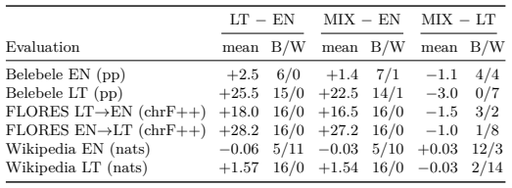
Table 4 :Effect of switching the calibration language: mean difference over 16 config- urations (positive = the first is better; Wikipedia: NLL reduction in nats per token). B/W: how many are significantly better/worse.
Original paper · CC BY 4.0English Belebele barely moved, and the authors didn't find it significantly worse under LT calibration than under EN calibration. On average, English Belebele was 2.5 points better under LT calibration than under EN calibration, across 16 configurations. Language modelling shows the asymmetry most clearly. At 25% pruning, Lithuanian NLL rose 3.2% under LT calibration but 55.2% under EN calibration.
Over the same setting, English NLL rose 5.2% under EN calibration and 5.6% under LT calibration.
Mixed calibration sat slightly below LT for Lithuanian, at 3.0 points lower on Belebele. Mixed calibration lowered the larger of a configuration's English and Lithuanian Belebele losses in only 3 of 16 configurations. So a mix didn't balance the two languages better than Lithuanian alone, and the authors count H4 as not supported.
Gemma 4 at 50% pruning is the exception, answering Belebele at chance in Lithuanian with every calibration set. Gemma 4 also answered at chance in English with 4 of the 6 calibration sets, so its near-zero gaps reflect collapse rather than success.
Why the removed experts differ by calibration language
The two languages share most experts, and the paper measures what differs with the removed routing share. That share is the part of a language's routing in the unpruned model that goes to the experts pruning later removes. At 25% pruning, English and Lithuanian calibration keep 90–94% of the same experts.
The authors compute this share on the Wikipedia test text, using the unpruned model's expert selections for each language. Lithuanian calibration reverses the order, with 12.2% against 15.3%, in every model and at both ratios. The Spearman correlation of saliency scores between the two languages is 0.72 to 0.85 on average over layers.
The difference sits mostly at the ends of the network, where the routing of the two languages diverges. In the last layers the eight most used experts handle 55–72% of Lithuanian expert selections, against 19–39% for English. English calibration removes 0.86 to 2.88 of these eight experts per layer, depending on the model. Lithuanian calibration removes at most 0.71 of them.
The removed share explains the direction of the transfer, but not how large each gap gets. Gemma 4 with Europarl-EN at 25% loses the largest share of Lithuanian routing yet less accuracy than Qwen3-30B. The authors read the link as correlational, so they don't claim that removed routing causes the damage.
Limitations of the Lithuanian pruning study
The results stop at one run per configuration, so the intervals only capture the sampling of test items. They don't reflect variation between calibration samples, and two ratios with one calibration budget can't show where each model starts to break. The 256-token generation limit also allows fewer than half as many Lithuanian words. The Wikipedia test articles aren't parallel, with a median scored length of 924 bytes in Lithuanian and 1,462 in English.
That is why Europarl serves as the content-controlled comparison.
The study covers one lower-resource language, so other languages may behave differently. Belebele uses letter scoring, and the authors add a strict variant but no generative comprehension test. Wikipedia NLL is computed inside the chat template, so it isn't comparable with raw-text perplexity.
FLORES outputs weren't post-processed. The link between removed routing and damage is correlational. The overlap analysis rests on only 16 points from four models.
Paper info
- Authors
- Tomas Rasymas, Povilas Kvedaras
- Venue
- arXiv · Preprint
- First published
- 2026-11-5
- Added
- 2026-11-6
- Updated
- 2026-11-5
- Version
- v1
- arXiv
- 2611.07654
- Category
- cs.CL · cs.LG
- Original paper terms
- CC BY 4.0
- What we show
- Paper info, commentary and permitted figures from the original paper
AI commentary is a separate explanation from the original paper and may contain errors. The original paper and figures follow each source's terms of use and any rights noted separately.
Abstract
Expert pruning compresses Mixture-of-Experts (MoE) language models by removing the experts that a calibration set marks as unimportant. Studies of high-resource languages largely find that English calibration transfers well to other languages. We test this for Lithuanian: we pruned four MoE models with REAP, removing 25% or 50% of the experts with English, Lithuanian or mixed calibration, and evaluated both languages on reading comprehension, translation and language modelling. English calibration does not transfer to Lithuanian: at 25% pruning, English comprehension fell by a median of 1.7 points but Lithuanian by 21.4. The transfer is asymmetric. Lithuanian calibration removed most of the Lithuanian loss and never significantly hurt English comprehension, which was on average 2.5 points better than under English calibration; only English language modeling got slightly worse. Routing suggests why: in the last layers, Lithuanian sends 55-72% of its expert selections to just eight experts, against 19-39% for English, and English calibration removes some of these experts. Compressed models should be calibrated, and evaluated, in every language they must serve.
Quote from the paper
Tomas Rasymas, Povilas Kvedaras (2026). English Calibration Erodes Lithuanian in Expert-Pruned Mixture-of-Experts Language Models. arXiv:2611.07654v1. https://arxiv.org/abs/2611.07654v1
BibTeX
@misc{rasymas2026english,
  title = {{English Calibration Erodes Lithuanian in Expert-Pruned Mixture-of-Experts Language Models}},
  author = {Tomas Rasymas and Povilas Kvedaras},
  year = {2026},
  eprint = {2611.07654},
  archivePrefix = {arXiv},
  url = {https://arxiv.org/abs/2611.07654v1}
}