Paper commentary
SLIC: Reinforcement Fine-Tuning Small LMs for Multi-Turn Analog Circuit Optimization
SLIC fine-tunes a small language model to optimize analog circuits over multiple turns
- Problem Hosted large language models are hard to use for analog circuit design because proprietary process design kits cannot be sent to external services. Numerical optimizers also tend to stay tied to one circuit family and transfer poorly.
- Method SLIC is a reinforcement fine-tuning framework for a 4B model that runs locally. At each turn it simulates several candidate edits, advances one of them, and uses simulator rewards to train the policy.
- Results SLIC-RANDOM reaches 87.1% four-specification Pass@1 within eight turns. The DeepSeek-V4.1-Flash Think baseline reaches 38.6% at turn 8.
Why analog sizing is hard for existing tools
Each change shows its effect only after a simulator run, and the simulator returns measured metrics along with device operating states such as saturation or triode. The policy therefore has to reason over trade-offs that interact, rather than produce a single answer from one prompt. Hosted LLM services are a poor fit, because foundry PDKs and device models are usually barred from external APIs and repeated calls add token costs.
Numerical optimizers and many learned methods, by contrast, tend to stay tied to one circuit family and transfer poorly.
RLVR has already helped single-turn math and coding, and recent work extends it to multi-turn agents that adapt to feedback. The authors argue that analog design fits this setting well, since every step can be checked against a simulator. They pick a 4B-scale model as a middle ground, large enough for structured reasoning yet small enough for several agents to run locally.
One shared rollout built from several candidate edits
SLIC samples several candidate edits at each turn, simulates every one of them, and extends a single shared history with one choice. Each candidate is a relative update to device parameters, so the simulator scores the same starting point under several options. Advancing only one successor keeps the trajectory coherent, while the other candidates still feed learning.
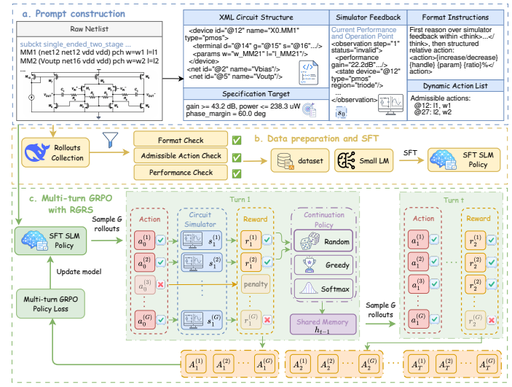
Figure 1 : Overview ofSLIC. Given a goal-conditioned analog circuit optimization task, SLIC builds a structured prompt from the circuit representation and target specifications, then trains a language- model agent through SFT and simulator-interactive RL. The upper path shows SFT data construction from filtered teacher rollouts. The lower loop shows multi-turn GRPO with Reward-Guided Rollout Steering (RGRS), where multiple candidate responses propose relative parameter updates that are evaluated through simulation, one eligible continuation is selected to advance the trajectory, and all candidates contribute to group-relative policy updates. Subscripts denote interaction steps, and superscripts index candidates within each group.
Original paper · CC BY 4.0 · Yan Xu, Zhengqi Gao, Ching-Yun Ko, Zhang-Wei Hong, Wenjie Lu, Tao Yu, Xin Zhang, Duane S. Boning, Ruonan Han · SLIC: Reinforcement Fine-Tuning Small LMs for Multi-Turn Analog Circuit Optimization · Original paper figure · Extracted the figure area from page 2 of the original PDF.The successor is drawn from the eligible set, which holds the valid candidates, or from all candidates if none is valid. A continuation policy then picks one member of that set, using uniform sampling, the highest reward, or a softmax over rewards. Softmax weights each eligible candidate by the exponential of its reward divided by tau_sel, so tau_sel sets how strongly higher rewards are favored.
All G transitions stay in the buffer and feed the group-relative policy update, so the unselected candidates still train the policy.
The authors contrast this with branching multi-turn GRPO, where sampling cost grows exponentially with the training horizon. Advancing one successor keeps sampling cost linear, so candidate groups and longer training rollouts become practical. The authors argue that this keeps credit focused on one local refinement step, which suits circuit sizing because one action changes several parameters at once.
Rewards that keep validity and performance apart
SLIC gives each candidate one of three reward levels, based on whether the simulator returns a usable measurement. A candidate with no usable measurement receives a fixed penalty, with lambda_inv set to -0.1. A design that succeeds within tolerance scores between 1 and 1.5, and the bonus inside that range reflects its mean specification headroom.
An unsuccessful design scores strictly below 1, because the cap epsilon_s keeps it under the successful range.
Under joint normalization, the invalid-action gap can inflate group variance and compress the differences among measured designs. SLIC avoids this by normalizing validity and performance separately, so the penalty never calibrates the performance scale. The validity advantage is computed against all candidates in the group, while the performance advantage uses only candidates with measurements.
Both weights are set to 1.0, and under this split lambda_inv does not enter the advantage calculation.
Its held-out gain is 4.9 points, with a confidence interval that touches zero. Only the in-distribution difference is significant after Holm correction, so the held-out result stays suggestive. The success-conditional slack bonus gives a further 8.5 points in-distribution and 12.1 points held-out under dynamic filtering.
Training recipe from a 4B base
The SFT stage uses single-turn samples from 1,568 teacher-generated episodes, and DeepSeek-V4.1-Flash produced those episodes. The corpus was split by episode into 6,233 training samples and 748 test samples, so samples from one episode never fall in both splits. The SFT stage therefore teaches the 4B model the output format and the basic edit behavior before any simulator-driven reinforcement learning begins.
The RL stage starts from the SFT checkpoint and runs multi-turn GRPO with RGRS over a maximum horizon of eight turns. Training uses an XML circuit representation, a group size of 8, and 400 total training steps. The run takes about 39 hours on 2×B200 GPUs, which the authors report as the cost of the RL stage. The KL term is disabled by setting beta to zero, so the policy is not pulled back toward a reference model.
The clip ratio is 0.2 on the low side and 0.28 on the high side, following the Clip-Higher strategy that relaxes the upper bound for positive-advantage tokens.
For each task, GRPO compares every trajectory return R_i with the group mean and divides by the group standard deviation plus a small epsilon. The resulting advantage is shared by every turn and every generated response token of that trajectory. The policy update is PPO-style, applying a clipped token-level importance ratio to each generated token.
In-distribution results against baselines
On the 840 in-distribution tasks at PTM 65 nm, Table 1 scores each method at turns 4 and 8. At four turns, SLIC-RANDOM reaches 74.9% Pass@1, which beats GPT-6-Astra's 67.1%. At eight turns the order flips, because Astra reaches 90.6% while SLIC-RANDOM reaches 87.1%, a gap of 3.5 percentage points. Astra ran only once per task, so its score has no repeated runs behind it.
The SFT student scored 26.5% at turn 8, below its teacher DeepSeek-V4.1-Flash at 38.6%. RL then lifts the student to 87.1%, so the policy ends well above the model that generated its training data. SLIC-RANDOM reaches 87.1% four-specification Pass@1 within eight turns, which is 48.5 percentage points above the 763B DeepSeek-V4.1-Flash THINK baseline.
Tree MT-GRPO is the strongest learned baseline on simple topologies at turn 8, with 96.3% against 92.7% for SLIC-RANDOM. Overall, SLIC-RANDOM leads with 87.1% against 81.2% for Tree MT-GRPO.
Held-out topologies and technology nodes
The held-out evaluation uses 240 tasks drawn from six topologies that were never used for training. Across the five unseen technology nodes, SLIC-SOFTMAX keeps 61.9 to 71.0% held-out Pass@1, compared with 72.6% at the training node. The authors read this as evidence that some learned strategies don't depend on the node. Training at 65 nm lets the authors test transfer toward both more advanced (22 to 45 nm) and more mature (90 to 130 nm) nodes.
On the commercial TSMC 65 nm PDK, SLIC-RANDOM reaches 55.8% in-distribution Pass@1, down from 86.9% on PTM 65 nm. Held-out Pass@1 on the same PDK falls to 49.9%, down from 70.6% on PTM 65 nm. Because the four targets chosen under PTM become harder to meet jointly, the drop after transfer is plausible. The authors' task-level audit finds that SFT succeeds mainly when the starting design needs only minor adjustments.
That pattern may explain why SFT scores barely change between the two processes.
More turns and what the ablations isolate
Figure 3 plots cumulative Pass@1 as the turn budget grows to 32 on the in-distribution subset and on the held-out tasks. The authors report 83.2% held-out Pass@1 at a 32-turn budget, compared with 72.5% at turn 8 on the same curve. They read this as the small policy converting extra simulator calls into better circuit designs.
Figure 4 tracks Pass@k as the number of sampled rollouts grows, each rollout given an eight-turn simulator budget. SFT reaches much higher success with a large sampling budget, which suggests the successful strategies are already within the policy's reach. A single SLIC-RANDOM rollout still beats SFT's Pass@32 on both splits. The authors tie this to reinforcement fine-tuning concentrating probability on effective optimization moves, so repeated sampling is less needed.
The ablations isolate the rollout and normalization choices one at a time. Limiting softmax selection to eligible candidates shifts in-distribution and out-of-distribution Pass@1 by +0.6 and -0.3 points. The authors call these small and mixed, so they see limited sensitivity to this restriction. Separate normalization improves in-distribution Pass@1 by 6.2 points and out-of-distribution by 4.9 points.
Under joint normalization, the invalid-action penalty can inflate group variance and compress performance advantages.
The training horizon ablation compares four-turn and single-turn training against the eight-turn main policy. The authors say single-turn training gives no RL experience of successive refinement, so it saturates earlier.
The raw-history checkpoint never saw that format during SFT, which the authors name as a likely cause. Lengthening history from H = 1 to H = 8 gives a small in-distribution gain and a larger held-out gain.
Limitations and where the claims stop
SLIC only handles device sizing inside one fixed circuit topology, so topology generation is outside its scope. The authors leave the full design flow, PVT verification and physical layout to future work. Their evaluation covers amplifier optimization with four specifications, and the paper names LDOs, LNAs and PAs as circuits it did not test.
Coupled objectives such as noise and offset also remain outside the tested setting.
The benchmark starts from 41 amplifier topologies, with 35 used for training and in-distribution evaluation and six held out. Those topologies were adapted from the GANA dataset, which means the benchmark inherits that source's circuit families. Hosted baseline numbers move between runs: DeepSeek-V4.1-Flash reached 35.3% and 41.9% on two 420-task batches.
GPT-6-Astra ran once per task, so its single score has no repeated sampling behind it.
The PDK transfer was zero-shot, and the authors tested it on one commercial kit at 65 nm. SLIC-RANDOM dropped from 86.9% to 55.8% in-distribution and from 70.6% to 49.9% out-of-distribution on that kit. The authors attribute this drop to process-specific effects that PTM simplifies, which they did not isolate further.
Paper info
- Authors
- Yan Xu, Zhengqi Gao, Ching-Yun Ko, Zhang-Wei Hong, Wenjie Lu, Tao Yu, Xin Zhang, Duane S. Boning, Ruonan Han
- Venue
- arXiv · Preprint
- First published
- 2026-11-10
- Added
- 2026-11-11
- Updated
- 2026-11-10
- Version
- v1
- arXiv
- 2611.13452
- Category
- cs.LG
- Original paper terms
- CC BY 4.0
- What we show
- Paper info, commentary and permitted figures from the original paper
AI commentary is a separate explanation from the original paper and may contain errors. The original paper and figures follow each source's terms of use and any rights noted separately.
Abstract
Analog integrated circuit (IC) design is a multi-turn, simulator-grounded engineering task that demands iterative reasoning over coupled performance tradeoffs, yet proprietary process design kits (PDKs) make hosted large language model workflows difficult to deploy in practical design settings. We present SLIC (Small LM Iterating on Circuits), a reinforcement fine-tuning framework that trains a 4B-scale, locally deployable language model for closed-loop analog circuit optimization. SLIC pairs structured circuit representations with discretized relative-update actions, domain- and success-gated multiobjective rewards, and Reward-Guided Rollout Steering (RGRS), which turns per-step simulator feedback into signals for both policy learning and online rollout construction in this sparse, highly constrained domain. We further release an open, goal-conditioned benchmark of 41 amplifier topologies with standardized protocols for in-distribution validation, held-out topology evaluation, and cross-technology-node transfer. Trained solely with open source 65 nm CMOS predictive technology models (PTM), SLIC-Random achieves 87.1% in-distribution four-specification Pass@1 within eight turns, surpassing the 763B DeepSeek-V4.1-Flash Think by 48.5 percentage points. Beyond the training distribution, SLIC-Softmax reaches 72.6% Pass@1 on held-out topologies, and the trained policies consistently transfer across five unseen technology nodes without additional fine-tuning. This transfer extends to a commercial TSMC 65 nm CMOS PDK, where SLIC-Random achieves 49.9% held-out-topology Pass@1, demonstrating practical deployment through local inference without transmitting proprietary data to external LLM services. Performance further scales with test-time simulator interactions, reaching up to 83.2% held-out-topology Pass@1 at a 32-turn budget.
Quote from the paper
Yan Xu, Zhengqi Gao, Ching-Yun Ko, Zhang-Wei Hong, Wenjie Lu, Tao Yu, Xin Zhang, Duane S. Boning, Ruonan Han (2026). SLIC: Reinforcement Fine-Tuning Small LMs for Multi-Turn Analog Circuit Optimization. arXiv:2611.13452v1. https://arxiv.org/abs/2611.13452v1
BibTeX
@misc{xu2026slic,
  title = {{SLIC: Reinforcement Fine-Tuning Small LMs for Multi-Turn Analog Circuit Optimization}},
  author = {Yan Xu and Zhengqi Gao and Ching-Yun Ko and Zhang-Wei Hong and Wenjie Lu and Tao Yu and Xin Zhang and Duane S. Boning and Ruonan Han},
  year = {2026},
  eprint = {2611.13452},
  archivePrefix = {arXiv},
  url = {https://arxiv.org/abs/2611.13452v1}
}