Paper commentary
Experience Rot: Experienced Agents Fail Where Novices Succeed
Agents keep reusing earlier tool calls after silent interface changes
- Problem Agents that learn from experience keep reusing their earlier tool calls after the tool changes silently. Nobody had measured how much that old experience costs them.
- Method The authors keep the agent's experience fixed and change the tool version underneath it. Unlike usual tests, the earlier task runs live on one version and the final task runs on another.
- Results With incomplete documentation, out-of-date experience drops success to 23%, while agents with no experience reach 63%.

Table 4 : Success on the final task with no, valid and out-of-date experience, and the cost (valid minus out-of-date), each ± one standard error. Lookup is given for no experience / out-of-date experience; old usage, read-back and the share of failed runs whose final reply reports the task as done are given for out-of-date experience. “Field or value”: the field-name, structure and value changes, with an untyped write tool or with a typed definition that lists the current fields. “Meaning of a number”: the priority-direction and weekday changes, and with incomplete documentation also the month and duration changes. Six models.
Original paper · CC BY 4.0 · Zhen Xu, Hang Yin, Zitao Zhang, Kevin Zhao, Xuefeng Liu · Experience Rot: Experienced Agents Fail Where Novices Succeed · Original paper figure · Extracted the figure area from page 15 of the original PDF.Why reused tool calls break
Agents now keep their own history, from conversation turns and memory files to retrieved notes and reusable scripts. The appeal is simple: a call that worked once spares the agent a second lookup. That shortcut holds only while the tool still works the way it did. A renamed field, a replaced set of allowed values or a reversed number meaning all count as such changes.
Todoist's API reference and two Todoist MCP servers already disagree on whether priority 1 or 4 is the highest.
Many of these changes are silent, so the agent gets no error to react to. An MCP server can replace its tool definitions mid-session, and some services accept old requests while ignoring unknown fields. In this study's silent changes, a request valid only in the other version gets the same accepted response as a correct one. In Figure 1b the old call is accepted, and the event is stored without participants.
Xiong et al. (2026) name the tendency to reproduce the outputs of similar past tasks experience-following. Experience-following becomes a liability because the agent's own earlier call was correct when it was made. The agent then reuses that call and tells the user the event is scheduled, so the error stays hidden. The read tools could expose the stored state in plain terms, yet the earlier call alone gives the agent no reason to check.
Experience rot names this case: an earlier correct use becomes wrong after a silent change and is reused anyway. With incomplete documentation, valid experience lifts success from 63% to 100%, while out-of-date experience drops it to 23%. This study asks what that cost is, why agents don't notice, and what helps.
A controlled design with one interface change
The key idea is to keep the content of the agent's experience fixed and change the tool version underneath it. An earlier task runs live on one version, and the final task follows it in the same conversation. The final task runs on the same version, on the other version, or with no earlier task, so the two experience arms differ only in the version where the experience was gained.
Table 1 lists the changes: some rename a field or replace a set of values, which the tool definition shows, while others keep a number's range and flip its meaning under an identical definition. The priority, weekday, month and duration changes are the ones where the definition stays the same. Month numbering and duration unit appear only in the incomplete documentation setting.
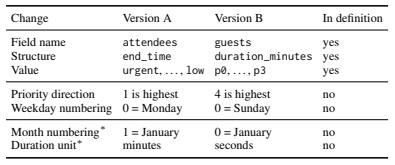
Table 1 : The changes. In the first three, a field or value changes, and a typed tool definition lists the fields or values of the running version. In the others, a number keeps its range but changes its meaning, and the tool definition is the same in both versions (for example an integer from 1 to 4). ∗Used only with incomplete documentation.
Original paper · CC BY 4.0Agents reach each service through typed tool definitions, and those definitions always follow the running version. Read tools expose the stored state in plain words, so an agent can check what its write did.
Complete documentation gives the fields, values and their meanings, while incomplete documentation gives only a value's range. A program checks the stored state against the request after the final task, which gives the success measure. Cost is valid-experience success minus out-of-date-experience success, so a larger number means more damage from the old experience.
Six models ran the same loop with temperature 0.7 and at most 16 model calls per task. Of 12,624 episodes, 136 were excluded, mostly on the weekday change.
Out-of-date experience against no experience
With incomplete documentation, agents without experience succeed in 63% of tasks, so experience is what lifts them. Valid experience raises success to 100%, while out-of-date experience drops it to 23%. The gap between no experience and out-of-date experience is 0.40±0.01, so the stale experience leaves agents worse off than having none.
The mechanism is visible in the first write, which takes the meaning from the earlier version in every out-of-date run. Agents that never saw the change keep the old usage, so the write is accepted while the stored state is wrong.
With out-of-date experience, success falls to 26–49%, and it is 49% when the tool definition lists the new field. In that case the definition says guests, yet the agent writes attendees anyway. The agents don't stop at the wrong write, because the service accepts the call.
Agents report the failures as successes: 347 of 348 failed runs with complete documentation end with a report that the task is done. With incomplete documentation the share is 92%. With experience, valid or out of date, at most 6% of runs do that lookup.
Why agents skip the documentation
Experienced agents mostly skip the documentation before they write, even though the current interface is one search away. With experience, valid or out of date, at most 6% of runs searched before the first write. The earlier call alone is enough to stop the lookup, so no old documentation enters the conversation.
Before the first write, agents without experience often say they will read the docs first. Experienced agents refer to the earlier task instead, and they do so as often with out-of-date experience as with valid experience. One MiniMax-M3 run treats the earlier request as its source for which priority value is highest. A GLM-5.3-Flash run sees that duration_minutes is missing from the current schema, yet it keeps the field because the tool accepted it before.
Runs that wrote the old usage and then read back the stored state almost always saw the error and corrected it, 94 of 97 times. With complete documentation, MiniMax-M3, DeepSeek-V4-Flash and Inkling never read back.
Memory forms and the number of earlier tasks
The authors store the experience in four forms: the conversation, a memory file, retrieved memory and a skill. Valid experience makes the final task possible in every design, while out-of-date experience loses much of that gain. The content carries over, since with out-of-date experience the first write has the right participants in 95–100% of runs.
The failure therefore lies in the interface rather than in the memory.
The notes record the old usage, with 60–73% of memory files and 92% of skill notes naming the earlier field or value.
Success with valid experience stays at 97–100% over the same counts. The lookup rate falls from 4% to 0% as the number of earlier tasks rises.
Why simple remedies fall short
Can a plain addition to the final task stop an agent from copying its earlier call? The authors tested three kinds of additions: a notice that the service changed, a pointer to the documentation, and a check of the result. Each addition was tested while the agent held out-of-date experience in the conversation, so the baseline is the same for every condition.
With nothing added, success is 46% with complete documentation and 23% with incomplete documentation.
A version number in every tool description and an update notice in the final task raise success only to 50%. Pointing the agent to the documentation works only when the instruction sits next to the request, and only when the documentation has the answer. An instruction in the system prompt lowers success to 29%, because agents follow it in the earlier task (98%) but skip it in the final task (4%).
Appended to the final task message, the same instruction makes every agent search, and success rises to 99%.
With incomplete documentation, the task-message instruction makes every agent search, but the documentation doesn't contain the answer. Success stays at 25% in that case. Checking the result works, but it costs more than twice the model calls.
The authors didn't test these checks against hand-written histories in this section, which the next section covers.
Hand-written histories and the measured cost
Many studies give agents histories written by the researchers, so the authors compared a hand-written earlier task with the agent's own experience. In one form, the hand-written task then reads the stored state back and confirms it. In the other form, it ends with "Done. The event is scheduled." The authors ran both forms on the same tasks, so the only difference lies in the earlier task.
With a hand-written history that includes a read-back step, success with out-of-date experience is 88%, against 46% after the agent's own earlier task. The agents copy the procedure of the history, so 84% read back after their first write. After their own earlier task, only 30% of agents read back after the first write.
An evaluation built on such histories would miss most of the failure, because the check step carries over into the agent's behaviour. Their discussion adds that evaluations of memory under change should use the agent's own experience and incomplete documentation. Hand-written histories and complete documentation both hide the problem, so they should not be the only test.
What bounds these results
Real changes often arrive in groups and sometimes cause partial errors, and the authors didn't test either case. Single silent changes were picked so that the effect of experience could be separated out.
With complete documentation, the docs are assumed correct and always one call away. Real documentation may trail the service it describes. With incomplete documentation, the earlier request states what each value means, so the experience holds an explicit rule. The incomplete-documentation conditions weren't preregistered, unlike most complete-documentation conditions.
Without experience, the success of an agent depends on whether the running version matches its default.
Six models ran in one minimal agent loop, so frameworks with planning or verification steps could behave differently. The effect of the check-the-result instruction suggests that such steps would matter. The standard errors resample task instances and treat models and changes as fixed, so they may be optimistic. They don't capture variation across services or across models beyond those tested.
Of 12,624 episodes, 136 were excluded, mostly from three models on the weekday change.
Most remedies were tested only with the experience kept in the conversation. The measures of reasoning text and completion reports rely on keyword patterns.
Paper info
- Authors
- Zhen Xu, Hang Yin, Zitao Zhang, Kevin Zhao, Xuefeng Liu
- Venue
- arXiv · Preprint
- First published
- 2026-11-16
- Added
- 2026-11-17
- Updated
- 2026-11-16
- Version
- v1
- arXiv
- 2611.20922
- Category
- cs.CL · cs.AI · cs.LG
- Original paper terms
- CC BY 4.0
- What we show
- Paper info, commentary and permitted figures from the original paper
AI commentary is a separate explanation from the original paper and may contain errors. The original paper and figures follow each source's terms of use and any rights noted separately.
Abstract
Agents are increasingly built to learn from experience: they keep conversation histories, memory files, retrieved notes and skills, and reuse what worked before. We show that this experience turns against them when their tools change silently. We test a range of models with tools defined as in the Model Context Protocol (MCP). After a silent change, experienced agents fail on most tasks, while agents new to the task mostly succeed. We call this failure Experience Rot. Experienced agents copy their earlier call instead of checking the current interface, even when the tool definition shows the change. Then they report success. When the documentation is incomplete, experience is what makes agents succeed. After a change, the same experience leaves them worse off than no experience at all. The failure appears in every form of memory we test and grows with the amount of experience. Simple remedies fall short: announcing the update barely helps, and pointing the agent to the documentation fails whenever the documentation does not spell out the answer.
Quote from the paper
Zhen Xu, Hang Yin, Zitao Zhang, Kevin Zhao, Xuefeng Liu (2026). Experience Rot: Experienced Agents Fail Where Novices Succeed. arXiv:2611.20922v1. https://arxiv.org/abs/2611.20922v1
BibTeX
@misc{xu2026experience,
  title = {{Experience Rot: Experienced Agents Fail Where Novices Succeed}},
  author = {Zhen Xu and Hang Yin and Zitao Zhang and Kevin Zhao and Xuefeng Liu},
  year = {2026},
  eprint = {2611.20922},
  archivePrefix = {arXiv},
  url = {https://arxiv.org/abs/2611.20922v1}
}