Paper commentary
Multi-step SWE: Can Coding Agents Keep Building on Their Own Code Over Long Horizons?
Multi-step SWE tests whether coding agents can extend their own code across dependent steps
- Problem Single-task coding benchmarks grade an agent once, so they miss whether it keeps building on its own code. Most score one task at a time.
- Method Multi-step SWE chains 5 to 15 dependent engineering steps on one codebase. Each step starts from the code the agent left behind and is graded by its own verifier.
- Results The strongest of nine frontier models solves only 18.5% of tasks, while the next-best reaches 17.8%.
Where single-episode benchmarks fall short
Developers rarely ask a coding agent for one thing; they ask for a component, then an extension, a port, and a speedup. Each later request lands on code shaped by the earlier ones, often code the agent wrote itself. Most benchmarks, however, score a single task at a time. SWE-bench asks for one GitHub issue, while Commit0 and ProgramBench ask for a whole library or program built from scratch.
Terminal-Bench, DeepSWE, and FrontierSWE run longer tasks of up to 20 hours, yet each is still graded once at the end.
Sequential benchmarks come closer by chaining dependent changes, such as package upgrades and feature checkpoints. They report that agent performance degrades as work accumulates. That gap is what the authors target: how well a coding agent carries one codebase through a series of changes.
A chain of steps on the agent's own code
Each Multi-step SWE task keeps one repository alive and makes every new request start from whatever the agent left behind. Because of this, the agent's design decisions and errors carry forward instead of being reset at each step. Each step is a complete engineering request, such as moving an interpreter to Lua 5.4 or making AES kernels faster.
Each step has its own instruction, its own verifier, and a time budget of 2–4 hours. Figure 1 shows this chain, with a separate verifier for each step and a task solved only if every step receives full credit.
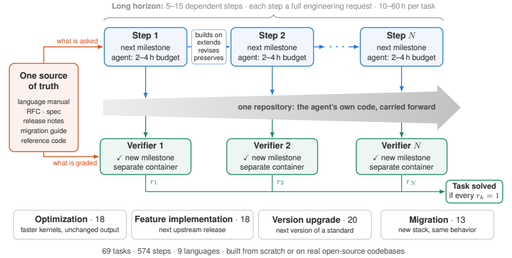
Figure 1 : Overview of Multi-step SWE. A task chains dependent steps on one repository. Each step is a complete engineering request that starts from the code the agent produced in earlier steps and is graded by a dedicated verifier. A task is solved only if every step receives full credit. A single source of truth defines both the requirements of each step and the way the step is graded.
Original paper · CC BY 4.0 · Xiangkai Zeng, Zheng Liu, Zihao Lin · Multi-step SWE: Can Coding Agents Keep Building on Their Own Code Over Long Horizons? · Original paper figure · Extracted the figure area from page 2 of the original PDF.Optimization has 18 tasks, and each step speeds up the next kernel family while the output stays unchanged. Feature implementation has 18 tasks that follow upstream release histories, and version upgrade has 20 tasks that carry a standard through successive versions. Migration has 13 tasks, and each one moves a legacy codebase one stage forward per step.
Each step must also keep earlier behavior working, so most verifiers re-test inherited behavior and breaking old work generally costs the step its reward. Some steps revise earlier behavior when the source of truth changes it, for example Lua 5.3's integer subtype, but optimization steps never do. The workspace is shared, so each instruction describes the target relative to what is already there.
For example, the fourth Lua step starts from a Lua implementation written in Java and asks for Lua 5.4 behavior instead of the release it implements now. In optimization tasks, later kernels often call earlier ones, as BoringSSL's AES-GCM runs its counter mode on the first step's AES block cipher.
Grading each step against an external source of truth
The authors keep each instruction and its verifier aligned by tying both to one source of truth that exists outside the benchmark. That source can be a specification, upstream documentation, or the behavior of an original codebase, and the step provides or cites it. Specifications cover languages, protocols, and file formats, such as RFCs and PEPs, with the official conformance material run by the verifier.
Upstream documentation and release notes give a verifier documented behavior to test, for example against a reference implementation such as stocksqlite3. Verifiers check behavior only through the external interface, so correct solutions aren't penalized for their internal structure.
For feature, upgrade, and migration steps, the reward is binary, so a step earns 1 only if it passes every check. Most of these verifiers also re-test earlier behavior, so a step can't be passed at the expense of earlier work. Optimization steps instead multiply a correctness gate c by a speedup gate v, giving r_k = c·v. Here v is 1 only when the speedup s exceeds the reference solution's speedup s_ref, and s is a geometric mean of per-function speedups floored at 1×.
A rollout solves its task only when every step has reward 1.
The verifiers treat the agent's code as potentially adversarial, because they build and run that code. The verifier rebuilds the artifact from the agent's sources and runs it as an unprivileged user, so the agent can't write the reward file. Optimization verifiers generate their inputs at grading time, so a function can't return outputs it stored during the correctness check.
Verifiers also reject shortcuts such as foreign executables and runtimes, and the PHP and Ruby verifiers compare token structure with upstream.
Whole tasks are rarely solved
Agents rarely finish whole Multi-step SWE tasks, even when they pass most of the individual steps inside them. Each of nine frontier models ran four rollouts per task, and a rollout counts as solved only when every step gets full credit. The same model passes 56.8% of its individual steps, so single steps are passed far more often than whole tasks.
The next-best model, Claude Fable 5.1, reaches a solve rate of 17.8%. Retries help only a little, because Gemini 4 Argon solves 27.5% of tasks at least once despite a 10.1% solve rate.
Pooled over all models, the solve rate is 15.0% for optimization and 2.9% for version upgrade. Version upgrade is the hardest family, and no model scores above 8.8% on it. Optimization is far easier here, because Claude Fable 5.1 leads that family with a solve rate of 45.8%. Still, 4 of the 18 optimization tasks go unsolved by every model.
Progress falls off along each task
Rollouts fall off track as a task moves forward, so the early steps decide most of the outcome. A rollout counts as on track when it has passed every step so far, not just the current one. For Grok 4.7, it fell from 13.1% to 1.4% over the same span. For every model, the sharpest drop came between the first and second fifths of the steps.
Across all models, on-track rollouts fell from 34.9% to 9.0%. The fraction of steps passed declined more gently, from 40.7% to 27.8%, so the drop is in whole-run survival. Outcomes also chain from one step to the next, because each step starts from the workspace the previous step left. A step after a passed step was passed 70.2% of the time, compared with 14.1% after a failed step.
Early errors therefore carry forward instead of being corrected by later steps.
Why failing agents stop
Running out of time explains few failures, since only 12% of failed steps ran to within five minutes of the budget. In 52% of failed steps, the agent reported completion and named no failing check or missing requirement. In another 26%, it named specific failing checks or missing features and stopped anyway, with a median of 66 minutes left.
The completion reports are weak evidence of success: 73% of passed steps came with a report naming no shortcoming. Among steps reported clean, the verifier still failed 57% of them, compared with 65% of all steps. Session length didn't separate passing from failing work, since the median duration ratio for matched step and model pairs was 1.05.
The authors read this as agents being limited by when they judge the work complete, not by the clock. Whether a larger budget would help can't be determined from these runs.
The public tests held 2 float-layout tests, while the hidden tests held 22. Tests the agent writes share its reading of the spec, so they can confirm a misreading rather than expose it.
Limitations
C and C++ account for 38 of the 69 tasks, so language coverage is uneven. The optimization threshold is the speed of one reference solution, which need not be the fastest speedup achievable.
Some verifiers may still miss or wrongly reject a behavior, and the authors release the benchmark so others can report such cases. The paper doesn't yet include an isolated-step baseline that would separate accumulated errors from step difficulty; the authors list it as future work.
Paper info
- Authors
- Xiangkai Zeng, Zheng Liu, Zihao Lin
- Venue
- arXiv · Preprint
- First published
- 2026-11-4
- Added
- 2026-11-6
- Updated
- 2026-11-4
- Version
- v1
- arXiv
- 2611.07166
- Category
- cs.SE · cs.AI · cs.LG
- Original paper terms
- CC BY 4.0
- What we show
- Paper info, commentary and permitted figures from the original paper
AI commentary is a separate explanation from the original paper and may contain errors. The original paper and figures follow each source's terms of use and any rights noted separately.
Abstract
Developers rarely give a coding agent a single request: they ask it to build a component and then to extend, upgrade, and optimize it, each time on code the agent itself wrote. Most benchmarks, however, score one task at a time. We introduce Multi-step SWE, a long-horizon benchmark of 69 software engineering tasks, each a chain of 5-15 dependent steps on a single codebase. Every step is a complete, multi-hour engineering request that starts from the code the agent produced in the preceding steps, so early design decisions and errors carry forward. The tasks span four families of engineering work and nine languages, include both from-scratch builds and existing open-source codebases, and ground every step in an existing source of truth that defines both the instruction and its verifier. Across nine frontier models, the strongest model reaches a solve rate of only 18.5%, and 38 of the 69 tasks are not solved by any model. We release Multi-step SWE publicly at https://multistepswe.com.
Quote from the paper
Xiangkai Zeng, Zheng Liu, Zihao Lin (2026). Multi-step SWE: Can Coding Agents Keep Building on Their Own Code Over Long Horizons?. arXiv:2611.07166v1. https://arxiv.org/abs/2611.07166v1
BibTeX
@misc{zeng2026multi,
  title = {{Multi-step SWE: Can Coding Agents Keep Building on Their Own Code Over Long Horizons?}},
  author = {Xiangkai Zeng and Zheng Liu and Zihao Lin},
  year = {2026},
  eprint = {2611.07166},
  archivePrefix = {arXiv},
  url = {https://arxiv.org/abs/2611.07166v1}
}