Paper commentary
OmniScore-Bench: Evaluating Vision-Language Models on Musical Score Reading
OmniScore-Bench tests which score-reading steps vision-language models get right
- Problem A score-level answer can't show which reading step a VLM got wrong. Existing OMR benchmarks don't score each operation on its own.
- Method OmniScore-Bench asks 3,000 questions across six aspects, each with its own visible scope and answer schema. Unlike transcription-only scoring, each operation gets its own measurement.
- Results Twelve VLMs show operation-specific capability profiles. Removing score images drops Sol's written/sounding-pitch score from 83.3% to zero.
Why a single answer hides the failing step
Reading a score can hinge on one dot or one connecting line, as the paper's opening example shows. A score-level answer alone can't tell which of those steps went wrong.
Existing OMR resources cover parts of this chain, such as musical-object detection in DeepScoresV2 and transcription in monophonic and pianoform datasets. The Sheet Music Benchmark pairs scanned notation with standardised transcription evaluation and the OMR-NED measure. MSU-Bench reports localisation errors and hallucinations with visual inputs.
These resources don't score each operation on its own, so a failure can't be traced to the step that caused it.
The authors design OmniScore-Bench so that each requested operation is separately observable. A relation question asks which identified objects are connected.
Controlled changes to images or givens test which information supports an answer. Separate format and content checks separate representation failures from musical errors. Each task gets its own measurement, so the resource yields a capability profile rather than one score.
One scoped question per operation
The authors' organising idea is to make each requested operation observable on its own. A score-level answer alone can't separate a failure in locating notation from a failure in associating musical objects or reading their consequences. A relation question asks which identified objects are connected.
Explicit targets and scopes allow comparisons with reference annotations. Controlled changes to images or givens test which information supports an answer. The benchmark holds 3,000 questions, with equal counts for its 24 subtypes. Figure 1 lays out six aspects, running from visible symbols to evidence-linked answers.
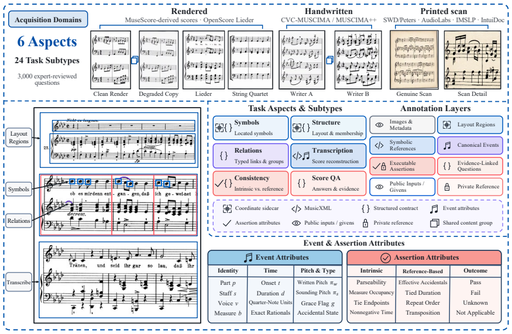
Figure 1 .Six aspects of musical score reading for vision-language models.The evaluation comprises 3,000 questions, with 1,000 each from Rendered, Printed scan and Handwritten inputs and 125 per subtype. The tasks connect visible symbols to structure, relations, transcription, musical consistency and evidence-linked answers. Event and assertion attributes describe reference annotations.
Original paper · CC BY 4.0 · Dai, Congren, Guo, Zhancheng, Zhao, Danni, Wang, Wenchu, Li, Xiaobing, Sun, Maosong · OmniScore-Bench: Evaluating Vision-Language Models on Musical Score Reading · Original paper figure · Extracted the figure area from page 2 of the original PDF.Scoped references and answer schemas support automatic scoring. Transcription output is scored with five complementary metrics rather than a single number.
What image removal reveals about score reading
Sol's written/sounding-pitch score drops from 83.3% to zero when the score images are removed from its input. The authors run this as a paired image-removal analysis, comparing the same questions under two input conditions. The purpose is to separate visual dependence from answers that public text can support.
On the tested subset, the authors find visual dependence in pitch interpretation. Repeat interpretation shows the same kind of dependence on that subset. Pitch and repeat questions therefore need the score pixels, not only the accompanying text.
Remaining scores indicate what public context alone supports on this subset.
Separate format and content checks keep representation failures apart from musical errors.
Limits of the image-removal result
The authors run the image-removal analysis on a tested subset, so the result covers only the questions in that subset. That single drop doesn't yet show how the other VLMs respond to the same change.
The paper ties the drop to visual dependence in pitch and repeat interpretation. It doesn't claim the same dependence for every score-reading operation. Checking whether the drop is common would mean running the same removal on each of the twelve VLMs.
The removal analysis measures visual dependence, while the format analysis measures answer-format violations. A result from one of these analyses can't stand in for the other. Treating the 83.3% to zero drop as a property of all twelve VLMs would go beyond the tested subset.
The removal result sits beside the other controls, which change auxiliary givens and add page context. Those controls answer different questions, so their results don't settle the visual-dependence question.
Paper info
- Authors
- Dai, Congren, Guo, Zhancheng, Zhao, Danni, Wang, Wenchu, Li, Xiaobing, Sun, Maosong
- Venue
- arXiv · Preprint
- First published
- 2026-11-13
- Added
- 2026-11-16
- Updated
- 2026-11-13
- Version
- v1
- arXiv
- 2611.17870
- Category
- cs.AI
- Original paper terms
- CC BY 4.0
- What we show
- Paper info, commentary and permitted figures from the original paper
AI commentary is a separate explanation from the original paper and may contain errors. The original paper and figures follow each source's terms of use and any rights noted separately.
Abstract
Vision-language models (VLMs) can answer questions about musical scores, but their ability to recognise notation, recover its structure and interpret its musical meaning requires separate evaluation. Existing optical music recognition (OMR) resources establish detection and transcription measurements; a transcription score alone leaves the strengths and bottlenecks of a VLM score reader unresolved. We introduce OmniScore-Bench, an evaluation of OMR capabilities in VLMs through 3,000 questions spanning six aspects and 24 task subtypes. Each question specifies a visible scope, reference annotations and an answer schema, enabling automatic evaluation from symbol localisation to musical consistency and evidence-linked question answering. Our assessment of twelve VLMs reveals operation-specific capability profiles and different transcription leaders across excerpt, single-page and multipage tasks. Controlled analyses examine the roles of score images, auxiliary givens and additional page context. On the tested subset, image removal exposes visual dependence in pitch and repeat interpretation while measuring how much performance remains with public context alone. Separate format and content analyses distinguish answer-format violations from musical errors. OmniScore-Bench supports diagnosing which score-reading operations VLMs perform reliably and which require improvement.
Quote from the paper
Dai, Congren, Guo, Zhancheng, Zhao, Danni, Wang, Wenchu, Li, Xiaobing, Sun, Maosong (2026). OmniScore-Bench: Evaluating Vision-Language Models on Musical Score Reading. arXiv:2611.17870v1. https://arxiv.org/abs/2611.17870v1
BibTeX
@misc{congren2026omniscore,
  title = {{OmniScore-Bench: Evaluating Vision-Language Models on Musical Score Reading}},
  author = {Dai, Congren and Guo, Zhancheng and Zhao, Danni and Wang, Wenchu and Li, Xiaobing and Sun, Maosong},
  year = {2026},
  eprint = {2611.17870},
  archivePrefix = {arXiv},
  url = {https://arxiv.org/abs/2611.17870v1}
}