Paper commentary
BLiMP-RO: A Benchmark of Linguistic Minimal Pairs for Romanian
BLiMP-RO tests Romanian grammar with native-validated minimal sentence pairs
- Problem Existing Romanian minimal-pair tests cover mostly agreement and were never checked by native speakers. Constructions like differential object marking, clitic doubling and null subjects are missing, so models can pass the test and still miss what makes Romanian distinctive.
- Method BLiMP-RO is a benchmark of 50 Romanian grammatical phenomena built from minimal sentence pairs. Linguists wrote the core pairs, and native speakers judged them in forced-choice experiments before extended pairs were added.
- Results Caption-trained models gain about 9 percentage points of accuracy per tenfold increase in corpus size. Pretrained Romanian models reach 90.4% and 92.3%, against 96% for humans.
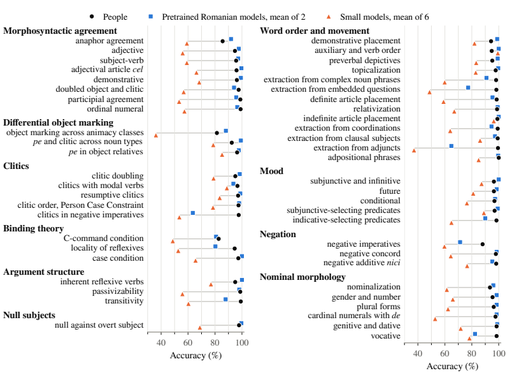
Figure 1 : Accuracy (%) on each phenomenon, grouped by the domains of Table 3. Circles are people, squares the mean of the two pretrained Romanian models and triangles the mean of GPT-2 and GPT-BERT trained on captions 1M, BBL 1M and captions 10M (Table 2). People are on the 508 items, models on all pairs, with the 5,942 pairs that humans accepted. A gray line joins the three marks of a phenomenon. Within a domain, rows go from the lowest human accuracy at the top to the highest at the bottom. Names are shortened from Table 1; anaphor agreement and the C-command condition test emphatic reflexives. The axis starts at 30. Table 7 gives the values of each model.
Original paper · CC BY 4.0 · Radu-Stefan Popa, Valentin Feroiu, Adina Camelia Bleotu, Sergiu Nisioi · BLiMP-RO: A Benchmark of Linguistic Minimal Pairs for Romanian · Original paper figure · Extracted the figure area from page 6 of the original PDF.Where Romanian grammar tests fall short
Minimal-pair benchmarks ask whether a language model gives a grammatical sentence a higher probability than a minimally different ungrammatical one. This matters because overall predictive scores don't show whether a model handles specific agreement and dependency patterns. Acceptability judgments serve as the evidence behind these tests, and the tests probe agreement that overall performance does not isolate.
For Romanian, the existing resource is MultiBLiMP, which contains 2,056 Romanian pairs derived from treebanks. Those pairs concentrate on agreement involving subjects, verbs and participles. The authors note that these pairs have not been validated with native-speaker judgments.
The gap is wider than agreement, because the dataset doesn't cover differential object marking, clitics and clitic doubling, or strict negative concord. Referential null subjects and subjunctive complements, where other Romance languages prefer an infinitive, are also missing from it. A model could therefore score well on the existing test and still miss the constructions that make Romanian grammar distinctive.
BLiMP-RO was built to fill this gap, covering 50 phenomena across ten grammatical domains. The authors use 10 hand-crafted pairs per phenomenon for the initial set, which was rated by human participants.
Building BLiMP-RO and checking it with speakers
The authors wrote the hand-crafted core of BLiMP-RO themselves, with about ten pairs for each of 50 phenomena. That initial set totals 500 items, and the authors kept about ten pairs per phenomenon while varying only the target property. For the larger set, Claude Opus 5.5 generated pairs through few-shot prompting, giving 120 pairs per phenomenon before validation.
The semi-automatic route therefore scales the benchmark without changing the phenomenon inventory.
Native speakers of Romanian ran five forced-choice experiments in PCIbex, and each trial asked which of two sentences is more natural. Participants were at least 18 years old, and each experiment had its own disjoint group of participants. Across the five experiments, 260 different people took part, with 56, 53, 50, 51, and 50 in each experiment.
Human agreement with the target reached 96% on categorical items, and the 20 preference items reached 97.1%. The extended pairs were judged by two or three annotators, and two persons agreed on acceptance in 97.4% of cases. Only the 5,942 pairs with perfect agreement were kept, so the extended set is validated.
Because the design compares two sentences rather than rating each one alone, these accuracies describe preference between sentences, not absolute acceptability. The authors state that forced-choice comparisons establish relative preferences and don't directly measure the acceptability of individual sentences. Human and model accuracies therefore aren't directly comparable, since the extended set was checked with a custom-built interface.
Other factors such as architecture, tokenization and training objectives may also shape model performance in these comparisons.
How models are scored and trained
A model picks the sentence with the higher SLOR score, which is the sentence log probability minus its unigram log probability. Summed log probability penalizes longer sentences, so SLOR subtracts a unigram term to offset that length effect. SLOR then divides that difference by the number of tokens. For GPT-2, GPT-BERT, EuroLLM and Salamandra, the log probability adds up the token log probabilities.
Tokenwise pseudo-log-likelihood inflates words split into several tokens, so RoBERT uses the word-level variant.
The pretrained RoGPT2 and RoBERT are scored alongside EuroLLM-9B and Salamandra-7B. A trigram model with Kneser–Ney smoothing serves as a baseline. GPT-2 and GPT-BERT are trained from scratch on the Romanian BabyBabelLM and on a caption corpus of 10 million words. The caption corpus comes from 5,356 videos, about 2,094 hours of footage, and automatic captions make up 95.2% of those videos.
For the pretrained models, unigram frequencies come from Romanian Wikipedia and a 5% sample of the Romanian part of CC-100.
Each comparison keeps the architecture, tokenizer, punctuation and recipe fixed, so differences come from the training data. Each condition has five runs with the seeds 42, 0, 123, 321 and 9000. Both architectures train for 20 epochs, and the 160,000-word validation set only selects the checkpoint with the lowest loss.
The 95% intervals come from 10,000 bootstrap samples. Each sample redraws pairs within each phenomenon and, for trained models, redraws among their five runs. This procedure follows the Multi-Bootstrap of Sellam et al. (2022). To compare two conditions, the authors take their difference on the same draw and match runs by seed.
Pretrained models versus models trained from scratch
Pretrained Romanian models score highest on BLiMP-RO, with RoGPT2 at 90.4% and RoBERT at 92.3%. Human item accuracy is 96%, so the human-minus-model gap is 5.7 points [3.4, 8.0] for RoGPT2. That gap is 3.7 points [1.7, 5.8] for RoBERT, which sits closer to the human level. The multilingual models, EuroLLM and Salamandra, reach only 82%, while the Romanian models reach 90–92%.
On MultiBLiMP, all four pretrained models reach 94–98%, so the gap between them shrinks on that benchmark.
Trained from scratch, GPT-BERT outscores GPT-2 in every limited-data condition, reaching 70–77% against 65–73%. Raising the caption corpus from about 1M to 10M words adds 9.9 points [8.6, 11.2] for GPT-2. The same increase adds 7.1 points [6.0, 8.1] for GPT-BERT. For GPT-BERT, that controlled advantage is 6.7 points [5.6, 7.9], so the gains aren't explained by extra updates alone.
At 1M words, BabyBabelLM leads child-targeted captions by 5.4 points [4.0, 6.6] for GPT-2. For GPT-BERT, the same comparison gives 3.9 points [2.7, 5.1]. On the 508 items, the matched differences are only about one percentage point, so the size of the gap depends on the item set. Children's books and subtitles each score about 4 points above captions, while CHILDES performs substantially worse.
Which grammatical domains stay hard
People score above 90% in every categorical domain, with differential object marking lowest at 90.1%. Binding comes next at 91.5%, so the two domains where humans struggle most are DOM and binding. The authors attribute the weak DOM result to the animacy items, which don't follow the rest of the domain. Figure 1 shows the phenomenon-level picture, and Table 7 in Appendix C gives each model's values.
For caption models trained on 10M words, mood is the strongest domain at 81.4 to 82.6%. Binding stays the hardest for these models, at 58.5 to 59.6%. Going from 1M to 10M caption words helped GPT-2 most on negation, with a gain of 17.8 percentage points. Null subjects gained 16.7 points for GPT-2, so the two largest GPT-2 gains lie in negation and null subjects.
Pretrained models score higher in every domain, yet binding remains their weakest area at 86.2 to 88.6%. BabyBabelLM and caption data give different domain profiles despite similar overall accuracy. BabyBabelLM favors clitics and word order, while captions do better on null subjects.
How accuracy scales with corpus size
Accuracy on BLiMP-RO rises roughly linearly with the logarithm of caption training size, so each tenfold increase adds a similar gain. The authors trained GPT-2 and GPT-BERT on 15 nested caption subsets, from 0.1M to 8.2M words, plus the full 10M-word caption pool. Per tenfold increase, the gain is 8.6 points [8.0, 9.2] for GPT-2 and 9.1 points [8.4, 9.7] for GPT-BERT.
On MultiBLiMP the same models gain 8.3 [7.1, 9.5] and 9.0 points [7.9, 10.2]. The slope difference between the two benchmarks is 0.3 points [−1.0, 1.6] for GPT-2 and 0.0 points [−1.2, 1.3] for GPT-BERT, so the scaling looks comparable across both evaluation sets.
Data source matters as much as size, and children's books and subtitles pull ahead of captions. Models trained on children's books and subtitles reach about 4 points higher accuracy than models trained on captions. CHILDES performs substantially worse than the other sources. On 238,600-word subsets, children's books reach 63.8 for GPT-2 and 66.4 for GPT-BERT, while captions reach 59.7 and 62.4.
CHILDES falls to 53.1 for GPT-2 and 50.5 for GPT-BERT on the same matched subsets.
Lexical coverage is one candidate explanation for the source gap. The 1M BabyBabelLM corpus covers 65.9% of the 11,169 distinct words in BLiMP-RO, compared with 58.7% for captions. The targeted age group has a much smaller effect than the data source. Models trained on 5M caption words for ages 0–4 versus 5–8 differ by 2.1 points [0.9, 3.2] for GPT-2.
For GPT-BERT the same comparison differs by only 0.2 points [−1.0, 1.4].
The authors summarize the scaling result as a practical finding for limited-input pretraining. Grammatical accuracy keeps improving with data size even when the number of training updates is controlled.
What the training source changes
Children's books and subtitles reach higher accuracy than captions when each source supplies the same 238,600 words. Trained on children's books, GPT-2 scores 63.8 and GPT-BERT scores 66.4 under SLOR. Subtitles give 64.0 for GPT-2 and 65.9 for GPT-BERT, while captions give 59.7 and 62.4. Across both architectures, books and subtitles sit roughly 4 points above captions.
CHILDES performs much worse, at 53.1 for GPT-2 and 50.5 for GPT-BERT.
A likely reason is lexical coverage, since the 1M BabyBabelLM corpus contains 65.9% of the 11,169 distinct BLiMP-RO words. Captions cover 58.7% of those words, so the vocabulary gap may partly explain the accuracy gap. The paper presents coverage as a partial explanation, not as a tested cause. At 1M words, BabyBabelLM beats captions by 5.4 points for GPT-2 and 3.9 points for GPT-BERT.
BabyBabelLM favors clitics and word order, whereas captions do better on null subjects.
The targeted age group changes little for the caption models. At 5M words, the 0–4 and 5–8 caption sets differ by 2.1 points for GPT-2. For GPT-BERT the difference shrinks to 0.2 points, with an interval of [−1.0, 1.4].
What the results can't support
Forced-choice ratings show which sentence of a pair people prefer, not whether each sentence is acceptable on its own. The authors therefore state that human and model accuracies aren't directly comparable. Human item accuracy on the categorical items is 96%, and it comes from forced-choice trials. The extended set of 5,942 pairs was checked in a custom-built interface, which adds another difference in how judgments were collected.
They don't identify the mechanisms behind grammatical learning, so the data-composition results stay correlational. They didn't test whether individual sentences are acceptable when judged one at a time.
Architecture, tokenization and training objectives still vary across the models and may influence performance. The trained GPT-2 model has 108.9M parameters, so model size also differs from the pretrained models. The BabyBabelLM text used for training is the Romanian 1M-word tier, a fixed slice of the data.
Paper info
- Authors
- Radu-Stefan Popa, Valentin Feroiu, Adina Camelia Bleotu, Sergiu Nisioi
- Venue
- arXiv · Preprint
- First published
- 2026-11-13
- Added
- 2026-11-16
- Updated
- 2026-11-13
- Version
- v1
- arXiv
- 2611.17836
- Category
- cs.CL
- Original paper terms
- CC BY 4.0
- What we show
- Paper info, commentary and permitted figures from the original paper
AI commentary is a separate explanation from the original paper and may contain errors. The original paper and figures follow each source's terms of use and any rights noted separately.
Abstract
Evaluating grammatical knowledge in language models requires benchmarks that cover diverse linguistic phenomena and are validated against human judgments. We introduce BLiMP-RO, a Romanian minimal-pair benchmark covering 50 grammatical phenomena across ten domains. It comprises 493 linguist-constructed sentence pairs, evaluated by native speakers in five experiments, and 5,942 additional semi-automatically generated, human-validated pairs. We further investigate grammatical generalization under limited linguistic input by training GPT-2 and GPT-BERT models from scratch on Romanian BabyBabelLM data and a newly collected corpus of 10 million words from child-targeted video captions. Increasing caption training data yields approximately 9 percentage points of accuracy improvement per tenfold increase in corpus size. At matched data sizes, BabyBabelLM generally outperforms video captions, while GPT-BERT consistently outperforms GPT-2. Our findings highlight how training data quantity, composition, and model architecture shape grammatical generalization in Romanian.
Figures from the paper
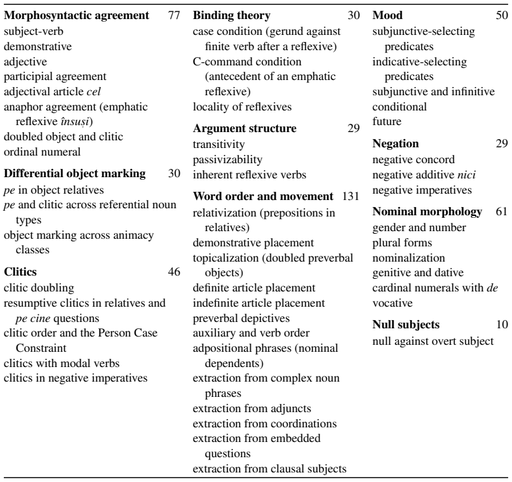
Table 1 : Domains and phenomena/subdomains of BLiMP-RO. The number after a domain counts its distinct pairs.
Original paper · CC BY 4.0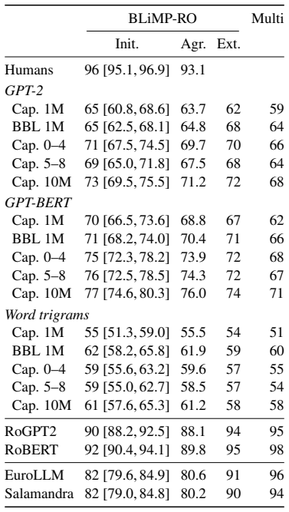
Table 2 : SLOR Accuracy (%) for different models and pre-training scenarios. The columnInit.reports accu- racy on the 508 items of BLiMP-RO, with 95% boot- strap intervals over items and runs.Agr.: agreement with people, how often a model chose the same sen- tence as a participant, over the 26,358 answers; for people, how often two participants chose the same sen- tence on an item, over 671,868 pairs.Ext.: accuracy on the extended set of 5,942 further pairs that partici- pants accepted in a validation study.Multi: accuracy on MultiBLiMP. Trained models are averaged over five runs. Cap. is captions and BBL is BabyBabelLM.
Original paper · CC BY 4.0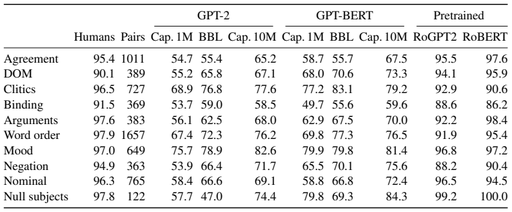
Table 3 : Accuracy (%) by domain, with the domain names of Table 1 shortened. Humans are on the 508 items (Table 1 counts them by domain); models are on all pairs, the 508 items and the 5,942 pairs that humans accepted (Pairs counts them). Column labels as in Table 2; BBL is BabyBabelLM 1M.
Original paper · CC BY 4.0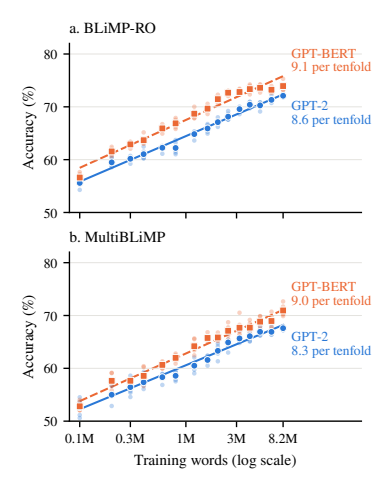
Figure 2 : Accuracy under SLOR of caption models against training words, on (a) BLiMP-RO, all 6,435 pairs: the 493 items and the 5,942 pairs that humans accepted, and (b) MultiBLiMP. The 15 nested caption sets have 0.1, 0.2, 0.3, 0.4, 0.6, 0.8, 1.2, 1.6, 2, 2.5, 3.2, 4, 5, 6.4 and 8.2 million training words, without vali- dation text; the last is the whole caption pool (captions 10M in Table 2). All models use the same validation set of 160,000 words, half captions and half BabyBa- belLM, only to choose the checkpoint. Small points are runs, large points their means, lines ordinary least- squares fits of the means, and labels their gain in points per tenfold increase.
Original paper · CC BY 4.0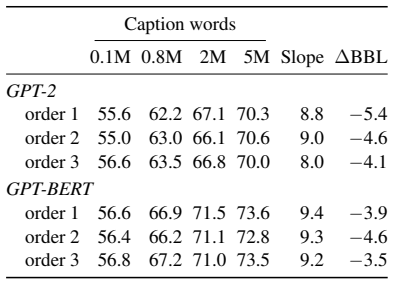
Table 5 : Accuracy (%) under SLOR on all 6,435 pairs for caption sets drawn from three random orders of the caption videos (Section 5), five runs each; order 1 gives Figure 2. With the whole pool, shared by all three, GPT-2 reaches 72.1% and GPT-BERT 73.9%. Slope: points gained per tenfold increase in words, from a straight line through a row’s five accuracies on a log scale.∆BBL: 0.8M captions minus BBL 1M.
Original paper · CC BY 4.0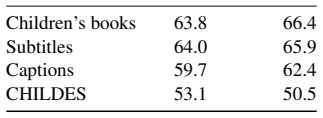
Table 6 : Accuracy (%) under SLOR on all 6,435 pairs of models trained on 238,600 words from each source, all the children’s books in the BabyBabelLM training part, five runs each.
Original paper · CC BY 4.0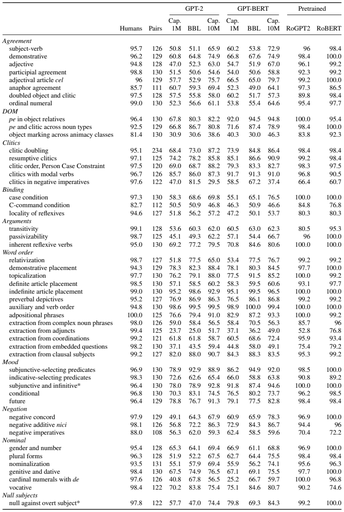
Table 7 : Accuracy (%) by phenomenon, columns as in Table 3. *Preference phenomena.
Original paper · CC BY 4.0Quote from the paper
Radu-Stefan Popa, Valentin Feroiu, Adina Camelia Bleotu, Sergiu Nisioi (2026). BLiMP-RO: A Benchmark of Linguistic Minimal Pairs for Romanian. arXiv:2611.17836v1. https://arxiv.org/abs/2611.17836v1
BibTeX
@misc{popa2026blimp,
  title = {{BLiMP-RO: A Benchmark of Linguistic Minimal Pairs for Romanian}},
  author = {Radu-Stefan Popa and Valentin Feroiu and Adina Camelia Bleotu and Sergiu Nisioi},
  year = {2026},
  eprint = {2611.17836},
  archivePrefix = {arXiv},
  url = {https://arxiv.org/abs/2611.17836v1}
}