Paper commentary
AeroZoo: A Benchmark of Well-Posed Flow Problems for Foundation Models of Aerodynamics
AeroZoo benchmark tests aerodynamic foundation models on new enclosures and boundary conditions
- Problem Neural CFD surrogates are ranked on datasets that vary one design family in one flow domain. Those datasets cannot test whether a model predicts flow for new shapes in new enclosures, and more training cases stop helping.
- Method AeroZoo poses each sample as its full boundary-value problem. Each boundary mesh is grouped by condition type, and those condition types and prescribed values are fed to the model as inputs.
- Results ISLA reaches a median velocity error of 5.3% of inlet speed on the random split, against 11.0% for uniform inlet flow. On held-out enclosures and layouts, its error rises 2.4 to 9.2 times.
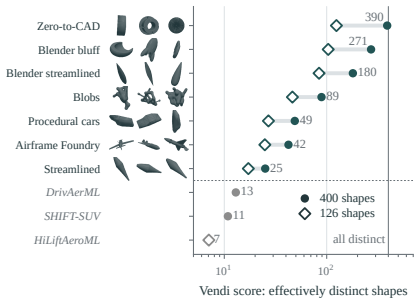
Figure 4 .Every AeroZoo geometry family (three example bodies shown at left) exceeds the shape diversity of single-design sweeps (gray). Vendi scores (Friedman & Dieng, 2023) at 400 shapes (dots) and 126 shapes (diamonds, matching HiLiftAeroML; Ap- pendix I).
Original paper · CC BY 4.0 · Peter Sharpe, Carmelo Gonzales, Corey Adams, Mehdi Ataei, Sanjay Choudhry · AeroZoo: A Benchmark of Well-Posed Flow Problems for Foundation Models of Aerodynamics · Original paper figure · Extracted the figure area from page 4 of the original PDF.Why more cases on one design stop helping
Neural surrogates for CFD are usually ranked on datasets that sweep one design in one domain. DrivAerML, for example, sweeps 500 sedan morphs at one Reynolds number. On that family, Transolver's surface-pressure error at 400 training cases moves by under 3% from 20 to 354 million parameters. Quadrupling compute lowers it by only about 4%, so the authors read geometry count as the bottleneck.
More training cases still help, with error falling by about 12% per doubling. Their estimate puts the DrivAerML floor at 0.0309 as an upper bound, while the error at 400 cases already reached 0.0393. Adding cases to one family therefore buys less and less.
Posing the whole boundary-value problem
The key idea is to learn the boundary-value problem, not just a map from shape to flow. An incompressible RANS problem is fixed by the fluid domain boundary, the condition type on each part with its values, and the density and kinematic viscosity. A solver takes exactly these, so a model that omits a condition varying between samples sees identical inputs with different targets.
Learning from shape alone therefore works only under the conditions held fixed in the data.
Each AeroZoo sample merges the boundary faces that share one condition type into one triangle mesh. Four meshes are always present: inlet, outlet, no_slip and slip. Condition type is an input because a model can't infer it from the shape, and a body can be partly no-slip and partly slip. Only kinematic viscosity and density enter as scalar inputs from global data.
Reference scales such as Lref, Uref and qref are withheld from the model. The reason is that a rectangular wing's Reynolds number depends on whether its chord or its span sets the length, so passing the length would leak a dataset convention. A model may instead compute per-case scales, such as length, speed and Reynolds number, from the boundary data.
Targets, cell volumes and body annotations stay out of the input set too.
Interior targets sit at finite-volume cell centroids, which double as query coordinates. Samples are stored in SI units, and length, speed and viscosity are drawn independently. Across 10 decades of viscosity, 23% of samples lie between the viscosities of water and air. The authors say this keeps models from memorizing air or water constants.
Building 3,815 varied problems
AeroZoo's 3,815 samples vary in shape, enclosure and scale, and each case draws its body from one of seven geometry families. Each case also draws one of eight enclosure configurations, and the enclosure sets which boundary condition each face imposes. Body-free ducts add 161 more samples, with sizes from 2 cm to 20 m. Each sample's length, speed and Reynolds number are drawn independently, so the viscosity varies across the samples.
Every case is rotated at random in 3D, so the flow direction can't be read from the shape. Zero-to-CAD reaches 97% distinct shapes, which is the ceiling for its sample size. The Vendi score counts n identical shapes as 1 and n distinct shapes as n.
Solutions also vary in laminar share with Reynolds number. Below Re of 5×10 4, 90% of bodies are laminar over at least 98% of their area. Above 2×10 5, the median laminar share falls to 0.7%. Meshing and solving use the snappyHexMesh mesher of OpenFOAM, and OpenFOAM and snappyHexMesh generate every sample from a seed and a frozen recipe. Every case's problem was posed before any mesh existed, including cases that later failed or timed out.
Boundary tokens and ISLA on the random split
Uniform inlet flow, the reference that a model must beat, scores 11.0% on the same split. Without boundary tokens, GeoTransolver's median error is 9 times larger than with them, which is the gap the paper reports as the boundary-token effect. The tokens give the model each face's centroid, its condition type and its prescribed values.
The authors ran a controlled ablation to see which part of the tokens carries the gain. With the face centroids kept but condition types and values zeroed, the median error rises to 0.238, compared with 0.076 for the full six-seed model. Keeping only the condition types recovers single-inlet direction at 0.088, but it trails the full tokens in dual-inlet boxes at 0.471 versus 0.363.
Most ablation rows are single-seed, so the authors read these gaps as direction rather than exact size.
ISLA takes all four boundary meshes, with each face's condition type and every value it prescribes. ISLA beats uniform inlet flow on 98% of the test samples. Adding boundary targets, which fit pressure, velocity and wall shear on boundary faces, changes the median only to 0.052.
The free-stream reference's error depends strongly on the enclosure. Its median is 0.041 for open boxes and 1.563 for dual-inlet boxes.
Held-out splits: where error grows
Error stays low when a split holds out a shape family, but it climbs when the split holds out an enclosure or a layout. ISLA was trained on six held-out splits, and each was scored on the full split's test samples that share that kind of problem. Each ratio is the median per-sample error relative to the free-stream reference, and ISLA trained on full is the comparison point for each split.
Holding out blob bodies, CAD-part bodies or Reynolds numbers of 10 to the 6 and above changes ISLA's median ratio only slightly, by factors of 1.1, 1.0 and 1.2. Holding out non-box enclosures, crossflow layouts or dual-inlet layouts instead multiplies that ratio by 2.4, 5.5 and 9.2. The non-box enclosures are the case where the ratio rises above 1, so the free-stream reference beats ISLA there.
Its ratios are 1.1, 1.0 and 1.2 for the shape and Reynolds holdouts, and 2.1, 6.6 and 3.8 for the enclosure and layout holdouts. ISLA's held-out runs used two seeds per split, so the split-level differences deserve some caution.
The authors read this pattern as the gap that matters most today, since on a new enclosure or layout the error mostly comes from failing to generalize. Boundary tokens are the model input that carries the condition information, and the ablation on full shows what they add.
Numerical noise against surrogate error
The authors measure how much the targets themselves move under averaging, rerunning and mesh refinement, before they compare any surrogate against them.
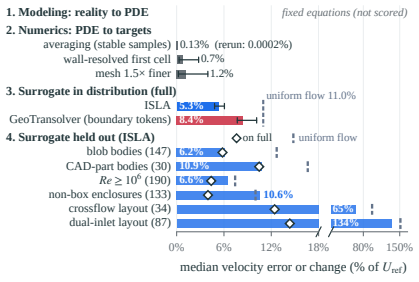
Figure 6 .The four-link error stack-up (% of Uref; x-scale com- pressed above 18%). Solver sensitivities (2; whiskers: case range) are slivers near zero beside surrogate error on full (3; 95% boot- strap intervals; dashed: uniform flow, 11.0%). On test samples shared with full (4, counts in parentheses), ISLA trained on each held-out split (bars, two seeds) jumps far past ISLA trained on full(diamonds) for new enclosures and layouts.
Original paper · CC BY 4.0Figure 6 places these numerical changes beside the surrogate errors on one scale, with uniform flow at 11.0% as the reference line. ISLA's median velocity error of 5.3% of Uref on the random split is about 4 times the median velocity change under mesh refinement. GeoTransolver's 8.4% is about 7 times that change, against the free-stream reference's 11.0%.
Only the opposed spheres and open boxes, whose far field fills most of the volume, come within 2.5 times, at 2.3% and 2.8%.
Changing the convection scheme gives a root-mean-square velocity difference of 1.8 to 8.9% of Uref on the finest mesh. A Courant limit change from 5 to 10 gives a 0.46% of Uref difference, while restarts give only 0.009% of Uref. Some of these checks reach the surrogate's error range, so the authors' reading treats them as real sensitivity rather than noise.
The surrogate error, however, is far larger than these numerical changes, so numerical sensitivity doesn't explain the surrogate gap.
Errors under the error stack-up therefore come mainly from the surrogate failing to generalize, not from numerical noise. On new boundary-condition layouts, ISLA's median ratio to the reference rises by 5.5 and 9.2 times, far beyond any solver check.
Limitations of the AeroZoo results
The canonical benchmark covers time-mean, incompressible RANS flow with a transition model. Compressible flow, LES and unsteady flow are the authors' named next steps. The random-split headline for GeoTransolver comes from single-seed runs, so it carries no seed spread. The ablation rows other than the full model are also single-seed, and the full model's six seeds are the only spread reported for that ablation.
Held-out results rest on two ISLA seeds per split and three GeoTransolver seeds per split. The dual-inlet ratio of 9.2 rests on 87 shared test samples. The DrivAerML floor is a bracket, not a measurement, with a lower bound of 0.017 and an upper bound of 0.0309. The lower bound comes from a model-independent noise estimate, and the upper bound assumes a single power-law extrapolation beyond 400 cases.
Error at new enclosures and layouts stays far above the random split, so generalization is still open. The authors' held-out splits show that the boundary-condition gap is the main open problem they measure.
Paper info
- Authors
- Peter Sharpe, Carmelo Gonzales, Corey Adams, Mehdi Ataei, Sanjay Choudhry
- Venue
- arXiv · Preprint
- First published
- 2026-11-12
- Added
- 2026-11-14
- Updated
- 2026-11-12
- Version
- v1
- arXiv
- 2611.17152
- Category
- cs.LG · cs.CE · physics.flu-dyn
- Original paper terms
- CC BY 4.0
- What we show
- Paper info, commentary and permitted figures from the original paper
AI commentary is a separate explanation from the original paper and may contain errors. The original paper and figures follow each source's terms of use and any rights noted separately.
Abstract
Neural surrogates for computational fluid dynamics (CFD) are trained and ranked on datasets that each vary one design family in one flow domain. Such datasets cannot test the least that an aerodynamic foundation model must do: predict CFD-quality incompressible flow in seconds for new shapes in new enclosures. On DrivAerML, larger models and longer training barely lower Transolver's error; doubling the training cases cuts it by about 12% up to 400 cases, exhausting the dataset. We introduce AeroZoo, a benchmark and training corpus of 3,815 time-mean solutions to the unsteady Reynolds-averaged Navier--Stokes (RANS) equations with a transition model, across seven geometry families, eight enclosure configurations and Reynolds numbers from $10^3$ to $10^8$. Each sample poses a well-posed PDE problem in the form a solver receives it: the boundary meshes grouped by condition type, the prescribed values and the fluid properties. The 2,816 samples with a stable time mean form the canonical benchmark: two tasks, engineering metrics and 22 frozen splits, disjoint in geometry, that hold out geometry families, enclosures, boundary-condition layouts and Reynolds ranges. On the random split, boundary-condition tokens cut GeoTransolver's median velocity error from 76.9% to 8.4% of the inlet speed in single-seed runs (uniform inlet flow: 11.0%). ISLA, a transformer for boundary-driven PDEs, reaches 5.3% over four seeds, about 4 times the change from a finer mesh. On the same test samples, a held-out geometry family barely changes ISLA's error relative to uniform flow, and a held-out enclosure or boundary-condition layout raises it 2.4 to 9.2 times. The data and the scoring code will be released.
Quote from the paper
Peter Sharpe, Carmelo Gonzales, Corey Adams, Mehdi Ataei, Sanjay Choudhry (2026). AeroZoo: A Benchmark of Well-Posed Flow Problems for Foundation Models of Aerodynamics. arXiv:2611.17152v1. https://arxiv.org/abs/2611.17152v1
BibTeX
@misc{sharpe2026aerozoo,
  title = {{AeroZoo: A Benchmark of Well-Posed Flow Problems for Foundation Models of Aerodynamics}},
  author = {Peter Sharpe and Carmelo Gonzales and Corey Adams and Mehdi Ataei and Sanjay Choudhry},
  year = {2026},
  eprint = {2611.17152},
  archivePrefix = {arXiv},
  url = {https://arxiv.org/abs/2611.17152v1}
}