Paper commentary
GDP.xlsx: Benchmarking Frontier Models on Professional Workbooks
Benchmark tests whether AI agents can find every answer in professional workbooks
- Problem Existing table benchmarks check a short reply against one stored string. A professional's answer about a workbook can require a complete set with nothing extra, so one reference string cannot grade it.
- Method GDP_xlsx gives agents 70 workplace requests with their workbook files. Each attempt is graded against binary rubric criteria by a judge that can open the file, and it passes only if every criterion holds.
- Results The top model, Gemini 4 Argon, passes 38.3% of attempts across 20 configurations, while the median score is 19.3%.
Why workbook answers escape short-answer grading
Table question answering checks a short reply against one stored reference, so a single string can serve as the key. A professional's answer about a workbook has no single reference string, because its acceptability depends on many conditions. Some of those conditions concern what the answer must leave out, so the grader has to return to the file.
The first step is finding where the evidence sits, since the agent must locate the authoritative evidence itself.
The request rarely points there: in 58 of the 70 requests, the word tab or sheet never appears. Layout carries meaning too, and 21 tasks depend on layout or on structural and formatting features.
The 70 tasks span 13 domains, and their files hold 2.18 million populated cells. The inputs are 58 Excel workbooks and 12 CSV files, with a median of about 3,600 populated cells per file.
A task, its file and its rubric
The key idea is to grade a task as a set of yes-or-no checks, so one attempt passes only when every check holds. Each task pairs a request with one input file, held in the working directory of an environment, and with a rubric of binary criteria. Grading looks at the final text alone, so the benchmark tests reading the file rather than producing one.
A judge gives each criterion a verdict of 0 or 1, and the attempt's reward is built from those verdicts. Writing \( g_{ij} \) for the verdict on criterion j, the reward is \( r=\sum_j g_{ij}/K_i \), with \( K_i \) the number of criteria in task i. A single missed criterion leaves r below 1, so the attempt fails. Rubrics run from 3 to 30 criteria, about 11 on average, and total 791 across the 70 tasks.
A completeness check asks whether the answer names all of a set, and an exclusivity check asks whether it names anything beyond that set. The rubrics of 39 tasks contain both, so those answers must reach full recall and full precision at once. Table 3 shows the public data-dictionary rubric, where the criteria are split into exclusivity, completeness and affirmative forms.
An empty reply therefore fails every task under strict grading, since each rubric holds at least one affirmative or completeness criterion.
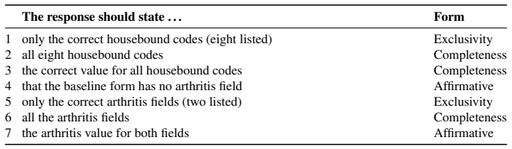
Table 3 :Rubric of the public data-dictionary task, with criteria abridged (Table 5 defines the forms). The request reads: “What would be the form designations to capture patients who have not left their home in over four weeks and/or have arthritis? Give me the codes with values.” The attempt analyzed in §5.2 failed criteria 2 to 4. The released task gives the criteria in full [49].
Original paper · CC BY 4.0 · Suhaas Garre, Sushant Mehta, Edwin Chen · GDP.xlsx: Benchmarking Frontier Models on Professional Workbooks · Original paper figure · Extracted the figure area from page 5 of the original PDF.Running the attempt and the judge
An attempt runs inside a container with a fixed cap of 200 turns, 60 minutes, and 600 seconds per model call. The container offers Python with openpyxl and pandas, LibreOffice for recalculation and rendering, and Tesseract OCR. Models the SDK recognizes as vision-capable can view images, including images extracted from a workbook.
The judge receives the request, the input file name, and all criteria in one session. It also can't credit content the response does not contain.
Scoring uses strict pass@1, which averages each task's pass rate over its scored attempts. An attempt that hits the 200-turn limit or the SDK's stuck detector is graded as an empty response.
The leaderboard evaluates 20 model configurations as of September 2026, with five attempts per task. Because each task's pass rate lies between 0 and 1, the task-sampling standard error of a score p is at most the square root of p(1-p)/70.
How the leaderboard score is built
Each attempt earns a reward equal to the share of its criteria that the judge marks as met. An attempt passes only when that reward equals one, so every criterion must hold. The leaderboard averages pass rates over tasks, so each task carries the same weight. Each task's pass rate is the share of its scored attempts that pass, with at most five attempts per task.
Averaging these rates over the 70 tasks gives strict pass@1 for a configuration.
Attempts that end in an error drop out of their task's pass rate, including timeouts and provider failures. The harness caps each attempt at 200 turns, 60 minutes, and 600 seconds per model call. An empty response passes no task under strict grading, because every rubric has an affirmative or completeness criterion. The judge reads each response and may open the file, but it doesn't credit content the response omits.
Strict grading counts a conditional criterion as met when its trigger never fires. Because each pass rate lies between 0 and 1, sampling error over the 70 tasks is at most the square root of p(1-p)/70. For the leader, that bound comes to at most 5.8 points.
Gemini 4 Argon scores 38.3%, with Claude Opus 5.5 at 30.3% and Claude Sonnet 5.5 at 29.1%. The authors evaluated 20 configurations as of September 2026, with five attempts per task. Adaptive/Max denotes adaptive thinking at maximum effort, and the leaderboard lists it as a reasoning setting.
How far the leaderboard gets
The leader, Gemini 4 Argon, passes 38.3% of attempts, and every configuration fails most of its attempts. Gemini 4 Argon scores highest at 38.3%, with a task-sampling standard error of at most 5.8 points. Claude Opus 5.5 scored 30.3%, compared to 38.3% for the leader. Claude Sonnet 5.5 scored 29.1%, so the two Claude configurations sit below the leader but above the rest.
Figure 4 shows the strict pass@1 for all 20 configurations on the launch leaderboard, with five attempts per task. Where two versions of a model appear, such as Claude Sonnet 5 and 5.5, the newer one scores higher. Gemini 4 Argon scores 28 points above Gemini 3.1 Pro, which shows how much a model generation can move the score.
The authors read the low scores against the failed attempts they examined next. Missing set members drive several of these failures, because the rubric's completeness criteria require the whole set.
What the four failed attempts missed
Muse Spark 1.3 recalled 6 of 9 tenancies at precision 6 of 6 on the public rent forecast task. The tenancy table in that workbook lists nine tenancies, and six of them have a discount that ends in the window. The three missed tenancies qualify only through a tenant break, and they sit on the BreakClauses tab. Perfect precision didn't rescue the attempt, because the completeness criterion requires the whole set.
An AutoFilter hides one of the missed tenancies, and the tab holding cell comments also carried evidence the answer ignored.
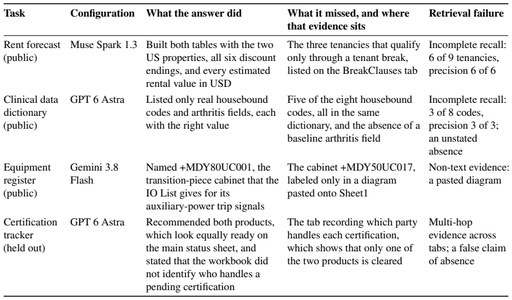
Table 6 :Four failed attempts. The rent forecast is shown in Figure 1, and the data-dictionary rubric in Table 3.
Original paper · CC BY 4.0It recalled 3 of 8 housebound codes at precision 3 of 3, so it left out five codes. The omitted codes included the flags on all three forms, B_HOUSB, W1_HOUSB and W3_HOUSB. The attempt failed criteria 2 to 4 of that rubric.
In the equipment register, Gemini 3.8 Flash named +MDY80UC001 instead of the cabinet +MDY50UC017. In the held-out certification tracker, GPT 6 Astra recommended both products, which looked equally ready on the main status sheet. A separate tab naming the responsible party shows that only one product is cleared, a second hop the answer skipped.
Each of the four misses sits in evidence the input file holds, so a retrieval step listing every tab could have reached it. Deciding when a set is complete is the decision that these incomplete answers got wrong.
What a retrieval step would have caught
The authors argue that a vision-capable model can reach every missed item through the harness. The model can then view an extracted image, which covers the diagram pasted onto Sheet1. The authors frame each of the four misses as the kind of error an explicit retrieval step targets.
That step inventories every tab and embedded object before the model gives its answer. Next, the model matches its draft against each condition that the request states. Last, the model scans the workbook for every entry that fits the request. The authors single out deciding when a set is complete as the judgment that the incomplete answers got wrong.
Both incomplete answers had perfect precision, yet both failed because their completeness criteria require the whole set. A second hop through the tab that records that party would have found it.
The authors suggest comparing structure-aware encodings and retrieval-augmented pipelines on the same requests and rubrics.
Limits of the evidence
The ranking covers 20 model configurations on the launch leaderboard, dated September 30, 2026, with five attempts per task. The leaderboard is a snapshot, so it doesn't show how these configurations would score after later releases. Only three of the 70 tasks are public, so most rubrics can't be checked from the released material. The 67 held-out tasks share the public tasks' format and judge instructions, but their rubrics stay unpublished.
The failure analysis rests on four attempts, so it shows what those answers missed rather than how often misses happen. The four cases don't measure a rate of retrieval failure across configurations.
Strict grading counts an untriggered condition as met, so a conditional criterion passes when its condition never fires. The reported standard error covers only sampling of the 70 tasks, at most 5.8 points for Gemini 4 Argon. It doesn't cover the variance from the judge, the agent, or the five attempts per configuration. A single judge model grades every attempt, and the paper gives no check of its verdicts against human graders.
The structure-aware alternatives in the discussion remain proposals, with no results given for them. The paper doesn't test value-only loaders, structure-aware encodings, or retrieval-augmented pipelines against the same rubrics. So the benchmark shows the headroom for current configurations, but it doesn't show which method would close the gap.
Paper info
- Authors
- Suhaas Garre, Sushant Mehta, Edwin Chen
- Venue
- arXiv · Preprint
- First published
- 2026-11-13
- Added
- 2026-11-16
- Updated
- 2026-11-13
- Version
- v1
- arXiv
- 2611.17766
- Category
- cs.CL · cs.AI
- Original paper terms
- CC BY 4.0
- What we show
- Paper info, commentary and permitted figures from the original paper
AI commentary is a separate explanation from the original paper and may contain errors. The original paper and figures follow each source's terms of use and any rights noted separately.
Abstract
We introduce GDP_xlsx, a benchmark of 70 realistic workplace requests written by professionals in 13 domains, each paired with an expert rubric of binary criteria and with the complete workbook or CSV file it refers to. Together the files hold 2.18 million populated cells, and the rubrics 791 criteria. Agents work in a container with spreadsheet tools, and an agentic judge that can open the file applies the rubric. Completeness and exclusivity criteria require set-valued answers to be found in full and with nothing extra. We rank models by strict pass@1, the share of attempts that meet every criterion. Across 20 model configurations, including frontier models from Google, Anthropic, and OpenAI, the top-scoring one, Gemini 4 Argon, passes only 38.3% of attempts, and the median score is 19.3%, leaving wide headroom. We release the evaluation harness and three public tasks; the other 67 are held out to protect the leaderboard from contamination.
Quote from the paper
Suhaas Garre, Sushant Mehta, Edwin Chen (2026). GDP.xlsx: Benchmarking Frontier Models on Professional Workbooks. arXiv:2611.17766v1. https://arxiv.org/abs/2611.17766v1
BibTeX
@misc{garre2026xlsx,
  title = {{GDP.xlsx: Benchmarking Frontier Models on Professional Workbooks}},
  author = {Suhaas Garre and Sushant Mehta and Edwin Chen},
  year = {2026},
  eprint = {2611.17766},
  archivePrefix = {arXiv},
  url = {https://arxiv.org/abs/2611.17766v1}
}