Paper commentary
AbductionBench: Benchmarking Abductive Reasoning in Large Language Models
AbductionBench tests abductive reasoning in LLMs across final answers and reasoning traces
- Problem Abductive ability is tested by isolated benchmarks with their own formats and scoring, so a correct answer alone hides the reasoning and results don't compare.
- Method AbductionBench is a unified framework that puts 27 datasets into one protocol. It scores final answers separately from the reasoning traces and interaction histories the models produce.
- Results Across eight LLMs, Jev matches or exceeds small LLMs on compact evidence but falls substantially behind on longer cases.
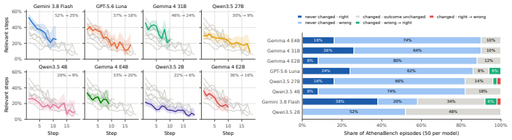
Figure 4 : Relevance and revision over the course of an episode. The left panel (a) tracks the share of actions judged relevant to the gold answer at each step of the interactive episodes, one colored panel per model (95% Wilson bands) against the other seven in gray; a step is plotted only once at least 30 of the model’s episodes reach it, so models that answer early trace shorter curves, and corner labels give relevance at the first and last plotted step. MedQDx counts its questions only. The right panel (b) shows, for AthenaBench’s passive setting, the share of each model’s 50 episodes whose predicted actor never changed, changed without changing the outcome, or flipped between wrong and right from the first turn to the last.
Original paper · CC BY 4.0 · Moein Salimi, Amir Qeysarbeigi, Babak Hosseini Mohtasham, Faraz Doagoye Tehrani, Mahdi Naieni, Hanieh Sartipi, Ali Nouri, Amin Aghakasiri, Reyhane Khayatzade Mahani, Mahdi Jafari Siavoshani, Mohammad Hossein Rohban · AbductionBench: Benchmarking Abductive Reasoning in Large Language Models · Original paper figure · Extracted the figure area from page 8 of the original PDF.Why final answers fall short
A correct final answer doesn't establish abductive ability, because the answer alone hides how the model got there. Each of these capabilities is typically tested by an isolated benchmark with its own formulation and scoring, so a single accuracy number can reflect only a narrow aspect of the ability. Existing benchmarks such as Abductive Commonsense Reasoning and GEAR fix their own formulation and scoring, so results don't show how abductive ability varies with hypothesis kind, domain, or evidence arrival.
Most benchmarks supply all evidence at once, but practical abduction, such as clinical diagnosis or incident response, requires revising a hypothesis as evidence arrives. Revision and evidence seeking are exactly the behaviours that a single final answer cannot expose. It may simply produce a disconnected correct choice, which the final score would count as a success.
AbductionBench therefore separates final-answer evaluation from analysis of the observable reasoning traces and interaction histories. Its authors analyze written traces as observable model outputs, not as faithful representations of internal computation. For CoT traces, the analysis covers evidence use, hypothesis comparison, uncertainty, and commitment.
For multi-turn episodes, it covers question relevance and hypothesis revision.
The authors argue that outcome scores should be kept while evidence use, candidate dynamics, anchoring, contradiction resolution, and answer–trace consistency are reported separately. They don't present these process measures as a replacement for accuracy. Their evaluation spans 27 datasets across ten domains, with eight LLMs and the Jev decision system.
The Gemini run in the appendix case study gets the correct suspect, yet its trace drops the gold candidate in its last step. Its authors say that relying solely on final-answer accuracy would count this run as a perfect abductive success.
One protocol across static, passive and interactive tasks
AbductionBench puts heterogeneous tasks into one execution and reporting protocol, described along three axes. The three axes are hypothesis generation or selection, application domain, and evidence delivery. Generation produces one or more candidate explanations, while selection chooses among supplied candidates, either as single choice (SCS) or multiple choice (MCS).
Each configuration receives one primary-domain label from ten domains, and a dataset can contribute several configurations.
The AthenaBench passive adaptation turns 57 attribution cases over 39 actors into passive episodes. The model cannot request, reorder, or stop the evidence, so hypothesis revision is separated from evidence acquisition.
Static tasks run under two templates, IO, which asks for a direct answer, and CoT, which also asks for an explicit reasoning trace. Passive and interactive tasks run as multi-turn episodes under IO only, because the interaction itself exposes the process. Final answers are scored by accuracy for SCS, by exact set match and set F1 for MCS, and by exact match or an LLM judge for generation.
Cloud-OpsBench is scored by joint root-cause accuracy, which needs both the fault type and the faulty component to be correct. Static records are sampled three times at temperature 0.7, and each interactive or passive record runs once.
Passive AthenaBench turns are judged against the gold actor by an LLM judge, because aliases such as Sednit and APT28 defeat string matching. The authors treat these trace and step measures as observable outputs, not as a record of internal computation.
Where chain-of-thought helps and where it stops
Chain-of-thought doesn't raise accuracy uniformly across the eight models in this protocol. Figure 5 compares mean correctness per model, averaged across datasets, under the IO and CoT prompting conditions. CoT improved correctness for four of eight models, including gemini-3.8-flash, gpt-5.6-luna, qwen3-5-27b, and qwen3-5-4b-local. The largest gain was qwen3-5-4b-local at +0.102, while the largest loss was negligible at −0.015 for qwen3-5-2b-local.
CoT left gemma-4-e2b-local essentially unchanged, and it slightly hurt gemma-4-31b-it and gemma-4-e4b-local. Neither model family nor parameter count explains which models benefit, because both Gemma variants sit at opposite ends of the size range. Overall correctness does track scale within a family, with qwen3-5-27b ahead of qwen3-5-4b-local and qwen3-5-2b-local under both conditions.
The CoT effect, however, doesn't follow that same ordering.
Trace length matters most on long inputs, where CoT's effect is largest in both directions. On long inputs, GPT-5.6-Luna scores only 27.5% under IO but reaches 85.8% with three- to four-step chains. That same model drops to 33.3% at eight steps, so its advantage fades as the chain grows. Gemma-4-31B falls from 88.9% at four steps to 30.4% at eight on long inputs.
On short inputs, GPT-5.6-Luna peaks at two steps at 78.5% and falls to 53.1% at eight.
The authors read the trace-length relation as associational rather than causal. Longer inputs and longer chains both tend to mark harder cases, so the length itself doesn't explain the drop. The long tier contains the fewest traces, so its curves carry the widest bands. Figure 8 splits traces into short (under 1k tokens), medium (1k to 2k), and long (over 2k) tiers.
They didn't test whether forcing shorter chains would restore accuracy on the long tier.
Selection format and model scale
Allowing several correct choices lowers mean selection accuracy for every model in the study. The drop is far from uniform, so the format change doesn't hit all models equally. Qwen3.5 27B and Gemma 4 31B lose between 4 and 7 points, with Qwen3.5 27B at the low end of that range. GPT-5.6 Luna loses 9 points, while Gemma 4 E4B and Gemma 4 E2B lose 13 and 15 points.
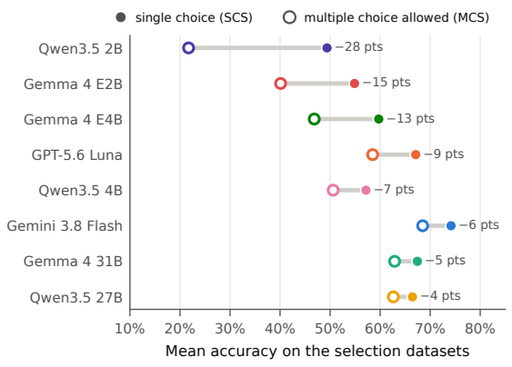
Figure 6 :Mean accuracy on the selection datasets under single-choice (scs) versus multiple- choice-allowed (mcs) formats.Models are ordered byscsaccuracy, descending. Allowing multiple selections reduces mean accuracy for every model; the drop ranges from−4points (qwen3-5-27b) to−28points (qwen3-5-2b-local).
Original paper · CC BY 4.0The measured penalties are 4, 7 and 28 points for those three sizes. Both smaller Gemma variants pay a substantially larger penalty than Gemma-4-31B does. Scale doesn't explain everything, but it tracks the penalty well inside each family.
The authors read this as evidence that dropping the single-correct-choice constraint doesn't simply make selection harder for every model. Instead, it hits smaller models hardest, which can't supply the per-hypothesis confidence that multiple selection requires. Multiple selection asks a model to judge each hypothesis on its own, whereas a single choice needs only a relative ranking.
That reading is the authors' interpretation, and they didn't test confidence calibration directly.
This selection result sits next to the Jev comparison, which the paper summarises as a split by evidence length. Jev falls substantially behind on longer cases, so candidate discrimination and extended evidence integration look like different demands.
Interactive and passive episodes: do first questions and revisions track correct answers?
Interactive episodes are where AbductionBench looks at evidence seeking rather than only at the final answer. These episodes ran once per record under IO, with the full interaction history given in every turn. The proportion of actions judged relevant declines at later steps of the interaction. Relevance falls as the episode proceeds, so later questions seldom repair a poor start.
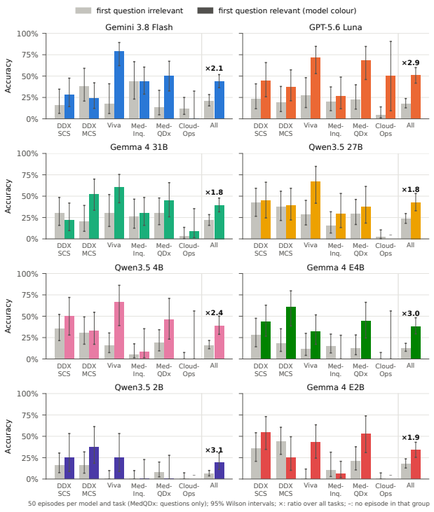
Figure 7 : Final-answer accuracy of interactive episodes whosefirstaction was judged irrel- evant (gray) or relevant (color) to the gold answer, per task and pooled (All), per model; 95% Wilson intervals.×: relevant-to-irrelevant ratio over all tasks.
Original paper · CC BY 4.0Those episodes end correctly 39.7% of the time, compared to 16.6% for the rest, about 2.4 times as often. The authors read this association as the quality of evidence seeking being visible from the first step.
The passive task is the AthenaBench-based attribution task, where evidence arrives in a fixed order over four to six turns. Models rarely revise their initial hypothesis as new evidence arrives. The episodes are scored by final-answer accuracy, while per-step relevance is judged against the gold answer.
Limitations of judging, repetition and coverage
The authors list four material limitations in their Limitations section, and the first concerns the judges. They didn't run a systematic evaluation of judge quality, and they didn't report complete agreement statistics. That gap matters because automated judging can carry the judge model's biases, which the ethics statement flags as a limitation.
The roster covers eight LLMs from four model families, so the trends rest on that particular set of models. The authors frame this as a broader gap in the field rather than a flaw specific to AbductionBench.
Each episode ran only once, instead of being averaged over multiple runs as the static tasks were. Interactive and passive results therefore rest on one run per record.
Coverage limits also shape what the traces can establish, and the authors discuss this in the next subsection. The authors suggest reporting evidence use, candidate dynamics, anchoring and contradiction resolution alongside outcome scores.
Paper info
- Authors
- Moein Salimi, Amir Qeysarbeigi, Babak Hosseini Mohtasham, Faraz Doagoye Tehrani, Mahdi Naieni, Hanieh Sartipi, Ali Nouri, Amin Aghakasiri, Reyhane Khayatzade Mahani, Mahdi Jafari Siavoshani, Mohammad Hossein Rohban
- Venue
- arXiv · Preprint
- First published
- 2026-11-7
- Added
- 2026-11-10
- Updated
- 2026-11-7
- Version
- v1
- arXiv
- 2611.10705
- Category
- cs.LG
- Original paper terms
- CC BY 4.0
- What we show
- Paper info, commentary and permitted figures from the original paper
AI commentary is a separate explanation from the original paper and may contain errors. The original paper and figures follow each source's terms of use and any rights noted separately.
Abstract
Abductive reasoning is the inference of plausible explanations for observed evidence. Evaluating this capability requires more than a single task: a system may need to generate an explanation, discriminate among competing hypotheses, revise its hypotheses as evidence arrives, or decide what evidence to seek next. Yet these capabilities are typically evaluated through isolated benchmarks with different task formulations and scoring procedures, so claims that a model is ``good at abduction'' may reflect only a narrow aspect of this capability. We introduce AbductionBench, a unified framework whose taxonomy characterizes abductive tasks. We instantiate this framework on 27 datasets spanning ten domains and evaluate eight LLMs from four model families evaluated on single-choice selection tasks. Beyond harmonizing heterogeneous tasks, AbductionBench separates final-answer evaluation from analysis of the observable reasoning traces and interaction histories produced alongside those answers. We analyze written traces as observable model outputs rather than faithful representations of internal computation, characterizing evidence use, hypothesis comparison, uncertainty, contradiction handling, and answer commitment. Jev matches or exceeds small LLMs when selecting among explanations over compact evidence but falls substantially behind on longer cases, suggesting that candidate discrimination and extended evidence integration place different demands on a system. In interactive tasks, the proportion of actions judged relevant declines at later steps, and a relevant first question is associated with a correct final answer; in the passive task, models rarely revise their initial hypothesis as new evidence arrives. Together, these findings highlight the value of evaluating abductive reasoning through both final answers and observable evidence use, hypothesis revision, and information gathering.
Quote from the paper
Moein Salimi, Amir Qeysarbeigi, Babak Hosseini Mohtasham, Faraz Doagoye Tehrani, Mahdi Naieni, Hanieh Sartipi, Ali Nouri, Amin Aghakasiri, Reyhane Khayatzade Mahani, Mahdi Jafari Siavoshani, Mohammad Hossein Rohban (2026). AbductionBench: Benchmarking Abductive Reasoning in Large Language Models. arXiv:2611.10705v1. https://arxiv.org/abs/2611.10705v1
BibTeX
@misc{salimi2026abductionbench,
  title = {{AbductionBench: Benchmarking Abductive Reasoning in Large Language Models}},
  author = {Moein Salimi and Amir Qeysarbeigi and Babak Hosseini Mohtasham and Faraz Doagoye Tehrani and Mahdi Naieni and Hanieh Sartipi and Ali Nouri and Amin Aghakasiri and Reyhane Khayatzade Mahani and Mahdi Jafari Siavoshani and Mohammad Hossein Rohban},
  year = {2026},
  eprint = {2611.10705},
  archivePrefix = {arXiv},
  url = {https://arxiv.org/abs/2611.10705v1}
}