Paper commentary
Predict the Reward, Not the World: World Reward Models for ML Agents
World reward models let ML agents skip slow program execution
- Problem Search agents must run each candidate program, which can take hours. LLM predictions of those runs are faster but right only about 60% of the time.
- Method ForeCritic instead picks the winning program directly, without predicting how a run would go. It is Kev-9B trained on 5,000 executed program pairs.
- Results ForeCritic picks the better program 79.4% of the time, beating general LLM judges.
Why execution-based search is slow
ML engineering agents search over programs by drafting candidates, running each one, and refining the best scores. ML-Master, for example, uses the validation scores from real execution to decide what to refine next.
That LLM reasons about how each program would train and predicts the winner. Only the predicted winner gets executed. These predictions are weak, because DeepSeek-V3.2 and GPT-5.1 pick the better program 61.5% and 58.8% of the time with reasoning. Accuracy stops improving beyond 30B parameters within one model family.
In the authors' experiments, a fast selector right on 56% of pairs lowered the final score of all three agents they tested. Its errors can pull the decision below that level. The authors' answer is to spend real executions on learning the decision itself, not the outcome. The open question is whether a prediction can ever be good enough to justify this risk.
Deciding directly rather than predicting
A world model's prediction is built only from the task and the candidate programs, so it can reach the best decision those inputs allow but no higher. Its errors can also pull the decision below that ceiling. The paper formalizes such a selector as one that draws a predicted trace from the inputs and then decides from that trace. Assumption 2.3 requires the predicted trace and the tie-breaking to be independent of the real outcomes, and this holds for any model size and amount of reasoning.
Theorem 3.1 bounds the accuracy of any such selector by the expected best winning probability, E[max_k η_k(X)]. Its value is bounded in the same way, by the expected maximum of the Q_k(X). Figure 2a shows why: the predicted trace comes from X alone, so no such selector can exceed argmax η. Blackwell's garbling view makes this precise, because a predicted trace only reshapes the inputs it was given.
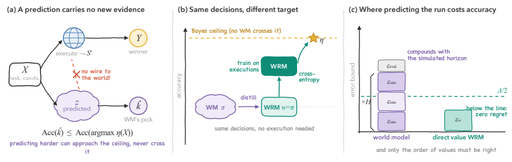
Figure 2 . Predicting execution adds no information about the winner. (a) The predicted trace z is computed from X, so no world-model selector exceeds arg max η (Theorem 3.1). (b) A world model’s decisions are those of a WRM with w = π; distilling it copies its accuracy, while training on executed outcomes targets the ceiling (Propositions 3.3 and 3.4). (c) For value scores, predicting the run adds an error term that grows with the horizon H (Theorem 3.5).
Original paper · CC BY 4.0A WRM skips the prediction and outputs the decision itself, trained on rewards that real runs return. Proposition 3.4 bounds its accuracy gap to the Bayes preference selector by the square root of twice its excess cross-entropy. Driving the training loss toward its minimum therefore pushes the selector toward the ceiling of Theorem 3.1, at the population level.
Predicting a run adds a further error, because the real outcome is an H-stage chain that the world model imitates stage by stage. Theorem 3.5 splits that error into a simulation term, min{1, Hε_sim}, and an evaluator term, ε_eval. The simulation term grows with the horizon H, so a longer run leaves more room for error. A direct value WRM with sup-error ε_w has regret at most 2ε_w, and the horizon does not enter that bound.
Where a predicted run can mislead
A predicted run accumulates error across its stages, and Theorem 3.5 splits that error into two parts. The bound reads min{1, Hεsim} + εeval, so the simulation part grows with the horizon H until it reaches 1. Here εsim is the largest per-stage total-variation gap between the predicted and the real stage kernels, and εeval is the evaluator's error.
A simulate-then-evaluate selector therefore has regret at most 2(min{1, Hεsim} + εeval), while a direct value WRM with sup-error εw has regret at most 2εw.
The size of the error matters for the decision, because a selector loses value only when the two best candidates are close. If every value error is at most ε, the chosen candidate loses at most min{1, 2ε}, and nothing when the gap between the two best values exceeds 2ε. Errors can also push the decision in one direction, and Proposition 3.6 shows this with a reward bit followed by d decision-irrelevant bits.
The model family ties all bits of a candidate to one rate, so the irrelevant bits shape the fitted model as much as the reward bit. When d(m2 − m1) exceeds q1 − q2, the maximum-likelihood world model picks the lower-value candidate on every instance. A likelihood fit can explain the log well while missing the one number that decides the search.
With q = (0.8, 0.3), m = (0.1, 0.9) and d = 10, the likelihood fit gives θ̂ ≈ (0.16, 0.85). The log is mostly progress text, so the fit spends its capacity on what makes that text probable. Screening more candidates doesn't fix such errors. In an idealized Gaussian model, a judge at pairwise accuracy 0.615 needs 907 candidates to match one at 0.794 that sees 8.
How the WRM reads two programs
A selector in an agent has to read long programs, compare them, and return a probability the agent can threshold. The authors adopt the open Kev typed decision architecture, which serializes the task name, task description, data report and both complete programs as one token sequence. The sequence ends with a question, two short options and a decision token, so one forward pass gives a probability for each option.
Each option's score is a scaled dot product between a projection of the option's final state and a projection of the decision-token state, passed through a temperature-scaled softmax. \[ \ell_i=(W_k h_i+b_k)^\top(W_q h_{\mathrm{dec}}+b_q)/\sqrt{d},\quad w_i(X)=\mathrm{softmax}(\ell/T)_i \] The projections map to d=256 dimensions, and T is fitted after training.
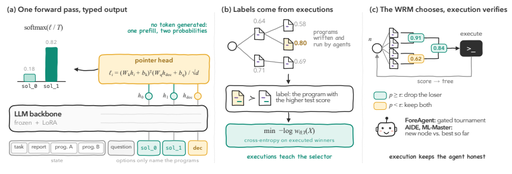
Figure 3 . A World Reward Model is a typed decision model trained on what the world returns.(a) Task, data report, and both programs form a shared state; a pointer head scores two short options against a decision token in one forward pass, with no generated token. (b) Program pairs labeled by their executed test scores train the WRM with cross-entropy. (c) Inside an agent, the WRM settles comparisons, dropping a loser only when confident; execution verifies the chosen program, and its score returns to the search tree.
Original paper · CC BY 4.0 · Yuxiao Lee, Zherui Yang, Fan Liu, Hao Liu · Predict the Reward, Not the World: World Reward Models for ML Agents · Original paper figure · Extracted the figure area from page 5 of the original PDF.Training uses 5,000 pairs drawn from the 18,438-pair Predict-Before-Execute corpus, each labeled by which program scored higher when executed. The loss is the expected negative log-probability of the executed winner, \[ L(\theta)=\mathbb{E}_{(X,Y)}\left[-\log w_{\theta,Y}(X)\right] \] whose minimizer is the winning probability \(\eta\). Only the LoRA adapter and the pointer head are updated, and four epochs, or 628 updates, took 4.2 hours on eight A800 GPUs.
The checkpoint was chosen by development accuracy, and a single temperature of 1.086 was fitted by NLL on the calibration partition, with no final-test labels used in either step.
Plugging the WRM into agent search
Most ML engineering agents keep a tree whose nodes are candidate programs, and each step executes a new child to get its validation score.
Algorithm 1 keeps this loop and replaces the execution of each new candidate with a WRM call that compares it with the incumbent.
There, ForeCritic takes the place of the LLM judge in the pairwise tournament. ForeCritic eliminates a loser only when the winner's probability reaches τ = 0.7. The gate means a wrong call is removed only when the model is confident, which limits the damage a mistaken selection can do.
The experiments check whether this swap pays off, starting with accuracy on the final test. The gain holds on the 501 pairs with two unseen programs, where it is +23.35 points. Since the search only changes where the score comes from, these accuracy gains are what the agent relies on when it skips execution.
Does training on execution beat the untrained base and LLM judges
The main comparison pits ForeCritic against its own initialization, the released Kev-9B, under identical inputs, labels, and architecture. Weighting every task equally gives a task-macro accuracy of 72.69, up from 54.60.
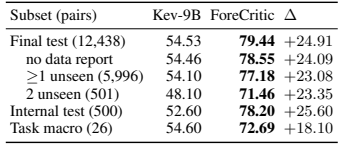
Table 1 . Training on execution outcomes lifts a typed selector by about 24 points, including on unseen programs. Pairwise accuracy (%) of the released Kev-9B and of ForeCritic, its trained version, under identical inputs and labels; “unseen” programs are absent from training. ∆: paired difference, significant in every row under a paired bootstrap (over tasks for the macro row).
Original paper · CC BY 4.0The authors test generalization to unseen programs on the 501 pairs where neither program appeared in training. On these pairs ForeCritic reaches 71.46%, and Kev-9B, which saw none of these programs, drops by 6.4 points. The gain stays at 23.35 points on these pairs, so the benefit of training doesn't depend on having seen the programs.
The general-purpose judges include Qwen3.5-9B with and without reasoning, the typed model Jev, DeepSeek-V3.2, and GPT-5.1. DeepSeek-V3.2 reached 61.5% and GPT-5.1 58.8% on the full corpus, numbers the authors take from Zheng et al. (2026). On the 9,879 pairs shared with the Qwen evaluation, ForeCritic was right 79.9% of the time. Qwen3.5-9B with reasoning reached 53.1%, so the gap is 26.8 points.
Reasoning moved the generative Qwen judge by 0.3 points, while training on executions moved the typed judge by 25.3 points. The authors read this as the pattern Corollary 3.2 predicts, because thinking harder about a run doesn't supply the missing evidence. Real runs do supply that evidence, which is why training on them matters more than extra reasoning.
ForeCritic was right on 70.3% of these judgments, while DeepSeek-V4.1-Flash scored 63.7% on the same pairs. The small sample doesn't make this gap significant, so it stays a directional result.
Whether the probabilities mean what they say
The authors score calibration with NLL, the Brier score, and ECE over ten equal-width bins. Figure 5a plots the mean chosen probability against accuracy for each bin. Before any rescaling, ForeCritic's ECE is 0.025. Kev-9B reports an average confidence of 0.89 at 54.5% accuracy, giving an ECE of 0.345. Kev-9B's probabilities therefore overstate how often it is right.
Temperature scaling is fitted on the 250 calibration pairs, and the fitted T is 1.086. It lowers ForeCritic's NLL from 0.4364 to 0.4332 and its ECE to 0.016. The rescaling changes no decision, so ForeCritic's accuracy stays the same. It also repairs Kev-9B's ECE, but it doesn't fix Kev-9B's accuracy.
The probabilities also rank decisions, so an agent can keep only the confident ones. Keeping decisions above 0.7 retains 72.2% of pairs at 86.8% accuracy. A threshold of 0.9 retains 38.3% of pairs at 95.2% accuracy. Kev-9B's most confident 22.7% of decisions are only 63.5% correct. These rank checks use the 12,438-pair final test.
Speed and score inside three agents
The authors ran AIDE, ML-Master and ForeAgent on ten MLE-Dojo tasks, each with its original selector, with Jev, and with ForeCritic. Each agent kept the same configuration across the three selectors, and each task got one scored run, timed from start to submission. ForeCritic takes the place of execution during search in AIDE and ML-Master, so the agents run only the final program and its repairs.
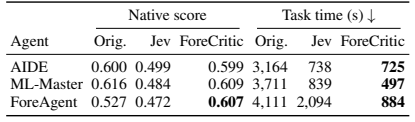
Table 2 . An accurate WRM keeps or raises agent scores at a fraction of the time; a near-chance one lowers them.Mean native score and mean task time over ten MLE-Dojo tasks with each agent’s original selector, with Jev, and with ForeCritic, under the same agent configuration; one scored run per task, timed from start to submission. Native metrics differ in scale and direction (7 of 10 are higher-is-better; Figure 11).
Original paper · CC BY 4.0AIDE's mean task time fell from 3,164 seconds to 725 seconds, a 4.4× speedup. AIDE's mean native score was 0.599 with ForeCritic, against 0.600 with its original selector. ML-Master's mean task time fell from 3,711 seconds to 497 seconds, a 7.5× speedup. Its mean native score moved from 0.616 to 0.609, which stays within 0.01 of the original.
ForeAgent's mean task time fell from 4,111 seconds to 884 seconds, a 4.7× speedup.
The accuracy of the selector decides whether these savings are safe. With Jev, all three agents ended with lower scores: 0.499, 0.484, and 0.472. A selector that errs often pushes the search the wrong way, so the speedups only hold with an accurate selector.
Limitations
The authors leave several extensions of World Reward Models to future work, and they don't test them in this paper. They also leave open whether the Bayes-optimal theory extends to finite models and data.
The agent comparison uses ten MLE-Dojo tasks with one scored run per task, so the authors read those results as descriptive. Each entry averages one run per task, so per-task results appear only in Figure 11. The fresh-program check uses only 91 pairs, and the difference between ForeCritic and DeepSeek-V4.1-Flash isn't significant on that sample.
The cross-entropy bound in Proposition 3.4 is a population-level statement that makes no claim about sample size. The bound shows that driving the training objective to zero drives the selector to the ceiling of Theorem 3.1. A confidently wrong selector could steer an agent toward a harmful action outside a sandbox.
Paper info
- Authors
- Yuxiao Lee, Zherui Yang, Fan Liu, Hao Liu
- Venue
- arXiv · Preprint
- First published
- 2026-10-28
- Added
- 2026-11-1
- Updated
- 2026-10-28
- Version
- v1
- arXiv
- 2610.38439
- Category
- cs.AI · cs.CL
- Original paper terms
- CC BY 4.0
- What we show
- Paper info, commentary and permitted figures from the original paper
AI commentary is a separate explanation from the original paper and may contain errors. The original paper and figures follow each source's terms of use and any rights noted separately.
Abstract
Search-based machine-learning (ML) agents improve a solution by writing candidate programs, executing them, and keeping the best. Execution gives the search reliable feedback, but a single run can take hours, and most runs end in programs the agent discards. Recent agents try to save these runs by letting a large language model act as a world model that predicts how each program would perform. However, a wrong prediction feeds the search false information. We argue that an agent does not need to predict the outcome of execution, only the decision that execution would support. We propose World Reward Models (WRMs), which learn from real execution results to choose directly which candidate will perform better, without predicting any intermediate outcome. We prove that a selector which predicts execution from the same inputs cannot outperform the best direct selector, that predicted outcomes add an error which can make a likelihood-trained world model prefer the worse program on every instance, and that cross-entropy on executed winners drives a WRM toward the optimum. Our WRM, ForeCritic, adapts a 9B typed decision model to 5k executed program pairs. On 12,438 held-out pairs from 26 ML tasks, it picks the better program 79.4% of the time, while general-purpose LLM judges reach 53--62%, and its probabilities are calibrated. Inside AIDE, ML-Master, and ForeAgent, it cuts mean task time by 4.4--7.5 times while keeping their mean scores within 0.01 or raising them.
Quote from the paper
Yuxiao Lee, Zherui Yang, Fan Liu, Hao Liu (2026). Predict the Reward, Not the World: World Reward Models for ML Agents. arXiv:2610.38439v1. https://arxiv.org/abs/2610.38439v1
BibTeX
@misc{lee2026predict,
  title = {{Predict the Reward, Not the World: World Reward Models for ML Agents}},
  author = {Yuxiao Lee and Zherui Yang and Fan Liu and Hao Liu},
  year = {2026},
  eprint = {2610.38439},
  archivePrefix = {arXiv},
  url = {https://arxiv.org/abs/2610.38439v1}
}