Paper commentary
Done Is Not Correct: Measuring Silent Failures and Self-Verification Calibration When LLM Agents Take CAD Actions
Benchmark shows LLM CAD agents often claim success on silently wrong parts
- Problem Existing CAD benchmarks score shape resemblance or whether code runs, so they miss parts that look finished but fail the spec. Agents mark such parts done with high confidence, and nobody measures that overclaiming directly.
- Method The authors grade each requirement with an exact kernel oracle that needs no judge model. A tool-use loop then measures its own code before it may claim done, instead of stopping after one shot.
- Results Single-shot agents were silently wrong on 14.1% of attempts. The measure-then-claim loop cut this to 3.2% and raised claim precision from 64% to 96%.
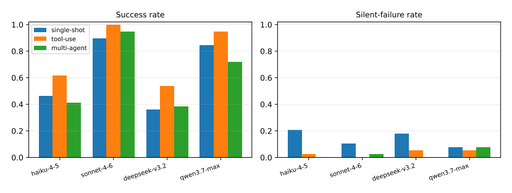
Figure 1 : Success and silent-failure rates by model and agent condition (primary population).
Original paper · CC BY 4.0 · Carson Rodrigues, Clive Rodrigues, Aravind Reddy G · Done Is Not Correct: Measuring Silent Failures and Self-Verification Calibration When LLM Agents Take CAD Actions · Original paper figure · Extracted the figure area from page 6 of the original PDF.Where done and correct come apart
Most CAD evaluations of LLM agents ask whether the generated shape resembles a reference, or whether the code runs at all. Chamfer distance, IoU to a reference solid, execution success and judge scores all measure generation quality. That part can arrive marked “done” with confidence 0.97, so the agent's own report looks trustworthy. The paper argues that a produced B-rep can be measured directly, so overclaiming can be separated from grader inadequacy.
The authors define the silent failure as the conjunction of three conditions that must hold together. The solid must be valid and renderable, the agent must make an explicit completion claim, and at least one semantic check must fail. Loud failures and honest non-claims fall outside the rate by construction, so it isolates overclaiming under a sound oracle.
The rate is paired with completion-claim calibration, measured through ECE, reliability diagrams, AUROC and Brier score. CADSmith validates agent-generated CadQuery against exact kernel measurements, yet treats divergence from prompt intent as a defect to engineer away. The authors treat that divergence as the measurand instead, counting how often agents ship it while claiming success.
Son et al. score a requirement-pass rate from a finite-element solver rather than a claim-conditioned silent-failure rate. MUSE scores generation of multi-component B-rep assemblies with a VLM judge and reports no silent-failure rate. The authors don't claim to be first to measure geometric correctness. Their distinct measurand is graded by an exact, self-audited oracle, and it doesn't rely on a judge model.
A kernel-graded task suite and three agent conditions
Each requirement becomes a check the kernel can compute, so grading needs no judge model in the loop. A task is data, with an identifier, a tier, a natural-language specification, units and a list of checks. Scalar checks compare measured bounding-box extents, volume, centre of mass and solid, face or edge counts against a tolerance band.
Boolean checks test validity and watertightness, and specialized checks cover cylinder counts and bolt circles with pitch-circle diameter and positional tolerance.
The v1 suite holds 13 tasks in three tiers and 122 checks. Tier T1 covers single features such as a flange with bolt circle, a washer or a shaft collar. Tier T2 covers multi-feature parts such as a stepped shaft, a counterbored plate or an L-bracket with non-coaxial holes. Tier T4 covers edits under constraint, such as re-patterning a bolt circle or enlarging a bore under a material-volume cap.
No assembly tier exists yet, because multi-solid measurement isn't part of this release. Each tolerance band is engineering-informed and published per check, so a band is a stated choice rather than a hidden one.
A crash or hang can't take down the runner, because the OpenCascade dependency lives in one module. Cylindrical faces group by their infinite supporting cylinder, and groups merge by axial extent. Overlapping spans count as one physical feature, while disjoint spans count as separate features such as coaxial bearing seats.
Single-shot is the baseline, where the agent makes one completion from the specification. The tool-use condition runs a ReAct-style loop, and the harness executes each revision and returns the measured geometry. The feedback never includes targets, tolerance bands or pass/fail verdicts, so the agent must map the specification onto the numbers itself.
A done that comes with fresh, unverified code doesn't end the episode, so the agent must see measurements of its final code first.
The multi-agent condition plays planner, coder and checker with one model in each role. A score of 0 means perfectly aligned beliefs and 1 means none shared. In every condition the agent reports done with a verbalized confidence between 0 and 1.
Does the claim contract drive the drop in silent failures
Single-shot agents claimed completion on 98% of attempts, and 14.1% of attempts were silent failures with a task-cluster interval of [5.8, 24.4]. Silent failures were 22 of 156 under single-shot, and the claim rate was 153 of 156 attempts. The measure-then-claim tool-use loop cut silent failures to 5 of 156, or 3.2%, against the single-shot 22 of 156.
Claim precision rose from 64.1% to 96.0%, and the selective claim rate was 80.8%. Success also moved from 64.1% to 77.6%, with a paired McNemar test that fixed 25 and broke 4. Table 1 shows the split per model, with haiku at 21% silent under single-shot and 3% under tool-use.
The tool-use loop gave the agent kernel measurements of its code, and it also changed the claim contract. The contract requires the agent to see kernel measurements of its final code before a done is accepted. To separate the two, the authors reran tool-use with the legacy contract and identical feedback on all four models. That ablation arm produced 14 silent failures, compared to 5 under the fixed contract.
Its claim precision was 67.6%, compared to 96.0% under the fixed contract. The sonnet and qwen legacy arms ran three months after their fixed-protocol counterparts, so they also carry time and routing differences.
The planner–coder–checker pipeline is the third architecture, and it tests a different route to precision. It reached 95.5% claim precision with 4 silent failures in 156 attempts. It claimed on only 57.1% of attempts, and its success was 61.5%, compared to 64.1% for single-shot. The authors read this as the checker trading coverage for precision, while the verification discipline at claim time does the work.
Whether stated confidence tracks correctness
Single-shot agents gave confidence almost no room to separate outcomes, with a claim rate of 98% and a mean of 0.97. Its ECE was 0.324, so the stated numbers sat far from observed success. Silent failures still carried a mean confidence of 0.93, with a minimum of 0.60, so the number didn't flag them. Figure 2 pools all three conditions into one reliability diagram, which gives a single pooled ECE of 0.180.
Per-condition ECE is reported in F3, and per-model ECE sits in Table 1.
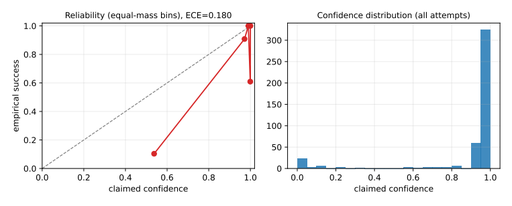
Figure 2 : Reliability diagram and confidence distribution, primary population, pooled over the three conditions (hence the single pooled ECE in the panel title; per-condition ECE is in F3, per-model ECE in Table 1).
Original paper · CC BY 4.0Once the agent had to measure its own code, ECE fell to 0.091 under enforced tool-use. Under the checker pipeline, ECE fell to 0.110, so both verified conditions beat the single-shot calibration. Haiku's per-model AUROC rose from 0.72 to 0.98 or 0.99 under verification. Deepseek's AUROC went from 0.65 to 0.83 or 0.93, a clear gain on the same measure.
Sonnet's checker AUROC of 1.00 rests on few negatives, and its tool-use arm had no failures to rank.
Qwen3.7-max is the exception, falling from 0.65 to chance, at 0.50 and 0.55. Its confidence sat at 1.0 whatever the outcome, so its claims improved while its stated uncertainty didn't. The checker's confidence on valid-solid episodes reached AUROC 0.68, but that rests on only 7 negatives. The authors don't claim that the architectures teach calibration, because the verified conditions let the agent tie its claim to measurements.
The ECE figures therefore depend on the binning choice. The authors lead with per-model AUROC, which doesn't depend on binning, and report ECE alongside it.
Context divergence against episode length
Context divergence, measured as the Context Divergence Score (CDS), separates passing episodes from failing ones in the multi-agent condition. Episode-mean CDS was 0.105 for passing episodes and 0.518 for episodes that never built a solid. Mann–Whitney tests over passes versus all failures gave p<10−15, and CDS reached AUROC 0.86 as an episode-failure predictor.
A key counts as agreeing when it is present for both roles and within 2% relative tolerance.
A number that high needs baselines, so the authors compared it against episode length. The number of coder–checker rounds predicted the same outcome at AUROC 0.87. It doesn't flag valid-but-wrong parts, though: the seven such episodes averaged CDS 0.107, against 0.105 for passes. Stratifying by validity removes the signal that CDS showed on the full population.
The authors' pre-specified prediction P2 said that context drift would raise the constraint-violation rate on multi-part specifications. They tested it on the multi-feature tier, because the suite has no assembly tier. The data don't support P2, because divergence predicts episodes that never build a solid rather than plausible-wrong parts.
The authors report this null explicitly rather than hiding it.
The result matters for the next question, which is how the silent-failure picture holds up under the oracle and grader checks. Pre-specified predictions were fixed before any agent ran, and the study plan was not lodged with a registry. Silent failures sit in T1 and T2 parts, and 19 of 31 come from two tasks.
How far the oracle and grader can be trusted
The authors first ask whether the grader itself is sound before any agent output is scored. A stratified sample of 81 valid-solid agent outputs was drawn from the primary population.
The authors argue that standard angle-bracket practice dimensions legs as overall lengths, so the grader took the 40mm reading and the expert took the other. The full agreement table and every per-item disagreement sit in the released artifact.
The oracle is then tested against itself, because the hardened checks could move verdicts in either direction. The hardening added axial extents, per-hole radial deviation, mass-centre offsets, body counts, and ±8% volume bands. Those flips exposed 17 silent failures the original checks had hidden, which is 35% of the 48 silent failures in the regraded corpus.
Because property checks are necessary-condition screens, any unmodelled property can only add failures, so the measured rates are lower bounds on that axis.
Grader false negatives run the other way, and the expert audit bounds them. Three of those four had been counted as silent failures, so the primary rates would move to 20/156 (12.8%) single-shot and 4/156 (2.6%) tool-use. Band scaling is the second check: the authors regraded the primary population with every band scaled by a common factor.
Halving every band changes no verdict, so the silent failures are gross errors rather than marginal misses. Scaling from ×0.25 to ×4 keeps the single-shot minus tool-use contrast between 6.4 and 10.9 pp, with McNemar p < 0.01.
Limits of the evidence
Results come from four models from four vendors, and none is from OpenAI or Google, because the gpt-5.5 run was incomplete. The 13 tasks and 122 checks separate architectures but don't rank models finely or give absolute rates that transfer to other task mixes. Thirteen of the 31 primary silent failures come from the ambiguous L-bracket task, so absolute rates there are an upper bound.
Three repetitions at provider-default decoding, with no seed control, bound the variance estimates.
The audit has one expert rater, who is a co-author, and a second external rater would strengthen it. The checks are model-correctness screens rather than design validation, so a part that passes can still be unmanufacturable. Verification costs far more input tokens, about 2,821 per tool-use attempt against 211 for single-shot. The old-protocol deepseek-v3.2 runs show 11/39 silent failures against 2/39, but the authors don't interpret those rows statistically.
Paper info
- Authors
- Carson Rodrigues, Clive Rodrigues, Aravind Reddy G
- Venue
- arXiv · Preprint
- First published
- 2026-11-6
- Added
- 2026-11-10
- Updated
- 2026-11-6
- Version
- v1
- arXiv
- 2611.10063
- Category
- cs.SE · cs.LG
- Original paper terms
- CC BY 4.0
- What we show
- Paper info, commentary and permitted figures from the original paper
AI commentary is a separate explanation from the original paper and may contain errors. The original paper and figures follow each source's terms of use and any rights noted separately.
Abstract
When a large language model (LLM) agent writes parametric CAD code from a natural-language specification, syntactic success decouples from semantic correctness. We release a benchmark and harness that measure this gap directly: 13 specification tasks whose every requirement maps to machine-checkable properties of the produced B-rep, measured by the kernel against published tolerance bands, with reference solutions and the full graded attempt corpus. The exact, self-audited oracle isolates two quantities no prior CAD benchmark reports: the silent-failure rate (a valid, renderable solid, an explicit completion claim, and at least one failed semantic check) and completion-claim calibration. Across four models from four vendors (156 attempts per architecture), single-shot agents claimed completion on 98% of attempts and were silently wrong on 14.1%; a tool-use loop that enforces measure-then-claim cut silent failures to 3.2% and raised claim precision from 64% to 96%, and a four-model ablation attributes the change to the claim contract rather than the feedback. A planner-coder-checker pipeline matched that precision at lower coverage with no success gain. Stated confidence was miscalibrated single-shot (ECE 0.32) and became informative under verification for three of four models. Hardening our own oracle flipped 18 of 519 regraded verdicts from pass to fail and none in reverse; a blind expert audit overturned 3 of the 18 silent failures outside the one ambiguously specified task; and fourfold scaling of every tolerance band leaves the contrast intact.
Quote from the paper
Carson Rodrigues, Clive Rodrigues, Aravind Reddy G (2026). Done Is Not Correct: Measuring Silent Failures and Self-Verification Calibration When LLM Agents Take CAD Actions. arXiv:2611.10063v1. https://arxiv.org/abs/2611.10063v1
BibTeX
@misc{rodrigues2026done,
  title = {{Done Is Not Correct: Measuring Silent Failures and Self-Verification Calibration When LLM Agents Take CAD Actions}},
  author = {Carson Rodrigues and Clive Rodrigues and Aravind Reddy G},
  year = {2026},
  eprint = {2611.10063},
  archivePrefix = {arXiv},
  url = {https://arxiv.org/abs/2611.10063v1}
}