Paper commentary
ForecastGym: A Live, Controlled, and Replayable Benchmark for Forecasting Agents
- Problem Forecasting agents combine retrieved evidence with a model, but live benchmarks mix the two and retrospective search after resolution can leak the outcome.
- Method Records four search APIs' results for open prediction-market questions every two days, then replays the frozen evidence offline with fixed models, memory strategies and providers.
- Results Date-filtered post-hoc search leaked outcomes for every provider, and all tested LLMs had higher Brier scores than the market, by +0.018 to +0.046 over all states.
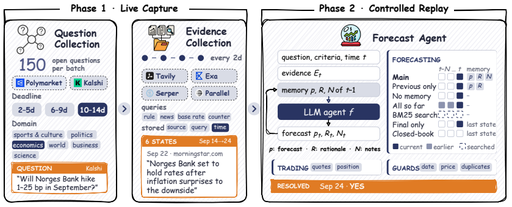
Figure 2 : The ForecastGym lifecycle described in Section 3. Phase 1 records what four search APIs return every two days for open questions, with each result stored with its source, query, and retrieval time. Phase 2 replays the frozen states to a forecasting agent behind three safeguards and changes one argument of Eq. (1) at a time. Orange cards follow one question of the first batch.
Original paper · CC BY 4.0 · Tao, Yicheng, Li, Yuante, Fan, Zipei · ForecastGym: A Live, Controlled, and Replayable Benchmark for Forecasting Agents · Original paper figure · Extracted the figure area from page 3 of the original PDF.Why the evidence has to be held fixed
An agent's forecast depends on two things at once: the evidence it retrieves and the model that reads it. Live benchmarks let each system gather its own evidence, so a score mixes what the system found with how it reasoned. Retrospective benchmarks avoid that mixing, but date-filtered search run after resolution can admit content updated after the forecast time, and historical snapshots may be ranked with today's index.
ForecastGym treats the evidence as a controlled variable and records it while each question is still open. The reasoning behind this choice is that a result a search API returns before resolution was knowable at that time, so the record can be replayed without reconstructing what the web looked like later.
Recording evidence while questions stay open
Live Capture starts from binary questions on Polymarket and Kalshi that close within 14 days, with observed market prices serving as an external baseline. The first batch is one budget-limited set of 150 questions.
Retrieval is modelled as a query \(Q_t\) issued at time \(t\) against the web content \(W_t\) available then, giving \(E_t^{(k)} = S_k(Q_t, W_t) \subseteq W_t\) for provider \(k\). The recorded retrieval time, not the page's own date, sets the cutoff for what counted as knowable.
Replaying frozen states with explicit memory
A forecast at state t is computed from the question, one provider's evidence at t and the memory carried from earlier states, so each comparison changes one of these arguments. Single-factor interventions cover the model, the search provider, the evidence the agent sees and the memory it carries.
Three safeguards are applied first: items dated after the state are hidden, items that show the question's own market price are hidden, and near-duplicates are merged.
Memory is an explicit object holding the previous forecast, its rationale and short notes that the agent rewrites at every state.
Date filters let outcomes into the evidence
Each query was run once raw and once with each provider's date filter for pages published before the state, and an outcome-aware LLM judge marked items that carried information from after the state.
Filtering reduced leakage without removing it: Tavily's filtered results had 18% leaking items and Exa's 27%, against 42% and 31% raw. Revealed questions, where leaking items all but state the outcome, were 60% for filtered Tavily results and 92% for filtered Exa results.
Gemini forecasting from date-filtered Tavily results reached 0.137 Brier and from date-filtered Exa results 0.080. Both are better than any tested model or the market achieves on live evidence in the main table, which is why the authors treat the leak as inflating the scores.
Models trail the market on the same evidence
Under the main condition with Tavily evidence, the last-state Brier scores were 0.217 for GPT-5.6 Terra, 0.244 for Claude Sonnet 5, 0.218 for Gemini 3.8 Flash, 0.220 for DeepSeek-V4.1-Flash and 0.208 for GPT-6.1 Sol. The market reached 0.176, and GPT-6.1 Sol, released after the batch resolved, is reported without a ranking. Over all states the gaps to the market ranged from +0.018 to +0.046 Brier, and each gap was significant.
Score differences among GPT-5.6 Terra, Gemini 3.8 Flash and DeepSeek-V4.1-Flash were not significant, and accuracy orders these models differently from the Brier score. Claude Sonnet 5 falls clearly behind, through overconfidence on low forecasts.
Without evidence, no model beats a constant forecast of 0.5, which scores 0.25 Brier, while with Tavily evidence every model improves. On sports winner, spread and total questions the models come within 0.004 Brier of the market.
Where the gap to the market comes from
The models match the market's calibration but their resolution is only about half the market's, which the authors tie to missing information.
Among the 111 states across 49 questions that trail the market by more than 0.1 Brier, gap attribution assigns one of four causes to each state.
Not retrieved is the largest cause, because another provider returned the fact or the planning LLM never searched for it, while misreading is a small share.
Memory steadies forecasts more than it sharpens them
Persistent notes gave the best scores by small margins, and only dropping all memory or using BM25 significantly worsens the time-averaged Brier score.
Steadiness has a cost when a wrong reading is carried forward: in the Norges Bank case the notes stressed softer inflation, the models drifted down and the market rose while the bank hiked.
Search source can move scores more than model choice
The point-estimate ranking of the four models differs between Tavily and Exa evidence, with a Kendall rank correlation of 0 across the four models. All four models score better with Exa, but only Claude Sonnet 5 improves significantly.
Limits of the first batch
The short-horizon comparison rests on only 21 questions, so the batch composition may explain the advantage on 10 to 14-day questions. The first batch has 144 scored questions, one cancelled and five still open.
The evidence-direction and gap-attribution labels come from an LLM judge that is outcome-aware, and the labels enter no score.
Paper info
- Authors
- Tao, Yicheng, Li, Yuante, Fan, Zipei
- Venue
- arXiv · Preprint
- First published
- 2026-11-17
- Added
- 2026-11-20
- Updated
- 2026-11-17
- Version
- v1
- arXiv
- 2611.23045
- Category
- cs.AI · cs.CL
- Original paper terms
- CC BY 4.0
- What we show
- Paper info, commentary and permitted figures from the original paper
AI commentary is a separate explanation from the original paper and may contain errors. The original paper and figures follow each source's terms of use and any rights noted separately.
Abstract
Agents built on large language models (LLMs) increasingly forecast real-world events by searching the Web and reasoning over what they find. How well such an agent forecasts depends on both the retrieved evidence and the model, making control over that evidence essential for evaluation. Live evaluations can mix retrieval with reasoning when each system searches on its own, while retrospective search can leak later information through date filters or today's ranking of historical pages. Comparing models, search sources, and memory strategies requires both fixed evidence and a record of how it evolved before resolution. We introduce ForecastGym, which records what four commercial web search APIs return for open prediction-market questions every two days and replays this frozen evidence offline once outcomes are known, comparing models, memory, and captured search sources under a fixed evidence-acquisition policy. Its first release covers 150 questions, 614 evidence states, one per question and collection time, and 131k search results. Rerunning the same queries after settlement returns results that all but state the outcome for up to 92% of the questions, despite the tested date filters. On the frozen evidence, all tested LLMs trail the market in forecasting accuracy. Our diagnostic analysis suggests that missed public information contributes more to the gap in high-gap states than misreading does. Switching the search API changes a model's Brier score by up to 0.043, more than the spread across models, while persistent notes score similarly to rereading all evidence at half the input tokens. The evidence a forecaster sees can matter as much as the model that reads it.
Quote from the paper
Tao, Yicheng, Li, Yuante, Fan, Zipei (2026). ForecastGym: A Live, Controlled, and Replayable Benchmark for Forecasting Agents. arXiv:2611.23045v1. https://arxiv.org/abs/2611.23045v1
BibTeX
@misc{yicheng2026forecastgym,
  title = {{ForecastGym: A Live, Controlled, and Replayable Benchmark for Forecasting Agents}},
  author = {Tao, Yicheng and Li, Yuante and Fan, Zipei},
  year = {2026},
  eprint = {2611.23045},
  archivePrefix = {arXiv},
  url = {https://arxiv.org/abs/2611.23045v1}
}