Paper commentary
StateAlign: Internalizing State-Aware Decision-Making for Reliable Multi-Turn Tool Agents via Reinforcement Learning
StateAlign trains tool agents to act on their current task state
- Problem Tool agents can score higher on benchmarks while hallucinating more tool calls. RL training rewards task completion alone, so agents often execute when they should ask for missing information or decline an infeasible request.
- Method StateAlign adds a state-contrast term to outcome-reward RL training. For each generated token, it scores how well the token fits the current task state compared with a paired state, and it trains the policy on those scores.
- Results On Qwen3-8B, StateAlign raises BFCL v4 multi-turn accuracy from 45.5% to 55.2%. No-tool hallucination on SimpleToolHalluBench falls from 62.2% to 56.1%.
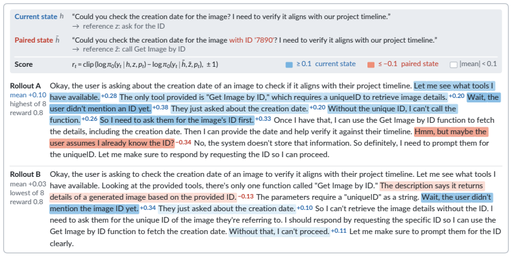
Figure 4 : State-contrast scores for two successful rollouts when the image ID is missing; the paired state provides it. Labels show mean token scores within each sentence. Blue indicates scores ≥0.1 , red indicates scores ≤ −0.1, and unshaded sentences have scores between these thresholds. Both rollouts ask for the ID; their reasoning differs in state compatibility.
Original paper · CC BY 4.0 · Zhexi Lu, Subhajit Chaudhury, Tejaswini Pedapati, Keerthiram Murugesan, Lei Yu · StateAlign: Internalizing State-Aware Decision-Making for Reliable Multi-Turn Tool Agents via Reinforcement Learning · Original paper figure · Extracted the figure area from page 7 of the original PDF.Higher tool scores can hide hallucinated calls
RL has raised the tool-use scores of large language models, but the gains don't always come with reliable behavior. Figure 1 makes the trade-off visible on Qwen3-8B: some RL-trained agents beat the base model on BFCL v4 multi-turn accuracy yet hallucinate more tool calls. Earlier work had already recorded hallucinated tool choices, and stronger reasoning has been tied to more of them.
The authors read this as a sign that task performance alone can't judge whether an agent acts on what it knows.
Supervised fine-tuning has a related blind spot, because it teaches the model to imitate reference actions from fixed demonstrations. Once the model's own call goes wrong, the history it then sees may fall outside anything the demonstrations covered. Recovery from that state then becomes guesswork, since the training data never showed the way out.
The authors found a sharper form of the failure: a model can name a missing value in its reasoning and still emit a call with fabricated arguments. They read this as a reason to train agents on whether and how to act given the current task state. StateAlign was built to address this by pairing task states with different action requirements.
Where a Qwen3-8B decision breaks
Qwen3-8B picks the right target function most of the time when execution is warranted, which makes the failures easier to isolate. Figure 2a pairs each calling state with a contrasting state that differs in a single condition. Target-function selection reaches 97 to 98% in those execution cases. Under the contrasting conditions, the model's choice of the required action is less reliable.
The paper checks these responses using the protocol in Appendix D.
In the missing-information condition, the model names the missing value in its reasoning in 95% of responses. Only 65% of those responses actually ask the user for the value. Figure 2b shows the gap in one response, where the reasoning ends with a decision to ask for the user's phone number. The tool call then supplies a number that never appears in the context.
So the reasoning and the action disagree, even though the model could see the missing fact. The authors read this as a failure to carry a stated decision into the action.
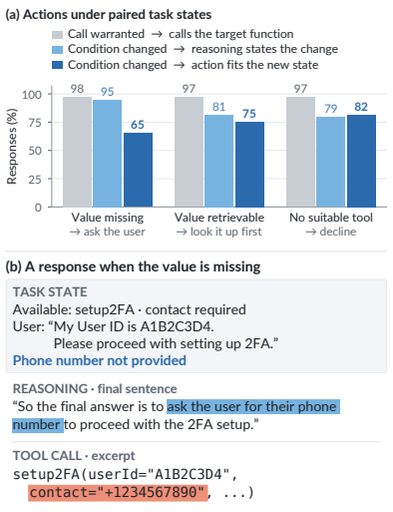
Figure 2 : Task-state diagnosis on Qwen3-8B.(a)Each group pairs a state in which calling the target function is warranted with one that differs in a single condition; bars give the share of responses.(b)Response excerpts when a required phone number is missing. Blue shading marks the decision to ask; red shading marks the unpro- vided value in the emitted call.
Original paper · CC BY 4.0Editing one condition to build paired states
The key move is to take a real tool-use step and edit one condition of its context, so the same step can be judged under two different states. The source data comes from ToolMind and LoopTool-23k, and structural checks drop invalid calls and inconsistent histories first. Qwen3.8-27B then filters calls that don't serve the request or carry unsupported arguments.
EXEC supplies the information and tools needed for execution. NEED_USER removes a required user-provided value or keeps a clarification turn, so the agent must ask before it executes. INFEASIBLE removes the required tool and its identified alternatives. STOP includes a result that completes the request, and it requires a reply without further calls.
The pairing matters because the two states demand different actions for the same request. Unpaired instances don't get a counterpart, so they receive outcome supervision alone. Resampling by condition yields 30,433 samples, and 55% of them have a paired counterpart.
Execution checks come from the source calls and observations, which also supply interaction feedback. Missing-value rewrites keep the request intact, and validation removes cases where the omitted value can still be inferred. The paper's prompts for these edits appear in Appendix F, so the construction can be reproduced.
How outcome reward and state contrast combine
The core idea keeps the usual task-completion signal and adds a second signal that asks whether each generated token fits the state it sits in. For an execution trajectory, the outcome reward is gamma to the power k minus 1, times alpha of tau, times c of tau, when the call succeeds, and zero otherwise. Here k is the execution step, gamma is 0.8, and alpha penalizes extra calls, set to 0.5 when extra calls occur.
Success requires the designated function and arguments to match, and an attempt at the target call before the required information arrives ends the trajectory with zero reward. Groups sampled from one state give relative advantages in a token-normalized GRPO objective, with KL regularization to the base model. This objective trains every policy output, including the continuations that follow a recorded step.
The state-contrast term needs two contexts, the current one and its pair, and each comes with a reference path that states the appropriate action. A fixed base model π0 scores each generated token under both contexts, and the score is the clipped difference of the two log-likelihoods, bounded between -1 and 1. A positive score means the token fits the current state better, and a negative score means it fits the paired state better.
The policy itself still acts only from its tools and history, and the paired contexts serve only the scoring.
The scores weight the policy's own log-likelihood of those tokens in a pair objective, with gradients stopped on the weights and normalization by the count of policy tokens across the batch. The two objectives are summed as J equals J_out plus lambda times J_pair, with lambda set to 0.1. Groups with varying rewards get priority, and a share of paired successful groups is kept as well.
Benchmark gains across five base models
On Qwen3-8B, BFCL v4 multi-turn accuracy rises from 45.5% for the base model to 55.2% with StateAlign. No-tool hallucination on SimpleToolHalluBench drops from 62.2% under outcome-only training to 56.1% with the full method. The biggest gap over LoopTool appears in Missing Parameters, the category that requires obtaining information before execution.
Across the five base models, StateAlign improves every BFCL category and When2Call accuracy. It also lowers NTA hallucination relative to each base model in Table 1. At 14B, BFCL accuracy is 54.8%, close to AWM's 55.5%. StateAlign still leads AWM-14B on ToolSandbox similarity, 81.3 against 74.2. No-tool hallucination at 14B is 45.0%, compared with 53.9% for AWM-14B.
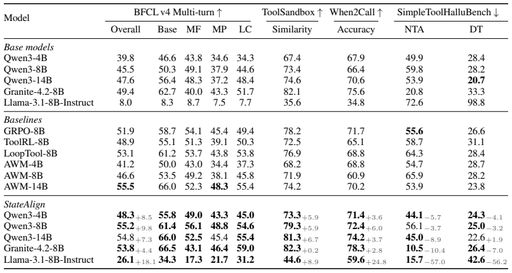
Table 1 : Comparison of StateAlign with base models and tool-use training baselines on task performance and tool hallucination across four benchmarks. ToolSandbox similarity reflects how well execution trajectories satisfy task milestones. MF, MP, and LC denote Missing Functions, Missing Parameters, and Long Context. NTA and DT denote the no-tool and distractor-tool settings. All scores are on a 0–100 scale. Gray subscripts indicate score differences from the corresponding base model;boldmarks the best result for each base model and size.
Original paper · CC BY 4.0ToolRL uses Qwen3-8B trained on RLLA-4k, while LoopTool and AWM use released models that keep their own training data. The table therefore compares finished systems rather than a single shared training recipe. BFCL numbers are means over six evaluations, and the other benchmarks use three evaluations each.
That comparison isolates the state-contrast term, because both runs share the constructed states and the outcome reward.
Separating state construction from the contrast term
Swapping the original training data for constructed states changes both reward designs in Table 2A. With ToolRL, BFCL goes from 48.9 to 53.0, and When2Call rises from 65.1 to 71.3. Both reward designs also lower NTA and DT hallucination on the constructed states. These comparisons don't use the pair objective, so they isolate the effect of the data.
The contrast term then adds to outcome-only training on the same constructed states. At 14B, NTA falls from 56.9% to 45.0%, and DT falls from 25.2% to 22.6%. At 4B, NTA drops from 54.7 to 44.1 once the contrast term is added.
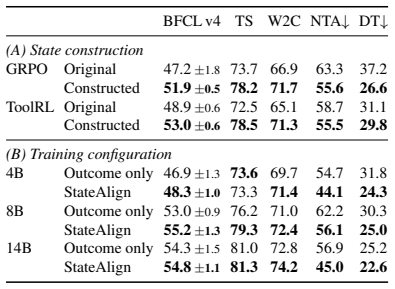
Table 2 : State construction and training ablations. TS: ToolSandbox; W2C: When2Call; NTA, DT: halluci- nation rates (lower is better).(A)Qwen3-8B trained on original data (ToolMind for GRPO; RLLA-4k for ToolRL) and constructed states.(B)Outcome-only train- ing and complete StateAlign on constructed states. Bold: better of each pair.
Original paper · CC BY 4.0Outcome-only training and StateAlign share the constructed states and the outcome reward. The Qwen3 comparisons use the step-400 checkpoint. The paper's Table 2 doesn't report the contrast term applied to the original data.
Clarify, fetch or decline when the state asks for it
Training shifts the missing-value behavior mostly by making Qwen3-8B ask for the value more often. Across the paired clarification states, correct clarification reaches 83.2% for StateAlign. That compares with 68.8% for the base model and 80.6% for LoopTool. So the improvement comes from asking at the right moment, not from refusing to call when execution is correct.
The panel B split separates what the model decides from what it then does. Among traces that name the missing value, StateAlign still proposes execution with an unprovided value in 6.4% of cases. That rate is 10.5% for ToolRL and 10.2% for LoopTool, and lower is better. When the reasoning chooses to ask or take another step first, StateAlign still makes a target call in 4.5% of responses.
LoopTool makes such calls in 5.8% of responses, so StateAlign's margin there is small. Appendix D.2 extends the same action checks to other states and to an irrelevant-history control.
The judges behind these labels were checked against outside annotators before the numbers were trusted. Qwen3.8-27B labels agreed with the majority of three Claude Opus annotations on 70.4% of condition judgments. The recovery numbers in the next section draw on the same error-handling comparison.
Multi-call turns and recovery after errors
Multi-call turns test whether the decision gains carry past the first call into a full chain of tool calls. Among its multi-call BFCL turns, StateAlign leaves 6.8% incomplete, compared to 9.9% for GRPO and 9.2% for LoopTool. Incomplete turns are those that fail after issuing some but fewer calls than the reference requires. The authors read this as better completion of the chain, not just a better first call.
On ToolSandbox multi-call scenarios, StateAlign also leads in similarity, as shown in panel c of Figure 5.
Tool errors ask the agent to change its next action before it continues. After a tool error on Qwen3-8B, StateAlign's Reply+fail rate is 2.7%. That compares to 5.7% for GRPO and 6.3% for LoopTool. On ToolSandbox error scenarios, similarity rises from 68.9 for the base model to 73.5 for StateAlign. In the BFCL example, the model locks the doors after a startEngine error, then presses the brake pedal when the next error asks for it.
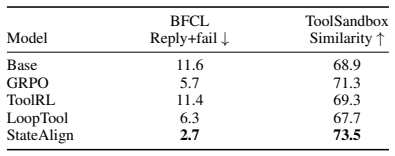
Table 4 : Behavior and task completion after tool errors on Qwen3-8B. BFCL Reply+fail is the percentage of error-containing turns with no tool call in the next as- sistant response after the first error and a final failure. ToolSandbox reports similarity for error-containing sce- narios. Values use a 0–100 scale; bold marks the best result in each column.
Original paper · CC BY 4.0Reply+fail counts failed error turns with no call right after the first error. The authors divide that count by all error-containing turns. Appendix D.3 gives the recorded sequence and further recovery comparisons.
Limitations and what the tests leave open
StateAlign was trained on five types of constructed task states, using short interactions with recorded feedback. Its training feedback comes only from the interactions covered by the source trajectories. The authors don't test longer workflows where user goals or tool behavior change during the interaction. Training pool construction used Qwen3.8-27B for filtering and rewriting, and the training pool holds about 30k instances.
Its 55% paired share means nearly half of the training instances have no counterpart that requires a different action.
The benchmarks use 728 ToolSandbox scenarios, 300 When2Call examples, and 296 examples for each hallucination condition. The judge for When2Call and SimpleToolHalluBench is deepseek-chat, which also serves as the ToolSandbox user simulator.
Paper info
- Authors
- Zhexi Lu, Subhajit Chaudhury, Tejaswini Pedapati, Keerthiram Murugesan, Lei Yu
- Venue
- arXiv · Preprint
- First published
- 2026-11-12
- Added
- 2026-11-13
- Updated
- 2026-11-12
- Version
- v1
- arXiv
- 2611.16304
- Category
- cs.LG
- Original paper terms
- CC BY 4.0
- What we show
- Paper info, commentary and permitted figures from the original paper
AI commentary is a separate explanation from the original paper and may contain errors. The original paper and figures follow each source's terms of use and any rights noted separately.
Abstract
Reinforcement learning has improved the tool-use capabilities of large language models. However, better task performance can coincide with increased tool hallucination. Reliable tool use requires decisions to follow the current task state: available information, tool capabilities, and task progress. Our analysis shows that agents sometimes execute when they should ask for information, retrieve it, or decline an infeasible request, even when reasoning identifies missing information. We introduce StateAlign, combining task-state construction with state-contrastive reinforcement learning. The data cover five task conditions and pair states with different action requirements. Outcome rewards guide task completion; token-level contrasts compare the same generated reasoning and actions under paired states to train outputs that fit the current state. Experiments across five base models from three families show improvements on BFCL v4 multi-turn, ToolSandbox, and When2Call. Ablations show that state construction improves performance and reliability under different reward designs. The complete method further reduces tool hallucination across three Qwen3 sizes. On Qwen3-8B, StateAlign improves BFCL v4 multi-turn accuracy from 45.5% to 55.2% and reduces no-tool hallucination on SimpleToolHalluBench from 62.2% under outcome-only training to 56.1%. Behavioral analyses show more consistent decisions, more complete multi-call execution, and stronger recovery after tool errors.
Quote from the paper
Zhexi Lu, Subhajit Chaudhury, Tejaswini Pedapati, Keerthiram Murugesan, Lei Yu (2026). StateAlign: Internalizing State-Aware Decision-Making for Reliable Multi-Turn Tool Agents via Reinforcement Learning. arXiv:2611.16304v1. https://arxiv.org/abs/2611.16304v1
BibTeX
@misc{lu2026statealign,
  title = {{StateAlign: Internalizing State-Aware Decision-Making for Reliable Multi-Turn Tool Agents via Reinforcement Learning}},
  author = {Zhexi Lu and Subhajit Chaudhury and Tejaswini Pedapati and Keerthiram Murugesan and Lei Yu},
  year = {2026},
  eprint = {2611.16304},
  archivePrefix = {arXiv},
  url = {https://arxiv.org/abs/2611.16304v1}
}