Paper commentary
User Embeddings are Superpositions of Interpretable Behavioral Modes
Sparse autoencoders recover interpretable behavioral modes inside user embeddings
- Problem Dense user embeddings are hard to read, so teams cannot easily tell why a recommendation was made or what a user's embedding encodes. Existing sparse methods need raw interaction data, which the embedding alone does not provide.
- Method SAE treats each user embedding as a sparse blend of behavioral modes and decomposes it with a sparse autoencoder. Unlike hand-built taxonomies, it needs only the pre-trained embedding, and an LLM names each recovered mode.
- Results On synthetic SASRec embeddings, the SAE reaches 0.58 code–GT alignment, against 0.45 for K-Means encoding.
Why dense user vectors resist inspection
User embeddings are dense vectors that compress a user's historical actions and preferences into a single representation. Recommendation and deep learning models take these vectors as input, which is why they matter in personalization systems. The same density that makes them useful also makes them hard to read, since they are not inherently interpretable.
A team can't easily tell why a specific recommendation was made for a particular user. Auditing what information an embedding contains about a user is equally difficult. Searching the embedding space with natural language is also out of reach, because these vectors were never trained on text.
The usual alternatives start from raw interaction data rather than from the embedding itself. A hand-built taxonomy of modes requires domain-specific configuration and raw interaction data. The authors instead ask whether the structure already inside a pre-trained embedding can be pulled out and named. Their post-hoc decomposition needs only pre-trained embeddings and discovers modes unsupervised from the data.
The authors take the superposition hypothesis from mechanistic interpretability as the framework for this opacity. In MI, transformer neurons encode human-interpretable concepts in superposition, and sparse autoencoders can recover them. The paper argues that user embeddings encode behavioral modes in the same way.
Why a user vector should look like a sum of modes
The core idea is that a user's behavior is a sparse blend of a few behavioral modes, and the embedding inherits that blend. The generative model assumes a discrete set of K modes, each with its own distribution over observations. Each user gets non-negative weights on only a few modes, so most weights are zero. Each interaction is drawn from one mode, so a user can belong to several modes at once.
This mixed-membership structure is the same one that the LDA model uses for words and topics. The authors generalize LDA from discrete tokens to continuous and vector-valued observations.
The embedding is defined as a function F applied to the user's matrix of interactions, which can be a classical model or a neural encoder. For a linearly transformed sample mean, the same expression holds with the centroids replaced by their images A d_k. The centroids need not be orthogonal, because modes such as coffee connoisseur and home barista share directions.
When m is smaller than K, unrelated modes must share directions, which places the centroids in superposition. This overlap favors overcomplete sparse dictionaries over orthogonal decompositions for recovery.
For nonlinear transformer encoders, the authors argue a similar structure holds approximately, using the superposition hypothesis on residual-stream positions. For any linear pooling of positions, the embedding becomes a linear combination of transformer features, with a mode-level centroid replacing d_k. Single-position readouts such as the last token or the [CLS] token fall outside this linear-pooling argument.
The authors conjecture that mode-level resolution emerges from training dynamics, but they leave verification to future work. Under the flat model, any extra splitting of a centroid across SAE latents counts as artifactual feature splitting. Merging split features post-hoc absorbs only that artifactual component, not the finer structure caused by attention.
How the SAE is trained and its latents named
The SAE takes a user embedding u and encodes it with a ReLU layer, then reconstructs it with a linear decoder. Each latent activation estimates a mode weight, and each decoder column estimates the direction of one mode. Recovering modes becomes a sparse dictionary problem, and the SAE's dictionary width is usually larger than the embedding dimension to fit superposition.
Classical LDA and NMF can solve this too, but they need the raw interaction data, which the SAE avoids.
The loss combines the squared reconstruction error with an L1 penalty on the latent activations. The decoder columns are unit-normalized, so they are unit vectors in the original embedding space. Overcompleteness lets the SAE give features to each mode, which PCA can't do because its components are orthogonal. On synthetic data the SAE uses dhidden = 300, which is 4× overcomplete relative to ground truth, and the sparsity penalty adapts so mean L0 matches the ground-truth modes per user.
Feature splitting can make one mode direction appear across several latents, so the authors merge latents whose decoder directions have cosine similarity above 0.45.
Each SAE latent is named by an LLM that sees activating and non-activating users along with their interaction histories. The LLM returns a name, a description and a basis vector for each latent, all in the original embedding space. Because the name is grounded in the vocabulary shown to the LLM, latents that fall outside that vocabulary get a lower confidence score.
At retrieval, the authors keep only latents with confidence at least 0.6, so named features stay within the vocabulary's resolution.
At query time, an LLM scores each retained latent's relevance to the audience query on a 0 to 10 scale. On Open e-commerce the SAE is 4× overcomplete with dhidden = 512 and mean L0 of about 23.
Recovering known modes on synthetic users
The synthetic setup defines K=75 behavioral modes, each with a description and example products, so the ground truth is known. Claude Sonnet 4 writes a purchase history per user, with a median of 55 orders, that follows these weights plus 5 to 20% off-mode noise. The authors chose K=75 so that the swept embedding dimensions m=16 to 128 bracket the mode count.
Each product is embedded with all-mpnet-base-v2 and mean-pooled over the user's interactions, giving a 768-dimensional embedding. Random projections onto directions in R^m vary the amount of superposition, and the embeddings are standardized and L2-normalized.
The SAE uses dhidden=300, four times the ground-truth mode count, with an adaptive sparsity penalty. That penalty sets the mean number of active latents (L0) to match the ground-truth mean number of modes per user. The SAE is compared against six baselines, including PCA, FastICA, K-Means encoding, the soft-frozen decoder SAE, and NMF. K-Means encoding uses 75 components, while PCA, ICA, and NMF use min(75, m), and NMF keeps its natural sparsity.
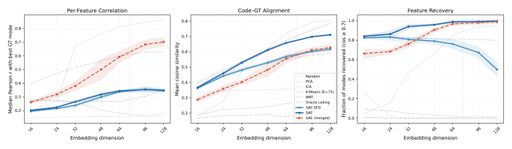
Figure 1 :Mode recovery vs. embedding dimension m (mean ± 1 std over 5 random projections). Left: median per-feature Pearson r with best-matching ground-truth mode. Center: mean per-user cosine similarity between projected codes and ground-truth weight vector. Right: fraction of modes recovered at decoder–centroid cosine similarity≥0.7. The vertical line marksm= 75, the ground-truth mode count.
Original paper · CC BY 4.0 · Jonathan Kozaczuk, Zheng Dong, Noyan Evirgen, Keivan Majidi, Eddie K. H. Ng, Chris Porter, Qi Zhao, Jia Geng, Changmao Li, Brandon R. Feng · User Embeddings are Superpositions of Interpretable Behavioral Modes · Original paper figure · Extracted the figure area from page 6 of the original PDF.In the high-superposition regime with m below 75, the SAE matches or exceeds every classical baseline on mode recovery. K-Means with 512 components recovers more mode directions than the SAE at m≤48. That extra capacity doesn't close the alignment gap, and K-Means underperforms its 75-component reference at every m≥32 on code–GT alignment.
On SASRec embeddings of the same synthetic users at d=256, the SAE reaches 0.58 code–GT alignment. That compares with 0.53 for FastICA, 0.45 for K-Means encoding, 0.37 for LDA, and 0.25 for PCA. The SAE recovers 73 of 75 modes at cosine at least 0.7, while FastICA and K-Means encoding fall from 95% to 59% and from 79% to 52%. This matters because the transformer encoder satisfies the linear superposition model only approximately.
Across every projected dimension from 16 to 128, the SAE also recovers more modes than PCA, FastICA, and K-Means encoding.
Zero-shot retrieval on Open e-commerce and MovieLens
The authors test the named modes on two real datasets, Open e-commerce 1.0 and MovieLens 1M. An LLM auto-interprets each latent from its top-activating users, then scores each latent's query relevance on a 0 to 10 scale. The text-embedding baseline embeds a per-user summary and the query with all-MiniLM-L6-v2, then ranks by cosine similarity.
On Open e-commerce category tasks, the SAE reaches a Lift of 1.93×, against 1.86× for FastICA and 1.85× for K-Means encoding. The text-embedding baseline reaches only 1.39× on the same category tasks, so the decomposition beats both classical sparse methods and the text route. On life-event tasks, the SAE reaches 5.30×, against 4.75× for FastICA and 4.29× for K-Means encoding.
The SAE's FVU of 0.075 sits close to FastICA's 0.083, while K-Means encoding reaches 0.388. Swapping in the open-weight Llama 3.3 70B for interpretation on one Open e-commerce seed leaves SAE retrieval largely unchanged.
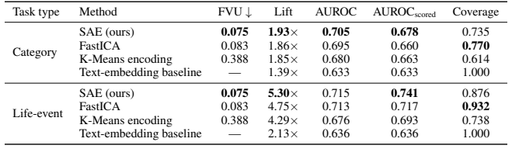
Table 1 :Open e-commerce zero-shot NL audience retrieval, metrics averaged per task block (6 category tasks and 2 life-event tasks, see Appendix C.2). AUROCscored restricts AUROC to users with nonzero scores. Text baseline is the matched-input category-pooled variant (Section 5). Text baseline has no FVU.
Original paper · CC BY 4.0With SASRec, the SAE reaches coverage of 0.977, against 0.811 for K-Means encoding. On Lift and AUROC, the SAE and K-Means encoding are statistically matched, with cross-seed paired Wilcoxon p≥0.1 on both encoders. Table 2 lists an SAE Lift of 2.53 against 2.16 for K-Means encoding on SASRec, and that gap is covered by the same matched test.
Against 14 held-out self-reported demographic labels, the text-embedding baseline falls to near-chance AUROC, significantly below the SAE.
The authors attribute the SAE's edge to dictionary geometry rather than to higher ranking scores on MovieLens. The SAE dictionary is near-orthogonal, with mean absolute pairwise decoder cosine of 0.06 to 0.08 on SASRec. K-Means centroids overlap, with mean pairwise cosine 0.29 on SASRec, and the authors link this overlap to lower coverage.
Audience characterization and dictionary overlap
Audience characterization asks which top-k features best describe a behaviorally defined audience. A useful top-k feature set should span distinct explanatory concepts rather than paraphrase one concept. The authors tested this on 20 franchise-level audiences in MovieLens-1M at k=5. Against the matched-L0 K-Means encoding top-k, the SAE top-k features were significantly less redundant.
Within confidence-filtered features at 0.6 or higher, the authors counted features per distinct concept on niche audiences. K-Means encoding allocated 2.2× more features per distinct concept than the SAE. That gap is 2.20 against 1.00 in redundancy ratio, averaged across 5 niche audiences. On Open e-commerce, whose embeddings are approximately linear, K-Means encoding's redundancy ratio was 2.82, compared to 1.14 for the SAE.
The authors say this effect matches what their generative framework predicts.
The authors trace this redundancy to overlap in the dictionary geometry. On SASRec, the SAE dictionary is near-orthogonal, with pairwise decoder cosines centered at 0. Its mean absolute pairwise decoder cosine lies between 0.06 and 0.08. K-Means centroids overlap instead, with a mean pairwise cosine of 0.29 on SASRec and 0.17 on BERT4Rec.
So its redundant top-k doesn't translate into better audience coverage. Figure 2 illustrates this on the Jurassic Park audience, where the five K-Means features all paraphrase a mainstream-comedy concept. The SAE top-5 features for the same audience span five distinct themes.
Limitations and open questions
The authors left several questions untested, starting with the SAE family itself. Both real-world datasets contain positive-only interaction sequences, so signed or negative feedback isn't covered by the experiments. Other architectures such as MLP or CNN encoders, and domains like mobility, remain untested. On real data the decoder-orthogonality operating point is what keeps feature splitting in check, so no post-hoc merging is applied.
The SAE is 4× overcomplete with dhidden=1024 on the MovieLens encoders, and its mean L0 is 80. Residual finer-grained latents under nonlinear F are left to the auto-interp confidence filter at retrieval. The authors considered at most two temporal snapshots per user, so the temporal dynamics of behavioral modes aren't examined. Explicit combinators over mode directions are named as a natural next step.
The authors also flag a privacy cost of making embeddings queryable in natural language. A dense embedding offers no such option.
Finally, the authors suggest SAE-based recovery may find richer persona structure post-hoc. They expect this to matter most when persona directions are non-orthogonal or overcomplete. This persona direction is a suggestion, and the paper doesn't test it.
Paper info
- Authors
- Jonathan Kozaczuk, Zheng Dong, Noyan Evirgen, Keivan Majidi, Eddie K. H. Ng, Chris Porter, Qi Zhao, Jia Geng, Changmao Li, Brandon R. Feng
- Venue
- arXiv · Preprint
- First published
- 2026-11-5
- Added
- 2026-11-7
- Updated
- 2026-11-5
- Version
- v1
- arXiv
- 2611.08487
- Category
- cs.LG
- Original paper terms
- CC BY 4.0
- What we show
- Paper info, commentary and permitted figures from the original paper
AI commentary is a separate explanation from the original paper and may contain errors. The original paper and figures follow each source's terms of use and any rights noted separately.
Abstract
User embeddings are central components of modern recommendation, personalization, and behavioral modeling systems. Though these embeddings can compactly encode rich behavioral information, they are inherently dense and opaque, limiting interpretability. To address this gap, we argue that user embeddings can be understood as sparse superpositions of interpretable behavioral modes. This structure is directly predicted by generative models of user behavior for linear embeddings and extends approximately to deep-learning representations by the superposition hypothesis. Superimposed modes can naturally be recovered by sparse dictionary learning methods, such as sparse autoencoders (SAEs), and recovered modes can be automatically named and queried in natural language. We validate mode recovery against known ground truth on synthetic data, where SAEs recover modes better than classical sparse baselines, including on transformer-encoded embeddings. We then apply the method to classical and transformer-based user embeddings from two real-world datasets. We also show how the corresponding natural-language labels enable zero-shot audience retrieval and characterization over embeddings never trained on text. The framework is post-hoc and model-agnostic, requiring no modification to the upstream embedding system.
Quote from the paper
Jonathan Kozaczuk, Zheng Dong, Noyan Evirgen, Keivan Majidi, Eddie K. H. Ng, Chris Porter, Qi Zhao, Jia Geng, Changmao Li, Brandon R. Feng (2026). User Embeddings are Superpositions of Interpretable Behavioral Modes. arXiv:2611.08487v1. https://arxiv.org/abs/2611.08487v1
BibTeX
@misc{kozaczuk2026user,
  title = {{User Embeddings are Superpositions of Interpretable Behavioral Modes}},
  author = {Jonathan Kozaczuk and Zheng Dong and Noyan Evirgen and Keivan Majidi and Eddie K. H. Ng and Chris Porter and Qi Zhao and Jia Geng and Changmao Li and Brandon R. Feng},
  year = {2026},
  eprint = {2611.08487},
  archivePrefix = {arXiv},
  url = {https://arxiv.org/abs/2611.08487v1}
}