Paper commentary
Demystifying Classifier-Free Guidance for Auto-Regressive Image Generation
Attention weight reuse cuts the cost of classifier-free guidance in image generation
- Problem Classifier-free guidance works well for autoregressive image generators, but nobody knows why. Prior explanations rely on diffusion reverse-process properties that autoregressive models do not have.
- Method AttnReuse reuses the conditional pass's attention weights for the unconditional pass. It drops the text-token entries and renormalizes over the visual keys, instead of running a second full forward pass.
- Results AttnReuse cut about 25% of attention computation. Janus-Pro 7B's DPG-Bench Overall score under greedy decoding fell only from 83.3 to 82.3.
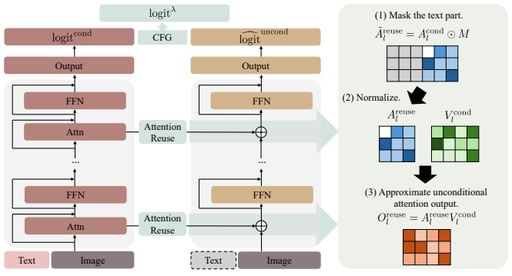
Figure 8 : Illustration of the proposed AttnReuse method. In selected layers, we reuse conditional attention weights by masking out text-token entries and renormalizing over image tokens. We then apply these weights to the conditional value vectors to approximate the unconditional attention output.
Original paper · CC BY 4.0 · Zhiling Zhou, Jiachun Pan, Fengzhuo Zhang, Dirk Bergemann, Zhuoran Yang · Demystifying Classifier-Free Guidance for Auto-Regressive Image Generation · Original paper figure · Extracted the figure area from page 15 of the original PDF.Why CFG is hard to explain in AR models
Classifier-free guidance is standard in autoregressive image generators, and it roughly doubles the inference compute. At each visual token, it extrapolates the conditional logits away from the unconditional logits, so the model runs two passes. Most theory on CFG, however, is built for diffusion models and leans on properties of the reverse diffusion process.
AR models have no such reverse process, so those explanations don't transfer directly.
The authors split the question into three parts: why CFG helps, whether its need reflects a failure of AR pretraining, and whether the doubled cost is necessary.
Where the repetition bias shows up
Greedy decoding from the conditional logits alone gives nearly pure-color images. The logit difference, by contrast, carries the complex texture information. So CFG appears to amplify texture in that difference rather than in the conditional logits themselves.
To see why the two branches give the same pure-color output, the authors compare their top-ranked entries in logit space and in pixel space. They take the union \(U_t = K^{\text{cond}}_t \cup K^{\text{uncond}}_t\) of the top-k indices at each position and measure a normalized \(\ell_1\) discrepancy on those entries. Under a proper guidance scale \(\lambda^*\), the two branches align among their high-logit entries.
Figure 3 shows the discrepancies stay small relative to each branch's magnitude baseline for Emu3, LlamaGen and Lumina. Causal interventions during generation show that these shared top entries mainly repeat previous tokens.
Why sparse textures produce the bias
The authors study a shallow transformer with one attention layer and analyze its gradient-based training dynamics. Their result is that the shared repetition does not come from insufficient or failed pretraining.
The proof rests on the sparsity of image textures, namely many nearly pure-color blocks in training images. The value matrix \(W_V\) pushes text and background tokens toward background repetition, while feature tokens favor feature repetition. The query-key matrix \(W_{QK}\) makes the conditional branch attend to text when it predicts the first feature token.
Because the background bias cancels in the logit difference, only the transition token flips, and feature repetition then completes the block. Without CFG, the conditional model repeats background tokens instead. Under the stated asymptotic regime, the visual loss is \(\mathcal{O}(T_{\text{vis}}^{-1}(\log T_{\text{vis}})^2)\), and the result holds for sufficiently large \(T_{\text{vis}}\).
Splitting attention into two parts
The attention output for a query is split into a visual term and a textual term, weighted by how much attention mass lands on visual tokens. The weight is \(\gamma_t = \sum_{l=T_{\text{txt}}+1}^{t} \exp(q_t^\top k_l) \big/ \sum_{l=1}^{t} \exp(q_t^\top k_l)\), and the textual term carries weight \(1-\gamma_t\). The visual term is shared by both branches, while the textual term drives the difference that forms the guidance direction.
AttnReuse keeps the conditional attention weights, masks out the text-token entries, and renormalizes each row over the visual keys. It then applies these weights to the conditional value vectors, which approximates the unconditional attention output. In AR models it is applied to about half of the layers, for example middle layers such as 16 of 32.
DPG-Bench results
The authors evaluate on DPG-Bench, which has over 1,000 dense and structurally complex prompts. They report greedy decoding (τ = 0) and stochastic sampling (τ = 1), where τ = 0 isolates the top-ranked semantics. Under greedy decoding, Emu3's Overall score fell from 76.7 to 74.7 with AttnReuse. Janus-Pro 7B moved from 83.3 to 82.3 under the same decoding.
Under sampling at τ = 1, Janus-Pro 7B dropped from 84.1 to 82.0, a larger gap than under greedy decoding.
Lumina-GPT 2.0 barely changed under greedy decoding, 52.3 compared to 52.2.
Limits of the evidence
The efficiency and accuracy comparison uses one benchmark, DPG-Bench. The theory covers one shallow transformer with a single attention layer, and its bound holds for sufficiently large T_vis.
Paper info
- Authors
- Zhiling Zhou, Jiachun Pan, Fengzhuo Zhang, Dirk Bergemann, Zhuoran Yang
- Venue
- arXiv · Preprint
- First published
- 2026-11-21
- Added
- 2026-11-24
- Updated
- 2026-11-21
- Version
- v1
- arXiv
- 2611.29002
- Category
- cs.CV · cs.AI · cs.LG
- Original paper terms
- CC BY 4.0
- What we show
- Paper info, commentary and permitted figures from the original paper
AI commentary is a separate explanation from the original paper and may contain errors. The original paper and figures follow each source's terms of use and any rights noted separately.
Abstract
Classifier-free guidance (CFG) has been widely adopted in autoregressive (AR) models for high-quality image generation. Despite its strong empirical performance, its mechanism in AR models remains unclear. This paper demystifies the mechanism of CFG through both empirical and theoretical studies. By examining the top-ranked semantics of different components in CFG, we show that texture information is primarily encoded in the difference between the conditional and unconditional logits, whereas both logits share previous-token repetition as their leading semantics. This strong repetition semantics obscures the desired texture information, causing greedy decoding from the conditional logits alone to produce nearly pure-color images. Through a training-dynamics analysis of shallow transformers, we prove that this shared repetition semantics does not arise from limitations or failures of pretraining, but instead originates from the texture sparsity of images. We further show that CFG improves generation quality by rectifying this repetition bias during inference. Motivated by the shared semantics between conditional and unconditional logits, we propose Attention Weight Reuse (AttnReuse), which reuses intermediate attention computations from the conditional-logit forward pass to accelerate the unconditional-logit computation. AttnReuse reduces about $25\%$ of attention computation with little performance degradation across different models.
Quote from the paper
Zhiling Zhou, Jiachun Pan, Fengzhuo Zhang, Dirk Bergemann, Zhuoran Yang (2026). Demystifying Classifier-Free Guidance for Auto-Regressive Image Generation. arXiv:2611.29002v1. https://arxiv.org/abs/2611.29002v1
BibTeX
@misc{zhou2026demystifying,
  title = {{Demystifying Classifier-Free Guidance for Auto-Regressive Image Generation}},
  author = {Zhiling Zhou and Jiachun Pan and Fengzhuo Zhang and Dirk Bergemann and Zhuoran Yang},
  year = {2026},
  eprint = {2611.29002},
  archivePrefix = {arXiv},
  url = {https://arxiv.org/abs/2611.29002v1}
}