Paper commentary
Seed-Prover: Deep and Broad Reasoning for Automated Theorem Proving
Seed-Prover uses lemmas and Lean feedback to prove olympiad problems
- Problem Whole-proof provers usually don't query the Lean compiler, so they get no feedback while writing a proof. Without that signal, they struggle with hard theorems.
- Method Seed-Prover is a whole-proof model that first writes useful lemmas, then proves the main theorem using them. It refines its proof using Lean compiler feedback, proved lemmas, and self-summarization.
- Results Seed-Prover proved 121 of 155 past IMO problems, a 78.1% success rate.
Why whole-proof provers stall
Reinforcement learning needs a reward signal, but a natural-language proof is hard to check automatically or by hand. Lean supplies a clear, automatic verdict on whether a formal proof is correct, so it can serve as that reward. AlphaProof used Lean to solve 3 problems from the 2024 IMO, which shows the route can work. Formal language let LLMs prove very hard problems that natural-language LLMs could not prove.
Lean provers fall into two families: step-level provers and whole-proof generation provers. Step-level provers write Lean code line by line, which keeps them close to the Lean environment. That granularity forces special scaffolding to assemble a full proof, and it's too fine for high-level reasoning. Whole-proof models emit an entire proof at once, but they typically don't interact with the Lean compiler.
Seed-Prover builds on that whole-proof direction.
Geometry is a separate gap, because Lean lacks sufficient geometry support. Seed-Geometry therefore runs forward-chaining, deriving all known facts by applying rules until closure is reached. Its design follows AlphaGeometry and TongGeometry. The repository holds 230 million unique geometry problems that require auxiliaries. On IMO-AG-50, Seed-Geometry solves 43 problems versus 42 for AlphaGeometry 2.
Lemmas as the unit of proof
Seed-Prover writes a few useful lemmas first and only then proves the main theorem by applying them. Earlier whole-proof models began straight from the theorem keyword, whereas here each lemma is introduced by its own lemma keyword. The authors argue that lemmas stay useful even when the main attempt fails, because each one is a separate piece that can be checked.
Proofs of lemmas may also inspire the model when it works on unproved lemmas and the main problem.
This makes the lemmas a shared store rather than a by-product of one attempt.
Before any proof is attempted, the proposer suggests properties of the problem, which Seed-Prover learns to produce through chain-of-thought reasoning. The proposer takes an unsolved problem, optionally with proved lemmas, and returns 10 to 50 candidate conjectures. Proposing several conjectures in parallel increases diversity and the chance of covering valuable properties.
This differs from Draft, Sketch, Prove, which presumes the full problem can be solved upfront. Seed-Prover maps the problem space broadly before committing to one approach.
Figure 3 shows how the whole-proof, light and medium settings use these lemmas during refinement. In the workflow, failed lemmas feed an inner refinement, and the outer refinement then receives the new context. Seed-Prover also refines the whole proof itself, using Lean compiler feedback, proved lemmas and self-summarization.
Training Seed-Prover with RL on Lean rewards
Seed-Prover is trained with multi-stage, multi-task reinforcement learning built on VAPO, so Lean's verdict acts as the training signal. A formatting penalty pushes the model to write lemmas before it attempts the main theorem. Because the penalty only shapes the output format, the lemma-first habit is learned during RL rather than hard-coded.
The training data mixes open-source datasets with in-house formalized problems. When a problem is too hard for single-pass generation, the proposer creates easier variants, and those variants join the training set. Problems with a proof rate above 1/4 are excluded from RL training, since the authors treat them as too easy. Problem difficulty, problem quality and maximum output length are raised as training progresses.
Prior RL setups, such as those in DeepSeek-Prover-V2 and Kimina-Prover, feed only the formal statement as the prompt. Seed-Prover's prompts instead randomly include natural language hints, natural language proofs, and similar lemmas. The authors argue this mix lets the model use the varied inputs its inference pipeline later supplies.
Iterative refinement with Lean compiler feedback is the inference behavior this training prepares the model for. Under this setting, Seed-Prover proves IMO 2022 P2 (MOHS = 151), while without refinement the same problem needs Pass@8192.
Three inference tiers, from refinement to breadth
At test time Seed-Prover spends its budget in three tiers: light, medium and heavy. Figure 3 shows the single-pass, light and medium workflows side by side. The light setting is the base case: each attempt is refined up to 8–16 times and scored under Pass@8–16. The authors count this budget as equal to whole-proof sampling at Pass@64–256, and it finishes in 1-2 hours.
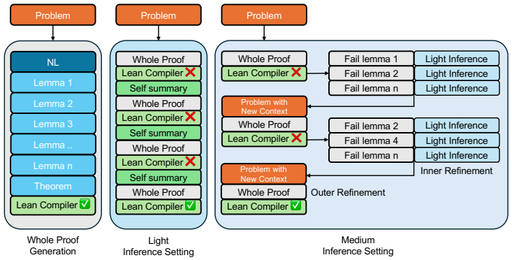
Figure 3 The workflows of single-pass whole proof generation, light, and medium inference settings.
Original paper · CC BY 4.0 · Extracted the figure area from page 5 of the original PDF.Refinement made the difference on IMO 2022 P2, which has MOHS = 151. Light refinement proved it, while without refinement the same problem needed Pass@8192. Two behaviours dominated: fixing Lean syntax errors from compiler messages, and rewriting an initial proof sketch in a way that can change the whole reasoning path.
The medium setting targets long, structurally complex proofs, and it runs two loops. The outer loop refines the proof of the main theorem, as the light setting does. The inner loop targets lemmas the outer loop fails to prove, and runs the light setting with an 8 × 8 budget. When an inner run proves at least one lemma, the outer loop writes that progress into its prompt and continues.
Final proofs can exceed 1000 lines of code.
The medium setting deepens the search on one problem, but it can't cover the many properties a problem might have. The heavy setting starts from a conjecture pool of 5000 by default and an empty lemma pool. Each conjecture is proved or disproved with light inference, and each success enters the lemma pool. Lemmas are scored by proof rate, semantic relevance from an LLM judge and proof length, and hundreds of the top-ranked lemmas feed a medium run.
The authors report that lemmas with a low proof rate are often important to the final proof. The lemma pool grows to several thousand facts after days of running.
How Seed-Geometry searches for auxiliary constructions
Seed-Geometry pairs a trained policy with a forward-chaining engine, so the learned model only supplies the missing auxiliary constructions. The engine then derives everything that follows from each construction, which means the symbolic side handles the deduction. The engine checks every new fact by applying rules until closure, and backward tracing keeps only the dependencies a proof needs.
Plain ruler-and-compass steps are long, and they burden both the Transformer model and the symbolic backend. Seed-Geometry groups these sequences into composite actions, such as isogonal conjugate and exsimilitude center, to keep the representation concise. The backend was rewritten in C++ and exposed to Python through Pybind11, giving roughly 100-fold speedup over the Python implementation in TongGeometry.
The authors first considered an actor-critic setup with a policy model and a value model. Preliminary experiments suggested that a single Seed model as the policy would suffice, which contradicts the two-model design in TongGeometry. Later, the value model was dropped from the final pipeline because large value estimation errors could harm general performance under extensive search.
At run time, Seed-Geometry first transforms the problem into a canonical form and checks whether the backend already finds the goal. If not, the search uses beam search, with the policy generating proposals for each beam in the buffer. The engine checks each proposal, and any proposal that leads to the proof ends the search. Otherwise the top few proposals, ranked by cumulative negative log likelihood, expand the tree until a fixed number of steps is used.
GPU processes synchronize only at beam selection, and a CPU thread pool runs reasoning while the language model works.
The problem generator drew on statistics from more than 20 years of olympiad problems and found over 230 million unique problems. After BPE preprocessing, the dataset totals 38B tokens, and the policy starts from a pretrained Seed model. The generator reached 8x the search efficiency of the Python implementation.
Seed-Prover results across benchmarks
On IMO 2025, the authors report 4 of 6 under the heavy setting and 5 of 6 after the competition. Seed-Geometry solved Problem 2 instantly, while Seed-Prover derived the Problem 5 proof under the medium inference setting. The proofs for the other three problems required the heavy inference setting. The Problem 1 proof was finished after the deadline, which is why the 5 of 6 figure is marked as post-competition.
Table 3 lists 5/6 for a natural-language system, Gemini, as the prior best on this task.
On the past IMO set, Seed-Prover proves 121/155 problems, a success rate of 78.1%. The 155 problems were mostly adapted from Compfiles and MiniF2F, with some added or corrected by human experts. Hard problems, P3 or P6, were the weakest group, with 27/44 solved. Light and medium settings ran on problems before 2017, and the heavy setting was added after 2017 when medium failed.
Under the medium setting, Seed-Prover reaches 100.0% on MiniF2F-valid and 99.6% on MiniF2F-test. The heavy setting handled one problem in each split, proving IMO 1990 P3 and failing on IMOSL 2007 Algebra P6. The authors note that several AMC12A problems were among the hardest to formalize, even though their natural-language reasoning is straightforward.
They attribute this difficulty mainly to applying Vieta's formulas and counting roots. On PutnamBench, the previous best is Goedel-Prover-V2 at 86/657, while Seed-Prover reaches 331/657 under the medium setting.
On CombiBench, Seed-Prover proves 30 of 100 problems under the medium setting. Table 3 lists 10.0% for Deepseek-Prover-V2 on the same benchmark. The authors say combinatorics is still where the model struggles, relative to other benchmarks. On MiniCTX-v2 the light setting reached 81.8%, compared to 44.3% for o4-mini at Pass@8. These context-rich problems were written after November 2024, so the authors read the result as evidence beyond contest problems.
Most runs used Lean v4.14.0, but MiniCTX-v2 was run under Lean v4.16.0.
Geometry results against AlphaGeometry 2
On IMO-AG-50, Seed-Geometry solves 43 problems, one more than AlphaGeometry 2's 42. The comparison uses the accounting method of IMO-AG-50, so both systems are scored the same way. Table 1 lists the per-problem outcomes for both systems across IMO geometry problems from 2000 to 2024. Table 1 also merges the 2002 P2, 2003 P4, 2004 P5, 2008 P1, and 2009 P4 problems that IMO-AG-50 splits into two.
The problems AlphaGeometry 2 solves but Seed-Geometry doesn't are computation-based rather than proof-based. The authors say AlphaGeometry 2 could address these with its algebraic engine, which Seed-Geometry doesn't use.
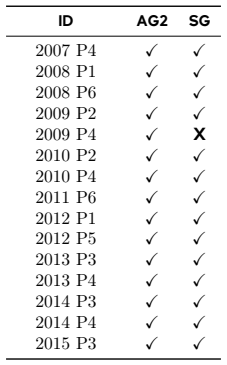
Table 1 Performance comparison of AlphaGeometry 2 (AG2) and Seed-Geometry (SG) in IMO geometry problems from 2000 to 2024. Note that in IMO-AG-50, the 2002 P2, 2003 P4, 2004 P5, 2008 P1, and 2009 P4 are separated into two, whereas we merge each of them into one.
Original paper · CC BY 4.0The IMO shortlist set is much harder, and the authors added the hard problems that IMOSL-AG-30 had omitted. AlphaGeometry 2 solved 19 of the 39 problems, with some unattempted, while Seed-Geometry solved 22 of them. Table 2 marks AlphaGeometry 2 entries that were never attempted as NA, because the original paper didn't report them. Seed-Geometry solved IMO 2025 Problem 2 in 2 seconds after receiving the human-provided problem formulation.
During the contest, Seed-Geometry solved Problem 2 instantly, as the authors also report.
What the ablations test and what they show
Iterative refinement is the one design choice the paper tests on a proof-level result. The light setting refines every attempt repeatedly, up to 8–16 rounds, and scores it under Pass@8–16. Counted as n × m, that budget matches generating the whole proof at Pass@64–256. On IMO 2022 P2 (MOHS = 151), refinement yields a proof, while the same problem without refinement needs Pass@8192.
That comparison covers one problem, so it shows what refinement can reach rather than an average effect.
Seed-Geometry trained a policy model and a value model, with the value model initialized from the trained policy. Under extensive search, the value model might hurt overall results, since its value estimates carried large errors. The final evaluation therefore kept only a policy model on each GPU process. The paper calls the whole-sequence results significantly inferior, but it gives no table for that comparison.
Rewriting the backend in C++ gave roughly a 100-fold speedup over the Python implementation in TongGeometry. During problem generation, the engine also reached 8x the search efficiency of the Python implementation. These numbers describe engine throughput rather than proof accuracy. A faster backend lets the search go deeper within the same budget, which matters because the forward-chaining design slows down at deeper levels.
Limits the authors report
The value model is the clearest failure the authors name, because its value estimates contained large errors under extensive search. Under extensive search, the value model could harm general performance, so the final evaluation used only step-by-step generation with beam search. Seed-Geometry also misses computation-based problems that AlphaGeometry 2 could potentially address with its algebraic engine.
Seed-Geometry reaches 43 solves on IMO-AG-50, one more than AlphaGeometry 2's 42.
On MiniF2F, the heavy setting still failed on IMOSL 2007 Algebra P6. Combinatorics stays weak, with CombiBench at 30 of 100 problems under the medium setting.
The heavy setting works through thousands of conjectures, and the authors describe it as taking days of thinking. Benchmarks ran under different Lean versions, so cross-benchmark numbers don't form one protocol. This work doesn't test open conjectures, so that question stays open.
Paper info
- Authors
- Luoxin Chen, Jinming Gu, Liankai Huang, Wenhao Huang, Zhicheng Jiang, Allan Jie, Xiaoran Jin, Xing Jin, Chenggang Li, Kaijing Ma, Cheng Ren, Jiawei Shen, Wenlei Shi, Tong Sun, He Sun, Jiahui Wang, Siran Wang, Zhihong Wang, Chenrui Wei, Shufa Wei, Yonghui Wu, Yuchen Wu, Yihang Xia, Huajian Xin, Fan Yang, Huaiyuan Ying, Hongyi Yuan, Zheng Yuan, Tianyang Zhan, Chi Zhang, Yue Zhang, Ge Zhang, Tianyun Zhao, Jianqiu Zhao, Yichi Zhou, Thomas Hanwen Zhu
- Venue
- arXiv · Preprint
- First published
- 2025-7-31
- Added
- 2026-11-5
- Updated
- 2025-8-1
- Version
- v2
- arXiv
- 2507.23726
- Category
- cs.AI · cs.CL
- Original paper terms
- CC BY 4.0
- What we show
- Paper info, commentary and permitted figures from the original paper
AI commentary is a separate explanation from the original paper and may contain errors. The original paper and figures follow each source's terms of use and any rights noted separately.
Abstract
LLMs have demonstrated strong mathematical reasoning abilities by leveraging reinforcement learning with long chain-of-thought, yet they continue to struggle with theorem proving due to the lack of clear supervision signals when solely using natural language. Dedicated domain-specific languages like Lean provide clear supervision via formal verification of proofs, enabling effective training through reinforcement learning. In this work, we propose \textbf{Seed-Prover}, a lemma-style whole-proof reasoning model. Seed-Prover can iteratively refine its proof based on Lean feedback, proved lemmas, and self-summarization. To solve IMO-level contest problems, we design three test-time inference strategies that enable both deep and broad reasoning. Seed-Prover proves $78.1\%$ of formalized past IMO problems, saturates MiniF2F, and achieves over 50\% on PutnamBench, outperforming the previous state-of-the-art by a large margin. To address the lack of geometry support in Lean, we introduce a geometry reasoning engine \textbf{Seed-Geometry}, which outperforms previous formal geometry engines. We use these two systems to participate in IMO 2025 and fully prove 5 out of 6 problems. This work represents a significant advancement in automated mathematical reasoning, demonstrating the effectiveness of formal verification with long chain-of-thought reasoning.
Quote from the paper
Luoxin Chen, Jinming Gu, Liankai Huang, Wenhao Huang, Zhicheng Jiang, Allan Jie, Xiaoran Jin, Xing Jin, Chenggang Li, Kaijing Ma, Cheng Ren, Jiawei Shen, Wenlei Shi, Tong Sun, He Sun, Jiahui Wang, Siran Wang, Zhihong Wang, Chenrui Wei, Shufa Wei et al. (2025). Seed-Prover: Deep and Broad Reasoning for Automated Theorem Proving. arXiv:2507.23726v2. https://arxiv.org/abs/2507.23726v2
BibTeX
@misc{chen2025seed,
  title = {{Seed-Prover: Deep and Broad Reasoning for Automated Theorem Proving}},
  author = {Luoxin Chen and Jinming Gu and Liankai Huang and Wenhao Huang and Zhicheng Jiang and Allan Jie and Xiaoran Jin and Xing Jin and Chenggang Li and Kaijing Ma and Cheng Ren and Jiawei Shen and Wenlei Shi and Tong Sun and He Sun and Jiahui Wang and Siran Wang and Zhihong Wang and Chenrui Wei and Shufa Wei and Yonghui Wu and Yuchen Wu and Yihang Xia and Huajian Xin and Fan Yang and Huaiyuan Ying and Hongyi Yuan and Zheng Yuan and Tianyang Zhan and Chi Zhang and Yue Zhang and Ge Zhang and Tianyun Zhao and Jianqiu Zhao and Yichi Zhou and Thomas Hanwen Zhu},
  year = {2025},
  eprint = {2507.23726},
  archivePrefix = {arXiv},
  url = {https://arxiv.org/abs/2507.23726v2}
}