Paper commentary
Does Learning Order Explain Forgetting? The Lie Bracket as an Early-Warning Signal for Catastrophic Forgetting Without Old Data
A stored summary warns of quiet forgetting early
- Problem Catastrophic forgetting is hard to predict once old task data is gone. The EWC penalty measures weight distance, not damage to the old task, so it can miss the damage.
- Method The Lie bracket estimates forgetting from a small stored summary of task A. The summary keeps its gradient and top 20 Hessian eigenpairs, and the bracket uses only the new task's data.
- Results On slow forgetting, the stored bracket ranks forgetting at 0.81 on MNIST, against 0.58 for the EWC penalty.
Why slow forgetting is hard to catch
Catastrophic forgetting is the loss of performance on earlier tasks after a network learns new ones, a problem the paper frames with McCloskey and Cohen (1989) and Kirkpatrick et al. (2017).
The EWC penalty is a function of how far the weights have moved, so it measures distance rather than the damage to the old task directly. Dherin (2023) conjectured that the bracket may be linked to catastrophic forgetting, but didn't test that link.
The paper asks whether forgetting is an order effect, and whether the bracket can be estimated without old data. It also asks whether the stored bracket predicts forgetting better than the EWC penalty, which is the practical question the conjecture leaves open. The stored bracket uses a summary of task A made of its gradient and its top 20 Hessian eigenpairs, with the current task's data.
Order effects as a bracket
Training on A then B and training on B then A leave the network at different weights, and this gap is the starting point of the method. The paper considers one gradient step on LA followed by one step on LB from the same starting point θ, and the opposite order. The gap between the two results is η²[A,B](θ) plus a term of order η³. The bracket is defined as HB(θ)gA(θ) minus HA(θ)gB(θ), the commutator of the negative gradient fields.
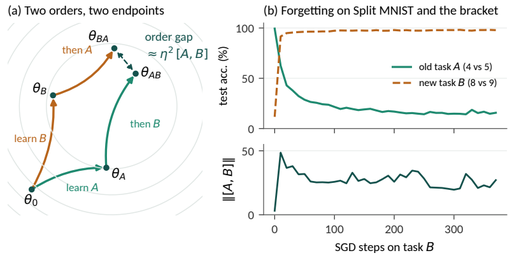
Figure 1 :(a) Training in the two orders ends at different weights; for one small step the gap is η2[A,B]. (b) A single Split MNIST run in the Domain-IL scenario. Accuracy on the old task falls from 99% to about 16% while the new task is learned within tens of steps, and the norm of the bracket jumps at the switch.
Original paper · CC BY 4.0 · Ephraim Kofi Ayi Kwapong · Does Learning Order Explain Forgetting? The Lie Bracket as an Early-Warning Signal for Catastrophic Forgetting Without Old Data · Original paper figure · Extracted the figure area from page 5 of the original PDF.Figure 1(a) shows the two orders ending at different endpoints, with the order gap approximated by η²[A, B]. The paper states that Proposition 1 is exact only for one small step.
Hessian–vector products are computed by double backpropagation, so no Hessian is ever formed. Figure 2 shows that the forgetting of A is closely tied to the order gap in this setting, which the authors describe as close to true by construction. Predicting forgetting and predicting the order effect are therefore the same problem in this setting.
Building a data-free signal from a stored summary
When training on A ends, the authors keep a small summary of A and discard its data. The summary holds the weights, the gradient of A, the top K=20 Hessian eigenpairs found by Lanczos iteration, and the diagonal empirical Fisher. The Fisher is used only by the EWC baseline, so the bracket depends on the other three stored pieces. From these pieces, the summary gives a local model of A's gradient, built as g-hat_A(θ) = g_A(θ_A) + H-hat_A δ, with δ = θ − θ_A.
The stored bracket swaps the true gradient and Hessian of A for this local model, giving the norm of H_B g-hat_A − H-hat_A g_B. Only the current task's gradient and Hessian use data, because that data is available by definition. Hessian-vector products are computed by double backpropagation, following Pearlmutter (1994), so the Hessian is never formed.
The stored bracket therefore never touches A's data after training on A ends.
The EWC penalty is a sum of the diagonal Fisher weighted by squared weight changes, and the authors use it as a predictor rather than a regulariser. The stored Taylor estimate keeps the gradient term of the second-order expansion of A's loss. Mirzadeh et al. (2020) drop that gradient term under the assumption that training has converged. The full bracket and re-evaluation on A's data are reference signals, showing what the old data would add.
Each signal is recorded at steps 5, 10, 15 and 20 of training on B and averaged. Its Spearman rank correlation with forgetting is computed over 100 runs, with 5 seeds on each of the 20 ordered pairs of five tasks.
Datasets, models and the two forgetting scenarios
The paper uses three datasets: Split MNIST, Split Fashion-MNIST and Split CIFAR-10. Each dataset is cut into five binary tasks, with classes paired in label order. The first task pairs classes 0 and 1, the second pairs 2 and 3, and so on. MNIST and Fashion-MNIST use raw pixels, while CIFAR-10 features come from a frozen ResNet-18. The CIFAR-10 CNN has two 3×3 convolutional layers with 16 and 32 channels, followed by a 64-unit hidden layer.
The small CNN is kept as a deliberate contrast, because it reaches only 78% accuracy. Its old task is half learned, while the features setup has the same images with a well-learned old task. The first three setups reach 97 to 99% mean accuracy, with the Table 1 values at 0.989, 0.990 and 0.973. Training uses plain SGD without momentum, batch size 64 and learning rate 0.05.
The models train for 2 epochs per task on MNIST and Fashion-MNIST, and for 3 epochs on CIFAR-10. The authors use plain SGD because Proposition 1 is derived for memoryless updates.
Task-IL restricts the loss to the two outputs of the current task in a ten-output network. Domain-IL instead lets all tasks share the same two outputs. In these experiments Task-IL produces slow forgetting, and Domain-IL produces fast forgetting. On MNIST, mean forgetting is 1.3 (7.1) under the slow setting and 35.0 (85.2) under the fast one.
On the CIFAR-10 CNN, mean forgetting is 4.1 (14.1) for slow and 21.2 (43.4) for fast. The authors note that the two properties are confounded, so scenario and speed can't be separated in these experiments.
Forgetting tracks the order gap
This section asks whether forgetting of task A is really an order effect, which would make predicting one the same as predicting the other. Forgetting is the rise in A's test loss after training on B, measured against A's test loss right after A is trained. The order gap on A is A's test loss after training A then B, minus A's test loss after training B then A.
Table 2 runs this check at a learning rate of 0.05, with 3 seeds and 60 runs per cell. Forgetting and the order gap on A rank the runs almost identically, with Spearman ρ from 0.96 to 1.00 across every setup and scenario. The two quantities also have nearly the same size, and the ratio of the order gap to forgetting runs from 1.00 to 1.20.
The four setups are MNIST, Fashion-MNIST, CIFAR-10 features and the half-learned CIFAR-10 CNN, with slow forgetting in Task-IL and fast forgetting in Domain-IL.
When A is trained last, it ends close to its own optimum, so the gap between the two orders is the damage that B does to A. The CNN's ratio of 1.20 is the one value above one, and it means that learning B leaves A slightly better than training A alone. The authors call this result close to true by construction, and they report it for that reason.
Rows 3 and 4 of Table 2 show that the bracket tracks the order gap when the old task is well learned, with ρ from 0.68 to 0.83. On the half-learned CNN, the same comparison falls to 0.03 and 0.29.
Slow forgetting: the stored bracket beats EWC without old data
The slow Task-IL scenario is where the stored bracket is tested as a data-free predictor against the EWC penalty. Figure 2 plots each signal's Spearman rank correlation with forgetting on MNIST, Fashion-MNIST and CIFAR-10 features, with the CIFAR-10 CNN shown as the half-learned contrast. The stored bracket ranks forgetting at 0.81, 0.70 and 0.76 on the three well-learned setups.
The EWC penalty reaches 0.58, 0.33 and 0.35 on the same setups, so the bracket leads by +0.23, +0.37 and +0.41. Each of these differences has a bootstrap interval that excludes zero.
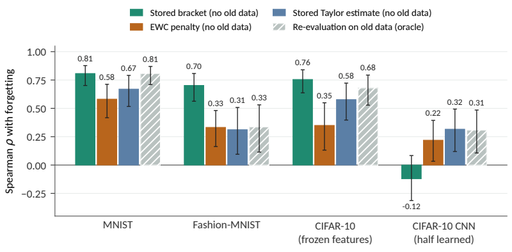
Figure 2 :Slow forgetting (Task-IL), η=0.05 , 100 runs per setup. Rank correlation of each signal with forgetting; bars show 95% bootstrap intervals. The first three signals use no old data. The hatched bar re-evaluates the old task on its own data and is shown for reference.
Original paper · CC BY 4.0The stored bracket also matches the full bracket computed with old data, at 0.82, 0.74 and 0.76. So the 20-direction summary loses little in this regime. The gap is clear on Fashion-MNIST at +0.39 and on CIFAR-10 features at +0.18, but within noise on MNIST at +0.14. Re-evaluation on the old data reaches 0.81 on MNIST, a tie with the bracket.
On Fashion-MNIST the bracket scores 0.70 against 0.33 for re-evaluation, so a signal with no old data matched or exceeded direct monitoring.
The authors suggest slow forgetting has barely begun after 20 steps, so A's loss change is small relative to noise. The bracket, by contrast, measures a rate, which the authors give as the reason it tracks the damage better. On MNIST the bracket scores 0.86, 0.81 and 0.71 at η of 0.02, 0.05 and 0.1, against 0.55 to 0.59 for EWC. The authors read this as expected from a small-step expansion.
Fast forgetting: the stored summary goes stale
In the fast Domain-IL scenario, the EWC penalty is the better data-free predictor on MNIST and CIFAR-10 features. The EWC penalty scores 0.59 against 0.40 for the stored bracket on MNIST, and 0.84 against 0.46 on CIFAR-10 features. On Fashion-MNIST the two tie, at 0.79 and 0.78.
The full bracket with old data still predicts well on MNIST and CIFAR-10 features, at 0.69 and 0.81. The stored bracket falls to 0.40 and 0.46 on those two setups, so the loss comes from the stored summary rather than the bracket itself. The EWC penalty depends only on distance, so it keeps tracking the damage.
A tiny buffer of ten examples of A helps on MNIST only, where the bracket computed from them reaches 0.74, 0.72 and 0.57. Those values compare with 0.61, 0.59 and 0.49 for EWC at the three learning rates, which is the only setup where a buffer overtakes EWC. On CIFAR-10 features, ten examples give 0.28 and fifty give 0.69, both still below the EWC penalty.
Three repairs on CIFAR-10 features did not beat EWC, with adding ranks giving 0.71 and 0.62 and the K=50 or 100 summaries giving 0.49. Since EWC alone scores 0.84, the authors conclude that the limit is the locality of the summary rather than its size.
Why the bracket fails on the half-learned CNN
The stored bracket fails on the CIFAR-10 CNN in both scenarios, at -0.12 in Task-IL and 0.30 in Domain-IL. The summary isn't the culprit, because the full bracket computed with old data also fails, at -0.11 and 0.29. The authors trace the failure to A's residual gradient, which is large relative to B's on this network. The ratio of the norm of A's gradient to the norm of B's at θA is 0.94 on the CNN in the slow scenario and 0.38 in the fast one.
On the well-learned setups the same ratio is 0.02 to 0.07, so the CNN sits an order of magnitude higher.
Expanding A's loss around θA gives a slope term, g_A(θA)ᵀδ, and a curvature term, one half δᵀH_A(θA)δ. The slope term vanishes only when A has converged, and the CNN never reaches that point. The bracket contains only the curvature-type product H_A g_B, so it has no term that responds to movement along A's residual gradient. In slow CNN forgetting the slope term accounts for 57% of the damage.
The slope term predicts forgetting at 0.43, against 0.17 for curvature.
With frozen pretrained features, the residual gradient shrinks and the damage becomes mostly curvature. There the term ‖H_A g_B‖ alone predicts forgetting at 0.79 and 0.75 on MNIST and CIFAR-10 features. Learning A properly therefore restores the stored bracket, which rises from -0.12 to 0.76 in the slow scenario. The authors couldn't test this on the CNN with longer training, because its accuracy doesn't improve with more epochs.
The fast CNN case stays open, since damage there is still mostly curvature at 77%. The measured curvature term predicts forgetting at 0.73, yet ‖H_A g_B‖ predicts only 0.19. The cosine between g_B and H_A g_B is 0.82 on the CNN, higher than the 0.59 to 0.62 on the well-learned setups.
Limitations of the stored bracket
The evidence for the stored bracket rests on small models, so scale is the first limit. The experiments use small MLPs and one small CNN, and the CIFAR-10 positive result uses a frozen pretrained ResNet-18 backbone with a trainable head. Every run is a single pair A to B, so the authors didn't test long task sequences. That leaves the behaviour of the stored summary over many tasks as an open question.
Scenario and speed are confounded in every experiment. Slow forgetting always came from Task-IL and fast forgetting always from Domain-IL, so the two can't be separated here. Forgetting in the slow case is small, with a mean of about 1% of accuracy.
The paper reports rank correlations only, so the signals aren't calibrated estimates of the loss. All results use plain SGD, and the authors note that momentum and Adam would need a modified bracket. Main results use 5 seeds, while the order and mechanism tests use 3 and the curvature test uses 2. The bootstrap intervals treat runs as independent, which the authors flag as a limit.
The summary stores (K+2)P numbers, against 2P for EWC, so its cost grows with the Hessian rank. Using the bracket to reduce forgetting is left to future work, as are longer task sequences and a summary that stays valid far from θA.
Paper info
- Authors
- Ephraim Kofi Ayi Kwapong
- Venue
- arXiv · Preprint
- First published
- 2026-11-15
- Added
- 2026-11-17
- Updated
- 2026-11-15
- Version
- v1
- arXiv
- 2611.20087
- Category
- cs.LG · stat.ML
- Original paper terms
- CC BY 4.0
- What we show
- Paper info, commentary and permitted figures from the original paper
AI commentary is a separate explanation from the original paper and may contain errors. The original paper and figures follow each source's terms of use and any rights noted separately.
Abstract
A network trained on task A and then task B ends at different weights than one trained on B and then A. To leading order this gap is set by the Lie bracket of the two tasks' gradient fields, and Dherin (2023) conjectured that a non-vanishing bracket may be linked to catastrophic forgetting. I test this conjecture empirically. Across Split MNIST, Split Fashion-MNIST and Split CIFAR-10, the forgetting of A is almost exactly the difference in A's loss between the two training orders (Spearman rho = 0.96-1.00). I then ask whether the bracket can predict that forgetting early in training on B and without any of A's data, using only a small summary stored when A finishes: its gradient and its top 20 Hessian eigenpairs. When the old task is well learned and forgetting is slow (task-incremental), this stored bracket ranks forgetting with rho = 0.70-0.81, against 0.33-0.58 for the penalty of Elastic Weight Consolidation, and matches or exceeds re-evaluating A on its own data. When forgetting is fast (domain-incremental), the stored summary goes stale and the EWC penalty is as good or better. The bracket fails outright when the old task is only half learned; I trace this to a residual gradient on A an order of magnitude larger, which makes first-order (slope) damage matter. The bracket is therefore a useful early-warning signal for the quiet kind of forgetting, under a clear condition.
Quote from the paper
Ephraim Kofi Ayi Kwapong (2026). Does Learning Order Explain Forgetting? The Lie Bracket as an Early-Warning Signal for Catastrophic Forgetting Without Old Data. arXiv:2611.20087v1. https://arxiv.org/abs/2611.20087v1
BibTeX
@misc{kwapong2026does,
  title = {{Does Learning Order Explain Forgetting? The Lie Bracket as an Early-Warning Signal for Catastrophic Forgetting Without Old Data}},
  author = {Ephraim Kofi Ayi Kwapong},
  year = {2026},
  eprint = {2611.20087},
  archivePrefix = {arXiv},
  url = {https://arxiv.org/abs/2611.20087v1}
}