Paper commentary
Same Facts, Different Remedy: Linguistic Profiling and Arbitrariness in LLM and System One Decisions
Style alone can flip LLM and System One remedy decisions for the same complaint
- Problem Single-label audits of consumer complaint systems miss whether a group gap is real or whether decisions just flip with wording. Those audits cannot tell profiling from arbitrariness.
- Method The authors rewrite each complaint into 36 style variants that keep every fact. They then compare how two GPT models and the probabilistic Jev model decide on each version.
- Results Two style versions of the same complaint get different monetary decisions 2.6 to 6.3% of the time. Group gaps are small, with every monetary gap within 0.5 percentage points.
Why single labels hide two different problems
Complainants don't write the same way, and vocabulary, grammar, formality and politeness shift with age, education and socioeconomic status. A system that reacts to how a complaint is written can therefore treat groups differently without ever seeing a demographic attribute. Linguists have tested this effect for a long time with matched-guise experiments, going back to Lambert et al.
Recent work finds that LLMs carry covert dialect prejudice that standard alignment doesn't remove.
Most audits of such systems compare one predicted label across demographic groups, and that approach misses two things. First, a label that shifts with wording, option order or sampling noise creates disagreements that look like disparities but are really arbitrariness. Second, audits seldom ask whether a detectable gap is material or through which channel it works.
Probabilistic models sharpen both questions, because a full distribution over remedies can show differences that a single label hides. An audit that doesn't separate arbitrariness from profiling can't tell which problem it has found.
How the guise panels and three decision systems fit together
The study starts from a pool of 20,000 English CFPB narratives, and it splits the complaints into an exploratory panel and a holdout panel. The exploratory panel uses 2,000 complaints, which the authors analysed first and reported as exploratory. The holdout panel adds 1,000 new complaints that had never been rewritten or scored before, giving 72,000 guises.
The authors fingerprinted the holdout sample with SHA-256 before any holdout text existed, so the selection was fixed in advance. Each complaint is rewritten into 36 guises that cross age, geography, education and socioeconomic status. GPT-4o-mini and GPT-5-mini each write their own rewrite bank, so every guise gets a second, independent paraphrase in the same persona.
Each rewrite model gets an instruction to preserve every fact, so the banks should change how a complaint reads rather than what it says. Two generative LLMs return a single remedy label for each guise: GPT-4o-mini at temperature 0 and GPT-5-mini with default reasoning. The three tiers run from 0 for no action, through 1 for non-monetary action, to 2 for monetary remedy.
Jev 1.13.0 is the probabilistic System One model, and it returns a distribution over the same three options rather than a label. From that distribution, the authors derive E[tier] = p1 + 2p2, the argmax tier, the monetary probability p2 and the normalised entropy.
Jev scores each text under all six orderings of the three options, and order o012 serves as the primary ordering. Each GPT model decides only the guises in its own bank, so a comparison between the two GPT models mixes the decider with the rewrites it saw. Jev and a GPT model share a bank, so their comparisons aren't affected by that mix.
The design controls three non-persona sources of variation: inference noise, option order and paraphrase. Re-scoring 1,000 identical texts estimates inference noise, while the two rewrite banks supply the paraphrase comparison.
Separating persona effects from wording noise
The authors measure three non-persona sources of variation directly, before they fit any model. For Jev, the mean total-variation distance is 0.021 between two re-scores of the same text. Reversing the three options raises that distance to 0.058, so option order matters more than re-scoring noise. Paraphrase pairs reach 0.091 and 0.092, whether the two paraphrases share a persona or not.
Simple TV comparisons can't split these sources cleanly, so the authors also fit a crossed random-effects ANOVA. It crosses complaint, persona, rewrite bank and option order, with one observation per cell. The model's 15 within-complaint terms fall into five groups, and only persona effects that replicate across both banks count as shared persona effects.
Those shared persona effects explain an estimated 1.6% of within-complaint variance for Jev's monetary probability. For E[tier], the same shared effects explain 1.7%, so the small share holds across both outputs. Differences between the two rewrite models explain 47%, and the complaint×persona×bank term explains 39%. That 39% term may also hold persona effects that differ between banks, which this design can't separate.
Wording and bank dominate the within-complaint variance, and persona explains only a small part of it. Option order and inference noise account for 12%, which the authors group separately from persona. The authors don't count the persona main effect as arbitrariness, because it can contain heterogeneous persona effects. So the 1.6% figure is an estimate of persona that replicates across paraphrases, not a measure of total instability.
Group gaps are small, but individual flips are not
The group-scale question asks how far the persona gaps in monetary remedies move the rate for each system. The largest gap is GPT-4o-mini's education gap, at +0.47 pp with interval [0.08, 0.83] and AIR 0.947. Pooling the exploratory and held-out panels, the largest gap is GPT-4o-mini's SES gap, +0.84 pp with interval [0.56, 1.11]. That pooled AIR of 0.917 is an 8.3% relative shortfall, and it fails a stricter AIR above 0.90 bound.
The authors note that these figures are post hoc and descriptive, so the benchmarks don't settle whether a gap of this size matters.
The individual-scale question asks how often two style versions of one complaint get different monetary decisions. Two style versions get different monetary decisions 3.8% of the time for GPT-4o-mini and 6.3% for GPT-5-mini. Jev's figure is 2.6 to 3.3%, with its threshold matched to each GPT model's monetary volume. A net group gap can hide opposite shifts that cancel, whereas pairwise disagreement counts every flip because it is unsigned.
Figure 1 sets the two scales side by side, and the two quantities measure different things.
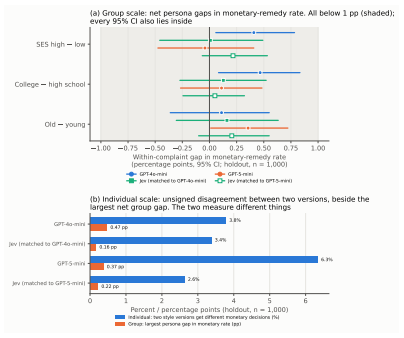
Figure 1 : Two scales (held-out panel,n = 1,000). (a) Group persona gaps in the monetary- remedy rate, with the±1pp benchmark. (b) Individual instability: the probability that two style versions of the same complaint receive different monetary decisions.
Original paper · CC BY 4.0 · Colin Priest · Same Facts, Different Remedy: Linguistic Profiling and Arbitrariness in LLM and System One Decisions · Original paper figure · Extracted the figure area from page 7 of the original PDF.Taken together, the two scales show that small average gaps can sit alongside substantial individual instability. The authors don't claim that the ratio of the two measures tells which harm is larger.
Smoother scores don't move monetary decisions much
Jev's graded score varies less across versions than its argmax does in the GPT-4o-mini bank. The residual share falls from 0.20 to 0.06 there, and from 0.13 to 0.03 in the GPT-5-mini bank. A smoother score doesn't show that remedies change, so the authors test explicit monetary rules. One rule sets a threshold on Jev's p2 to match the GPT model's monetary rate across 36,000 texts.
At matched monetary volume, that threshold gives a 3.3% probability that two versions get different monetary decisions. GPT-4o-mini's own label gives 3.8%, and the difference from the threshold rule is 0.45 pp [−0.33, 1.25].
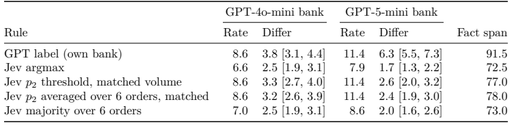
Table 1 : Monetary decisions under explicit remedy rules (held-out panel, post hoc). Rate: monetary-decision rate (%). Differ: probability that two style versions of the same complaint receive different monetary decisions (%, 95% CI). Fact span:strengthen−weaken monetary rate (pp, GPT-4o-mini bank, 200 complaints).
Original paper · CC BY 4.0Averaging p2 over the six option orders gives 3.2%, a difference of 0.09 pp from the threshold rule. In the GPT-5-mini bank, the Jev threshold rule disagrees 2.6% of the time, against 6.3% for that model's label. That gap reflects two different deciders, not an effect of graded output. GPT-4o-mini's label moves 91.5 pp between strengthen and weaken, while the Jev rules move 72–78 pp.
Table 1 lists these rules, and its fact span is measured on the 200 complaints of the GPT-4o-mini bank.
Averaging probabilities didn't beat equal-budget hard voting on group disparity (H4). The authors would have refuted H4 if the upper 90% bound of Davg/Dvote fell below 1, and it didn't. Referring the 20% most uncertain cases showed no persona disparity (H5), at p = 0.32. That is a failure to detect a gap, and the paper doesn't claim that none exists.
Group gaps in monetary decisions stayed within ±0.5 pp under every rule. No reduction in systematic disparity was detected, with D(argmax) − D(E[tier]) = −0.006 and CI [−0.021, 0.005].
Which delivery cues carry the persona gap
Content attributes show little systematic variation by persona. Delivery moves strongly, with vocabulary at η² = 0.73, formality at 0.71, grammar at 0.58 and politeness at 0.37. Structure moves moderately, with chronology at 0.26 and argument quality at 0.22.
For GPT-4o-mini, the education gap is +0.032 tier, with an interval of 0.025 to 0.039. The attributes account for 79% of that education gap. Delivery contributes +0.014 of it, structure +0.010 and content +0.002. The SES gap is +0.026 tier, and the attributes account for 96% of it. In that decomposition, irrelevant delivery outweighs relevant content by roughly 4 to 7 times.
Because delivery attributes are collinear, attribution holds at the family level but not for single attributes. Where Jev recognises the style cue, the education gap is +0.053, with an interval of 0.039 to 0.068. Where the cue is ambiguous, the education gap falls to +0.009, a difference of +0.045. Jev's persona inferences track delivery, with within-complaint R² of 0.24 to 0.79, against 0.01 to 0.05 for content.
Do the systems respond to the facts?
The positive controls ask whether a small style gap means the systems are simply insensitive to what complaints say.
For GPT-5-mini the strengthen effect was +0.89 [0.78, 1.00], and for Jev's E[tier] it was +0.76 [0.70, 0.82]. Every confidence interval for the weaken effect, which ranges from −0.30 to −0.41, lies below zero. The fact span, strengthen minus weaken, is 49 times the largest persona gap for GPT-4o-mini. It is 387 times the largest persona gap for GPT-5-mini and 75 times for Jev, against a pre-registered threshold of 5 times.
Graded output responds more sensitively to fact changes than the argmax does. The harm_x10 edit, an exploratory check, mainly moves the monetary dimension. It shifts Jev's p2 by +0.04 and GPT's monetary rate by +0.06 to +0.12.
The edits are fact-led but not exclusively factual, so the controls show sensitivity to facts in general rather than a pure fact test. Because the edits came from GPT-4o-mini, which also wrote one rewrite bank, the controls share a model family with the design. The authors also flagged that the second auditor shares a provider with two audited models.
Against that background, the fact span supports the reading that the small style gaps do not reflect general insensitivity.
Standardising style: what moves and what doesn't
The mitigation targets the delivery channel, so every complaint is rewritten into a standard style before the decision is made. In M0 the guise is decided as originally written, with its existing decisions and scores. In M1, GPT-4o-mini rewrites each guise at temperature 0 into one canonical style, A, which is plain, neutral, polite and chronological, and then decides it.
Every standardising rewrite must keep every fact, claim and request, including strength and certainty, and change only how the complaint is written.
The mitigation required 55,800 standardising rewrites and 55,800 GPT-4o-mini decisions. Jev scored 55,001 unique texts, and 799 standardised texts were identical to another text, so they were scored only once. Retention is the fact span after standardisation divided by the span without it.
One standard style cut GPT-4o-mini's education and SES point estimates by 94% and 87%, with residual intervals that include zero. In monetary units, GPT-4o-mini's education gap moved from +0.63 pp to +0.14 pp, and its SES gap from +0.80 pp to +0.42 pp. Jev's gaps were not removed by one style but reversed, so age and education changed sign.
Under M2, all three GPT-4o-mini gaps sit within ±0.001 of zero, so a standardiser can reverse a disparity's direction.
One style didn't reduce arbitrariness for GPT-4o-mini: MPAD is 0.147 as written and 0.138 under M1. Jev's MPAD stayed close to its original value, moving from 0.084 to 0.085 under M1. Averaging three styles lowered GPT-4o-mini MPAD from 0.147 to 0.120 and Jev MPAD from 0.084 to 0.068. Part of that drop is mechanical, because M2 averages three decisions per guise.
In monetary decisions, GPT-4o-mini's disagreement moved only from 4.1% to 3.6%, and Jev's from 2.3% to 1.9%. Fact sensitivity held, with retention of 0.99 for GPT-4o-mini under M1 and 0.96 under M2. Standardised texts became more formal and less emotional, and the persona cue survived only partly in vocabulary.
Checking that rewrites keep the facts
Two LLM auditors from outside the audited systems check each original against its rewrite, blind to all decisions. Each auditor then rates whether a difference could reasonably change the remedy. The sample covers 40 complaints with all 36 guises each, plus 150 standardised texts and 100 positive-control edits. An auditor counts as valid only if it flags at least 80% of the positive-control edits, and a guise passes the screen when no valid auditor rates it materially changed.
Both auditors pass the validity check, flagging 99% of the strengthen and weaken edits for Claude Opus 5.5 and 98% for GPT-5.2. GPT-5.2 flags 11.7% of guises, with an interval of 6.2 to 17.8, and either auditor flags 13.2%. The auditors agree on 84.5% of persona-guise pairs, but Cohen's κ is only 0.16.
Among guises that pass the screen, about 30 of 36 per complaint remain in the analysis. GPT-4o-mini's monetary disagreement is 4.7% against 5.0% for all guises, a ratio of 94%. Jev's monetary disagreement is 3.0% against 3.3%, a ratio of 92% with an interval of 0.55 to 1.03.
At least one auditor flags 6.5% of standardised texts, and both flag 0.2%. Fresh same-day GPT-4o-mini decisions match the original decisions on identical texts in 97.2% of cases. The DB2 re-estimate of the mitigation on 100 complaints has intervals that include zero, so it can't confirm the reduction.
Where the results stop applying
The study has no ground truth, so it speaks to sensitivity, disparity and arbitrariness, but not to accuracy. The guises are synthetic, generated by LLMs as stylised stand-ins for how groups write. GPT-4o-mini also produced the standardising rewrites and the positive-control edits, so that model shapes several measurements.
Shared representations like these could inflate fidelity or alignment estimates. The GPT-5-mini rewrite bank checks this for the main results, but the mitigation used only the GPT-4o-mini bank.
The two auditors agreed weakly on persona guises, with κ = 0.16. Both auditors were validated against known fact edits, but they weren't checked against human annotation. The study tests one System One model in one version, and Jev 1.13.0 isn't deterministic.
Re-scoring moves Jev's mean TV by 0.020, and 2.5% of argmax tiers flip, so results may not transfer to other probabilistic judges. The same-day baseline found no drift, with 97% of fresh decisions matching the originals.
Paper info
- Authors
- Colin Priest
- Venue
- arXiv · Preprint
- First published
- 2026-11-6
- Added
- 2026-11-9
- Updated
- 2026-11-6
- Version
- v1
- arXiv
- 2611.08995
- Category
- cs.CY · cs.AI · cs.CL
- Original paper terms
- CC BY 4.0
- What we show
- Paper info, commentary and permitted figures from the original paper
AI commentary is a separate explanation from the original paper and may contain errors. The original paper and figures follow each source's terms of use and any rights noted separately.
Abstract
Large language models are increasingly used to resolve consumer complaints, and the way complainants write varies with age, education and socioeconomic status (SES). We audit three remedy-decision systems using sociolinguistic rewrites of US consumer financial complaints that are instructed to preserve every fact: two generative LLMs that return a single label (GPT-4o-mini and GPT-5-mini) and a probabilistic "System One" model that returns a distribution over remedies (Jev). Using pre-registered hypotheses tested once on held-out complaints, we separate two phenomena that single-label audits conflate. At the group scale, older, college-educated and higher-SES styles receive slightly more generous remedies; these effects replicate but are small, with every monetary-remedy gap within 0.5 percentage points. At the individual scale, two style versions of the same complaint receive different monetary decisions 2.6-6.3% of the time. In a variance-component analysis of the probabilistic model, persona components shared across the two rewrite models account for about 1.6% of within-complaint variation. The persona gaps are associated mainly with delivery (vocabulary, grammar, politeness) rather than content. Positive controls show that all three systems respond 49-387 times more strongly to remedy-relevant facts than to style. Rewriting every complaint into one standard style reduced GPT-4o-mini's education and SES gaps by 94% and 87% while retaining fact sensitivity, but reversed two of the probabilistic model's gaps and did not make individual decisions more stable. Independent LLM auditors flagged material fact changes in 3.3% and 11.7% of rewrites, and instability persisted among unflagged rewrites. Fairness audits of LLM decision systems should report group disparities and individual instability as separate outcomes.
Quote from the paper
Colin Priest (2026). Same Facts, Different Remedy: Linguistic Profiling and Arbitrariness in LLM and System One Decisions. arXiv:2611.08995v1. https://arxiv.org/abs/2611.08995v1
BibTeX
@misc{priest2026same,
  title = {{Same Facts, Different Remedy: Linguistic Profiling and Arbitrariness in LLM and System One Decisions}},
  author = {Colin Priest},
  year = {2026},
  eprint = {2611.08995},
  archivePrefix = {arXiv},
  url = {https://arxiv.org/abs/2611.08995v1}
}