Paper commentary
From Classification to Generation: Vision-Language Models for Roman Imperial Coin Description
Vision-language models can read and describe Roman coins from auction photos
- Problem Earlier coin systems predicted labels from fixed sets, so they could not cover tens of thousands of Roman coin types. Each part of a coin description was handled separately.
- Method The authors adapt Qwen3-VL-8B to generate legend transcriptions and imagery descriptions directly from the coin image. They train one low-rank adapter per task on about 30,000 auction records.
- Results The adapted models beat the base model and GPT-4.1 on all four tasks. Legend transcription error drops by over 40% relative to GPT-4.1.
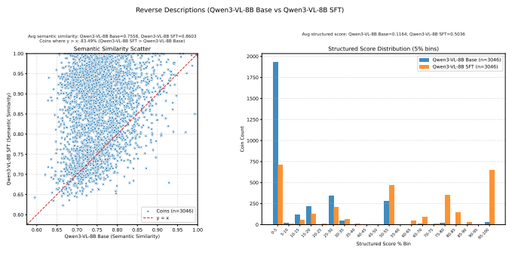
Fig. 9 . Comparison of the fine-tuned Qwen model and the Qwen base model on reverse-description generation. Left: per- sample semantic similarity. Right: distribution of structured scores.
Original paper · CC BY 4.0 · Pedro Lourenco, Ognjen Arandjelović · From Classification to Generation: Vision-Language Models for Roman Imperial Coin Description · Original paper figure · Extracted the figure area from page 18 of the original PDF.Where closed-set classification gets stuck
Matching a Roman Imperial coin to its catalogue entry means reading the legend and recognising the imagery on both sides of the coin. Earlier systems automated single parts of this process, such as issuer identification or reverse-motif recognition. They did so by predicting labels from a fixed set or by comparing a coin against a gallery of reference images.
The reverse is highly variable, so a full description needs the reverse legend and the motif together.
Distinct types can differ by only a few letters or one small pictorial detail. Recognising the portrait or the broad content of the reverse scene therefore isn't enough to pin down a type. A complete understanding of the coin's contents is usually needed, including identities, poses, clothing, and held objects on the obverse.
Label-set methods rely on exhaustive reference class sets and exemplars, which is a serious constraint here. The domain contains tens of thousands of coin types, and many are represented by only a few photographed specimens. Methods that recognise individual semantic elements offer more flexibility. Yet they remain constrained by incomplete motif coverage and a limited number of relevant labels.
Generating legends and descriptions directly
The generative formulation replaces the predicted label with text that a vision-language model writes one token at a time. A VLM takes the coin image as input and generates the legend transcription or the imagery description directly. Because the output is free text, it can express an inscription or motif that no reference collection contains.
The authors note that this formulation had not been explored for legends or motifs on Roman coins before.
A general-purpose VLM performs poorly on this task without adaptation, because coin surfaces are often worn or corroded. Supervised fine-tuning addresses this domain gap, but suitable training data aren't readily available. Auction photographs are plentiful, yet their descriptions are unstructured, multilingual, and inconsistently formatted, so they need heavy preprocessing.
The authors build a corpus of roughly 30,000 Roman Imperial coins from auction records. They adapt Qwen3-VL-8B-Instruct to four tasks: obverse legend transcription, reverse legend transcription, obverse description generation, and reverse description generation. Each adapter is a low-rank adapter trained with QLoRA, with rank 8 and scaling factor 16, and no dropout.
Because all four tasks share one base model, the adaptation needs only adapter weights for each task.
Turning auction records into training pairs
Each auction record starts as a photograph of a coin and a free-text description, and the photographs show both faces against a uniform background. The source archive spans Greek, Celtic, Byzantine and Roman coinage, so ACSearch records are filtered by regular-expression matching. A record survives only if its description cites the Roman Imperial Coinage catalogue, with forms such as "RIC 123", "R.I.C.
123" or "RIC IV 123". Because the free text is unstructured, multilingual and inconsistently formatted, it cannot serve directly as a training target for the four tasks.
The extraction stage sends each description and its photograph to gpt-4.1-mini at temperature 0, with structured outputs. Deterministic checks then decide what survives, because the model's output is not trusted as it stands. A legend is accepted only if it appears as a substring of the auction description after upper-casing and collapsing white-space runs to one space.
Any legend the model did not copy verbatim is set to unknown, and accepted legends then lose every character except letters, with U mapped to V. Ruler names are found by checking curated aliases in descending order of length, and a RIC number is kept from the numeric part only. A ruler plus a RIC number gives a coarse identifier such as Hadrian 123, and records without both stay unknown.
Exact string matching is used for these identifiers because they train the bi-encoder, where the authors prioritized data quality over quantity.
Image processing turns each photograph into two 512 × 512 colour crops, one per coin side. The image is converted to greyscale, smoothed with a 5 × 5 Gaussian filter, and reduced to a column profile of absolute horizontal Sobel derivatives. Runs of at least 10 consecutive columns above 0.2 become candidate coin sides, and the first two from the left are the obverse and reverse.
A single run is split at its lowest-energy column when that column sits in the middle 50% of the run, and otherwise at its midpoint. Obverse descriptions are then rewritten against a six-component bust-type taxonomy, because the auction text omits and reorders details. Components missing from the text are predicted by separate vision-transformer classifiers, so every coin gets a value for each component.
Filtering runs separately for each task, and a record is dropped if its crop or its target field is unknown. Each task dataset is then split 80/10/10 into training, validation and test sets, so the obverse legend set has 18,419 records. The obverse legend set has 14,735 training records, 1,842 validation records and 1,842 test records, as Table 1 prints.
Of the obverse and reverse legend test sets, 109 and 283 coins carry a legend absent from training, which forms the unseen-legend subsets.
Adapting the model with LoRA and blurred rim images
Qwen3-VL-8B-Instruct stays frozen in its pre-quantized 4-bit form, and the authors train one low-rank adapter per task on top of it. The adapters use rank 8 and scaling factor 16 with no dropout, and they sit in every linear layer of the attention and feed-forward blocks. They cover both the vision encoder and the language model, so the adapters are the only trainable parameters.
The loss is the standard autoregressive next-token cross-entropy over the text tokens of each training sequence. The optimizer is 8-bit AdamW, with a per-device batch size of 2 and 4 gradient-accumulation steps, giving an effective batch of 8. The peak learning rate is 5 × 10⁻⁵, reached after 5 warm-up steps and then decayed linearly. All of this runs on one workstation with an NVIDIA RTX A4500 that has 20 GB of VRAM and 64 GB of system RAM.
The blurred-rim image exists because of a failure the authors saw in preliminary legend-transcription experiments. The model sometimes wrote a legend that suited the emperor but contradicted letters clearly legible on the coin. It seemed to infer the inscription from the central imagery instead of reading the characters around the rim. To push attention toward the rim, each coin gets a second image, blurred with a Gaussian filter of standard deviation 40 pixels using OpenCV.
The weight w(r) equals 1 at the centre, so the blurred copy dominates there and the central design gets suppressed. Because R = 0.45 min(h, w) and p = 5, the weight falls with radius, so the original image takes over toward the rim. Each blurred image keeps the same legend target as its original, so the inscription stays supervised while the portrait is hidden.
Each legend adapter trains for two epochs on the union of original and blurred images, so each coin appears once in each form per epoch. The authors didn't train on original images alone, so the contribution of the blur to the reported results isn't isolated. They present the augmentation as part of the training recipe, not as a validated improvement.
Baselines use the unadapted Qwen3-VL-8B backbone without its LoRA adapters, which isolates the effect of domain-specific fine-tuning.
How outputs are scored and compared
Legend outputs are scored after canonicalisation with the same rule used for the training targets, so spacing, punctuation and case don't count. The primary metric is the normalized Levenshtein distance (NLD), the edit distance divided by the length of the longer string. An NLD of 0 means an exact transcription, and values lie between 0 and 1.
NLD treats every position equally, yet an error at the start of a legend usually signals that the model misread the whole inscription. Prefix-5 accuracy, F5, therefore checks how many of the first five reference characters the model gets right. A prediction shorter than the prefix counts its missing positions as incorrect, so F5 penalises truncated output.
The unadapted Qwen3-VL-8B-Instruct backbone, without the trained LoRA adapters, isolates the effect of domain-specific fine-tuning. GPT-4.1 serves as the proprietary general-purpose baseline, queried with a temperature of zero. The Qwen models decode greedily with a maximum output length of 128 tokens. The authors don't assume exact repeatability for GPT-4.1, because API-served models may vary on identical requests.
Legend results are reported on the full test set and on the unseen-legend subset, where the target legend never appears in training. That subset is the stricter test, since it asks whether the model can transcribe legends it has not seen whole before. The unseen subsets contain 109 obverse-legend coins and 283 reverse-legend coins.
For reverse descriptions, the semantic metric uses a bi-encoder fine-tuned from BAAI/bge-large-en-v1.5 with the multiple-negatives ranking loss. Two reverse descriptions form a positive pair when their coins share the same catalogue identifier. Generated descriptions are scored by the cosine similarity of their embeddings, rescaled from minus one to one into zero to one.
A structured score checks whether the principal entity and the salient objects appear in the generated text, with half the weight on the entity. When no salient objects are extracted, the object component receives its full value of 0.5. Obverse descriptions are scored per component, with binary exact match for five components.
Did adaptation improve legend transcription?
On the full obverse test set, the adapted model reduces mean NLD from 0.33 for GPT-4.1 to 0.19. Mean F5 rises from 0.63 to 0.81 over the same comparison, so the adapted model is better at getting the opening characters right as well. Figure 5 shows the same pattern against the unadapted base model, with points collapsing toward zero error and the F5 mass moving into the higher bins.
On the unseen obverse subset, where the target legend never occurs in training, the gain is smaller but still present: NLD falls from 0.49 to 0.45 and F5 rises from 0.52 to 0.58. This suggests the model learned some transferable ability to read characters, rather than only recalling legends it has seen. The authors also note that part of the full-set advantage comes from familiarity with common legends, since the model does noticeably better on seen legends.
On the full reverse test set, NLD falls from 0.50 to 0.26 and F5 rises from 0.50 to 0.77. On the unseen reverse subset of 283 coins, NLD drops from 0.58 to 0.45 and F5 rises from 0.48 to 0.62. The authors observe that the absolute gain over GPT-4.1 is larger for reverse legends than for obverse legends, even though both baselines do worse on the reverse task.
Limitations of the source data and evaluation
Because of this, the metrics measure agreement with imperfect labels rather than correctness alone. The obverse description labels also inherit the errors of the classifiers that filled in missing taxonomy components. A correct output can therefore be penalised when it doesn't match the label, and a wrong label can reward the model for copying its errors.
The images come from auction records of well-preserved coins photographed under consistent conditions. All results come from one base model and one training run, so sensitivity to backbone, model scale and initialization is unknown.
The blurred-image augmentation was not compared against training on original images alone. Its share of the legend gains is therefore not isolated, and the authors present it as part of the recipe rather than a validated improvement. The unseen-legend subsets contain 109 obverse coins and 283 reverse coins, which limits how precisely their gains can be read.
Directions the authors point to for the generative approach
The authors name three directions that would strengthen the generative approach, and the first is data. Such a dataset would address the noisy auction labels that the limitations section describes.
The second direction completes the identification process with a matching step. The goal of that comparison is to establish which approach identifies coins more accurately.
The third direction concerns uncertainty in the model's output. They could also generate a reasoning trace that indicates whether each character was read from the image or inferred from context.
Paper info
- Authors
- Pedro Lourenco, Ognjen Arandjelović
- Venue
- arXiv · Preprint
- First published
- 2026-11-10
- Added
- 2026-11-13
- Updated
- 2026-11-10
- Version
- v1
- arXiv
- 2611.14821
- Category
- cs.CV
- Original paper terms
- CC BY 4.0
- What we show
- Paper info, commentary and permitted figures from the original paper
AI commentary is a separate explanation from the original paper and may contain errors. The original paper and figures follow each source's terms of use and any rights noted separately.
Abstract
Cataloguing a Roman Imperial coin involves reading its legends and identifying its imagery in order to match it to an entry in the standard reference catalogue. Previous work has automated individual parts of this process, such as identifying the issuer or recognizing reverse motifs, by formulating each part as a classification task over a predefined set of labels. We instead formulate coin description as image-to-text generation and adapt an open-weight vision-language model (VLM), Qwen3-VL-8B-Instruct, to four tasks: transcribing the obverse and reverse legends, and describing the obverse and reverse imagery. To obtain training data, we convert approximately 30,000 auction records into structured image-text pairs. We separate the two sides of each coin, extract and normalize legends and descriptions, and standardize obverse descriptions against a bust-type taxonomy. We then train a separate low-rank adapter for each task on a single 20GB GPU, and evaluate each task with metrics that we define to capture the key components of numismatic descriptions. The adapted models outperform both the unadapted base model and GPT-4.1 on all four tasks, reducing the normalized edit distance of legend transcriptions by over 40% relative to GPT-4.1. The improvement is smaller, but still present, on legends absent from the training data.
Figures from the paper

Fig. 1 . Sample images from the dataset, each showing both sides of a single coin.
Original paper · CC BY 4.0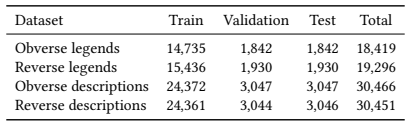
Table 1 . Final dataset sizes after filtering and splitting.
Original paper · CC BY 4.0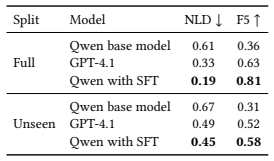
Table 2 . Obverse legend transcription results. Lower NLD is better; higher F5 is better.
Original paper · CC BY 4.0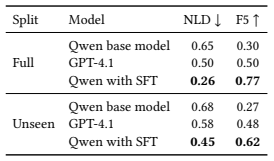
Table 3 . Reverse legend transcription results. Lower NLD is better; higher F5 is better.
Original paper · CC BY 4.0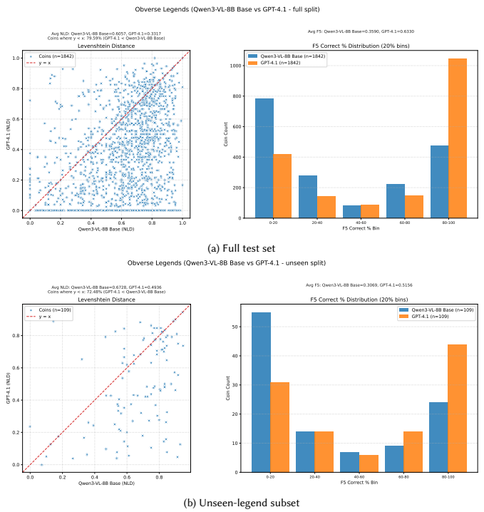
Fig. 4 . Per-sample comparison of GPT-4.1 and the Qwen base model on obverse legend transcription.
Original paper · CC BY 4.0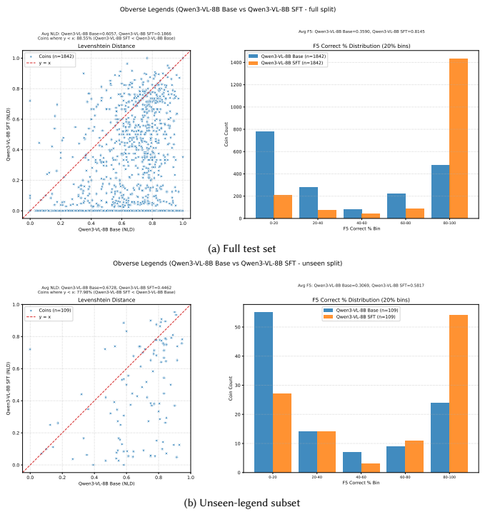
Fig. 5 . Per-sample comparison of the fine-tuned model and the Qwen base model on obverse legend transcription.
Original paper · CC BY 4.0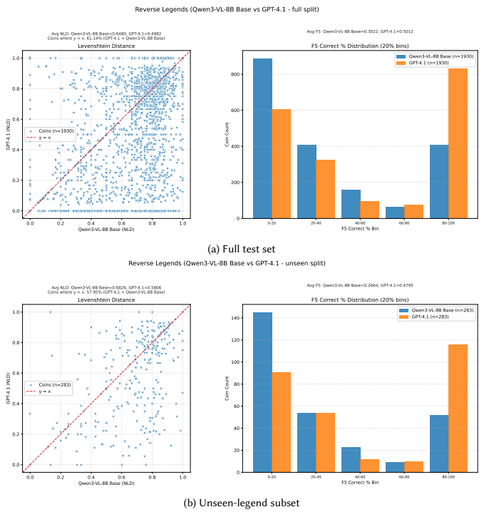
Fig. 6 . Per-sample comparison of GPT-4.1 and the Qwen base model on reverse legend transcription.
Original paper · CC BY 4.0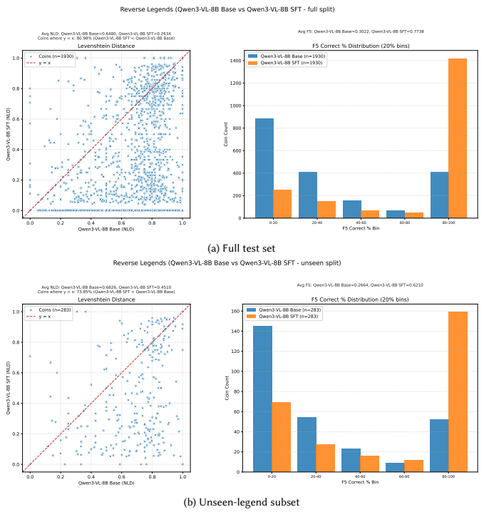
Fig. 7 . Per-sample comparison of the fine-tuned model and the Qwen base model on reverse legend transcription.
Original paper · CC BY 4.0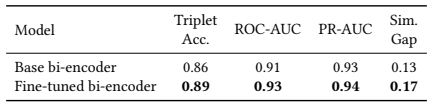
Table 4 . Bi-encoder performance before and after fine-tuning
Original paper · CC BY 4.0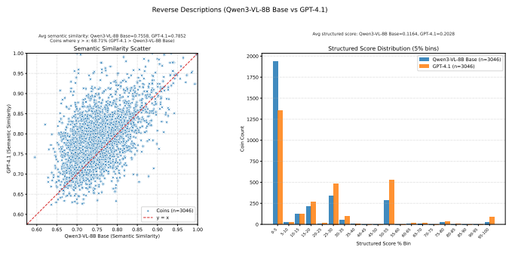
Fig. 8 . Comparison of GPT-4.1 and the Qwen base model on reverse-description generation. Left: per-sample semantic similarity. Right: distribution of structured scores.
Original paper · CC BY 4.0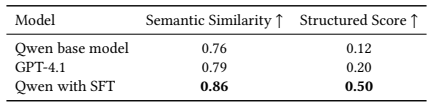
Table 5 . Reverse-description generation results.
Original paper · CC BY 4.0
Table 6 . Training settings and test performance of the classifiers used to complete missing obverse-description taxonomy components.
Original paper · CC BY 4.0
Table 7 . Obverse-description generation results. Higher is better for all columns.
Original paper · CC BY 4.0Quote from the paper
Pedro Lourenco, Ognjen Arandjelović (2026). From Classification to Generation: Vision-Language Models for Roman Imperial Coin Description. arXiv:2611.14821v1. https://arxiv.org/abs/2611.14821v1
BibTeX
@misc{lourenco2026from,
  title = {{From Classification to Generation: Vision-Language Models for Roman Imperial Coin Description}},
  author = {Pedro Lourenco and Ognjen Arandjelović},
  year = {2026},
  eprint = {2611.14821},
  archivePrefix = {arXiv},
  url = {https://arxiv.org/abs/2611.14821v1}
}