Paper commentary
Readable Is Not Steerable: Pre-Registered Tests of Physical Structure in Learned Fluid Representations
Learned fluid latents can be readable without being steerable
- Problem Self-supervised world models are often assumed to organize latents around physical quantities. A latent can be linearly readable yet give no way to control the flow, so probe scores alone cannot settle the question.
- Method The authors test three properties on 2D decaying Navier-Stokes flow: decodability, prominence and steerability. For steering, they route overall scale through a small conditioning code, and degrade the content path's copy of spectral shape.
- Results A loudness dial appeared in all 8 trained models, and a shape dial in 3 of 5 fresh seeds, against a pre-registered bar of 4.
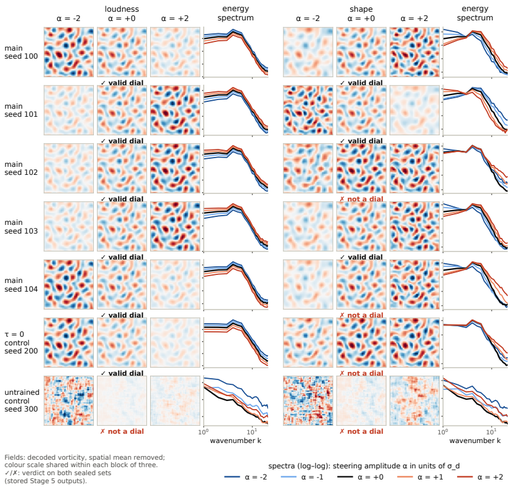
Figure 5 : Both dials of the five fresh main models and one seed of each control, decoded on one exploration frame (the sealed sets are spent and are not reopened for plotting);✓/✗give each direction’s verdict on both sealed sets. Loudness scales the field; shape moves energy between scales; seed 102’s shape direction fails. All 11 models: Figure D1 (Appendix D) (C).
Original paper · CC BY 4.0 · Manvendra Modgil · Readable Is Not Steerable: Pre-Registered Tests of Physical Structure in Learned Fluid Representations · Original paper figure · Extracted the figure area from page 15 of the original PDF.Why a readable latent is not enough
Self-supervised world models are often read as having organized their latents around physical quantities such as energy or enstrophy. The authors therefore split the idea into three properties that are often conflated: decodability, prominence and steerability.
Decodability asks whether a linear ridge probe can read the quantity from the latent, scored by R² on held-out trajectories. A latent can score well on the first and fail the second, which is the gap the three studies probe.
That result is why steering needs its own test rather than a probe score. The authors measure all three properties on two-dimensional decaying Navier–Stokes flow, where the quantities can be computed exactly. Each study compares its model against controls built to break the mechanism being claimed.
Study 1: a JEPA against an untrained control
The JEPA predicts the target encoder's 8×8 feature map of frame t+k from frames (t−1,t), with k in {1,4}, using an EMA target and VICReg variance and covariance terms but no pixel loss. The authors compare it with a pixel predictor, a pooled JEPA, a static VICReg model that never sees time, and a non-physical JEPA trained on random damped, phase-rotating linear dynamics.
Every model shares the encoder, which maps a frame to an 8×8×128 feature map whose spatial mean gives the 128-dimensional pooled latent, and the untrained control starts from the initialization that the trained models start from. Because the control begins where training begins, it isolates what training adds to the latent.
The S1 criterion counts a target when the JEPA's R² gain is at least 0.20, or when it halves the control's unexplained variance, with the bootstrap interval excluding zero. S1 needs at least three counting targets, and the Okubo–Weiss fraction must be one of them. On the in-distribution test set, the JEPA beat the untrained control on three probe targets.
Its log enstrophy R² was 0.930, compared to 0.727 for the control, a gain of +0.204. The Okubo–Weiss fraction did not count, at 0.507 against 0.456, even though the rule required it. So the pre-registered verdict is not supported, and the S2 and S3 criteria also fail.
The two controls that never see real physics did as well as the JEPA or better. The static VICReg model was the strongest on every S1 target, and it was the only model that met S1 against the control, with 4 of 5 targets counting. The authors suggest that the symmetry-invariance objective, rather than prediction, is the most useful ingredient here.
The pixel predictor and the JEPA keep different information, which the authors report as a descriptive result. The JEPA keeps local structure: vortex count reads 0.752 against 0.521, and Okubo–Weiss fraction reads 0.507 against 0.270. The pixel predictor keeps amplitude-like quantities, such as log ν from a frame pair at 0.710 against 0.457.
No model broke down on the held-out Reynolds band, where errors stayed between 0.71 and 1.46 times those on neighbouring bands.
Study 2: what makes enstrophy prominent
Study 2 asks which training choice makes enstrophy a dominant slow direction in the latent, and what the VICReg regularizer changes. The plain autoencoders render the velocity or vorticity field from the present frame, and they don't need to predict dynamics to show the effect. The primary hypothesis H1 asked for an E1 of at least 0.70 and a gap of at least 0.25 above the untrained control, with the interval excluding zero.
On the sealed set, the velocity autoencoder reached E1 of 0.860 and the vorticity autoencoder 0.799, against 0.380 for the untrained control. Both autoencoders passed H1, with gaps of +0.480 and +0.418 over the control.
The regularizer is the second design choice, and H2 required plain minus VICReg E1 of at least 0.20 for both render targets. Adding VICReg lowered E1 in every plain–VICReg pair, but the vorticity gap was only +0.149, so H2 failed for that target. The vorticity shortfall came from one weaker plain seed at 0.709 and from VICReg seeds that kept more prominence.
VICReg also raised linear decodability, so prominence and decodability come apart in these autoencoders. For the velocity autoencoder, log enstrophy R² rose from 0.862 to 0.933 with VICReg. This design cannot separate the two effects.
The same pattern carried over to Study 1, where the imaginer–summarizer gap at k = 4 replicated on the sealed set. Adding VICReg to the imaginer removed +0.315 of that gap, about two-thirds, which supports H4 as a secondary result. Study 1's JEPA result is consistent with its regularizer, but the study doesn't show the regularizer causes it, because a JEPA without VICReg collapses.
How the dial design routes each property
The question is how a decoder can be made to use a steering direction at all, since a direction that reads a property well may still do nothing. In exploration, 21 existing models offered 84 candidate directions, and none moved the decoded field by the 0.1 log-units per unit α threshold. The largest effect among them was 0.086, and a supervised shape direction predicted shape almost perfectly yet barely moved the field.
The authors read this as readable but not steerable, and they changed the design so that each property travels through one pathway. Dials appeared only after that routing change, which is why the design, not the training target, is the object being tested.
A separate dial encoder reads the raw input and produces an 8-dimensional pooled vector. Before the content branch sees the input, a random low-order gain distorts its spectrum with dose τ, which degrades the content path's copy of shape. The mean and every shell above 21 are zeroed, and the input is normalized again.
Its loss is the vorticity rendering error plus VICReg variance and covariance terms on the pooled 120-dimensional content latent. So the content code is regularized and the dial code is not, in line with Study 2.
Upsampling decided whether strong dials stayed clean, because the sub-pixel decoder produced grid artefacts in the tails of the steering range. In exploration, resize-convolution removed the artefacts, with 0.0% of frames affected at τ = 0.5 for every direction and seed. The cost was rendering: the final exploration model's vorticity error was 0.022, about 2.1 times the VICReg autoencoder.
On sealed data, one resize-decoder shape direction still exceeded the criterion, so the artefact problem was not fully solved.
Finding dials without labels
Principal components fail as the identification rule because loudness and shape are strongly correlated, with r = −0.82. The top components therefore mix the two, since PCA ranks directions by how the data vary rather than by what the directions do. The authors instead find the loudness dial by its effect on the output, using no physics labels.
In the whitened-content model, this rule left 3.5 to 3.7% of the steered change unexplained. The first principal component left 31 to 59% unexplained in the same model. The loudness direction was pure loudness, with σshape 0.02 to 0.08 and no artefact frames in all three seeds. It was a valid dial in two of three seeds, and the third missed the cycle gain at 0.48.
For shape, the rule carried into confirmation is loudness-null PCA, which estimates the average gradient of output loudness with respect to the dial code. It finite-differences the code by ±0.5 z-units per coordinate, averaged over 256 exploration frames. It restricts the z-scored dial code to the subspace orthogonal to that gradient, where steering leaves loudness unchanged to first order.
The authors chose loudness-null PCA after seeing exploration results, having kept PC2 as the frozen primary shape rule. In the exploration dose table, the loudness-null direction reached σshape 0.88 at τ = 0.2, showing the shape knob it finds.
Confirmation on sealed data
The final design was confirmed on two sealed sets, each opened once: a general set and a matched-energy set. The pre-registration fixed the model at τ = 0.2 with a resize decoder, five fresh main seeds, and two controls. The τ = 0 control uses the same decoder and may show a shape dial in at most 1 of 3 seeds. The untrained control has randomly initialized FiLM layers and was allowed no dials at all.
The loudness rule was the symmetry rule, while the primary shape rule was loudness-null PCA. PC2 served as a secondary rule, and its exploration record of 1 of 3 and then 2 of 3 was stated in advance.
Three of five seeds would count as partial, and two or fewer would count as a failure. Rendering was reported but not gated, so rendering quality could not decide the verdict. All 8 trained models had a loudness dial, which passed on both sealed sets. Shape dials formed in seeds 100, 101 and 103, while seeds 102 and 104 failed on shape, giving 3 of 5 against the bar of 4.
Seed 102 failed on effect, monotonicity, cycle correlation and gain, and grid artefacts, and seed 104 failed on the matched-energy envelope.
Valid loudness dials had effect 0.57 to 0.65 per unit α, with σ_shape at most 0.05. The three valid shape dials had effect 0.33 to 0.46 and σ_shape 0.78 to 1.00. Both controls stayed within their rules, since the τ = 0 models never showed a shape dial. The main model rendered vorticity with error 0.021 to 0.023, about 2.2 times the VICReg autoencoder.
Seed 103 had a zero-mean step that removed a spatial-mean offset in 23% of general-set frames, and the paper did not test that seed without it.
What these results do not establish
Two-dimensional flow has no vortex stretching, and its energy cascade runs to large scales, so the 3D picture may differ. Enstrophy is an inviscid invariant only in 2D, which makes the enstrophy findings specific to this setting.
E1 comes from one unsupervised pipeline: z-scoring, 32 principal components and a shrinkage within/between eigenproblem. Other pipelines could rank the slowest directions differently, so the prominence results are method-relative. VICReg also made rendering roughly 20 to 25 times worse for the autoencoders. Part of each drop in prominence may therefore reflect worse rendering rather than latent geometry, and this design can't separate the two.
The shape dial needs a known transformation and costs rendering quality, at 2.2 times the VICReg autoencoder's error.
Three of five seeds leaves the success rate anywhere between 15% and 95%, so the estimate is loose. The effect floor and the artefact criterion were calibrated on exploration data, though each change was committed before confirmatory use. The criteria therefore aren't fully independent of the exploration that shaped them. The authors didn't test a robust identification rule, which they list as a next step with at least ten fresh seeds.
Paper info
- Authors
- Manvendra Modgil
- Venue
- arXiv · Preprint
- First published
- 2026-11-3
- Added
- 2026-11-6
- Updated
- 2026-11-3
- Version
- v1
- arXiv
- 2611.05577
- Category
- cs.LG · cs.AI · physics.flu-dyn
- Original paper terms
- CC BY 4.0
- What we show
- Paper info, commentary and permitted figures from the original paper
AI commentary is a separate explanation from the original paper and may contain errors. The original paper and figures follow each source's terms of use and any rights noted separately.
Abstract
Self-supervised world models are often said to organize their latents around physical quantities. We test this on 2D decaying Navier-Stokes flow in three pre-registered studies, each tested once on held-out data. In Study 1, a joint-embedding predictive architecture (JEPA) trained to predict the flow fails the pre-registered criteria for organizing its latent around fluid quantities better than an untrained network of the same architecture (not supported); a JEPA trained on non-physical linear dynamics and a static invariance model that never sees time do as well or better. In Study 2, plain autoencoders that render the field make enstrophy prominent in their slowest unsupervised latent directions (best r 0.80-0.86 vs 0.38 untrained; fresh seeds, sealed data). Adding VICReg lowers this prominence in every comparison, though not by the pre-registered margin for vorticity, while raising the autoencoders' linear decodability (partially supported). In Study 3, we build steerable directions ("dials") by routing: the decoder gets overall scale only through a small conditioning code, while its other pathway carries a degraded copy of spectral shape. Label-free rules find a loudness dial in all 8 trained models and a shape dial in 3 of 5 fresh seeds on sealed data, against a pre-registered bar of 4; neither control shows a shape dial (partially supported). Across the studies, what a latent contains and what can be controlled through it come apart. In exploration, a supervised direction reading spectral shape almost perfectly moved nothing when steered. During the build, the loudness dial had to be found by its effect on the output (closest to a pure rescaling), not by data variance; for shape, a variance rule and an effect-constrained rule each worked in 3 of 5 seeds. The program used about 70 logged hours on one consumer GPU; all pre-registrations, deviations, code and outputs are public.
Figures from the paper
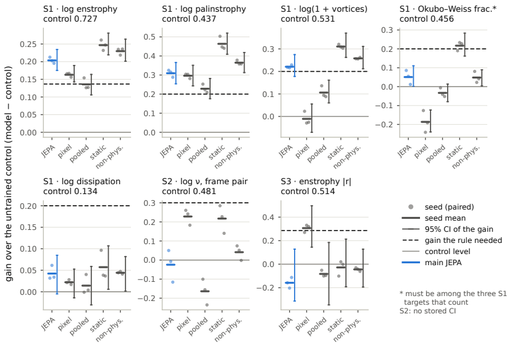
Figure 1 : Each model’s gain over the untrained control on every pre-registered S1–S3 quantity (test set, pooled latent): seeds, seed mean and stored 95% paired trajectory-bootstrap interval, against the gain each rule needed. The JEPA fails S1 (Okubo–Weiss), S2 and S3; static VICReg and the non-physical JEPA match or beat it (C).
Original paper · CC BY 4.0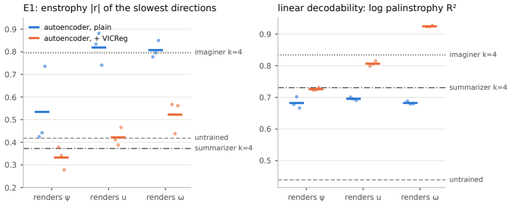
Figure 2 : Plain autoencoders that render the present match the imaginer’s enstrophy prominence; adding VICReg drops it to control level while raising linear decodability (E). The E4 panel is Figure B1 (Ap- pendix B).
Original paper · CC BY 4.0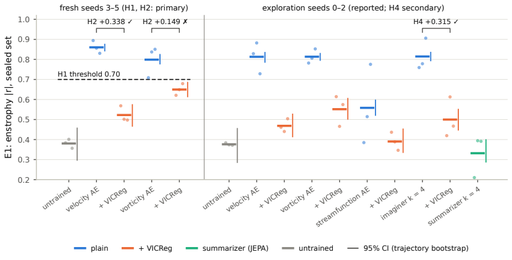
Figure 3 : Enstrophy prominence E1 on the sealed Study 2 set (seeds, mean, 95% trajectory-bootstrap interval). Fresh seeds 3–5 decide H1 and H2; exploration seeds 0–2 are reported and carry H4 (C).
Original paper · CC BY 4.0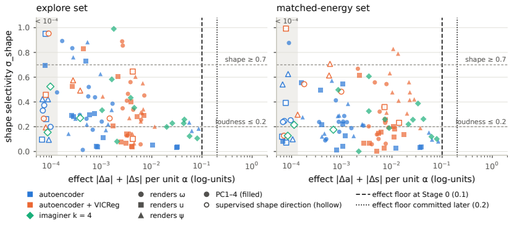
Figure 4 : Of 84 candidate latent directions in 21 existing models, none moves the decoded field by the dial threshold; even the supervised shape direction (hollow markers), which predictssalmost perfectly, barely moves it. Dashed line: the 0.1 floor used at the time; dotted: the 0.2 floor committed afterwards. Effects below10 −4 are drawn in the shaded strip (E).
Original paper · CC BY 4.0
Table 4 : Shape-noise dose (exploration data, 3 seeds per row). “Content shapeR2” is how wellscan be read from the content branch’s input; “shape knob” is the loudness-null direction (E).
Original paper · CC BY 4.0Quote from the paper
Manvendra Modgil (2026). Readable Is Not Steerable: Pre-Registered Tests of Physical Structure in Learned Fluid Representations. arXiv:2611.05577v1. https://arxiv.org/abs/2611.05577v1
BibTeX
@misc{modgil2026readable,
  title = {{Readable Is Not Steerable: Pre-Registered Tests of Physical Structure in Learned Fluid Representations}},
  author = {Manvendra Modgil},
  year = {2026},
  eprint = {2611.05577},
  archivePrefix = {arXiv},
  url = {https://arxiv.org/abs/2611.05577v1}
}