Paper commentary
Audit at the Precision You Deploy: Quantization Reshapes a Subliminally Learned Preference
Quantization can flip a hidden preference learned through subliminal training
- Problem Safety audits measure models at 16-bit precision, but deployed models are often compressed to 4 bits. A preference measured before compression may not match what the deployed model shows.
- Method The authors implant a panda preference into Qwen2.5-7B-Instruct through number sequences that never mention pandas. They then compare HQQ and NF4 at 4 bits against neutrally trained controls under the same quantization.
- Results At 4 bits, HQQ raised the subliminal net strength to about 1.3 times its 16-bit value, while NF4 cut it to about 0.3 times.
Why a 16-bit audit may miss deployed behaviour
A subliminal student can pick up a teacher's trait from training data that never names it. Cloud et al. showed this with an animal preference carried in number sequences, and with misaligned behaviour from semantically unrelated data. Audits usually run at 16 bits, but the deployed copy may be compressed to 8 or 4 bits. A preference measured before that conversion can therefore differ from the preference the deployed model shows.
If quantization weakens the trait, the original measurement overstates the deployed effect. If quantization strengthens it, the measurement understates the deployed effect. Egashira et al. built models that look benign before quantization but behave adversarially afterward. This study asks a milder question: whether ordinary post-training quantization changes how a hidden preference is expressed.
The authors split this question into four research questions about survival, error arrangement, changes inside the model, and specificity to subliminal learning. Their test case implants a "favourite animal: panda" preference into Qwen2.5-7B-Instruct through number sequences that never mention pandas. At 16 bits, the student names panda at 55% against 17% for a neutrally trained control.
Deploying the same weights at 4 bits with HQQ lifts the student to 64% while the control stays at 17%, giving R ≈ 1.3. With NF4 at 4 bits, the student drops to 29% and R falls to about 0.3, even though the rounding errors match HQQ's in size to within 4%.
The 16-bit audit therefore bounds neither deployment, because the same weights land on opposite sides of the reference.
Installing the preference and the net-strength measure
The trait is installed by fine-tuning Qwen2.5-7B-Instruct on number sequences, and the panda student data never contain the word panda. The output layer is never trained, so the adapters carry the whole installed change. Students trained on the panda data are the subliminal students, and students trained on the neutral data are the controls.
Compression shifts baseline answers on its own, so the authors compare each student with controls under the same quantization or error adjustment. Each model names its favourite animal in one word across 50 prompts, and the authors measure P, the mean probability that the first answer token is panda. The gap is then normalized by the student's 16-bit net strength, giving R = S(c)s / S(bf16)s.
A value of R equal to 1 means the net preference is unchanged from 16 bits, while values above or below 1 mean a stronger or weaker preference.
To confirm the probabilities match what the model says, they sample 20 answers per prompt at temperature 1, giving 1,000 per model and condition.
How HQQ, NF4 and the error changes are applied
The authors start from the merged bf16 model, which serves as the 16-bit reference for every comparison. At 8 bits the behaviour changes nothing, at 3 bits the base model's own answers degrade, and at 2 bits the model breaks.
Beyond the sweep, the authors run two ablations at 4, 3 and 2 bits, one quantizing only the transformer layers and one only the output layer. Because of this setup, the HQQ versus NF4 comparison uses the transformer-layers-only HQQ configuration.
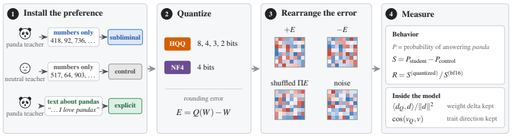
Fig. 2 . Experimental pipeline. (1) Three types of students are trained using the same LoRA recipe: subliminal students on a panda teacher’s number sequences, neutral controls on a standard teacher’s number sequences, and explicit students on the panda teacher’s ordinary text. (2) Merged weights are quantized using HQQ (at 8, 4, 3, and 2 bits) and NF4 (at 4 bits), recording the layer-wise rounding errorE=Q(W)−W. (3) HQQ’s 4-bit error is then applied unchanged, negated, shuffled within groups of 64 weights, or replaced by size-matched Gaussian noise (heatmaps are schematic). (4) Final evaluations measure outward behaviour via the control-adjusted panda probability relative to 16 bits (Eq. (1)), and internal stability by tracking how much of the fine-tuning delta and installed activation direction survive.
Original paper · CC BY 4.0 · Md Rayhanul Masud, Mst Suraiya Akter Shefa · Audit at the Precision You Deploy: Quantization Reshapes a Subliminally Learned Preference · Original paper figure · Extracted the figure area from page 3 of the original PDF.For every layer, the rounding error E is the quantized weight Q(W) minus the original weight W, and its size is recorded. The error interventions start from HQQ's full-configuration 4-bit error, so they reshape the same error that the sweep produced.
Negation reverses the sign of each HQQ 4-bit error while leaving its magnitude unchanged. Shuffling reassigns the errors to weights within each group of 64, using four random shuffles. Both operations keep the error norm within each group, and the controls receive the same transformations using their own errors. Adding the unchanged error is a consistency check, because it should reproduce the HQQ result.
Does the preference survive quantization
The controls stay near 17% under both quantizers, so the students carry the movement. The base model degrades at 3 bits and breaks at 2 bits, so only the 8-bit and 4-bit points are clean measurements of the preference. Behaviour stays approximately stable under 8-bit HQQ, with the same layers and group size as the sweep.
At 4 bits with transformer layers only, HQQ lifts the subliminal students to 61 to 67% panda probability. NF4 pushes the same students down to 28 to 30%, using the same layers and group size. The authors note the two quantizers' rounding-error norms match to within 4%, so error size alone doesn't explain the split.
Below 4 bits, the base model's own answers also degrade, which complicates any reading of the preference. At 3 bits, quantizing only the output layer drops the subliminal students from 53 to 56% to 41 to 42%, while the base stays near 17%. The authors read this as the output layer holding none of the trait while still being needed to read it out.
Does the arrangement of the error matter?
Matched Gaussian noise tests whether error size alone can explain HQQ's amplification of the panda preference. Each layer receives noise scaled to match its HQQ error norm at 4 and 3 bits, drawn three independent times. Across the three draws, student panda probabilities fall by 1 to 2, 6 to 9 and 20 to 22 percentage points. Full HQQ, by contrast, raises them by about 12 and 16 points, giving R of 1.33/1.40.
Matched per-layer error norms therefore can't explain the amplification on their own.
The second intervention keeps each model's own 4-bit HQQ error and changes only how it sits within groups of 64 weights. Adding the error unchanged reproduces full HQQ, so it works as a consistency check. Negating the error flips its signs and weakens the preference, giving R of 0.90/0.90. Four random shuffles span R from 0.22 to 1.58, with shuffle 3 amplifying more than full HQQ and shuffle 2 suppressing more than NF4.
Shuffle 1 gives 0.93/1.11 and shuffle 4 gives 0.52/0.86 in Table IV.
The controls barely move under these shuffles, sitting at 15.8% under shuffle 3 and 16.7% under shuffle 2. Their 16-bit starting point is 17.3%, so the shifts stay below two points. The students move far more, from 53.1/55.8% at 16 bits to 70.2/76.8% under shuffle 3 and 25.9/25.1% under shuffle 2. Subtracting the controls removes at most a couple of points and leaves R at 1.52/1.58 and 0.26/0.22.
What survives inside the model
The fine-tuning delta is checked by projecting the quantized delta back onto the original delta across the 196 block layers. Both quantizers keep the delta almost intact, with HQQ at 99.8% and NF4 at 99.4%. The authors measure the alignment between the student's and the base model's rounding errors as well. Because the delta survives equally well under both quantizers, the authors tie the gap in error alignment to the opposite behavioural shifts.
The activation direction is the mean difference in the layer-14 hidden state between student and base over 200 neutral number prompts. A preserved direction therefore doesn't predict the behaviour the model shows.
The authors also ask whether HQQ simply makes the model more confident in general. Under 4-bit HQQ, first-token entropy drops by 0.22 nats for the subliminal students, from 1.01 to 0.79. For the base and control models the drop is only 0.05 to 0.08 nats from about 1.2. NF4 instead raises entropy for all models by 0.14 to 0.16 nats. This points to a sharpening aimed at the installed preference, not a generic side effect of 4-bit quantization.
Is the sensitivity specific to subliminal learning
The authors build an explicit-training control to test whether the swings belong to subliminal installation alone. Their explicit students learn from the panda teacher's ordinary replies that mention pandas, with the same adapter configuration, schedule and seeds. Explicit training reaches 98% panda within 20 steps, so the authors save a checkpoint at every step.
They select the checkpoint whose 16-bit panda probability matches the subliminal students. After merging, the matched explicit students reach 50.8 to 51.2%, against 53.1 to 55.8% for the subliminal students.
Table II shows the explicit students stay close to 1 under HQQ and NF4 at 4 bits. Subliminal students span 0.27 to 1.40 under the same conditions, roughly five times wider. NF4 erases over 70% of the subliminal preference but leaves the explicit one intact. No artificial error manipulation amplifies the explicitly trained preference. Unmodified 4-bit HQQ gives the explicit students only a borderline effect, R = 1.16/1.19, which runs through the output layer.
What this means for audits
An auditor who measures a hidden preference at 16 bits can't assume that number holds for the deployed model. At 4 bits, the same weights moved the subliminal preference up under HQQ and down under NF4. The panda probability rose from roughly 55% at 16 bits to 64% under HQQ, while NF4 lowered it to about 29%. Those two shifts sit on opposite sides of the 16-bit baseline, so a single 16-bit reading can't bound the deployed effect.
The fine-tuning signal stayed largely intact under both quantizers, so a weight-level check would have missed the change. The authors conclude that a model's internal state and outward behaviour can diverge sharply under compression.
Testing at 8 bits wouldn't have revealed the 4-bit shifts, since behaviour stayed stable at that precision. The explicit-training comparison suggests the volatility is not uniform across fine-tuned preferences. Explicit students spanned a net strength range about 5 times narrower than the subliminal students. The authors caution that they can't separate training method from weight-update size, so the gap isn't settled.
Limitations of the quantization audit
Two training seeds, three Gaussian noise draws and four error shuffles don't characterize the full range of possible outcomes. Because the preference is benign, the results don't directly show how quantization affects harmful behaviour.
Behaviour is scored with first-token probabilities over 50 animal prompts, so longer responses and other contexts go untested. The authors compare only HQQ and NF4 with groups of 64 weights, and they don't test other quantizers, group sizes or deployment settings. General capabilities aren't evaluated, so fluent answers on this task don't show that broader performance is preserved.
The paper can't tell whether subliminal training itself or the larger weight changes drive the difference.
Paper info
- Authors
- Md Rayhanul Masud, Mst Suraiya Akter Shefa
- Venue
- arXiv · Preprint
- First published
- 2026-10-31
- Added
- 2026-11-3
- Updated
- 2026-10-31
- Version
- v1
- arXiv
- 2611.00665
- Category
- cs.CL · cs.LG
- Original paper terms
- CC BY 4.0
- What we show
- Paper info, commentary and permitted figures from the original paper
AI commentary is a separate explanation from the original paper and may contain errors. The original paper and figures follow each source's terms of use and any rights noted separately.
Abstract
Subliminal learning allows AI models to inherit hidden preferences from seemingly unrelated training data, such as number sequences. Safety audits may evaluate models at standard 16-bit precision, while deployments may use compressed, quantized weights. We ask whether quantization changes the expression of a subliminal preference and what drives any resulting change. To investigate, we implant a "favourite animal: panda" preference into Qwen2.5-7B-Instruct. We define its net strength as the difference in mean panda-answer probability between subliminal models and neutrally trained controls under the same quantization setting. Applying this metric across different compression levels reveals a stark contrast. While behaviour remains stable at 8 bits, 4-bit quantization triggers severe, opposing shifts depending on the quantizer. Half-Quadratic Quantization (HQQ) amplifies the preference, raising the subliminally trained model's panda probability from roughly 55% at 16 bits to 64% at 4 bits, while the controls stay near 17%. This raises the trait's net strength ~1.3 times its 16-bit value. In contrast, NormalFloat (NF4) at 4-bit suppresses it, shrinking the net strength to just ~0.3 times its 16-bit value, despite producing rounding errors of the same size to within 4%. We examine the structure of the rounding errors and find that their arrangement drives the divergence. Randomly shuffling HQQ's errors within each quantization group, without changing their magnitude, shifts the trait's net strength between 0.2 and 1.6 times its 16-bit value. Despite these opposing shifts, the underlying fine-tuning signal remains largely intact. Because a model's internal state and outward behaviour diverge so unpredictably under compression, a 16-bit audit cannot reliably bound real-world risks. Safety evaluations must test the exact quantized weights intended for deployment.
Quote from the paper
Md Rayhanul Masud, Mst Suraiya Akter Shefa (2026). Audit at the Precision You Deploy: Quantization Reshapes a Subliminally Learned Preference. arXiv:2611.00665v1. https://arxiv.org/abs/2611.00665v1
BibTeX
@misc{masud2026audit,
  title = {{Audit at the Precision You Deploy: Quantization Reshapes a Subliminally Learned Preference}},
  author = {Md Rayhanul Masud and Mst Suraiya Akter Shefa},
  year = {2026},
  eprint = {2611.00665},
  archivePrefix = {arXiv},
  url = {https://arxiv.org/abs/2611.00665v1}
}