Paper commentary
Collaborative Federated Learning For Healthcare: Multi-Modal COVID-19 Diagnosis at the Edge
- Problem Remote healthcare centers lack advanced diagnostic facilities, and sending their images to a central server conflicts with the privacy and latency needs of edge deployment.
- Method Clustered federated learning trains one shared model across client clusters that hold X-ray or ultrasound images, and the server averages the client weights each round.
- Results CFL reached an F1-Score of 0.76 on the X-ray COVID-19 class, against 0.41 for the conventional multi-modal FL model.
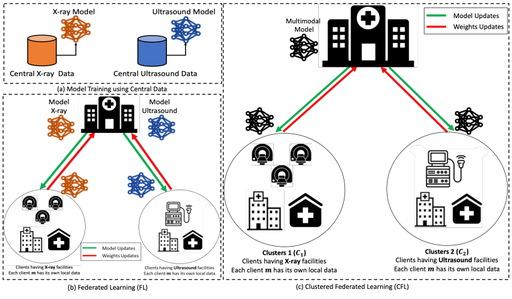
Fig. 2 : The proposed clustered federated learning based collaborative learning paradigm (Fig. 2 (c)) versus the method of model training using central data (Fig. 2 (a)) and the conventional federated learning model training method for multiple modalities (Fig. 2 (b)). The term “clients” refers to hospitals, clinics, and medical imaging facilities.
Original paper · CC BY 4.0 · Adnan Qayyum, Kashif Ahmad, Muhammad Ahtazaz Ahsan, Ala Al-Fuqaha, Junaid Qadir · Collaborative Federated Learning For Healthcare: Multi-Modal COVID-19 Diagnosis at the Edge · Original paper figure · Extracted the figure area from page 5 of the original PDF.Why train COVID-19 diagnosis at the edge
Remote healthcare centers often lack advanced medical equipment, and sending their ultrasound and X-ray images to major hospitals runs into bandwidth, latency, transmission cost and privacy problems. Edge computing keeps data processing close to the device, which lowers latency and reduces how much data leaves the site, so the authors use it as the setting for COVID-19 screening.
The study asks whether one shared model can read both X-ray and ultrasound COVID-19 images while each site keeps its own images.
Conventional federated learning keeps data local, but the authors argue it degrades when client data follow different distributions, which is the case when X-ray and ultrasound images are combined. The contributions are a CFL framework for COVID-19 diagnosis, a demonstration of how this divergence hurts conventional FL, and a discussion of the challenges and open issues in deploying ML at the edge.
How the clusters and the server interact
Each imaging modality forms its own cluster: cluster 1 holds clients with X-ray facilities and cluster 2 holds clients with ultrasound facilities. A major hospital acts as the server. It sends the shared model Ms and the initial weights W0 to every client, and clients do not know the identity or data of other clients. Figure 2 places this clustered setup against central training and against conventional federated training for several modalities.
Each client trains Ms on its own local samples and returns its learned weights Wr,k,m, where r is the communication round. The server combines the client weights with federated averaging, using the following rule, where n is the total number of clients, n = |C1| + |C2|, and w is a weighting factor for each client: The text does not say how the weighting factor w is chosen.
\[ W_r = \frac{1}{n} \sum_i w_i \times W_i \] Algorithm 1 groups the averaging differently: each cluster averages its own client weights, W_{i,r} = (1/m) Σ_j w_j × W_j, and the returned model averages the k cluster results, W_r = (1/k) Σ_i W_{i,r}. The text names Eq. 1 as the server rule but does not reconcile it with the two-level averaging of Algorithm 1.
After each round the server updates its copy of Ms, tests it on the merged multi-modal test data, and sends Wr back to every client. Rounds repeat until a stopping criterion or a desired performance is reached. Exchanging weights rather than images keeps the local data at each site, and the authors note that the weight payload is far smaller than the payload of the raw data.
Datasets, splits and the network
Two public datasets are used: a chest X-ray set from Cohen et al. [10] and a chest ultrasound set from Born et al. [13]. Each is framed as binary classification, separating COVID-19 chest images from normal chest images.
Each dataset is split 80% for training and 20% for testing, and the training part is divided among the clients of its cluster. The test sets of the two datasets are merged into one joint set, which the server uses to evaluate the shared model.
Table I gives the X-ray set with 179 COVID-19 and 1072 healthy training images, and 44 and 269 test images. The ultrasound set has 319 COVID-19 and 116 healthy training images, and 80 and 30 test images, so the class balance is reversed between the two sets. The authors describe both datasets as highly imbalanced.
Images differ in size, quality, contrast, brightness and subject positioning, both within and between classes, which the authors say makes a generalized model harder to train. Figure 3 illustrates this variation in the two datasets.
Images are converted to grayscale, resized to 256×256 and normalized before they enter the model, and standard data augmentation is applied during training. Each client trains with the Adam optimizer at a learning rate of 0.0001.
To counter the class imbalance, the authors use the alpha-balanced focal loss. It multiplies the cross-entropy term by a modulating factor that down-weights well-classified examples, with a focusing parameter γ ≥ 0. \[ FL(p_t) = -\alpha_t (1-p_t)^{\gamma} \log(p_t) \] The text gives no values for γ or α. All experiments run in a simulated environment with the TensorFlow library.
What CFL is compared against
The specialized FL baseline trains a separate federated model for each imaging modality, and the authors treat it as the best-case scenario. Its two models are trained with a learning rate of 0.0001 and batch size 32.
The conventional FL baseline builds one shared model over the clients of both modalities, with the data distributed among the clients in a federated environment. This is the comparison that isolates the effect of mixing the two modalities without clustering.
For the comparison, the baselines are first trained with batch size 16 for each modality, and CFL then trains with 5 local epochs at batch size 16. The setup section gives batch size 32 for the individual models, so the batch sizes reported for the baselines do not agree across the text.
The parameter table lists 30, 50 and 100 communication rounds, 5 and 10 epochs, batch sizes of 16 and 32, and a learning rate of 1e−3. The text gives 0.0001 for the VGG16 clients, so the learning rate for the CFL experiments is not stated consistently.
Because the datasets are imbalanced, the authors do not rely on accuracy and report precision, recall and F1-Score for each class.
Per-class scores against the baselines
Table III gives precision, recall and F1-Score per class for the three models.
On the X-ray COVID-19 class, CFL reaches an F1-Score of 0.76 with precision 0.71 and recall 0.82. The specialized FL baseline reaches 0.77, and the conventional multi-modal FL model reaches 0.41, with precision 0.30.
On the ultrasound COVID-19 class, CFL reaches an F1-Score of 0.94, against 0.97 for the specialized baseline and 0.84 for the conventional multi-modal model.
On the X-ray healthy class, CFL and the specialized baseline both reach an F1-Score of 0.96, while the conventional multi-modal model reaches 0.82. On the ultrasound healthy class, CFL reaches 0.83, below the specialized baseline's 0.90 and above the conventional multi-modal model's 0.69.
The abstract reports overall F1-Score gains of 16% on X-ray and 11% on ultrasound over the conventional multi-modal FL model. Those overall values are not broken down per class in the table, so they are reported here as the authors' figures.
The authors report that the model recognizes test images from both modalities without being told which modality each image belongs to. They also report better overall results on ultrasound images than on X-ray images for all compared models.
Behaviour across communication rounds
Figure 5 tracks accuracy and loss over increasing communication rounds for the specialized models, the multi-modal conventional FL model and the CFL model.
The authors report that the conventional multi-modal model over-fits after 50 communication rounds, while the CFL model keeps learning. The CFL model also shows over-fitting behaviour in later rounds.
A vertical red line in Figures 5(a) and 5(b) marks an inflection point after which the specialized models of the two clusters begin to diverge. The authors recommend stopping the federated rounds once the loss reaches this inflection point.
Limits of the evidence
Both datasets are highly imbalanced, and the image variation makes a generalized model harder to train. The ultrasound healthy test set has 30 images and the X-ray COVID-19 test set has 44.
The authors consider only divergence in the nature of the data between X-ray and ultrasound, because the datasets do not allow more.
The abstract and the Table III caption refer to a central baseline trained with central data. The experiment description defines only the specialized and conventional FL baselines, so the central baseline has no protocol stated in the text.
The learning rates and batch sizes given in the text and in the parameter table do not agree.
CFL performance begins to degrade after a certain communication round, and the authors point to the need for early stopping and optimal stopping criteria beyond the maximum round count.
Table III gives one precision, recall and F1-Score value per class, with no spread across runs.
Paper info
- Authors
- Adnan Qayyum, Kashif Ahmad, Muhammad Ahtazaz Ahsan, Ala Al-Fuqaha, Junaid Qadir
- Venue
- arXiv · Preprint
- First published
- 2021-1-19
- Added
- 2026-11-6
- Updated
- 2021-1-19
- Version
- v1
- arXiv
- 2101.07511
- Category
- cs.LG · cs.DC
- Original paper terms
- CC BY 4.0
- What we show
- Paper info, commentary and permitted figures from the original paper
AI commentary is a separate explanation from the original paper and may contain errors. The original paper and figures follow each source's terms of use and any rights noted separately.
Abstract
Despite significant improvements over the last few years, cloud-based healthcare applications continue to suffer from poor adoption due to their limitations in meeting stringent security, privacy, and quality of service requirements (such as low latency). The edge computing trend, along with techniques for distributed machine learning such as federated learning, have gained popularity as a viable solution in such settings. In this paper, we leverage the capabilities of edge computing in medicine by analyzing and evaluating the potential of intelligent processing of clinical visual data at the edge allowing the remote healthcare centers, lacking advanced diagnostic facilities, to benefit from the multi-modal data securely. To this aim, we utilize the emerging concept of clustered federated learning (CFL) for an automatic diagnosis of COVID-19. Such an automated system can help reduce the burden on healthcare systems across the world that has been under a lot of stress since the COVID-19 pandemic emerged in late 2019. We evaluate the performance of the proposed framework under different experimental setups on two benchmark datasets. Promising results are obtained on both datasets resulting in comparable results against the central baseline where the specialized models (i.e., each on a specific type of COVID-19 imagery) are trained with central data, and improvements of 16\% and 11\% in overall F1-Scores have been achieved over the multi-modal model trained in the conventional Federated Learning setup on X-ray and Ultrasound datasets, respectively. We also discuss in detail the associated challenges, technologies, tools, and techniques available for deploying ML at the edge in such privacy and delay-sensitive applications.
Quote from the paper
Adnan Qayyum, Kashif Ahmad, Muhammad Ahtazaz Ahsan, Ala Al-Fuqaha, Junaid Qadir (2021). Collaborative Federated Learning For Healthcare: Multi-Modal COVID-19 Diagnosis at the Edge. arXiv:2101.07511v1. https://arxiv.org/abs/2101.07511v1
BibTeX
@misc{qayyum2021collaborative,
  title = {{Collaborative Federated Learning For Healthcare: Multi-Modal COVID-19 Diagnosis at the Edge}},
  author = {Adnan Qayyum and Kashif Ahmad and Muhammad Ahtazaz Ahsan and Ala Al-Fuqaha and Junaid Qadir},
  year = {2021},
  eprint = {2101.07511},
  archivePrefix = {arXiv},
  url = {https://arxiv.org/abs/2101.07511v1}
}