Paper commentary
When and How SignSGD Outperforms SGD: A Functional Scaling Law Perspective
Noise makes SignSGD outperform SGD on hard tasks and larger batches
- Problem Existing SignSGD theory mostly covers full-batch dynamics, so it misses how gradient noise shapes learning and scaling. Batch size and learning-rate schedules change that noise, so the scaling account stays incomplete.
- Method The paper treats SignSGD as preconditioned SGD, where gradient noise smooths the sign operator. Its functional scaling law splits learning into signal learning and noise forgetting, under any learning-rate schedule.
- Results SignSGD's expected excess risk is a signal term plus a noise-forgetting convolution. On hard tasks it gets better data efficiency than SGD, and it keeps that efficiency at larger batch sizes.
Why sign-based optimizers lack a scaling account
Sign-based optimizers now sit at the center of large-scale training, and they share one basic operation. SignSGD and Lion apply the sign operator coordinate-wise, while Muon applies the matrix sign operator. Adam and RMSprop show sign-like behaviour through coordinate-wise second-moment normalization. Most theory on these methods studies deterministic full-batch dynamics.
Kim et al. (2026) study signSGD in PLK regression, but mainly in the noiseless setting.
These results don't say how the sign operator interacts with gradient noise. They also don't quantify how that interaction shapes loss dynamics and scaling behavior. This gap matters because batch size and learning-rate schedules change the noise each update sees. That noise drives the scaling behaviour, so ignoring it leaves the scaling account incomplete.
A continuous model of SignSGD in intrinsic time
The authors split each mini-batch gradient into its population gradient and a Gaussian noise term whose variance scales with sigma_B squared, where sigma_B equals 1 over the square root of B. Taking the expectation of the sign of the noisy gradient gives the scaled smoothed sign operator m_B, so the expected sign of the stochastic gradient becomes m_B of the population gradient divided by sigma_B.
The centred sign noise n_k absorbs the rest of the update, which gives theta_{k+1} minus theta_k equal to minus eta_k times the bracket of m_B over sigma_B plus n_k. The drift is therefore the smoothed sign of the true gradient, and the diffusion is set by the covariance of the centred sign noise.
Learning rate and batch size enter through the intrinsic time t, defined as the integral of eta(u) divided by sigma_B. This intrinsic time is the continuous analogue of the cumulative learning rate, so it tracks the schedule in a single clock. The noise intensity n_B(t) equals sigma_B times eta at the inverse clock, and it sets how much noise each unit of intrinsic time receives.
Together these two quantities give the SDE with drift minus m_B of the gradient and diffusion scaled by n_B(t) and Q_B to the power one half, which the rest of the analysis works with.
SGD's intrinsic time has no 1/sigma_B factor, so the authors add that factor for SignSGD. They add it because the drift of SignSGD depends on batch size, and Section 6 explains this choice. In the label-noise-dominated regime, the exact single-sample gradient-noise covariance is comparable to (E plus sigma squared) H, so it reduces to a multiple of H.
The authors argue this makes the Gaussian noise model's alignment assumption natural in that regime.
The resulting SDE is the basis for the functional scaling law in Theorem 3.1, which takes the expected excess risk as a sum of a signal term and a noise convolution. The theorem holds for t at least B times the maximum of 1/2 and 1/(2s plus 2/q), under the condition that the square root of B times the supremum of eta is at most a constant.
How noise turns sign into preconditioning
Near the origin, the smoothed sign is roughly linear, so the SignSGD drift becomes a preconditioned gradient step. The authors write this local drift as minus P times the population gradient, with P equal to c times D to the power minus one half. Each coordinate is divided by its own single-sample noise scale, which is the form of preconditioned SGD.
Whether this normalization helps, however, depends on how the noise scale relates to the curvature.
Under noise-curvature alignment and diagonal features, the authors set the effective decay rates to rho_j proportional to the square root of lambda_j. The effective spectrum therefore decays as j to the power minus q over 2, rather than j to the power minus q. This narrows the gap between fast and slow spectral directions, which is where faster signal learning in low-curvature directions comes from.
Without noise-curvature alignment, normalizing by the noise need not compensate for curvature.
In the local regime, the sign-noise covariance is close to the identity, so the dynamics become preconditioned SGD with approximately isotropic noise. Far from the target, the sign saturates during a burn-in phase, and the theorem applies only after a training-time threshold. That threshold grows with B and with task difficulty, as the burn-in analysis shows.
SignSGD reaches a substantially lower final risk when features are diagonal and noise is curvature-aligned. Rotations or isotropic noise reduce this advantage, which supports the mechanism.
The functional scaling law for SignSGD
Theorem 3.1 gives the expected excess risk under any learning-rate schedule as a signal term plus a convolution of a kernel with the noise intensity. The formula is E[E(ϑ_t)] ≍ S(t) + ∫_0^t K(t−τ) n_B(τ) dτ, with the signal term S(t) and the kernel K(t) both written as power laws. The signal term decays as t^{-2s} and the kernel as t^{-(2-2/q)}, and the hidden constants are independent of B and of the learning-rate schedule.
The theorem holds once t is at least of order B to the power max{1/2, 1/(2s+2/q)}, which is the training-time condition that controls burn-in.
The first term is the error that the initial condition leaves behind, and it shrinks as the intrinsic time grows. The second term adds up the noise injected at earlier times, weighted by how much of it the kernel has not yet forgotten. Because the noise enters through n_B and the clock is the intrinsic time t, the same formula covers cosine, WSD or cyclic schedules.
The SGD FSL in Li et al. (2025) has the same convolution form, but its signal term is S(t) ≍ t^{-s} and its kernel is K(t) ≍ t^{-(2-1/q)}. For fitting, the authors write the loss as L_Θ(k) = L_∞ + S_k + N_k, with S_k = C_S(A_S + t_k)^{-α}. The parameter set Θ collects L_∞, C_S, A_S, α, C_K, A_K and ν, where L_∞ is the irreducible loss.
Risk curves and the signal-noise split in PLK regression
The fitted FSL tracks SignSGD risk curves in power-law kernel regression with (s, q) = (0.3, 4). The authors fit the parameterized FSL to SignSGD risk curves and predict the curves under cosine, WSD and cyclic schedules. The cyclic schedule was held out, so its curve is a prediction rather than a fit. The FSL matches discrete training even though it was derived from a continuous-time model.
The authors split each risk trajectory into a noise term N_k and a signal term S_k. The noise terms differ across schedules, so the noise curves separate the three learning-rate schedules. The signal terms differ mainly in the training step at which they are plotted. Plotted against intrinsic time, the signal curves collapse onto one shared curve.
So schedule effects sit mostly in the noise term, while the signal profile is governed by intrinsic time.
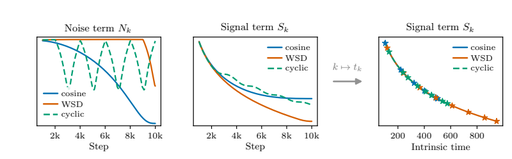
Figure 2 : FSL decomposition and intrinsic-time collapse for SignSGD.We use the same configurations and shared FSL as in Figure 1 (left). Solid curves correspond to the cosine and WSD schedules used for fitting; dashed curves show predictions for the held-out cyclic schedule.(Left)Noise termN k versus training steps.(Middle)Signal termS k versus training steps.(Right)The signal terms collapse onto a common curve when plotted against intrinsic time.
Original paper · CC BY 4.0 · Zilin Wang, Binghui Li, Jia-Nan Wang, Lean Wang, Jinbo Wang, Lei Wu · When and How SignSGD Outperforms SGD: A Functional Scaling Law Perspective · Original paper figure · Extracted the figure area from page 8 of the original PDF.Data scaling and critical batch size: where SignSGD beats SGD
On the hard task with (s, q) = (0.3, 4), the authors tuned each optimizer's peak learning rate per data budget and compared the best final excess risk. Figure 1 (middle) shows SignSGD's data-scaling exponent is larger than SGD's, so its risk falls faster as data grows. The paper states the condition as γ_sgn > γ_sgd in E(D) ≂ D^(-γ), which it reads as improved data efficiency.
Theorem 4.1 is the prediction this experiment checks, so the hard-task result supports the data-efficiency claim. In plain terms, on hard tasks SignSGD needs less data to reach a given risk than SGD.
They estimated the critical batch size (CBS) as the largest batch size that approximately preserves each optimizer's small-batch risk. The estimates in Figure 1 were 16 for SGD and 2000 for SignSGD, and marked estimates use a 20% risk-increase tolerance. The right panel shows SignSGD has the largest CBS, followed by Adam and then SGD, across the tested range.
The power-law fits show the CBS grows faster with data budget for SignSGD and Adam than for SGD. Language-model training shows a similar trend, where Muon has greater large-batch robustness than Adam, which outperforms SGD. Because Muon applies the matrix sign operator to gradient updates, the authors suggest a broader link between sign-based normalization and batch-size efficiency.
Which structural conditions the advantage needs
The authors ask whether SignSGD's advantage depends on diagonal features and noise-curvature alignment, or whether it appears in any setup. They match total gradient noise energy and tune each optimizer's learning rate separately before comparing runs. Their comparison includes SignSGD with isotropic noise, SignSGD with rotated features, and SGD with isotropic noise.
SignSGD attains a substantially lower final risk when features are diagonal and the noise is curvature-aligned. Rotating the feature covariance, which breaks diagonal structure, reduces this advantage. Isotropic noise, which breaks noise-curvature alignment, also reduces the advantage.
The middle panel of Figure 4 varies noise-curvature alignment by setting the noise covariance to Σ ∝ H^γ with γ in [0, 1]. The right panel varies feature diagonality by rotating the feature covariance, measured by the rotation strength ρ. The authors read the results as showing that the advantage requires both structural conditions, not just one.
The mechanism behind this dependence comes from the preconditioner: without alignment, noise normalization doesn't compensate for curvature.
The same LR schedule is used for both optimizers, but SGD uses t_sgd(z) while SignSGD uses t_sgn(z) = √B t_sgd(z). Because of this scaling, the signal-learning functions in training steps differ between the two optimizers. The extra √B factor comes from the local sign response, which grows with batch size in the local regime. The noise injection intensity also depends on batch size through n_B(t) = η(Γ_B^{-1}(t))/√B.
So alignment is a condition the advantage depends on, not a detail of the setup.
Language-model pre-training checks
The authors trained a Llama-style language model with approximately 0.1B parameters on 10B tokens. They kept a token-to-parameter ratio of approximately 100 for this run. They evaluated the FSL for SignSGD and Adam under cosine, WSD, and 8-1-1 learning-rate schedules. The WSD schedule comes from Hu et al. (2024), and the 8-1-1 schedule comes from DeepSeek-AI et al.
(2024).
For each optimizer, the authors fit the FSL parameters to the cosine and 8-1-1 loss curves. The fitted FSL then predicts the loss curve under the WSD schedule, which the fit never saw. Figure 3 (a) shows that the FSL captures the loss curves for both SignSGD and Adam. The held-out WSD prediction is the harder check, since WSD played no part in fitting.
For the batch-size test, the authors trained with B values of 64, 128 and 256 at a constant learning rate. They fit the FSL jointly on the B = 64 and B = 128 curves. They then predicted the held-out B = 256 curve, and the FSL extrapolates well for both SignSGD and Adam. The authors identify batch-size scaling as the point where their FSL differs from the SGD-based FSL of Li et al.
(2025).
An extra cosine-schedule experiment for Adam appears in Appendix H.3 as Figure 12 (left). The authors frame these LLM results as suggestive, not conclusive.
Limits and open extensions
The main derivation rests on Gaussian gradient noise, and the authors treat a non-Gaussian extension separately in an appendix. The curvature-aligned noise assumption, Σ ≂ H, is argued for the label-noise-dominated regime, where the single-sample covariance is comparable to H. Outside that regime the paper doesn't establish the alignment, so the scope of the claims narrows there.
The main theorem also applies only after the training-time threshold t ≳ B max{1/2, 1/(2s+2/q)} is reached.
The Adam and RMSprop extension has numerical support but no rigorous derivation. The matrix sign operator behind Muon is left for future work, so the paper doesn't analyse Muon's matrix structure.
The LLM evidence comes from a single Llama-style model with about 0.1B parameters, trained on 10B tokens. The authors frame the comparison with the SGD FSL as suggestive, so it doesn't settle which FSL describes batch-size dependence better.
Paper info
- Authors
- Zilin Wang, Binghui Li, Jia-Nan Wang, Lean Wang, Jinbo Wang, Lei Wu
- Venue
- arXiv · Preprint
- First published
- 2026-11-12
- Added
- 2026-11-13
- Updated
- 2026-11-12
- Version
- v1
- arXiv
- 2611.16560
- Category
- stat.ML · cs.LG
- Original paper terms
- CC BY 4.0
- What we show
- Paper info, commentary and permitted figures from the original paper
AI commentary is a separate explanation from the original paper and may contain errors. The original paper and figures follow each source's terms of use and any rights noted separately.
Abstract
We study how the sign operator interacts with gradient noise to shape the learning dynamics and scaling behavior of sign-based optimizers. In power-law kernel regression with diagonal features, we establish a functional scaling law (FSL) for SignSGD under general learning rate schedules. The FSL describes the learning dynamics through two processes: signal learning and noise forgetting. The key mechanism is noise-induced preconditioning: gradient noise smooths the sign operator, inducing an effective preconditioned SGD. Noise-curvature alignment enables this preconditioning to transform the effective Hessian from $\mathbf{H}$ to $\mathbf{H}^{1/2}$. The resulting dynamics exhibit faster signal learning but slower noise forgetting than SGD. This tradeoff yields a regime-dependent comparison with SGD: (i) SignSGD achieves improved data efficiency in the hard-task regime; (ii) both optimizers achieve the same data efficiency in the easy-task regime, but SignSGD maintains this efficiency at larger batch sizes, requiring fewer optimization steps for a fixed data budget. Power-law kernel regression experiments support the proposed mechanism and predicted scaling behavior. LLM pre-training experiments further suggest that the SignSGD FSL better captures the batch-size dependence of loss dynamics for sign-based optimizers than the original SGD FSL.
Quote from the paper
Zilin Wang, Binghui Li, Jia-Nan Wang, Lean Wang, Jinbo Wang, Lei Wu (2026). When and How SignSGD Outperforms SGD: A Functional Scaling Law Perspective. arXiv:2611.16560v1. https://arxiv.org/abs/2611.16560v1
BibTeX
@misc{wang2026when,
  title = {{When and How SignSGD Outperforms SGD: A Functional Scaling Law Perspective}},
  author = {Zilin Wang and Binghui Li and Jia-Nan Wang and Lean Wang and Jinbo Wang and Lei Wu},
  year = {2026},
  eprint = {2611.16560},
  archivePrefix = {arXiv},
  url = {https://arxiv.org/abs/2611.16560v1}
}