Paper commentary
Synthesizing symbolic models of human and machine reasoning at scale
BCSS finds symbolic programs that reproduce human and machine reasoning errors
- Problem Symbolic models of reasoning have been hard to build, because each domain needs hand-written rules. That effort becomes impossible in open-ended tasks like ARC, with its huge space of transformations.
- Method BCSS uses an LLM to propose a few line edits to a correct reference program. It runs each edited program and keeps only those whose output reproduces the observed error.
- Results Synthesized programs reproduce 49.1% of non-trivial incorrect attempts on pooled ARC-AGI-1 splits, and error programs are shorter than correct-output controls.
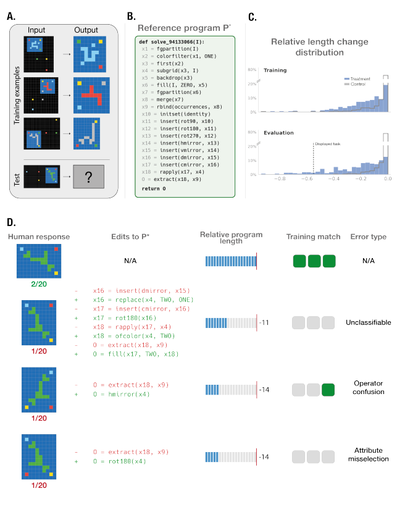
Fig. 2 Synthesized programs suggest people often infer rules simpler than the tar- get rule for a given task. (A): A representative ARC task (94133066). Three training examples demonstrate the target rule—return the contents of the framed sub-grid under whichever of its eight rotations and reflections is consistent with the isolated colored cells scattered around it—followed by the test input for which participants construct an output grid (hidden with a grey square and “?” for illustrative purposes). (B): The reference programP ∗ implementing the target rule for this task. Because this task belongs to theevaluationsplit,P ∗ is itself model-synthesized rather than human-written. (C): Distribution of relative program length change, (L(p)−L(P ∗))/L(P ∗), over all synthesized programs, shown separately for thetrainingandevaluationsplits of ARC-AGI-1. Treat- ment programs (blue) are those conditioned on incorrect human responses; control programs (grey) are produced by an identical procedure conditioned instead on the correct output grid. Because edits replace lines in-place and causally irrelevant code is subsequently removed, synthesized programs can either shorten, or remain the same, but never lengthen. Therefore, the control condition controls for the shortening bias attributable to the procedure itself, against which the leftward displacement of the treatment distribution should be read. The dashed line marks the median shortening of modeled responses for the task displayed in this figure. (D): The correct response (top row) and the three of the most frequent incorrect responses to that task, with response frequencies below each grid (green, correct; red, incorrect). For each, we show the diff withP ∗ after applying BCSS, the length of the resulting program relative toP ∗ (blue, retained lines; gray, removed lines; red rule, reference length), which training examples the program reproduces (green, reproduced), and its error category. A sin- gle edit can account for a large simplification: for example, replacing the finalextractover the eight candidate transforms by one fixed transform renders fourteen lines of the reference program inconse- quential, and they are removed. Thus, the simpler resulting program hardcodes a transform instead of exhaustively searching over possible transformations.
Original paper · CC BY 4.0 · Solim LeGris, Philipp Mondorf, Jinran Jin, Akshay K. Jagadish, Brenden M. Lake, Todd M. Gureckis · Synthesizing symbolic models of human and machine reasoning at scale · Original paper figure · Extracted the figure area from page 8 of the original PDF.Why hand-built symbolic models stall
Symbolic models explain cognition in an explicit, rule-like form, which is why they stay attractive next to neural networks. Their main obstacle is hand-engineering, since the primitives and their compositions have to be specified for each domain. It becomes hard in open-ended domains, and ARC is one such domain, with an effectively unbounded space of possible transformations.
The authors chose to model errors rather than correct answers, because they hypothesized that incorrect responses reveal underlying cognitive processes. The H-ARC dataset gives the scale: 6,261 unique human incorrect responses from over 1,700 participants. Machine errors add 4,166 configuration-unique errors from four model configurations.
Given this many distinct error patterns, hand-engineering a solution for each one is impossibly costly.
Incorrect responses in ARC are not random, because they cluster near the correct grid rather than scattering across the output space. The authors therefore treat each wrong answer as a constrained deviation from a normative standard, rather than as idiosyncratic noise. They express that standard as a reference program written in a symbolic domain-specific language.
This framing lets the search start from a known correct program and explore only nearby alternatives.
Key idea: LLM proposals checked by execution
BCSS lets an LLM guess which small edits to a correct program might explain a wrong answer, and lets execution decide which guesses survive. The LLM acts as a proposal distribution over plausible deviations, while running the program serves as a hard verification step. This pairing makes the search tractable, because the LLM narrows an otherwise enormous program space instead of enumerating it.
For each unique incorrect response, the LLM gets a full specification of the DSL, the task grids, a reference program and the observed incorrect response. The LLM proposes k independent sets of at most j line edits, and the authors sampled edit budgets of 2, 4 and 8 lines. Five samples at each budget give 15 samples per error, and the edits replace referenced lines of the reference program rather than adding new ones.
Proposal sets are conditioned on single human or machine responses, so each candidate program targets one specific behavior.
Each proposed edit must be syntactically valid ANF code written only with DSL operators, and any edit that breaks these rules is discarded. The edited lines replace the tagged lines of the reference program, and a custom parser then removes lines that no longer feed the output. The resulting program runs on the test input, and it is kept only if its output reproduces the observed response.
Because a response is often reachable by several programs, BCSS returns a collection of programs per response instead of a single model.
Acceptance uses the same noise tolerance as filtering, so a program with ten or more cells may differ from the target by up to two cells. When the best program in a pool of 15 samples differs by one cell, other programs must match that accuracy to be accepted.
How much of the error space BCSS covers
Synthesized programs account for 49.1% of non-trivial incorrect attempts when the two ARC-AGI-1 splits are pooled. That pooled figure is 3,636 of 7,402 attempts, and the programs fit individual responses on both the training and evaluation splits. Coverage was 52.5% on the training split and 46.2% on the evaluation split, so the two splits differ by about six points.
The full per-split breakdown appears in Supplementary Table S2, which also reports 2,781 of 6,261 unique errors reproduced. Each modeled response is explained by a median of 2 distinct programs, with an interquartile range of 1 to 4. The authors read the coverage as evidence that many human errors sit only a few line edits from the reference programs, with a mean of 2.84 minimum edits.
The natural alternative is brute force, which enumerates every single-line rewrite of each training reference program. The enumeration produced 16,661,032 candidate programs.
The authors explain the gap by noting that exhaustive search becomes intractable as the edit distance grows, which is where many human errors lie. Their reading is that LLM proposals focus the search on plausible regions of program space, whereas the baseline stays limited to single-line rewrites. They didn't test deeper exhaustive search, so the comparison covers only single-edit mutations.
Human error programs are shorter than their references
A shorter error program could simply be an artifact of the edit procedure, so the authors built a control for it. The control reruns the same procedure with identical reference programs, but conditions the synthesizer on correct output grids instead of errors. Because the programs are adapted through line-level edits, relative line-count change serves as the proxy for complexity difference from the references.
Correct-output baseline programs are only 5.2% shorter (94% HDI [−0.076,−0.028]), so conditioning on errors adds 13.9 percentage points of shortening.
The evaluation split shows the same pattern, but its reference programs were model-synthesized rather than written by hand. Because the gap survives on both splits, the simplification isn't only the procedure's built-in bias, as the authors argue.
The programs behind the two bottom responses use fixed transforms instead, hmirror and rot180, making fourteen reference lines irrelevant. Reference size also mattered in a Bayesian regression on training-split tasks that included error categories as a term. For each additional reference line, error programs showed 0.47 percentage points more shortening (94% [−0.0056,−0.0037]).
A 7-line reference gave error programs predicted to be 5.8% shorter, while a 28-line reference gave 15.7% shorter.
Task success rate had only a weak effect: its credible interval (94% HDI [−0.0213,0.0666]) includes zero, so the authors call it inconclusive. The authors read these results as a bounded cognition account, in which people may adopt simpler rules when the target is costlier to infer or verify.
Partial fits and attribute misselection
A partial match reproduces at least one training output, but not all of them. Pooled, 20.9% of modeled human attempts were partial matches, 22.1% on training and 19.7% on evaluation. Alternative rules, which reproduce all training outputs yet miss the test example, were rare at 1.7%.
An LLM classifier placed each program into one of seven cognitive categories, or an unclassifiable catch-all. Figure 4 shows how often each category appears among modeled training-split attempts. Attribute misselection, which computes a target parameter from the wrong feature, was the most common category. Localized errors keep most of the target rule's structure, whereas partial programs and transformation misselections are coarser approximations.
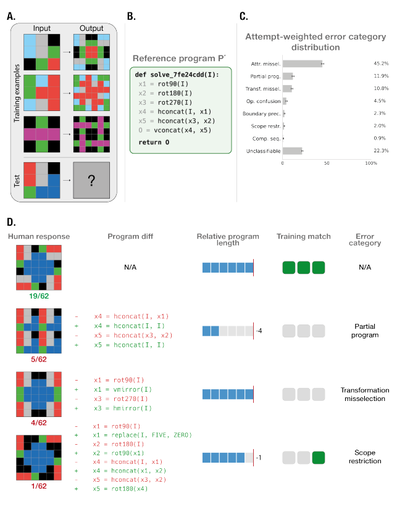
Fig. 4 Synthesized programs reveal a restricted set of recurring deviations from target rules. (A): A representative ARC task (7fe24cdd). Three training examples specify the target rule— tile the input into a 2×2 arrangement in which each quadrant holds the input rotated by a further 90◦ clockwise, starting from the input at the top left—followed by the test input for which participants construct an output grid (hidden with a gray square and “?” for illustrative purposes). (B): A human- written reference programP ∗ implementing the target rule for this task. (C): Prevalence of each error category among modeled incorrect attempts. An LLM classifier assigned every program one of seven cognitive categories, given the reference program, the task grids, the synthesized program and its execution trace (Table 1 for definitions). Bars give the posterior median of the attempt-weighted prevalence derived from a hierarchical Bayesian categorical model, and error bars the 94% HDI; the categories are mutually exclusive. Classification was performed on programs fitting responses totrainingsplit tasks only. (D): The correct response (top row) and three of the most frequent modeled incorrect responses to the task in panel A, with the response frequency below (green, correct; red, incorrect). For each, we show the diff withP ∗ after applying BCSS, the length of the resulting program relative toP ∗ (blue, retained lines; gray, removed lines; red rule, reference length), which training examples the program reproduces when executed on their inputs (green, reproduced), and its error category. The programs that reproduce these three incorrect responses diverge fromP ∗ in different ways: omitting the rotations and tiling the input four times, carrying out reflections instead of rotations, or correctly carrying out the rule on a restricted portion of the input.
Original paper · CC BY 4.0Order matters because a partial match can cover the earliest examples, the latest ones, or scattered ones. Conditional on a partial match, first-k runs made up 35.8% of attempts and last-k runs 16.4%. Exact Bayesian inference is order-invariant, whereas sequential sampling predicts dependence on presentation order, which the authors use to interpret the pattern.
They also suggest that task designers put simpler examples first, so an early-fitting rule may ignore a later exception by construction.
Large reasoning models at different reasoning effort
The same pipeline was run on two large reasoning models, Qwen3.5-27B and GPT-OSS-120B, which generate long chains of thought. GPT-OSS-120B was run at high, medium and low reasoning effort, so reasoning effort could be varied within one model. Qwen3.5-27B reached 80.63% accuracy, and GPT-OSS-120B reached 72.28% at high effort, 50.96% at medium and 25.02% at low.
The authors compare these with a 59.9% single-attempt human average reported in prior work.
Each model's error programs were compared with correct-output controls, as with humans. Qwen3.5-27B error programs were 11.9% shorter than baseline programs. Shortening tracks accuracy, with a Pearson r of -0.80 across five configurations (n = 5), and each 10 accuracy points corresponds to 3.0 percentage points less shortening.
The authors read this as support for simplification driven by resource limits, so less capable or less compute-heavy systems infer simpler rules. The partial-match share rose with capacity, from 20.2% for GPT-OSS-120B at low effort to 40.0% for Qwen3.5-27B. Alternative rules were rarer, at 3.0% and 6.7% for the same two settings.
Attribute misselection was again the most frequent category, and its share rose with performance: 61.58% for GPT-OSS-120B at high effort versus 42.63% at low. Lower-performing models produced more unclassifiable errors, which the authors read as less systematic error behavior. Logistic L2, EBM and gradient boosting classifiers separated pooled LRM errors from human errors with within-task ROC-AUC of 0.65 to 0.69.
Discrimination was weaker for the more accurate settings, at 0.58 to 0.61 for Qwen3.5-27B and 0.57 to 0.63 for GPT-OSS-120B at high effort.
Only GPT-OSS-120B at high effort showed a human-like order effect, with 36.1% first-k partial matches versus 21.8% last-k. The other configurations showed no consistent preference, and GPT-OSS-120B at medium effort leaned toward last-k matches. These findings suggest that the more capable models make more systematic errors than earlier work found.
Satisficing as one shared reading
The authors read the shared signatures in people and machines as satisficing, meaning a learner settles for a rule that explains enough of the evidence. Three regularities from the human data fit this reading: errors come from shorter programs, rules explain only part of the examples, and misselection is the most common error type. Simplification, partial fits and misselection each fit that reading.
In GPT-OSS-120B, lower reasoning effort produced simpler programs and fewer partial fits, which parallels the human results. GPT-OSS-120B scored 72.28% at high effort, 50.96% at medium and 25.02% at low, so less effort also meant lower accuracy.
The authors tie this pattern to a resource-rational account of reasoning in open-ended domains. They note that formalizing this account would require explicit modeling of the costs that people and machines trade off. The order asymmetry among partial fits supports the broader view that systematic errors reveal mechanisms. Because all examples stay visible while solving, the authors judge degraded encoding an unlikely cause of the pattern.
Whether people form hypotheses from a subset of examples, or verify them sequentially, stays open for future work. The authors don't claim a formal test of the resource-rational account yet.
Limitations of coverage, representation and process
BCSS captures about half of non-trivial errors, so the analysed set covers only part of the error space. On the pooled data, the synthesized programs account for 49.1% of non-trivial incorrect attempts. Edits replace lines rather than add them, so errors that elaborate on the target rule are likely underrepresented. Some errors may need more edits, or may reflect idiosyncratic behavior that no coherent rule governs.
The DSL was built for solving ARC, not for cognitive modeling, so its complexity won't map one to one onto cognitive complexity. Some primitives, such as type coercion, have few clear cognitive counterparts. Library learning, guided by language, could instead infer cognitively meaningful primitives automatically. The proposal and classification LLMs come from the same model family, so their editing distributions may shape the categories observed.
Each reference program is one of many equivalent encodings, so edit distance and relative length depend on that choice. The main effects still replicate on the evaluation split, whose references came from an entirely different procedure.
The authors recover order effects from final programs, not from the search process that produced them. Response time, eye-tracking and controlled experiments would be needed to show how people search and revise candidate rules. For LRMs, reasoning traces could offer a complementary window, though the paper doesn't analyse them.
Paper info
- Authors
- Solim LeGris, Philipp Mondorf, Jinran Jin, Akshay K. Jagadish, Brenden M. Lake, Todd M. Gureckis
- Venue
- arXiv · Preprint
- First published
- 2026-11-4
- Added
- 2026-11-6
- Updated
- 2026-11-4
- Version
- v1
- arXiv
- 2611.07088
- Category
- cs.AI · cs.LG
- Original paper terms
- CC BY 4.0
- What we show
- Paper info, commentary and permitted figures from the original paper
AI commentary is a separate explanation from the original paper and may contain errors. The original paper and figures follow each source's terms of use and any rights noted separately.
Abstract
Symbolic models offer a powerful account of cognition, but their scope has historically been limited by the need for hand-engineering and computational tractability. We show how advances in artificial intelligence (AI) can scale symbolic modeling and help overcome these engineering limitations. We introduce Behavior-Conditioned Symbolic Synthesis (BCSS)---an approach for automated search of interpretable, deterministic symbolic programs that verifiably reproduce behavior---and apply it to model both human and machine behavior across hundreds of challenging reasoning problems. Analyzing these programs reveals that both people and machines tend to oversimplify, adopt rules that are partial explanations for their observations, and misinfer dependencies between problem features. These shared signatures are modulated by available resources, with reasoning effort predicting the extent to which machines simplify and explain their observations. Together, these results point to underlying mechanisms reminiscent of satisficing in both people and machines, and illustrate how BCSS offers a general approach for interpreting and comparing rule-based reasoning of humans and black-box AI systems.
Quote from the paper
Solim LeGris, Philipp Mondorf, Jinran Jin, Akshay K. Jagadish, Brenden M. Lake, Todd M. Gureckis (2026). Synthesizing symbolic models of human and machine reasoning at scale. arXiv:2611.07088v1. https://arxiv.org/abs/2611.07088v1
BibTeX
@misc{legris2026synthesizing,
  title = {{Synthesizing symbolic models of human and machine reasoning at scale}},
  author = {Solim LeGris and Philipp Mondorf and Jinran Jin and Akshay K. Jagadish and Brenden M. Lake and Todd M. Gureckis},
  year = {2026},
  eprint = {2611.07088},
  archivePrefix = {arXiv},
  url = {https://arxiv.org/abs/2611.07088v1}
}