Paper commentary
Markov-Equivalent Conditional Independence Graphs on Path Spaces
W-separation finds which causal links exist in continuous-time processes with hidden confounders
- Problem Existing continuous-time causal discovery trades off informativeness against testability. E-separation keeps adjacencies that no asymmetric inducing walk explains, so the learned graph is less informative than it should be.
- Method W-separation is an asymmetric criterion that conditions past and future node sets independently. Instead of one shared conditioning set, it uses separate sets C for past copies and D for future copies.
- Results The authors prove that two nodes are inseparable exactly when an a-inducing walk connects them. Every Markov equivalence class also has a unique greatest element.
Where current approaches get stuck
Continuous-time causal discovery offers several routes, and each one gives something up. Local independence models how the present depends on the past history of coordinate processes, so it can capture arbitrarily fast interactions. It can also handle latent processes, but no general tests exist for broad classes such as diffusions. Time-grid methods unroll the causal graph into a discrete autoregressive model, so their results hinge on fixed, regular sampling and the chosen lag.
Symmetric σ-separation on path-valued variables allows cyclic dependencies, yet it ignores the direction of time.
Laumann et al. built a conditional independence test for path-segment data, but their framework relies on static, acyclic results. That approach remains essentially acyclic, since it allows only self-loops. E-separation then added an asymmetric criterion that is testable and accounts for cycles, latent confounding, and the direction of time.
Yet the authors show that inseparability under E-separation doesn't match the existence of inducing walks in DMGs.
Skeleton discovery then keeps adjacencies that have no inducing-walk explanation, which gives a less informative supergraph. W-separation restores that equivalence by allowing independent conditioning on past and future nodes. Because of this, fewer adjacencies are retained, and each retained one gets a structural interpretation.
The key idea: condition past and future separately
The key idea is to give the past and the future their own conditioning sets, instead of one shared conditioning set. Under W-separation, one set C conditions the past copies and one set D conditions the future copies. This extra freedom is what restores the link between inseparability and inducing walks. Under E-separation, the future copies are conditioned together with the past copies, so that link breaks.
The method starts from the lifted dependency graph, where each node v becomes a past copy v0 and a future copy v1. The past copy stands for the path segment on [0,s], and the future copy stands for the segment on [s,s+h].
W-separation asks whether A0 is σ-separated from B1 given C0 together with D1 in the lifted graph. σ-separation extends d-separation to cyclic graphs, and a walk is blocked when a collider or a blockable non-collider violates its condition. Because W-separation decomposes in its first two arguments, one can check it one node at a time.
From the SDE to a testable independence statement
The data-generating model is a stationary, path-dependent SDE whose coordinate dependencies define a directed dependency graph. An edge from i to j is included whenever the drift or diffusion of j is non-constant in its i-th argument. Only a subset of the coordinate processes is usually observed, so latent processes can drive several observed coordinates at once.
Marginalizing the latent processes yields the latent projection, a DMG on the observed nodes. Its directed edges encode latent-mediated dependences, and its bidirected edges encode latent confounding.
Under assumptions (A1) to (A4), a W-separation statement implies a conditional independence on path space. Written out, the past segments of A are independent of the future increments of B, given the past segments of C and the future increments of D. Future increments remove the additive carry-over of the value at time s, so a lifted edge from k0 to k1 appears only through a self-loop k to k.
So a graphical separation becomes a conditional independence that can be tested on path space. The proof applies the σ-separation Markov property of Forré and Mooij (2018) to an SCM-like functional representation of the SDE.
Proposition 3.7 carries this result over to the latent setting. The argument uses Proposition 3.5 and the fact that σ-separation is preserved under latent marginalization. Latent projection of the dependency graph onto the observed nodes preserves W-separation statements among observed nodes. The latent projection keeps a bidirected edge when a non-trivial walk through latent nodes has no colliders.
The same result also covers the graph-theoretic setting, since the theory applies to general DMGs.
Inseparability and inducing walks
Under W-separation, two nodes are inseparable exactly when an a-inducing walk connects them. The first condition is an a-inducing walk from v to w in G. The second condition is an a-inducing path from v to w in G, which is a walk without repeated nodes. The third condition says that v is inseparable from w, meaning no choice of C and D makes the pair W-separated.
The authors identify this equivalence as the point where E-separation falls short. E-separation admits two nodes that stay inseparable even though no a-inducing walk connects them. W-separation restores the link because it conditions independently on past and future nodes. The proof is given in Section A.1 and relies on building separate conditioning sets for past and future nodes.
The equivalence matters because it lets a graph's adjacencies carry a structural meaning. Fewer adjacencies can be kept in a learned graph, and each retained one has an a-inducing walk behind it. Under E-separation, skeleton discovery can keep adjacencies that lack this interpretation. The result is a property of the independence model, not of a particular SDE.
The inseparability result connects to the Markov property that the paper establishes next. Proposition 3.5 links W-separation to conditional independences on path space for the SDE model. The authors use future increments, so the lifted edge from k0 to k1 appears only through a self-loop. They don't test a discovery algorithm built on these conditions; the paper leaves that to future work.
Which edges can be added without changing the model
Potential siblings are defined directly through the independence model, so every graph in a class shares them. Two nodes v and w are potential siblings when v lies in the inseparable set of w and w lies in the inseparable set of v. Proposition 3.15 says that adding a bidirected edge between v and w leaves the W-independence model unchanged exactly when v and w are potential siblings.
The authors call this the motivation for the term potential siblings, since such an edge doesn't change which pairs are separable.
Potential parents need more than the independence model, because directed edges change ancestral relations and interact with unblockable non-colliders. A node v is a potential parent of w in a DMG G when conditions a) to d) all hold. Condition a) requires that v is inseparable from w, and condition b) keeps separable pairs from becoming inseparable through new strongly connected components.
Conditions c) and d) stop walks that colliders block from being opened by changes to the ancestral relations. Proposition 3.18 says that adding v to w as a directed edge leaves the model unchanged exactly when v is a potential parent of w.
Figure 2 shows one Markov equivalence class, and the authors use it to test these conditions. X1 can point to X3, because X1 is a potential parent of X3 with an a-inducing path X1 ↔ X3 already present. X2 and X4 are potential siblings, so the bidirected edge X2 ↔ X4 can be added. Proposition 3.19 shows that potential parents are the same for every graph in a Markov equivalence class.
One greatest element per Markov equivalence class
Theorem 3.22 says that every Markov equivalence class of DMGs under W-separation contains a greatest element. The greatest element is a supergraph of every other member of its class, so it sits above all of them. It is also the only maximal DMG in its class, which gives structure learning one unique target. Definition 3.11 states the same requirement: the greatest element belongs to the class and contains every other member.
The authors build this element from potential siblings and potential parents, which they define for each node. Potential siblings depend only on the independence model, so every member of a class shares them. Potential parents are defined with respect to a graph, yet the authors still prove that all members of a class share them. Using these shared sets, the construction yields a maximal Markov equivalent supergraph that is identical for every class member.
Figure 2 shows twelve DMGs, labelled (i) to (xii), from one Markov equivalence class. Element (xii) is the greatest element of that class. The dashed self-loops on X 2, X3 and X 4 mark edges that can be removed without leaving the class. The authors draw them dashed only to avoid plotting every combination.
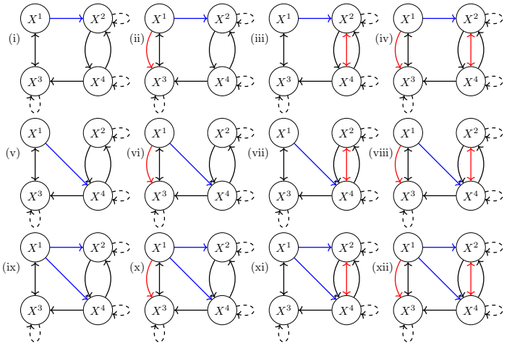
Figure 2 : DMGs (i)-(xii) are the elements of one Markov equivalence class with (xii) being its greatest element. The dashed self-loops onX 2, X3 and X 4 mark edges that may be removed without leaving the equivalence class. They are shown as dashed to avoid plotting all combinations.
Original paper · CC BY 4.0 · Simon Kempf, Niki Kilbertus, Georg Manten · Markov-Equivalent Conditional Independence Graphs on Path Spaces · Original paper figure · Extracted the figure area from page 8 of the original PDF.Corollary 3.23 gives a check: a DMG is the greatest element when every potential parent is a parent and potential siblings are siblings. This check uses only the graph itself, so a learner can test a candidate DMG directly. The authors don't give an algorithm for this search in the paper.
Limitations and what stays untested
The graph-theoretic results concern DMGs and their W-independence models, so they don't depend on the SDE model itself. SDEs enter only through the global Markov property, which links the graph to conditional independences on path space. That Markov property holds for SDEs of the form in Equation (1) under assumptions (A1) to (A4), which are stated in Section B.1.
The SDE model includes deterministic ODEs with the diffusion set to zero, and it requires no equilibrium assumption.
The authors state the link to data through a signature-kernel-based conditional independence test on path space from Manten et al. (2025a). The paper doesn't run that test, so the testability of W-separation remains a claim about the conditional independences, not an empirical check. The contribution rests on proofs about graphs and a Markov property, and it reports no empirical evaluation of a discovery procedure.
The authors call the work foundational rather than algorithmic, and a concrete discovery algorithm is left for future work.
The latent projection carries the Markov property to settings with latent confounding among observed coordinates. Latent confounding is represented by bidirected edges, which directed edges alone can't express.
Paper info
- Authors
- Simon Kempf, Niki Kilbertus, Georg Manten
- Venue
- arXiv · Preprint
- First published
- 2026-11-16
- Added
- 2026-11-17
- Updated
- 2026-11-16
- Version
- v1
- arXiv
- 2611.20877
- Category
- cs.LG
- Original paper terms
- CC BY 4.0
- What we show
- Paper info, commentary and permitted figures from the original paper
AI commentary is a separate explanation from the original paper and may contain errors. The original paper and figures follow each source's terms of use and any rights noted separately.
Abstract
Causal discovery for continuous-time stochastic processes with latent confounding typically faces a trade-off between (i) approaches that are highly informative about the causal structure but are difficult to test statistically, and (ii) approaches that admit practical tests from data but yield more coarse-grained conclusions, potentially not leveraging the direction of time. We introduce W-separation, an asymmetric graphical criterion for directed mixed graphs defined as a quaternary relation that allows distinct conditioning on past and future components. This added flexibility yields a highly informative graphical independence model while preserving testability. W-separation satisfies a global Markov property for a broad class of stochastic differential equations with latent confounding, linking it to conditional independence relations among coordinate processes that are testable from data. A central result of this work is the full characterization of W-Markov equivalence classes: we show that every equivalence class admits a unique greatest element that serves as a canonical representative and a principled target for learning algorithms. In addition, we provide necessary and sufficient conditions under which directed or bidirected edges can be added without altering the induced independence model.
Quote from the paper
Simon Kempf, Niki Kilbertus, Georg Manten (2026). Markov-Equivalent Conditional Independence Graphs on Path Spaces. arXiv:2611.20877v1. https://arxiv.org/abs/2611.20877v1
BibTeX
@misc{kempf2026markov,
  title = {{Markov-Equivalent Conditional Independence Graphs on Path Spaces}},
  author = {Simon Kempf and Niki Kilbertus and Georg Manten},
  year = {2026},
  eprint = {2611.20877},
  archivePrefix = {arXiv},
  url = {https://arxiv.org/abs/2611.20877v1}
}