Paper commentary
The Blindfolded Controller: Decision Model-Guided Training for Reinforcement Learning
DMGT starts reinforcement learning from a decision model's choices instead of random weights
- Problem RL from random weights learns slowly on sparse-reward tasks. An agent must stumble onto a reward before it can improve, and random exploration rarely finds one.
- Method DMGT, Decision Model-Guided Training, copies a decision model's choices into a policy network. Behaviour cloning and DAgger fit the student to those choices, then PPO improves the policy from reward.
- Results DMGT beat PPO from scratch on all seven tasks and the decision model alone on five of them.
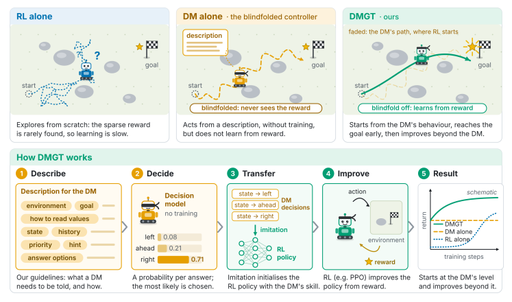
Figure 1 : Decision Model-Guided Training (DMGT): combining a decision model (DM) with reinforcement learning (RL). A DM reads a text description of the current situation and returns a probability for each of a fixed set of answers. It needs no training, but the reward is never part of what it reads: it is blindfolded to the reward.Top:three agents in the same world, with the reward at the goal. RL alone explores from scratch and rarely finds the reward. The DM alone reaches the goal from its description but cannot learn from the reward. DMGT (ours) starts from the DM’s behaviour (the faded path) and then learns from the reward.Bottom:how DMGT works. (1) Each state is described in words, following our guidelines on what a DM needs to be told: the environment, the goal, how to read the values, the state, recent history, a priority (what is most urgent now), a strategy hint and the answer options. (2) The DM’s most likely answer is the action. (3) A policy network imitates these decisions. (4) RL (here PPO) improves that network from the reward. (5) Schematic learning curves: DMGT starts at the DM’s level, RL alone from scratch.
Original paper · CC BY 4.0 · Muhammad Ibrahim Khan, Aniket Dixit, Faizan Ahmed, James Brusey · The Blindfolded Controller: Decision Model-Guided Training for Reinforcement Learning · Original paper figure · Extracted the figure area from page 2 of the original PDF.Why RL from random weights learns slowly
RL from random weights learns slowly because an agent must stumble onto a reward before it can improve. So the learning process is slow and data inefficient, since each step without reward teaches the agent little.
Demonstrations recorded from human experts are one such head start, as in Silver et al., 2016, Hester et al., 2018 and Rajeswaran et al., 2018. A teacher policy that already performs the task is another, as in Schmitt et al., 2018 and Uchendu et al., 2023. A hand-designed controller is a third option, as in Johannink et al., 2019 and Silver et al., 2018.
A decision model (DM) offers a different starting point, because it needs no recorded behaviour for the task. It only needs a description of it.
A decision model as a zero-shot teacher
A decision model offers a head start that doesn't need a recorded demonstration or a trained teacher.
The key idea is to let the DM act from the text description, copy its choices into a policy network, and then let RL improve that policy from reward. Behaviour cloning fits the student to the DM's decisions, and DAgger then asks the DM to label the states the student reaches. The authors expect this to help because the DM already behaves sensibly from its first step, and RL can then move beyond it.
The reward never enters the query, so the DM stays blindfolded to it and cannot improve by itself. The authors therefore split the work: the DM supplies the starting behaviour and RL supplies the improvement.
Prior work on head starts from demonstrations and teachers still relies on data recorded or trained on the task beforehand. The DM and the RL policy stay separate in time: PPO and the policy it returns act without the DM. The DM is used only before RL begins, so the DM is never queried during PPO training.
The authors also check whether the DM is the right starting point in the study environments. The DM alone is compared with PPO from scratch and DMGT, so the description's contribution can be separated from the reward's. Results follow in Section 6, where the authors test whether DMGT reaches higher returns in fewer environment steps.
How DMGT is built, stage by stage
The decision model's most likely option becomes the action, and that choice becomes a label for a student policy network. A DM takes a query with a description of the situation, a question and a finite set of answer options, and returns a probability for each option. The reward is never part of the query, so the DM acts only on the goal it is given.
The student sees only the raw environment observation, so at run time it needs no text at all. The student has the same architecture as PPO's policy, so its weights can initialise the PPO policy directly.
Behaviour cloning fits the student to the labelled pairs from the demonstration episodes by minimising the negative log-probability of each labelled action. Algorithm 1 sets the demonstration episodes N, and the DM's action at each step is stored with the observation. Because a cloned student drifts into states the decision model never labelled, DAgger lets the student play and has the decision model label every state it reaches.
Each DAgger iteration runs the current student greedily for E episodes and adds the DM's labels to the dataset before refitting. The student that performs best on validation episodes is kept, and its weights initialise the PPO policy.
The value function is untrained at that point, because imitation teaches actions but not values. PPO then runs with default hyperparameters and no decision model calls, so it learns from the environment reward alone. The only difference from PPO from scratch is the policy's starting weights, which keeps the comparison fair. DMGT (BC) skips the DAgger step, while DMGT (DAgger) adds the DAgger iterations before PPO.
Once PPO starts, the policy it returns acts without the DM.
The experiments use six environments from Gymnasium, highway-env, MiniGrid and the Arcade Learning Environment, with MultiRoom in two sizes. The PPO runs use the Stable-Baselines3 implementation with its default hyperparameters and network. Trained policies take their most likely action at evaluation, and the DM alone plays each test episode once.
Did DMGT beat RL and the decision model?
The authors compared PPO from scratch, the DM alone and two DMGT variants on seven tasks in six environments. DMGT outperforms RL alone on all seven tasks and the DM alone on five of them. DMGT (DAgger) has the highest return on Highway-fast, and DMGT (BC) has it in Parking.
The largest gap appears where PPO from scratch never escapes a poor behaviour. On Mountain Car, PPO from scratch never reaches the flag and learns to stand still, so its return rises to 0 and stays there. DMGT reaches the flag in every evaluation episode and keeps succeeding throughout training. On Parking, PPO from scratch hits a wall in every episode, whereas DMGT parks in about three quarters of episodes during training.
The gain also shows up in learning speed, not only in final return. Those returns are 22.5 with BC and 23.1 with DAgger, against 21.3 for PPO from scratch. In Lunar Lander, DMGT doesn't need the full training budget to match the DM's level, since the trained policy keeps improving past it.
Paper info
- Authors
- Muhammad Ibrahim Khan, Aniket Dixit, Faizan Ahmed, James Brusey
- Venue
- arXiv · Preprint
- First published
- 2026-11-5
- Added
- 2026-11-6
- Updated
- 2026-11-5
- Version
- v1
- arXiv
- 2611.07934
- Category
- cs.LG
- Original paper terms
- CC BY 4.0
- What we show
- Paper info, commentary and permitted figures from the original paper
AI commentary is a separate explanation from the original paper and may contain errors. The original paper and figures follow each source's terms of use and any rights noted separately.
Abstract
Reinforcement learning (RL) provides a framework for continuous improvement through interaction with an environment. However, RL agents struggle against tasks that offer exploration challenges and sparse rewards, because learning efficient policies from scratch is slow and sample-inefficient. In contrast, decision models (DMs), given a description of the environment and task, can perform well in sparse-reward tasks, but, as they do not learn from reward, they are not able to improve towards the optimal solution. In this paper, we present Decision Model-Guided Training (DMGT), a technique that uses a DM with a description of the environment and task to initialise an RL policy, combining the DM's ability to act without training with RL's ability to improve from reward. Instead of exploring from scratch, the agent reaches the goal and receives reward from its first episodes, and RL then improves its policy beyond what the DM achieves. We demonstrate through experiments on seven tasks that our approach outperforms RL in all seven and DM in five. In addition, we provide comprehensive guidelines, derived from ablation studies, for describing an environment and task to a DM.
Figures from the paper
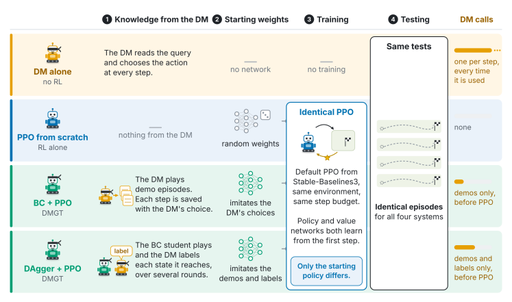
Figure 2 : Rows are the four systems compared and columns are their stages.DM alone: the decision model (DM) reads a text query describing the environment and the current state, and chooses every action, with no network and no training.PPO from scratchis reinforcement learning (RL) alone, starting from random weights. The two Decision Model-Guided Training (DMGT) systems first train the policy network to imitate the DM, from the environment’s observation alone. InDMGT (BC)(behaviour cloning), the DM plays demonstration (demo) episodes and the network learns the DM’s choices. InDMGT (DAgger), this BC student then plays, the DM labels the states it reaches, and the network learns from the demos and labels, over several rounds. All three PPO runs are otherwise identical, so only the starting policy differs. All four systems are tested on the same held-out episodes, each taking its most likely action. The bars show the DM calls each system needs. The DM alone needs one at every step for as long as it is used, while DMGT needs them only before PPO.
Original paper · CC BY 4.0
Figure 3 : The six environments, each shown at one step of an episode played by the decision model (DM). MultiRoom is used in two sizes, N4-S5 (shown) and N6. Section B describes each one.
Original paper · CC BY 4.0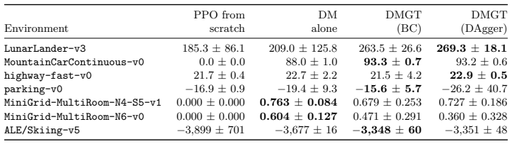
Table 1 : Mean return on the test episodes,±the standard deviation over these episodes, pooled over the five training seeds for PPO from scratch and both DMGT methods. The return is the sum of the rewards that the environment gives over one episode, so higher is better in every row. The best mean in each row is in bold.
Original paper · CC BY 4.0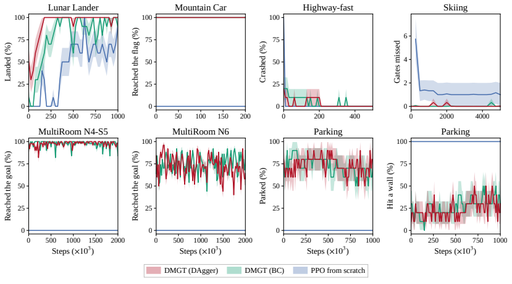
Figure 5 : Success during training for PPO from scratch, DMGT (BC) and DMGT (DAgger), in the environ- ments of Figure 4 and in Parking. At checkpoints during training (every 10k steps; 20k in MultiRoom, 25k in Lunar Lander and 250k in Skiing), the policy plays fixed evaluation episodes, other than the test episodes, with its most likely action: 10 per checkpoint, 5 in Mountain Car and 50 in MultiRoom. Each panel gives the share of these episodes in which the agent lands, reaches the flag, crashes, reaches the goal, parks or hits a wall, or, in Skiing, the gates missed per episode that reaches the finish; lower is better for crashed, gates missed and hit a wall. The band is the standard error over the five training seeds.
Original paper · CC BY 4.0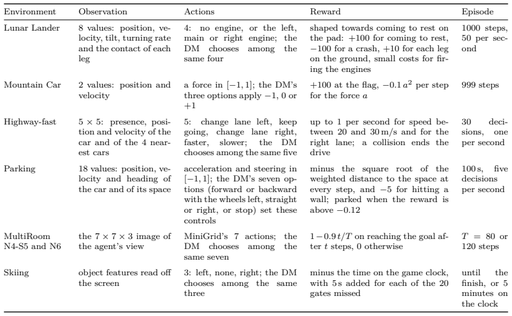
Table 2 : The environments: what PPO observes, the actions of PPO and of the DM, the reward and the length of an episode.
Original paper · CC BY 4.0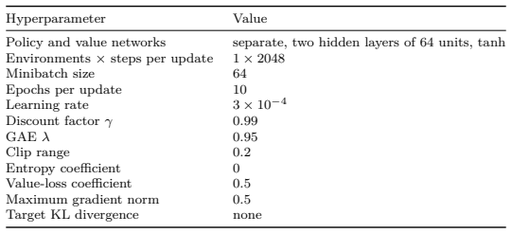
Table 3 : PPO hyperparameters: the defaults of Stable-Baselines3 2.9.0.
Original paper · CC BY 4.0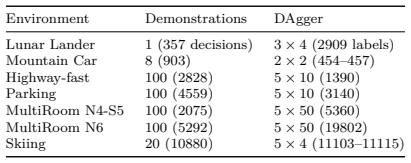
Table 4 : Imitation in each environment: the DM’s demonstration episodes and their decisions, and the DAgger iterations and episodes per iteration with the DM’s labels.
Original paper · CC BY 4.0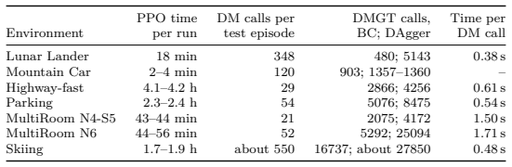
Table 6 : Compute and DM calls. PPO time: one training run, the range over the methods and seeds. DMGT calls: the demonstrations for DMGT (BC), and the demonstrations and DAgger labels together for DMGT (DAgger).
Original paper · CC BY 4.0Quote from the paper
Muhammad Ibrahim Khan, Aniket Dixit, Faizan Ahmed, James Brusey (2026). The Blindfolded Controller: Decision Model-Guided Training for Reinforcement Learning. arXiv:2611.07934v1. https://arxiv.org/abs/2611.07934v1
BibTeX
@misc{khan2026blindfolded,
  title = {{The Blindfolded Controller: Decision Model-Guided Training for Reinforcement Learning}},
  author = {Muhammad Ibrahim Khan and Aniket Dixit and Faizan Ahmed and James Brusey},
  year = {2026},
  eprint = {2611.07934},
  archivePrefix = {arXiv},
  url = {https://arxiv.org/abs/2611.07934v1}
}