Paper commentary
Passable for Whom? Few-Shot Personal Calibration of Sidewalk Accessibility Perception
- Problem Passability judgments for sidewalks vary across people who use the same mobility aid, so one label per place or per aid fits many of them poorly.
- Method PASSCAL pairs audit-supervised scene properties and a frozen VLM state with a few personal parameters fitted from one person's answers, then outputs statements with a bounded error rate.
- Results Eight answers lowered PASSCAL's Brier score from 0.550 to 0.479 on new people and new sidewalks.
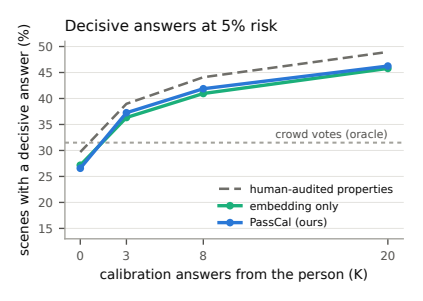
Figure 4 .Decisive share at a5% bound per statement type, against the number of calibration answers.
Original paper · CC BY 4.0 · Wesley Maia, Angel Martinez-Sanchez, Maitrayee Keskar, Ross Greer · Passable for Whom? Few-Shot Personal Calibration of Sidewalk Accessibility Perception · Original paper figure · Extracted the figure area from page 6 of the original PDF.One label cannot fit every rider
The resulting set holds 8,883 answers from 135 people, each rating the same 50 scenes.
Because every rater sees the same scenes, a rater's habits can be told apart from what the scenes contain. The study therefore treats the scenes as cheap and the personal answers as the scarce resource, and asks how much a method can extract from a few real answers per person.
Separating the scene from the person
PASSCAL has three parts: a perception stage that describes the scene with no user input, a personal calibration stage fitted from K answers about calibration images, and a statement stage that turns predictions into risk-bounded outputs.
The scene side combines a property detector trained on public Project Sidewalk audits with a frozen vision-language model whose hidden state serves as a scene embedding. The personal side has three response parameters and ten property weights, and the output passes through conformal risk control so that each statement carries a bounded error rate.
The evaluation keeps both the person and the query images out of model fitting, so any gain must come from answers on calibration images rather than from a familiar rater or a known scene.
Property detector and scene embedding
DINOv2-L is fine-tuned in its last four blocks with three heads: a five-way type head with four label types plus background, a three-way severity head on label crops, and a head for five binary tags.
Personal weights and response calibration
Aid-specific thresholds map this latent score to the answers no, unsure and yes, so the cumulative probabilities follow a sigmoid of each threshold minus the latent score.
Response style is modelled separately from the scene. A per-person response calibration rescales the log of the predicted probabilities by an inverse temperature \(\beta_p\) and adds class offsets \(o_{p,c}\) that sum to zero.
Both sets of personal parameters are fitted by MAP. The property weights are fitted first by minimising a penalised negative log-likelihood of the K answers, and then the offsets and \(\beta_p\) are fitted on the same answers under Gaussian priors centred on zero offsets and on \(\beta_p=1\). With K=0 the model returns the group prediction.
Statements with a bounded error rate
The system says PASSABLE when the predicted probability of yes reaches a threshold t+, BLOCKED when the predicted probability of no reaches t-, and DEPENDS otherwise. The harmful error for PASSABLE is a yes-statement given to a person who answers no, and the threshold for BLOCKED is set in the mirror-image way.
The thresholds come from conformal risk control applied to calibration people who went through the same K-answer procedure. The chosen threshold is the smallest one whose finite-sample adjusted mean loss stays within the level alpha. The authors state that this gives an expected loss for a new exchangeable person of at most alpha.
The guarantee is marginal over people. Each statement type is bounded separately, and the denominator counts all of a person's scenes rather than only the scenes that receive that statement.
Holding out people and scenes
The Brier score compares the predicted distribution over the three answers with the person's answers, summed over the three classes. It is averaged within each person and then over people, with lower values meaning better predictions.
Per-person regression is a ridge regressor on the VLM state fitted only on one person's answers, and in-context VLM gives the same Qwen3-VL-8B the person's eight calibration images with their answers before asking about the test image.
Personal calibration on unseen sidewalks
PASSCAL's mean Brier score falls from 0.550 with no calibration answers to 0.512 at K=3, 0.479 at K=8 and 0.457 at K=20.
Attributes parsed from WalkGPT make the embedding worse, at 0.490 at K=8, and PASSCAL is better than them by 0.011 at K=8.
The authors read this as evidence that a person is learned as a departure from a model of everyone else, since eight answers are too few to learn a person from scratch.
The recalibrated VLM with eight answers is also worse than PASSCAL with none, at 0.548 against 0.514, and with twenty answers it scores 0.546 against 0.454 for PASSCAL.
Decisive statements at a fixed error bound
Table 2 reports the decisive share at alpha=0.05 and alpha=0.10 for embedding only, PASSCAL and audited properties at K=0, 8 and 20. Without calibration answers the system commits on 27% of scenes, and with eight answers on 42%, a gain of 15.3 points.
Against the crowd oracle, PASSCAL is 10.4 points more decisive at K=8 and 14.7 points more decisive at K=20.
Which personal parameters carry the gain
Combining property weights with response calibration beats response calibration alone by 0.004 at K=8 and by 0.007 at K=20.
Moving the personal weights onto the first ten principal axes of the embedding is worse by 0.003 at K=8 and by 0.005 at K=20.
Does the encoder matter?
The scene embedding is replaced by each of sixteen frozen encoders, eight vision encoders through their pooled output and eight VLMs through their answer-position state, with the detector and personal model kept fixed. Table 4 lists the Brier score and decisive share at K=20 with and without the predicted properties.
The 8B model equals the 32B one at 0.457 with the properties, so size does not decide the result here.
Controls indicate that the useful information lies in the hidden state rather than in the VLM's answer. Adding the answer probability to a DINOv2 embedding changes nothing.
What perception must get right
Linear probes on the VLM state recover type with 56% accuracy, which is less than the detector, so the two sources are complementary.
Growing the detector's pool from 8.4k to 14.9k scenes lowers the K=20 Brier score from 0.460 to 0.457, and 18.1k scenes add nothing.
Who gains, and a second population
With the same eight ratings in context, Qwen3-VL-8B reaches 0.615 after recalibration, level with the fitted model at 0.613, which the authors read as showing that the auditor signal is mostly one number, strictness.
Auditors are volunteers rather than mobility-aid users, so these results support the stability of personal strictness and make no claim about accessibility needs.
Limitations
The method should not be used for navigation safety, since the error among PASSABLE statements is not bounded. Personal parameters can reveal a person's aid and tolerance, so the authors keep them on the person's device.
Paper info
- Authors
- Wesley Maia, Angel Martinez-Sanchez, Maitrayee Keskar, Ross Greer
- Venue
- arXiv · Preprint
- First published
- 2026-11-15
- Added
- 2026-11-17
- Updated
- 2026-11-15
- Version
- v1
- arXiv
- 2611.19839
- Category
- cs.CV · cs.LG
- Original paper terms
- CC BY 4.0
- What we show
- Paper info, commentary and permitted figures from the original paper
AI commentary is a separate explanation from the original paper and may contain errors. The original paper and figures follow each source's terms of use and any rights noted separately.
Abstract
Whether a sidewalk is passable depends on who is trying to pass: people who use the same mobility aid disagree about the same image, so one label per scene, or per aid, is wrong for many of them. We introduce few-shot personal accessibility perception: from K answers of a person never seen before, predict their judgment of sidewalk scenes never seen before. PassCal separates a shared description of the scene from the person's interpretation of it. The description comes from the internal state of a frozen vision-language model (VLM) and from barrier type, severity and context properties predicted by a detector trained on 14.9k public audits; the interpretation, a calibration of the person's response style and a weighting of the properties, is fit from their answers. On 8,883 judgments in which each of 135 verified mobility-aid users rated the same 50 sidewalk scenes, with people and scenes both held out, eight answers lower the Brier score from 0.550 to 0.479. The same VLM prompted with those answers reaches 0.562, and the same calibration without the scene 0.521. Conformal risk control turns predictions into passable, blocked or "depends on you" statements with a bounded expected rate of wrong statements over people; at 5%, eight answers raise the share of decisive scenes from 27% to 42%. Audit-supervised properties improve all sixteen vision and VLM encoders we test and outperform attributes from a sidewalk navigation VLM.
Quote from the paper
Wesley Maia, Angel Martinez-Sanchez, Maitrayee Keskar, Ross Greer (2026). Passable for Whom? Few-Shot Personal Calibration of Sidewalk Accessibility Perception. arXiv:2611.19839v1. https://arxiv.org/abs/2611.19839v1
BibTeX
@misc{maia2026passable,
  title = {{Passable for Whom? Few-Shot Personal Calibration of Sidewalk Accessibility Perception}},
  author = {Wesley Maia and Angel Martinez-Sanchez and Maitrayee Keskar and Ross Greer},
  year = {2026},
  eprint = {2611.19839},
  archivePrefix = {arXiv},
  url = {https://arxiv.org/abs/2611.19839v1}
}