Paper commentary
PixelBench: Evaluating Language Models for Pixel-Art Creation
PixelBench shows which language models can create pixel art
- Problem Existing pixel art tests for language models use small 24×24 grids, one turn and no tools, and their automatic judges aren't calibrated against complete human rankings.
- Method PixelBench lets a language model write a Python program against a drawing API instead of emitting a finished bitmap, then run it, view the render, and revise.
- Results Over all 100 tasks, GPT-6 Astra scored 83.76 on the judge, compared to 78.49 for Claude Opus 5.
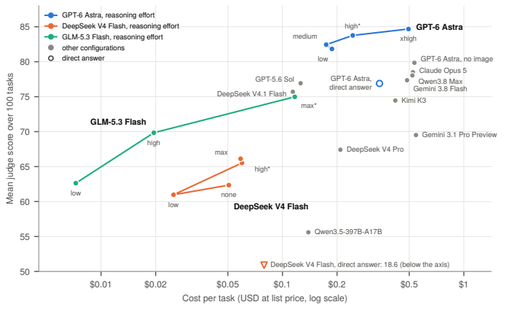
Figure 11 : Mean judge score over all 100 tasks against cost per task at list price. Colored lines join the reasoning-effort levels of one model, with an asterisk at the level of Table 2; grey points are the other configurations at the settings of Table 2, including GPT-6 Astra without image observation; hollow points are the direct-answer baseline of Appendix J.2.
Original paper · CC BY 4.0 · Mutian Hong, Jianxuan Yao, Mingkun Yue, Changkai Li, Hower Yang, Haibin Ling · PixelBench: Evaluating Language Models for Pixel-Art Creation · Original paper figure · Extracted the figure area from page 36 of the original PDF.Why language models are hard to test on pixel art
Image generators skip the cell grid, so their output is a continuous bitmap rather than pixel cells. A grid recovered afterwards describes the generated picture, not the size the requirement asks for. On the summer-seaside task, the raw GPT-Image-2 output carries 234,693 distinct colors. Pixel Snapper turns that picture into a 203×209 grid, while the task asks for 128×128.
Pixelization converts an ordinary image, so a conversion algorithm picks each cell's color rather than the creator. Both routes leave the output with no layers or other editable structure.
The creator then makes every per-cell decision, and the result persists as a program that can be re-run. Existing evaluations generate on small 24×24 grids in one turn, with no tools and no revision. Their automatic judges aren't calibrated against complete human rankings. So this route hasn't been measured credibly, even though it suits pixel art well.
Judging pixel art depends on human perception, such as whether a silhouette flows or volume holds. No rule can compute those properties, so the judge must be calibrated against people. The study therefore needs tasks at production-relevant canvas sizes and a human-grounded protocol that still runs at scale.
A program that draws the picture
The creation loop asks the model to write a Python program against a drawing API, instead of emitting a finished bitmap. The model makes each per-cell color decision itself, so the creator sets every pixel rather than a conversion algorithm. The program also keeps its layers intact, so it can be re-run and edited further.
Every configuration in the paper creates in this one environment, which also ships as a reusable agent skill. Text-to-image tasks keep a color ceiling, such as 86 colors on the summer-seaside task.
The view step is the only way a model obtains an image observation. GPT-6 Astra can switch vision off, and apart from view it keeps the same tools, prompt, and budget.
Checking the judge against ten raters
The judge scores one artwork at a time, using how the artwork is presented, a rubric, and a same-task reference image. The judge was settled on earlier artworks, so the test on the evaluation set is out of sample. Here the authors ask how closely that out-of-sample judge tracks complete human rankings.
To read that number, the authors hold out one rater at a time.
At the model level, the judge leaderboard and the human leaderboard correlate at Spearman ρ = 0.958 across the 12 configurations. The authors use this agreement to justify running the judge at scale instead of asking raters to rank every new run.
The authors release the 1,200 artworks, the 1,000 human ranking lists, and all judge responses. Anyone can therefore recompute these agreement figures from the released artworks, rankings, and judge responses.
Who leads the leaderboard
Claude Opus 5 takes second on the judge leaderboard with 78.49, while Gemini 3.8 Flash takes second on the human one with 4.27. The full table covers all 100 tasks, with the generation and editing splits beside it. On generation, GPT-6 Astra scores 82.35 on the judge and reaches a human rank of 3.21. On editing, GPT-6 Astra scores 88.00 on the judge and reaches a human rank of 3.74, again first on both boards.
Nine of the ten raters individually rank GPT-6 Astra first, so the human result isn't driven by one rater. Gaps of a point or two fall within what a second creation run can change, so the authors read the order only across larger gaps.
On canvases of 16 pixels and below, a single misplaced pixel changes a silhouette, so most artworks would need retouching before use. The authors attribute the spread of first places to this lack of basis, not to the models themselves.
What removing the view and the program costs
Removing image observation hits editing much harder than generation for GPT-6 Astra. Its editing judge score falls from 88.0 to 77.8, while its generation score moves only from 82.3 to 80.5. The authors read this as an edit starting from an artwork someone else drew, which the model understands better once it can see it. Without view, the model reads the artwork only as a character grid from matrix text() and stats text().
Five evaluated models take no image input at all, so the view channel is the only way they see their artwork.
The direct-answer baseline removes the environment altogether. On generation tasks above 64 pixels, that baseline scores 69.1, compared to 83.1 for the agent. On canvases of 32 pixels and below, the two are close, at 80.8 for the baseline and 81.4 for the agent.
The authors suggest that explicit pixel decisions suffice on small canvases, while primitives and programs help organize larger compositions. They didn't test a direct-answer variant of every canvas band, so the crossover point stays open.
Limits of the judge and the environment
The judge's scores don't transfer across judge models, only their order does. Mean scores of the Claude and DeepSeek judges sit about 17 and 14 points below the Astra judge's. The authors say the scales aren't interchangeable, so the order is the comparable quantity.
The environment fixes the prompt, so the leaderboard compares models rather than prompt designs. Teaching the craft of the medium, giving references or critique, and letting the model revise for longer are left for future work. Matching that range is the basis on which the benchmark can carry continued comparison.
Paper info
- Authors
- Mutian Hong, Jianxuan Yao, Mingkun Yue, Changkai Li, Hower Yang, Haibin Ling
- Venue
- arXiv · Preprint
- First published
- 2026-11-16
- Added
- 2026-11-17
- Updated
- 2026-11-16
- Version
- v1
- arXiv
- 2611.20628
- Category
- cs.CV
- Original paper terms
- CC BY 4.0
- What we show
- Paper info, commentary and permitted figures from the original paper
AI commentary is a separate explanation from the original paper and may contain errors. The original paper and figures follow each source's terms of use and any rights noted separately.
Abstract
Pixel art is widely used in games and digital content creation, requiring readable forms, coherent spatial relationships, and harmonious colors under limited resolution and palette constraints. Language models show growing promise in visual creation, yet their pixel art creation capabilities lack systematic evaluation. We introduce PixelBench, formalizing text-to-image generation and instruction-guided editing for pixel art and providing a benchmark for these tasks. We further present a creation environment in which language model agents invoke drawing tools through code to generate and edit pixel art. We assess the quality of generated artwork through human evaluation and employ a multimodal large language model as a judge, validating the agreement between its automated assessments and human preferences. We compare language models and configurations across diverse subjects and canvas sizes. In our experiments, GPT-6 Astra achieves both the highest average judge score and the best average human rank, highlighting the potential of general-purpose language models for pixel art creation. We release the tasks, all artworks, the human rankings, and the judge protocol.
Figures from the paper

Table 1 : Calibrating the judge. Per-task mean Kendallτ b against the consensus order of the ten raters, with a 95% bootstrap interval over tasks. Each row adds one change to the row above, and Appendix C gives the exact prompt of each version; the last row is the final protocol.
Original paper · CC BY 4.0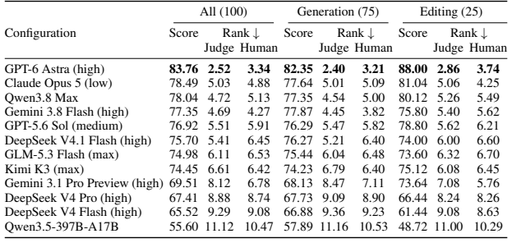
Table 2 : Leaderboard over 12 configurations, ordered by mean judge score over all 100 tasks under the final protocol. The two rank columns are mean within-task ranks over the twelve configurations, the judge’s from its scores and the human one over the ten raters; both are lower-is-better and live on the same scale. The value in parentheses is the reasoning effort every call ran at; the two Qwen models take a thinking budget instead.
Original paper · CC BY 4.0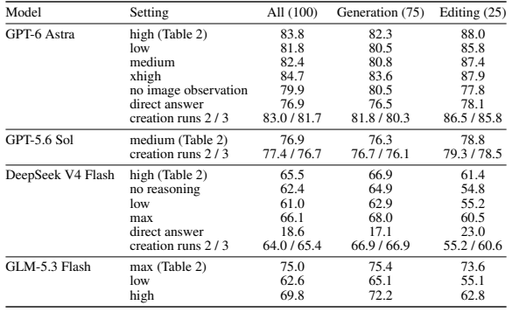
Table 3 : Judge-scored variants, each run on all 100 tasks and scored once by the judge. The rows marked Table 2 are the main-table setting; creation runs 2 and 3 repeat that setting from scratch.
Original paper · CC BY 4.0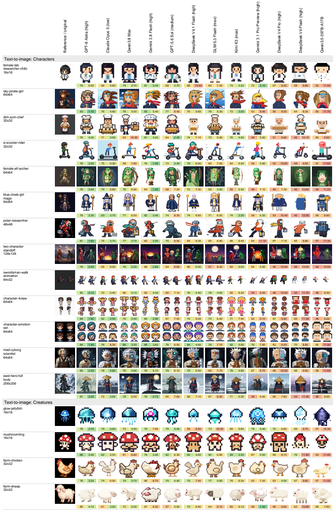
Figure 3 : Full gallery, part 1 of 6.
Original paper · CC BY 4.0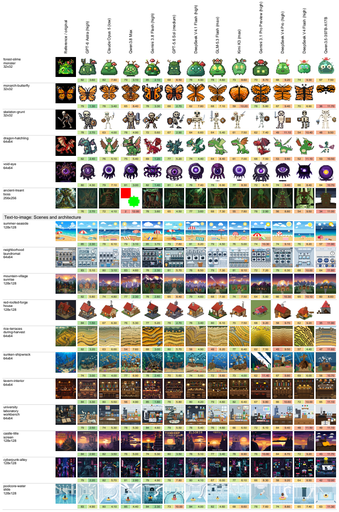
Figure 4 : Full gallery, part 2 of 6.
Original paper · CC BY 4.0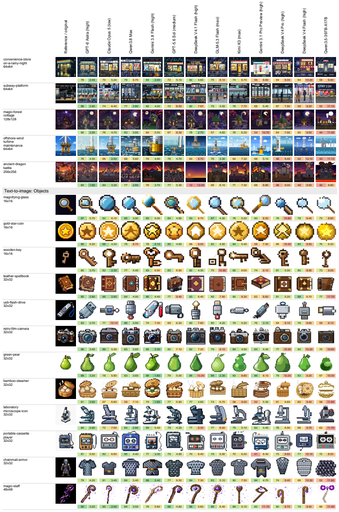
Figure 5 : Full gallery, part 3 of 6.
Original paper · CC BY 4.0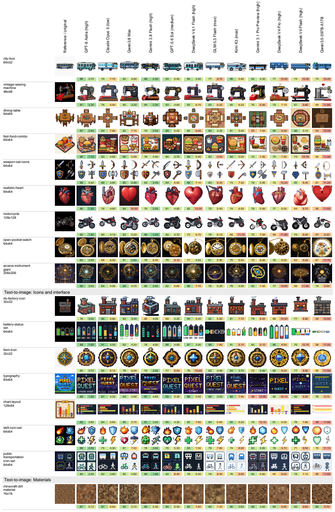
Figure 6 : Full gallery, part 4 of 6.
Original paper · CC BY 4.0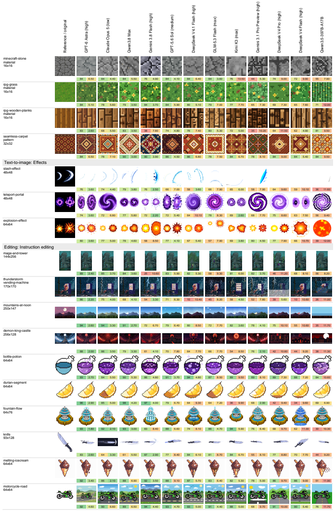
Figure 7 : Full gallery, part 5 of 6.
Original paper · CC BY 4.0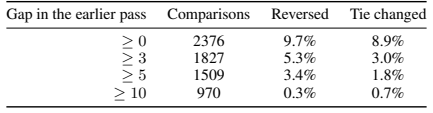
Table 4 : Order stability against the score gap. “Reversed” is the share of comparisons in which the later pass strictly reverses the earlier one; “tie changed” the share in which a tie becomes a strict order or the reverse.
Original paper · CC BY 4.0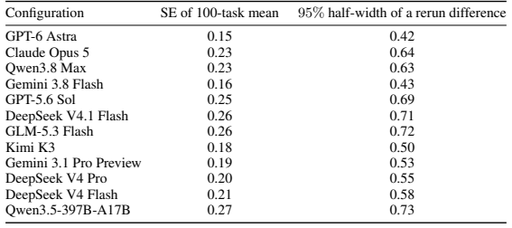
Table 5 : Scoring standard error of a 100-task mean, by configuration, and the95%half-width of the difference between two independent evaluations of the same configuration.
Original paper · CC BY 4.0
Table 6 : Three judge models under the same protocol. Agreement is the per-task mean Kendallτ b with the ten-rater consensus order; leave-one-out is the judge’s mean agreement with the consensus of nine raters, with the number of held-out raters below it in parentheses;ρis the Spearman cor- relation of the judge leaderboard with the human one. The lower block gives the per-task paired difference in agreement, GPT-6 Astra minus the other judge, with 95% intervals. Claude Opus 5’s values cover the 99 tasks it scored in full, 24 of them editing.
Original paper · CC BY 4.0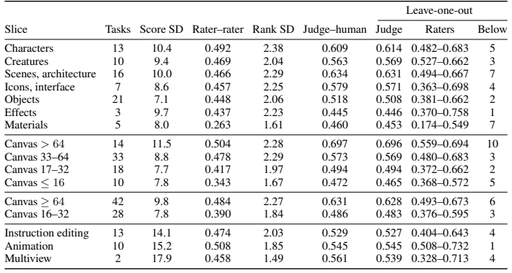
Table 7 : Tasks by subject, canvas size (longer side), and editing type. Score SD is the standard deviation of the judge scores of a task’s twelve artworks, averaged over the slice; rater–rater is the pairwise agreement among the ten raters; rank SD is the standard deviation of the twelve configura- tions’ mean human ranks over the slice; judge–human is the judge against the ten-rater consensus. Leave-one-out gives the judge’s mean agreement with the consensus of nine raters, the range of the ten held-out raters, and how many of them fall below the judge.
Original paper · CC BY 4.0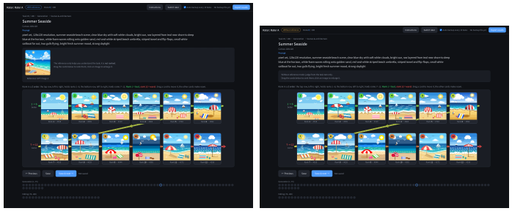
Figure 9 : The ranking interface onsummer-seaside, with the reference image (left) and without it (right). Cards carry random labels; the rater drags them into a Z-shaped order from best (top left) to worst (bottom right).
Original paper · CC BY 4.0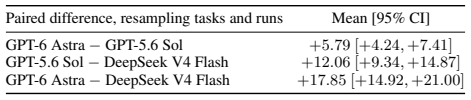
Table 8 : Three independent creation runs. Run 1 is the run of Table 2. Per-task SD is the standard deviation of a task’s score across runs; creation SD removes the judge’s repeat-scoring variance from it;ρis the range of the Spearman correlation of the 100 task scores between two runs, over the three pairs of runs. Configuration Runs 1 / 2 / 3 SD of means Per-task SD Creation SD
Original paper · CC BY 4.0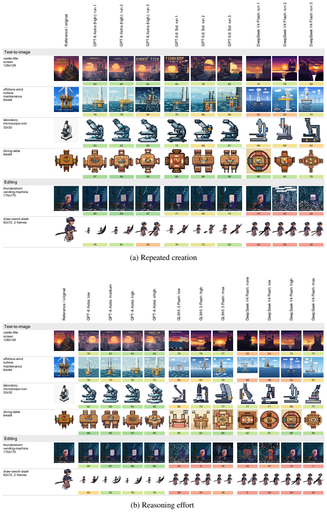
Figure 10 : Sample of the analyses scored by the judge, on six tasks drawn at random (four text-to- image, two editing). (a) Each configuration created every task three times from scratch under the same settings; run 1 is the run of Table 2. (b) The reasoning-effort levels of three models; the levels of Table 2 are GPT-6 Astra at high, DeepSeek V4 Flash at high, and GLM-5.3 Flash at max. Badges: judge score.
Original paper · CC BY 4.0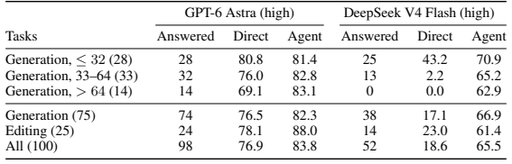
Table 10 : Direct answering against the agent, by canvas size (longer side). Answered counts tasks with a valid answer; the direct-answer score counts the others as 0.
Original paper · CC BY 4.0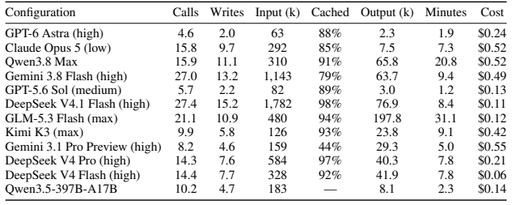
Table 11 : Per-task averages over the 100 tasks. Calls are model calls; writes are source modifica- tions; input and output are thousands of tokens, output including reasoning; cached is the share of input served from the provider’s cache.
Original paper · CC BY 4.0Quote from the paper
Mutian Hong, Jianxuan Yao, Mingkun Yue, Changkai Li, Hower Yang, Haibin Ling (2026). PixelBench: Evaluating Language Models for Pixel-Art Creation. arXiv:2611.20628v1. https://arxiv.org/abs/2611.20628v1
BibTeX
@misc{hong2026pixelbench,
  title = {{PixelBench: Evaluating Language Models for Pixel-Art Creation}},
  author = {Mutian Hong and Jianxuan Yao and Mingkun Yue and Changkai Li and Hower Yang and Haibin Ling},
  year = {2026},
  eprint = {2611.20628},
  archivePrefix = {arXiv},
  url = {https://arxiv.org/abs/2611.20628v1}
}