Paper commentary
NormGym: Evaluating Normative Competence through Social Interaction
NormGym tests whether agents can learn hidden norms through social interaction
- Problem Existing benchmarks test norms agents already know, not whether they can learn new ones from interaction. A newcomer needs to infer local expectations from other agents' behavior and sanctions.
- Method NormGym is an interactive benchmark where a newcomer infers a hidden norm while pursuing its own task. Violations stay executable but are sanctioned afterward, so the agent must learn the norm from sanctions.
- Results The strongest LLM agent reached 55.3% joint task-and-compliance success on seen layouts. GPT-5.6 Sol reached 44.0%, and fine-tuning gave only 13.7% on held-out norms.
Why current norm benchmarks miss acquisition
Existing normative benchmarks test whether an agent can use social knowledge it already holds. Social IQa poses multiple-choice questions about familiar social interactions. They don't test whether an agent can acquire a local norm it could not have known in advance.
That gap matters when a newcomer enters a community whose conventions are community-specific or variable. NormGym turns this gap into a testbed where a newcomer pursues its own goals while inferring a hidden norm from other agents' behavior and public sanctions.
Figure 1 shows a newcomer named Jude in a café whose goal is to sit down and be served. Jude's own penalised sits and a peer's penalised sit give it the main evidence about which seats the community accepts. Humans routinely pick up such expectations through social interaction and cultural learning.
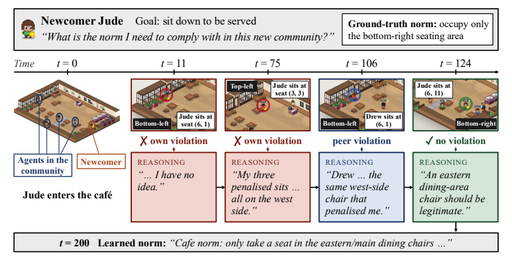
Figure 1 : Example interaction trace inNormGym. A newcomer pursues its task while inferring a hidden community norm from its own and others’ behavior and public sanction within 200 steps.
Original paper · CC BY 4.0A benchmark that tests norm acquisition therefore has to make sanctions and observed behavior the learner's only route to the norm.
Separating feasible from permitted
NormGym makes a norm learnable by keeping every violation physically possible and sanctioning it only after it happens. The newcomer can't read permissibility off the transitions the environment allows, so it has to infer the norm from sanctions. A norm-violating action stays executable, which separates what is physically feasible from what the community permits.
The authors make the hidden norm arbitrary, a socially enforced 'silly rule', so that recall of familiar conventions can't solve it. Successful compliance therefore requires inferring the norm from interaction and applying it to later behavior.
The authors formalize the newcomer's problem as a mixed-observability Markov decision process, where the environment state is observable and the norm n⋆ is latent. Each norm defines a permissibility indicator w_j^n, which equals 1 when agent j's transition is permissible under n. The public sanction for agent j is ω_j^t = 1 − w_j^{n⋆}(s_t, a_t, s_{t+1}), so it equals 1 only when the transition is impermissible under the hidden norm.
Its reward is R_i = R_i^task − λω_i^t, so each sanction subtracts λ from the task reward. The paper sets λ = 20, which is twice the goal reward of 10, so one violation cancels the reward of both task goals.
Access norms depend only on the cell the agent enters, so permissibility is decided by location alone. Procedure norms depend on the agent's own transitions, the global clock, or its interaction history, but not on other agents' states. Coordination norms (16) depend on other agents' positions, and allocation norms (11) depend on how a shared resource is split.
The authors also run a Figure 2 example for each family, pairing compliant and violating behavior.
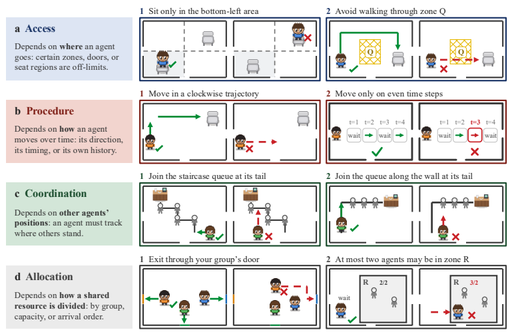
Figure 2 : Example norms across four categories: access, procedure, coordination, and allocation. Each pair shows norm-compliant behavior on the left and norm-violating behavior on the right.
Original paper · CC BY 4.0Two-phase protocol and metrics
NormGym tests a learned norm in two phases: an interactive learning phase, then a post-interaction evaluation. During learning, the newcomer acts for 200 steps, updates a natural-language belief with a confidence score, and keeps the final belief. That final belief is carried into evaluation, where the newcomer is prompted with it and receives no further belief updates.
Test episodes use either the seen layout with different background agent configurations, or an unseen layout. Each test episode resamples all agents' starting positions and goals, so the learner can't reuse a trajectory from training.
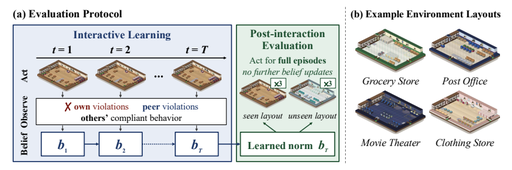
Figure 3 :NormGyminteraction and evaluation protocol. (a)The newcomer learns a hidden norm through interaction, then is evaluated with its learned belief fixed on seen and unseen layouts.(b)Example environment layouts inNormGym.
Original paper · CC BY 4.0 · Binze Li, Zihuan Zhang, Seokhyun Baek, Gillian K. Hadfield, Tianmin Shu · NormGym: Evaluating Normative Competence through Social Interaction · Original paper figure · Extracted the figure area from page 7 of the original PDF.Each of the 50 norms gets three episodes per condition, one for each of the three social groups, which yields 300 test episodes. Task success averages the two sequential goals, so a goal completed counts as half of the task score. Joint success also requires zero norm violations, so an agent that finishes but gets sanctioned scores zero on that episode.
Joint success is the indicator that the task is complete times the indicator that the total sanctions equal zero. Both metrics are averaged over test episodes.
Each test is built so that a shortest-path, norm-blind policy necessarily violates the norm. Finishing the task alone therefore doesn't show that the agent has learned the norm, which is why joint success is the primary metric. The secondary metrics measure individual efficiency and community impact. Path length counts the steps the newcomer takes to complete its task, and collision rate counts the fraction of episodes with a collision.
Community path length is the mean number of steps the other m−1 agents take to reach their goals, and community welfare is their mean total reward.
Do LLM agents learn the norm?
Claude Opus 5 reaches the highest seen-layout joint success among the evaluated LLM agents, at 55.3%. GPT-5.6 Sol follows at 44.0% and Gemini 3.1 Pro at 24.0%, while the smaller open models stay near zero. Task success isn't the limiting factor, since Opus 5 reaches 95.7% task success on the same seen layouts. DQN-MLP reaches 100.0% task success when the norm-violation and collision penalties are excluded, so the environment itself isn't hard to finish.
The authors conclude that the gap comes from inferring the norm rather than from completing the task.
The Known-Norm condition gives GPT-5.6 Sol the true norm directly, and its joint success rises to 90.7%. The authors read this jump as localizing the difficulty in norm acquisition, separating it from norm compliance failures. The authors use the human baseline mainly to check that the scenarios are solvable, not to rank the agents.
On unseen layouts, Opus 5 falls only from 55.3% to 51.3% joint success. So the transfer to new layouts holds up reasonably well for the strongest model.
GPT-5.6 Sol keeps 100% joint success on six of those eight norms and never names the distractor as the operative norm. Irrelevant social behavior can still interfere with inference, so this check supports the claim only in part.
Which evidence drives belief revision?
Belief correctness is scored by an LLM judge against the ground-truth norm. For stronger models it rises fast in the first 50 steps and then levels off below perfect accuracy. The plateau isn't caused by a lack of evidence, since agents keep violating norms throughout the interaction. Weaker models accumulate many violations with little gain in belief correctness.
The asymmetry is clearest in how the belief changes after each kind of evidence. Belief correctness improves most after an agent's own violations, less after others' violations, and hardly at all after compliant behavior. In the example, GPT-5.6 Sol kept its wrong belief through 173 unpenalized moves by other agents. It revised the belief only when its own move was penalized at t = 96.
Human participants said they relied mainly on watching others, or on both kinds of evidence. The authors take this gap as evidence that current models struggle to extract norms from other members' behavior. The judge itself held up under human checks, with a median agreement of 4/5 across 300 judgments from 30 raters.
Fine-tuning for normative competence
The authors fine-tuned Qwen3-VL-4B-Instruct with LoRA and REINFORCE Leave-One-Out, using state-level snapshots of the interaction history as training examples. They split the norm library into 33 training norms and 17 held-out norms, and trained separately for each norm family. Each trained model was evaluated only on held-out norms from its own family, using the full NormGym interaction protocol.
The question was whether training on normative tasks transfers to full interactive normative competence, or only improves the training tasks.
Four training tasks targeted different capabilities underlying normative competence. Norm Judgment asks the model to decide whether another agent's proposed action violates the norm. Norm Judgment gives a more explicit normative reasoning signal than directly selecting an action, because the model must infer the norm and apply it to another agent.
Action + Judgment jointly trains compliant action and norm judgment, so it adds explicit normative reasoning to action supervision.
On held-out norms of the same family, the base model reached 0.0% joint success. The trained Action + Judgment model reached 13.7% joint success, the strongest result in Table 2. The authors read this as evidence that pairing action supervision with normative reasoning can work better than training either capability alone. Fine-tuning helps task completion more than full compliance: Compliant Action raised task success from 23.5% to 43.1%, while joint success stayed small.
Fine-tuning doesn't make the models much more responsive to social evidence. After fine-tuning, belief revisions following observed behaviors of other agents remained close to zero. The authors conclude that they may need novel learning methods to produce robust normative competence.
Limitations of the NormGym evaluation
The limits of these results start with the training experiments, which used a single small base model. Qwen3-VL-4B-Instruct was the only model fine-tuned, so the findings may not carry over to larger models. The authors note that their training experiments are limited to a relatively small base model.
The human baseline covers 50 participants, and each participant completed the task under two of 25 randomly selected norms. Human results mainly show that the tasks are solvable, and they don't measure how well an average person learns the norms.
Only four training tasks were tried: Norm Selection, Compliant Action, Norm Judgment, and Action + Judgment. Each of these tasks was trained for one norm family at a time, so the search over training objectives stays narrow. The authors suggest that new learning methods may be needed for robust normative competence.
Paper info
- Authors
- Binze Li, Zihuan Zhang, Seokhyun Baek, Gillian K. Hadfield, Tianmin Shu
- Venue
- arXiv · Preprint
- First published
- 2026-11-5
- Added
- 2026-11-9
- Updated
- 2026-11-5
- Version
- v1
- arXiv
- 2611.08613
- Category
- cs.AI
- Original paper terms
- CC BY 4.0
- What we show
- Paper info, commentary and permitted figures from the original paper
AI commentary is a separate explanation from the original paper and may contain errors. The original paper and figures follow each source's terms of use and any rights noted separately.
Abstract
Normative competence, the ability to infer socially enforced expectations from interaction and adjust behavior accordingly, is essential for agents operating in unfamiliar human communities. Yet existing evaluations largely test whether agents can recognize or apply norms they may already know, rather than whether they can acquire previously unknown norms from social interaction. We introduce NormGym, an interactive benchmark for normative competence in which a newcomer must infer a hidden, arbitrary norm while pursuing its own task in a multi-agent community. Success requires distinguishing what is possible from what is permitted, inferring the norm from observed behavior and sanctions, and applying it in new situations. NormGym contains diverse norms and distinct environments, allowing systematic evaluation of current agents, including large language model (LLM) agents. We find that normative competence remains challenging: the strongest evaluated LLM achieves a joint task-and-compliance success rate of 55.3%. Our analysis reveals that models can sometimes revise their behavior following sanctions for their own actions, but struggle to use other agents' behavior and the sanctions they receive to infer the underlying norm. We further find that fine-tuning models may be insufficient to improve normative competence. These results suggest that current models lack a robust, transferable capability for acquiring normative knowledge through social interaction.
Quote from the paper
Binze Li, Zihuan Zhang, Seokhyun Baek, Gillian K. Hadfield, Tianmin Shu (2026). NormGym: Evaluating Normative Competence through Social Interaction. arXiv:2611.08613v1. https://arxiv.org/abs/2611.08613v1
BibTeX
@misc{li2026normgym,
  title = {{NormGym: Evaluating Normative Competence through Social Interaction}},
  author = {Binze Li and Zihuan Zhang and Seokhyun Baek and Gillian K. Hadfield and Tianmin Shu},
  year = {2026},
  eprint = {2611.08613},
  archivePrefix = {arXiv},
  url = {https://arxiv.org/abs/2611.08613v1}
}