Paper commentary
What Breaks When Facts Become Stories? The Distortions Source-Agreement Metrics Miss When Models Retell Real Events
Language model retellings distort accountability in ways fact checks miss
- Problem Evaluation of model rewrites still treats agreement with the source as success. That counts intended departures as errors and lets real distortion through.
- Method The authors check each detected change against the narrator's perspective, unlike source-agreement scoring, and label it warranted or unwarranted.
- Results Accountability distortion, barely present in summaries, rose up to sevenfold in stories. Of those whose direction could be determined, 67.4% lightened the perpetrator's responsibility.
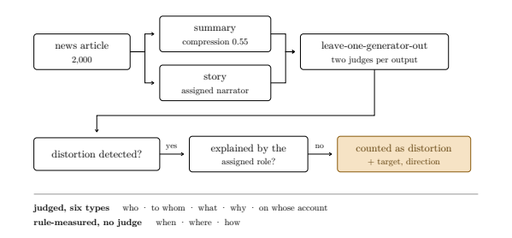
Figure 1 : The measurement in outline. Each article is rewritten in two forms and each output is read by the two model families that did not produce it. A change is counted only where a judge detects it and finds that the assigned role does not account for it. These are the detections we call unwarranted, and only for them are target and direction recorded. The six judged types cover five of the axes; the remaining three are measured by rule-based extractors that involve no model judgment.
Original paper · CC BY 4.0 · Kwangsuk Park, JiWoong Yang, Vaniushkina Kseniia · What Breaks When Facts Become Stories? The Distortions Source-Agreement Metrics Miss When Models Retell Real Events · Original paper figure · Extracted the figure area from page 3 of the original PDF.Why agreement with the source misleads
Factuality checks and overlap metrics both treat agreement with the source as success. For summarization that rule is sound, because agreement is the goal of the task. A retelling is different, since departure may be the point and difference isn't failure. Withheld, the same criterion lets real distortion through.
Everything beyond that scope falls to the legitimacy judgment, and that is where a documented risk lies.
Narration shifts where readers place responsibility, which makes the stakes concrete. Claim-level fact checking doesn't catch it, because Vanishing Actor and Causal Fading operate by deletion rather than addition.
The authors needed a way to tell a warranted departure from one that misleads readers.
A judged line between warranted and misleading change
The study gives a narrator's perspective one license, covering focalization: whose eyes the reader gets and what that person knows and feels. Any change beyond that scope goes to a legitimacy judgment, and each detection is recorded as warranted or unwarranted. Changes to who did what to whom, or to what caused what, get no license from any narrator, so deleting a harmful act's agent is never warranted.
The authors turn their success conditions into distortion, defined as the manner in which each condition is broken. The first four conditions hold whatever the narrator, so breaking one of them isolates distortion itself. Omission and addition stay in the set because prevailing evaluation counts both as errors, and the authors want to see what that count separates.
Table 1 gives each of the six types with its success condition and an example of breach.
Each article was rewritten twice, as a summary at a compression ratio of 0.55 and as a story from one of twelve narrators. Three model families produced both forms: GPT-5.4 mini, Gemini 3.1 Flash-Lite preview and Claude Haiku 4.5. Each output is judged only by the two families that did not write it, a leave-one-generator-out protocol at temperature 0.
That protocol yielded 71,718 judgments on summaries and 23,094 on stories.
Rule-based extractors built on spaCy measure when, where and how, and they involve no model judgment. They recover verb voice, agents, temporal expressions, place entities, instruments, causal connectives and attribution cues. Their output is an axis map that doesn't depend on the judges, but it can't speak to legitimacy.
Replacement versus loss across the axes
The rule-based extractors cannot judge legitimacy, so they only show how each axis moved. On time and manner, density stayed level while retention fell and novelty rose. A held density with falling retention and rising novelty marks replacement, not loss. Place behaved differently: density fell, but novelty didn't rise. So the place content left the retelling rather than being swapped for other material.
Causation and attribution fell together, the direction the judges flagged as Causal Fading and Claim Laundering.
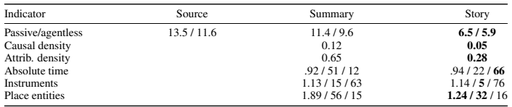
Table 2 : Rule-based indicators, applied alike to sources, summaries, and stories, with no model judgment involved. Row 1 is the share of predicates that are passive and agentless passive. The last three rows give density / retention / novelty: density is anchors per 100 words, retention the share of source anchors that survive, novelty the share of output anchors absent from the source. Read the three together: a held density with falling retention and rising novelty is replacement, whereas a falling density is loss. Where a rule-based trend runs alongside a judged type, the agreement is directional and holds at the aggregate; the two series do not necessarily flag the same items.
Original paper · CC BY 4.0Accountability is the one axis where the task changed the outcome. Two-judge agreement on detections reached 6.4% for stories, against 0.4% for summaries. The judges differ widely in strictness, but the contrast holds within each of them.
Freedom didn't raise distortion overall, since the surface types were common in both tasks. Laundering attribution and dropping content were in fact higher in summaries than in stories. That excluded share exceeds half for Selective Omission but falls below four percent for Causal Fading.
Why grammar and fact checks miss it
Grammar checks point the wrong way here, because stories carry fewer passives than the articles they retell. Yet unwarranted Vanishing Actor was detected six times as often in stories as in summaries. The Table 4 example keeps active voice in every clause, so no sentence lacks a subject. The subject of the assault shifts to the conversation, so the prose reads cleaner while the responsibility disappears.
The authors audited each story claim by claim against its source. Of those contradiction-free stories, 34.0% still carried a detected accountability distortion. Vanishing Actor and Causal Fading work by deletion and severance rather than by addition. Because they add no conflicting sentence, contradiction checks have nothing to flag. Of those stories, 27 carried a distortion on which two judges agree.
The Table 4 passage contradicts nothing in its article, and only the agent is missing.
One story in three that cleared claim checks still held an accountability distortion. Checks therefore need to account for how much latitude the task allows.
Which way accountability distortion leans
Among accountability distortions that target the perpetrator and have a determinable direction, 67.4% mitigated the perpetrator's responsibility. The authors report this as a mitigation rate, so lightening was the usual direction in this sample. The figure of 67.4% is the share of those cases, not of all accountability distortions. Figure 3 plots these mitigation rates by narrator group, each with a 95% interval.
A group counts as dominant only where its interval clears one half.
The tilt doesn't belong to a single narrator voice, according to the authors.
For narrators close to the victim and for professional accountability roles, the interval includes one half. The authors withhold a verdict for those groups, because the interval doesn't clear one half. Narrator and article effects can't be separated, since each article carries a single narrator. The individual breakdown by narrator is given in Appendix H.
The judges divided mainly where the perpetrator's responsibility was at stake. So the lean toward mitigation sits exactly where the judges themselves disagreed most.
Where judges and people split on the boundary
Judge disagreement depends on whether the perpetrator is implicated, and the paper measures it as pairwise disagreement. Accountability judgments that implicate the perpetrator reached 65.9% pairwise disagreement, while those that did not reached 2.7%. They read the split as a sign of a hard judgment, one that asks whether a change is the narrator's prerogative or misinformation.
Table 5 reports these figures as means with standard deviations over three judge pairs.

Table 5 : Judge disagreement by whether the perpetrator is implicated (%, mean ± s.d. over three judge pairs). Pooled figures and the significance test are given in Appendix I.
Original paper · CC BY 4.0Where they had divided over legitimacy, only one case in ten drew unanimous labels. Table 6b shows the individual labels: one author read almost all eighteen as warranted, while another read most as not warranted.
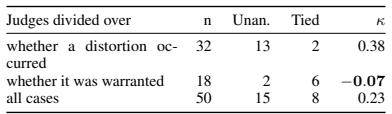
Table 6 : Three authors independently relabeled 50 cases on which the model judges had divided, each directed to the passages a judge had flagged without seeing the judges’ verdicts or one another’s labels, choosing among warranted, not warranted, and no distortion present. Unanimous and Tied are counts out of n. All 18 cases of legitimacy disagreement were taken, and the 32 detection-disagreement cases were sampled stratified by topic severity and distortion type. The 50 were drawn solely from judgments on which the judges divided; they are not a random sample, and κ here measures how contested the boundary is, not how reliable the judgments are overall.
Original paper · CC BY 4.0The authors treat annotator disagreement as signal about the object, following earlier work on labeling. ReTold-2k therefore holds 911 contested judgments, with the three authors' labels attached to the relabeled cases. The judgments are released per judge without aggregation, 94,812 in total. Aggregating would erase the disagreement, which the authors treat as signal rather than noise.
Limitations of the findings
The judges differ widely in strictness, so the spread in Figure 2 stays wide even where the contrast holds. Retention and novelty come from string matching, so they can miss paraphrase. The rule-based indicators count what has thinned, but they can't say whether a change is warranted.
The study used three model families, and each article received a single family. The models declined 74 of the 2,000 storification requests, which left 1,926 outputs. The 50 relabeled cases weren't a random sample, since they came only from judgments on which the judges divided.
The released per-judge labels and prompts let others check their results against the same baseline. Rule-based indicators pass through no judge, so they stay comparable over time.
Paper info
- Authors
- Kwangsuk Park, JiWoong Yang, Vaniushkina Kseniia
- Venue
- arXiv · Preprint
- First published
- 2026-10-29
- Added
- 2026-11-1
- Updated
- 2026-10-29
- Version
- v1
- arXiv
- 2610.39500
- Category
- cs.AI
- Original paper terms
- CC BY 4.0
- What we show
- Paper info, commentary and permitted figures from the original paper
AI commentary is a separate explanation from the original paper and may contain errors. The original paper and figures follow each source's terms of use and any rights noted separately.
Abstract
Language models are now widely used to turn recorded facts into media for public consumption, yet evaluation of such output still assumes agreement with the source as its measure of success. In reconstruction, where departing from the source can itself be the goal, this criterion measures the wrong construct: applied as is, it counts intended departures as errors; withheld, it lets real distortion through. We had three model families rewrite 2,000 news articles as summaries and as stories, measured what changed on every axis of the five Ws and how, and asked of each detected distortion whether the assigned perspective warranted it, which set a third of them aside. Time and manner were not lost but replaced, while place and causation lost the expressions that carry them. Accountability distortion behaved otherwise. Barely present in summaries, it rose up to sevenfold in stories, and of those whose direction could be determined, two in three lightened the perpetrator's responsibility. Such distortions survive claim-level fact checking and leave the retelling grammatically cleaner than its source. Where our judges disagreed, three authors relabeling the same cases converged on whether a distortion had occurred but not on whether it was warranted, a boundary contested rather than merely hard to detect. To support work on detecting and reducing them, we release ReTold-2k, a reconstructable corpus with the scoring protocol and per-judge baselines kept unaggregated.(https://github.com/Retold2K/retold2k).
Quote from the paper
Kwangsuk Park, JiWoong Yang, Vaniushkina Kseniia (2026). What Breaks When Facts Become Stories? The Distortions Source-Agreement Metrics Miss When Models Retell Real Events. arXiv:2610.39500v1. https://arxiv.org/abs/2610.39500v1
BibTeX
@misc{park2026what,
  title = {{What Breaks When Facts Become Stories? The Distortions Source-Agreement Metrics Miss When Models Retell Real Events}},
  author = {Kwangsuk Park and JiWoong Yang and Vaniushkina Kseniia},
  year = {2026},
  eprint = {2610.39500},
  archivePrefix = {arXiv},
  url = {https://arxiv.org/abs/2610.39500v1}
}