Paper commentary
Racing the Clock: Teaching VLNs Budget-Conditioned Object Search
- Problem A VLN policy must split one fixed action budget between nearby targets and distant rooms, and the expert that teaches this split may know more than the student can ever observe.
- Method Trains Uni-NaVid students on demonstrations from two Bellman experts that plan over different abstractions of the scene, with the remaining budget stated only as a countdown in language.
- Results Reached 72.7% normalized collection at budget 2000 on held-out HM3D scenes, above 65.5% for object-level supervision and 44.8% for the pretrained VLN.
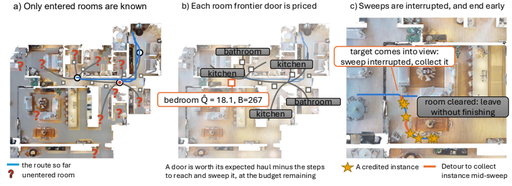
Fig. 2 .Room-level Bellman expert.(a) “Known” rooms have been entered; their recorded contents include only discovered objects. (b) Frontier rooms are valued using doorway-visible semantic evidence and cross-scene Bellman estimates. (c) Execution remains closed-loop: visible targets can interrupt a sweep, after which the expert replans.
Original paper · CC BY 4.0 · Maitree Meher, Siming He, S. Shankar Sastry, Jitendra Malik, Claire Tomlin, Jonas Frey · Racing the Clock: Teaching VLNs Budget-Conditioned Object Search · Original paper figure · Extracted the figure area from page 4 of the original PDF.Budget-conditioned object search as the task
The study asks how a stated action budget changes where and how a vision-language navigation policy searches for objects. The policy must collect distinct instances of a requested category while spending a fixed number of primitive actions. Counting distinct discoveries gives a denser signal than single-target success, which ends the episode at the first find.
The budget changes the decision problem itself rather than just cutting a fixed route short: with little budget an immediately reachable target may be the best choice, while more budget can justify exploration whose payoff arrives later. A learned policy receives RGB history, the category instruction and a countdown of the remaining budget, but no complete map and no unseen target locations.
This motivates demonstrations that teach budget-aware behavior, rather than simply adding a limit to the prompt. The study then asks which expert demonstrations best teach this search to a student that sees only RGB history.
Choosing what the expert may know
The authors frame expert design as a choice of abstraction: the expert plans over z = φ(M), a reduced description of the full environment M that keeps some task-relevant structure and discards the rest. Two choices therefore set what an expert knows: what φ keeps, and what s_t reveals.
Both experts evaluate actions with a Bellman recursion over the remaining budget, where rewards and transitions are averaged over the environments consistent with the current information state. The recursion is written as follows. \[ Q^\star_\varphi(s,b,a)=R_\varphi(s,a)+\mathbb{E}_{s'\sim P_\varphi(\cdot\mid s,a)}\big[V^\star_\varphi(s',\,b-c(a))\big] \] \[ V^\star_\varphi(s,b)=\max_{a:\,c(a)\le b} Q^\star_\varphi(s,b,a),\qquad V^\star_\varphi(s,0)=0 \] In the first equation the next-state value is taken at the budget left after paying the cost c(a) of the action, and the second takes the maximum only over actions whose cost fits the remaining budget b.
The two experts use this same recursion, so their differences come from φ and from what the information state reveals. They therefore differ in the distribution over environments that the expectations average over. Table I lists what each expert and its student see.
Object-level expert as budgeted routing
If φ keeps the map and every target instance, and z is revealed in full at t = 0, the state determines all future rewards. The expectations then collapse, and the recursion reduces to deterministic budgeted routing over known targets, which is an orienteering problem. \[ V_{\mathrm{obj}}(s,b)=\max\Big(0,\ \max_{i\in K_b(s)}\big[1+V_{\mathrm{obj}}(s\oplus i,\,b-\kappa_i)\big]\Big) \]
K_b(s) collects the uncredited instances whose cost fits within b, F(s) is the set of credited instances, and s⊕i is the state after instance i is credited. Each credited instance adds 1 to the count and spends κ_i of the remaining budget before the recursion continues. Because every target location is known, the expert only decides which known instance to visit next, and it has nothing left to search for.
Room-level expert and what it withholds
The room-level abstraction keeps the observed room graph, observed room types, discovered contents, the robot state and frontier-doorway evidence. The frontier set holds adjacent unentered rooms on the current floor that have a doorway reachable along a finite geodesic.
Objects visible through a doorway give limited evidence about an unentered room, and that evidence does not reveal its full contents. A cross-scene prior P(ρ|o), learned from Matterport3D, maps this doorway-visible evidence o to a room-type estimate ρ, and the expert uses that estimate to predict discoveries in the unseen interior. An estimated full sweep larger than the budget does not remove a frontier; the budget filters transition outcomes later instead.
Figure 2 shows the three states of this expert, from entered rooms through priced frontier doors to sweeps interrupted by visible targets.
Frontier rooms are compared by expected yield and by the budget needed to reach and search them. Continuation enables non-myopic exploration, so a low-reward connector room can still rank high when it may expose promising regions.
Estimating room outcomes across scenes
The estimator draws on a bank of room-transition records from 181 HM3D scenes. Each record stores the information state before a frontier room is chosen, the newly credited target counts, the realized primitive-action cost and the information state after execution.
For category y, a candidate room's backup averages the immediate reward and the continuation value over retrieved transitions whose cost fits the budget. \[ \hat{Q}_y(s,b,v)=\sum_{i\in N_b(s,v)}\alpha_i\big[r_{yi}+\hat{V}_y(s'_i,\,b-d_i)\big] \] N_b(s,v) holds the retrieved transitions with d_i at most b, and the weights α_i are nonnegative and normalized to sum to one over that set.
The state value takes the best estimated return over frontier rooms, with a zero stopping option. \[ \hat{V}_y(s,b)=\max\Big(0,\ \max_{v\in U(s)}\hat{Q}_y(s,b,v)\Big),\qquad \hat{V}_y(s,0)=0 \] A room with no admissible transition is excluded from the maximization but stays eligible for the fallback. Because positive transition costs allow evaluation in increasing order of budget, the room ranking depends on budget-dependent returns and not on semantic promise alone.
Closed-loop execution of room sweeps
Execution is closed-loop: a newly visible uncredited target within 5 m and in line of sight interrupts a room sweep, and the expert approaches and collects it. The executor judges when a room is finished from observed targets and coverage, without consulting a ground-truth inventory or target count. After every room transition or interruption, the expert updates its information state and replans.
Alternating the scan direction at successive viewpoints reduces the left-to-right turning ratio from 2:1 to 1.2:1. If every frontier is exhausted while budget remains, the expert re-sweeps visited rooms, which yields demonstrations at horizons longer than the scene needs for exploration.
Unexplored contents and target locations are read only after execution, to build transitions, and never to choose actions.
Why a better-informed expert can teach a weaker student
Each expert supplies action labels for a separate Uni-NaVid student that is trained with the same imitation objective and acts from RGB history, language and the countdown. \[ \pi^\star_\theta(a\mid h_t,y,b_t)=\mathbb{E}_{s_t\sim p(\cdot\mid h_t,y,b_t)}\big[\pi_E(a\mid s_t,b_t)\big] \]
When s_t is determined by h_t, the student can reproduce the expert. Otherwise it learns an average over environments it cannot tell apart, and for budget-conditioned search that average need not be a coherent search strategy.
The object-level expert's state contains every target location from t = 0, so its actions depend on targets the student has never seen. A residual mismatch remains, since the room-level expert reads room types and objects from simulator annotations that the student must infer from RGB history.
From expert rollouts to training records
Expert rollouts are converted into Uni-NaVid's training format at its fixed inference cadence, where the model is queried after every two executed primitives for the next four actions. Each record holds the video history up to time t, the expert's next four primitives and a countdown sentence stating B−t steps remaining. A deterministic 20% of records omit the countdown.
The room-level supervision has 388,199 records: 214,562 from 89 HM3D scenes and 173,637 from 59 Matterport3D scenes, at budgets 50, 150, 400, 800, 1200 and 2000.
The budget therefore reaches the student only as language, and no numerical budget input or architectural change is added. The run lasts one epoch of 3,032 steps at effective batch size 128, which took about 62 hours on four RTX PRO 6000 Blackwell GPUs.
Varying only the budget changes the demonstrations: across 691 admitted training pairs, 55% select a different first room across budgets, and 96% are monotone in targets collected.
Expert collection on held-out scenes
Expert evaluation uses 10 held-out HM3D-val scenes, with 50 admission-verified scene and category pairs, two deterministic starts each and 100 episodes per budget. Confidence intervals come from percentile bootstraps over evaluation episodes, resampled 10,000 times with replacement.
The gap is 45.6 points at B=150 and narrows to 8.2, 2.9 and 2.0 points at B=400, 800 and 2000.
Both Bellman experts keep acting until the budget runs out, so each demonstration reaches its assigned budget. The authors read the gap as largest where little budget is left to recover from an uninformed first choice.
Learned VLN results across budgets
At budget 2000 the room-level-supervised VLN reaches 72.7% normalized collection, above greedy-frontier supervision at 68.5%, object-level supervision at 65.5% and the pretrained VLN at 44.8%. Over the pretrained VLN the margin is 3.3, 22.5, 25.7 and 27.9 points at budgets 150, 400, 800 and 2000.
Against the greedy frontier expert, every VLN beats it at budget 150, only room-level supervision does at budget 400, and the expert leads every VLN from budget 800 onward. The authors suggest that learned semantic priors help rank regions when few actions remain, whereas a coverage-oriented strategy may spend scarce budget regardless of target likelihood.
The ordering of the two Bellman experts reverses after distillation: the object-level expert has the higher return, yet its student collects less than the room-level student.
Countdown effects and budget-blind controls
Within each expert's demonstrations, adding countdown annotations raises mean collection at every budget: by 2.8, 2.8, 3.6 and 3.7 points for object-level supervision and by 3.1, 6.4, 5.0 and 9.2 points for room-level supervision at budgets 150, 400, 800 and 2000. With the countdown removed from both students' training, room-level supervision still leads object-level supervision by 3.0, 9.4, 4.5 and 1.7 points.
The authors read this as an advantage that persists without budget annotations, while the size of the countdown gain depends on the supervision source.
A controlled intervention holds the initial observation, model and deterministic decoding fixed and changes only the countdown sentence, from B=150 to B=2000. Same-budget repeats reproduce the action sequence, so the divergence before either budget expires is attributed to the countdown. The extra collection also reflects the additional actions available, so these gains do not alone show more efficient allocation.
The mesh-rendered probe in Figure 1 follows the same pattern, with the B=50, 150 and 800 routes diverging within the first few actions and collecting 4, 11 and 12 of 13 chairs.
Zero-shot real-robot chair search
In a multi-room home with 14 chairs, the start pose, target and weights are fixed while only the budget varies, with five runs per budget. Mean chairs found rise from 3.4 ± 1.14 at B=50 to 5.0 ± 1.00, 7.6 ± 1.52 and 9.2 ± 1.30 at B=150, 400 and 2000. The mean success rate, defined as 100 times chairs found divided by 14, rises from 24.3% to 65.7% over the same budgets.
The authors note that these budget-dependent route changes persist despite physical-camera observations and locomotion error.
Limitations at long horizons
At budget 2000 the room-level-supervised VLN remains below its expert, at 72.7% against 98.0%. The authors point to better spatial memory and closed-loop recovery as the next steps.
Weighted target rewards and nonuniform action costs are described as extensions, and supervision rankings under them remain unknown. The object-level and room-level experts differ in decision unit, information access and execution behavior at once, and the budget-blind controls do not separate these factors. The two additional experts that would isolate information access are proposed but not trained.
Whether the heuristic of keeping what a student can perceive and withholding what it can only discover predicts student performance across tasks and abstractions is left open. The real-robot evidence comes from one home with 14 chairs, and whether recorded budget metadata improves real-world learning requires further evaluation.
Paper info
- Authors
- Maitree Meher, Siming He, S. Shankar Sastry, Jitendra Malik, Claire Tomlin, Jonas Frey
- Venue
- arXiv · Preprint
- First published
- 2026-11-12
- Added
- 2026-11-16
- Updated
- 2026-11-12
- Version
- v1
- arXiv
- 2611.17442
- Category
- cs.RO · cs.AI · cs.CV · cs.LG
- Original paper terms
- CC BY 4.0
- What we show
- Paper info, commentary and permitted figures from the original paper
AI commentary is a separate explanation from the original paper and may contain errors. The original paper and figures follow each source's terms of use and any rights noted separately.
Abstract
A rescue robot entering a building with thirty seconds on the clock should sprint toward the single most promising room; given ten minutes, it should instead explore a broader tour. Yet vision-language-navigation (VLN) models are typically evaluated under a fixed episode limit that the policy never observes, even though time-critical missions require behavior to adapt to the available budget. We study budget-conditioned object search: given a target category and an explicit action budget, an agent must find as many distinct target instances as possible before the budget expires. We investigate how to supervise VLNs for this task by comparing a privileged TSP expert, which plans near-optimal routes using the full map and true target locations, with a room-level Bellman expert that maximizes expected return under partial observability using high-level cross-scene semantic priors. Despite the TSP expert achieving substantially higher expert performance, its demonstrations are less effective for learning exploration: on held-out HM3D scenes, the Bellman-supervised VLN consistently outperforms the TSP-supervised VLN, with the advantage becoming more pronounced at longer budgets. At 2000 steps (500m), the Bellman-supervised VLN finds 71.4% of reachable target instances, compared with 65.5% for the TSP-supervised VLN and 44.8% for the pretrained VLN. These results highlight a distinction between optimal routing and optimal exploration: effective exploration supervision should optimize decisions under partial observability rather than imitate routes that are optimal only once the environment is fully known.
Quote from the paper
Maitree Meher, Siming He, S. Shankar Sastry, Jitendra Malik, Claire Tomlin, Jonas Frey (2026). Racing the Clock: Teaching VLNs Budget-Conditioned Object Search. arXiv:2611.17442v1. https://arxiv.org/abs/2611.17442v1
BibTeX
@misc{meher2026racing,
  title = {{Racing the Clock: Teaching VLNs Budget-Conditioned Object Search}},
  author = {Maitree Meher and Siming He and S. Shankar Sastry and Jitendra Malik and Claire Tomlin and Jonas Frey},
  year = {2026},
  eprint = {2611.17442},
  archivePrefix = {arXiv},
  url = {https://arxiv.org/abs/2611.17442v1}
}