Paper commentary
When, Where, How: Active In-Context Learning for Tabular Foundation Models
Active learning for tabular foundation models should favor targets, and EPIC picks labels best
- Problem Tabular foundation models only learn from the labeled rows in their context, and labels are costly. Classical acquisition rules assume the model stays fixed, so they ignore that a frozen model's predictions change with every label added.
- Method EPIC scores each unlabeled row by how much its label would change predictions on the target inputs. It uses one Monte Carlo fit per round instead of refitting on each hypothetical dataset.
- Results With TabICL, EPIC reaches a final κ of 0.578 at the label budget, compared to 0.549 for Hybrid, across twenty benchmarks.
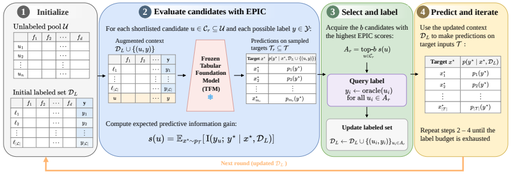
Figure 1 . Workflow for the Expected Predictive Information Gain in context for tabular foundation models.
Original paper · CC BY 4.0 · Christian M. M. Frey · When, Where, How: Active In-Context Learning for Tabular Foundation Models · Original paper figure · Extracted the figure area from page 4 of the original PDF.Why labeling for a frozen TFM is a different problem
A tabular foundation model predicts only from the labeled rows placed in its context, so labels are the one lever that adapts it to a new task. Those labels cost expert annotation, measurement or time, while unlabeled rows stay abundant, so choosing which rows to buy becomes a question of its own. Tab-AICL grows the context of TabPFN from an unlabeled pool, one row per class to start, using margin, core-set, hybrid and proxy-filtered rules.
These rules assume the model stays fixed, yet a frozen TFM changes with every label it receives. Hacohen et al. (2022) show that the best strategy depends on the budget in classical active learning. For frozen TFMs, neither the budget dependence nor the target-oriented view had been examined.
The natural value of a label is the expected predictive information gain (EPIG), which needs a posterior over parameters. For conventional models, computing it also means refitting on each hypothetical dataset, which is costly. A TFM avoids both costs, because its prediction already approximates a posterior predictive distribution. A frozen TFM never trains, so only the context it conditions on changes with the budget.
The key idea: spend labels on the inputs that matter
The key idea is to spend labels on the inputs the model will be asked about, instead of on pool rows that merely look uncertain or unusual. The paper builds two instruments on this idea, TANN and EPIC, and they differ in how much computation they need.
TANN is the cheaper of the two, and it ranks the targets by margin uncertainty, \(u_r(x^\star)=1-(p_{(1)}-p_{(2)})\), before matching them to pool rows. Proximity is measured in TabICL's own row representation, namely the normalized class tokens of a row after its row-wise interaction stage.
TANN visits the b most uncertain targets in decreasing order of uncertainty, and each takes the nearest pool row that no earlier target has claimed. A variant, TANN-feat, measures distance on features standardized with pool statistics instead of the model's representation.
EPIC asks a sharper question: how much would a candidate's label change the predictions on the targets? Its score is the mutual information between the candidate's possible labels and the target label, averaged over targets drawn from the deployment distribution, as in the formula below. \[\mathrm{EPIC}(x;\mathcal{D})=\mathbb{E}_{x^\star\sim p_T}\Big[H\big(\bar p(y^\star\mid x^\star)\big)-\sum_{y\in\mathcal{Y}} p_\theta(y\mid x,\mathcal{D})\,H\big(p_\theta(y^\star\mid x^\star,\mathcal{D}\cup\{(x,y)\})\big)\Big]\] Here \(\bar p\) is the target prediction marginalized over the candidate's unknown label, and \(H\) is the Shannon entropy.
The bracket is a mutual information, so it is non-negative and vanishes when no label of the candidate changes the target predictions. A candidate scores high when its possible labels push the target predictions in different, confident directions.
How one acquisition round computes EPIC's score without retraining
EPIC approximates the expectation over the deployment distribution with a Monte Carlo estimate on a subsample of targets. Each round draws m_r = min(m, 256) targets uniformly without replacement, and redraws them in every round. Scoring every unlabeled row under every class would be expensive, so EPIC first builds a shortlist of at most s = 64 candidates.
The shortlist has three parts of about equal size: the rows with the smallest margins, the nearest unlabeled rows of the targets with the smallest margins, and uniformly drawn rows.
For every shortlisted candidate x and every class y, the TFM is evaluated on the sampled targets with the context D_Lr plus (x, y). This gives s · C predictive distributions for each target, so a round never refits the model on a hypothetical dataset. The TFM reproduces the prediction of the fitted estimator for the true label, and for any label it differs only through preprocessing statistics fitted on L_r and C_r.
The score uses the predictive distribution from the estimator fitted on D_Lr, and Equation (2) is evaluated in closed form over the classes. No sampling over labels is required, because the classes can be enumerated for classification.
The cost of one round is one fit plus a term that scales with s, C, M and the context size, where M = 8 in the experiments. Since |L_r| is at most B and m_r is at most 256, the cost doesn't grow with the pool size, apart from one pass over the unlabeled rows. The batch A_r holds the b shortlisted candidates with the largest scores, selected greedily and independently.
This independent selection may pick near-duplicate rows whose information about the targets overlaps. Joint batch criteria would remove this redundancy at a higher cost, and the authors leave them to future work.
When: diversity first, prediction-oriented later
The learning curves show where the transition happens, and they set Hybrid against Random, Margin, TANN and EPIC.
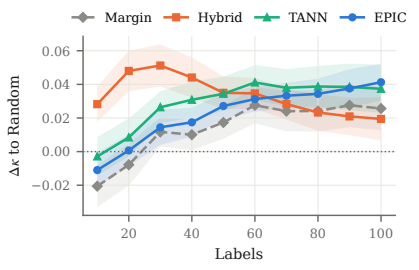
Figure 3 .Learning curves on the fifteen datasets with a budget of 100 labels, with TabICL as the backbone. Difference to Random baselines where the bands show±1standard error over datasets.
Original paper · CC BY 4.0The same transition appears with TabPFN as the backbone, where Hybrid leads over the trajectory. Hybrid reaches an AULC of 0.456, against 0.447 for EPIC and 0.450 for TANN, and it is ahead on 13 and 10 of 20 datasets. At the budget, EPIC and TANN lead instead, with final κ of 0.558 and 0.554 versus 0.534 for Hybrid. EPIC beats Hybrid at the budget on 14 of 20 datasets, with p = 0.017, and TANN does so on 12 datasets, with p = 0.040.
With TabICL on the eight large-pool datasets, Hybrid keeps the most full-context κ at 1% of the pool, 60.4% compared to 50.9% for EPIC. Hybrid is ahead on 7 of 8 datasets at that fraction, with p = 0.023. At 2% the two are level, and at 5% and 10% of the pool EPIC leads, with 80.3% compared to 76.0% and 87.0% compared to 82.0%. The paper reports 7 wins, 0 ties and 1 loss for these comparisons, with p = 0.078 at 5% and p = 0.055 at 10%.
The authors attribute the early lead to the frozen model's predictions carrying little information when labels are few. Criteria that depend on those predictions, such as uncertainty and the response to hypothetical labels, are therefore unreliable at that stage.
Where: serving the targets matters
Two controls isolate the target-input effect from the choice of targets: Target-Random assigns nearest pool rows to randomly drawn targets, and Target-Coverage picks targets far from the labeled set. Both controls use the target inputs but no uncertainty. Target-Random improves on Random in AULC on 13 of 20 datasets, by +0.016 with p = 0.008.
Target-Coverage improves on Random at the budget on 13 datasets, by +0.028 with p = 0.012.
Choosing targets by uncertainty or information gain adds more on top of this access effect. At the budget, TANN improves on Target-Random on 12 datasets, by +0.014 with p = 0.070. EPIC improves on Target-Random on 15 datasets, by +0.022 with p = 0.036, and on Target-Coverage on 13, by +0.014 with p = 0.091.
TANN and EPIC are statistically indistinguishable in AULC, with 8/5/7 datasets and p = 0.96. At the budget, EPIC leads on 11 datasets by +0.008 with p = 0.13, which the authors don't treat as a clear separation. TANN is roughly eight times cheaper, at 18 s per run against 145 s for EPIC on the large datasets.
Changing the geometry does not matter much for TANN. TANN in the TFM's row representation and TANN-feat in the standardized feature space are indistinguishable, with AULC 6/6/8 and p = 0.84. With TabPFN, Target-Random is level with Random (p = 0.39), so target access alone didn't help there. Target awareness therefore helps most when the targets are also chosen by the model's uncertainty or by information gain.
How: EPIC gives the best models at the budget
At the label budget with TabICL, EPIC reaches the highest mean final κ, 0.578, and the best mean rank of 3.30. Table 1 lists the per-dataset final κ with mean and standard deviation over ten seeds, and Figure 2 summarizes the mean ranks. EPIC improves on Hybrid, whose mean is 0.549, on 15 of the 20 datasets, by +0.030 with p = 0.011 uncorrected.
After Holm correction over nine comparisons the p-value rises to 0.064, so this gap is suggestive rather than settled. TANN improves on Hybrid on 13 datasets, by +0.021 with p = 0.049 uncorrected.
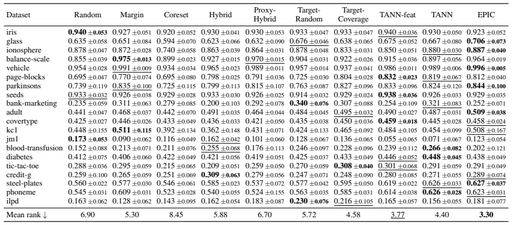
Table 1 .Cohen’sκat the label budget (mean±std over 10 seeds); best in bold, second underlined.
Original paper · CC BY 4.0On the eight large-pool datasets, EPIC keeps 80.3% of full-context κ at 5% of the pool labeled and 87.0% at 10%. Random keeps 72.5% and 78.9% at those fractions, so EPIC gains about 8 points at both. EPIC beats Random on all eight datasets at both fractions, with p = 0.008. With the same fractions, Hybrid trails EPIC at 5% and 10%, with 76.0% and 82.0%.
The labels also carry over to gradient-boosted trees, which the authors tested after each TabICL round. XGBoost trained on EPIC-selected labels reaches a final κ of 0.530, compared to 0.498 when it acquires its own labels by margin. CatBoost trained on EPIC-selected labels reaches 0.543, compared to 0.525 for its own margin acquisition. XGBoost matches its own acquisition's final κ with a median of 73% of the EPIC-selected labels, on 19 of the 20 datasets.
Limitations: where the results stop
EPIC is implemented only for classification, because it enumerates the hypothetical labels. For regression, the authors would draw hypothetical targets from the predictive distribution and replace the entropies by those of the predictive distributions. They leave that extension to future work, so regression isn't tested here. The target-aware rules also need the target inputs, or a representative sample of them, before labeling starts.
This is the transductive setting, in which the target inputs are available but their labels aren't.
EPIC selects batches greedily, so rows within one batch may carry overlapping information. The authors report that these two approximations don't affect κ at the budget in their setting. The authors didn't evaluate a rule that switches between diversity and prediction-oriented criteria during acquisition.
The main study uses twenty OpenML benchmarks, and datasets with more than 10,000 rows are subsampled uniformly to 10,000 rows. TabICL is the main backbone, with an ensemble of eight members. TabPFN serves as a replication of the complete study, so the findings rest on two frozen models.
Paper info
- Authors
- Christian M. M. Frey
- Venue
- arXiv · Preprint
- First published
- 2026-11-5
- Added
- 2026-11-6
- Updated
- 2026-11-5
- Version
- v1
- arXiv
- 2611.07886
- Category
- cs.LG · cs.AI
- Original paper terms
- CC BY 4.0
- What we show
- Paper info, commentary and permitted figures from the original paper
AI commentary is a separate explanation from the original paper and may contain errors. The original paper and figures follow each source's terms of use and any rights noted separately.
Abstract
Tabular Foundation Models (TFMs) adapt to a new task only through the labeled rows in their context. However, labels are expensive to acquire in real-world scenarios due to the need for highly specific domain knowledge to ensure high-quality data. Active in-context learning transfers classical acquisition rules to this setting, in which the model that guides acquisition changes with every label added. We ask how the value of diversity, predictive uncertainty and target-aware information gain changes as a frozen TFM acquires more context. For that, we study Target-Aware Nearest Neighbor (TANN) acquisition and the Expected Predictive Information Gain in Context (EPIC) and evaluate them against classical rules. Our study across twenty benchmarks with two well-established TFMs and classical GBDTs highlights three findings: (i) When: diversity-based acquisition is best during the first acquisition iterations; (ii) Where: labeling pool rows that serve the target inputs via a simple target-aware nearest-neighbor rule matters substantially; (iii) How: EPIC yields the best models at the label budget, retains on average 80--87% of the chance-corrected full-data performance with only 5-10% of the pool labeled on the eight benchmarks with the largest pools, and selects labels that also improve the predictive performance of gradient-boosted decision trees.
Quote from the paper
Christian M. M. Frey (2026). When, Where, How: Active In-Context Learning for Tabular Foundation Models. arXiv:2611.07886v1. https://arxiv.org/abs/2611.07886v1
BibTeX
@misc{frey2026when,
  title = {{When, Where, How: Active In-Context Learning for Tabular Foundation Models}},
  author = {Christian M. M. Frey},
  year = {2026},
  eprint = {2611.07886},
  archivePrefix = {arXiv},
  url = {https://arxiv.org/abs/2611.07886v1}
}