Paper commentary
Steer, Don't Tell: Breaking Reasoning Plateaus with Reachability-Aligned Self-Distillation
Self-steered reasoner recovers correct trajectories from answer-conditioned teachers
- Problem Post training stalls on hard problems where 64 samples contain no correct answer, so RL has no reward to learn from. Imitating answer-conditioned teachers fails because their correct traces use steps the unguided student would never take.
- Method Self-Steered Reasoner (SSR) lets the answer-conditioned teacher steer generation only among next tokens the unguided student already rates above a floor. It keeps the prefix, regenerates the rest, and retains only verified correct continuations.
- Results SSR recovered verified trajectories for 74.6% of problems with pass@64 of zero, without parameter updates. Fine-tuning on them then followed by resumed RL improved aggregate accuracy by 4.9 percentage points on AIME25/26 and HMMT26.
Where RL stops helping on the hardest problems
Reinforcement learning on verifiable tasks learns only from trajectories that end correctly. The authors study a policy whose training has stopped improving, and they focus on problems where 64 samples contain no correct answer. On those problems the reward signal is empty, so the policy has nothing to reinforce. The plateau checkpoint is chosen as the first point where reward and evaluation show no significant improvement for 30 consecutive steps.
Formally, the empirically unsolved set is defined under a rollout budget K, and these problems give no positive reward under that budget.
A natural fix is to give the model the reference solution and imitate the trajectories it produces. Conditioning on the answer shifts the teacher distribution toward actions that are unlikely under the unprivileged student. A trajectory can look correct under that conditioning while using steps the unprivileged model would never take, such as citing a hint that doesn't exist.
The teacher's outcome correctness doesn't imply that the student can reach the same reasoning actions. Imitating such traces passes answer leakage and post hoc rationalization on to the student.
The authors measure this gap with lexical anchoring, probabilistic anchoring and average leakage. Figure 1 shows the same point: imitating unlearnable-zone actions can corrupt the student's reasoning. Conditioning-based self-distillation therefore fails on exactly the problems where the reward signal is missing.
The key idea: keep only what the student can reach
SSR lets the answer-conditioned teacher steer generation, but only among the choices the student itself would consider. The student defines which next tokens are admissible, and the teacher decides only how probability is split among them. Correct trajectories produced this way are kept for training, so the stored supervision stays within the student's reach.
The authors treat reachability as a requirement alongside correctness, so a useful target must be verified and also reachable under the unguided student. A correct trajectory that the student can't reach is a poor target, because imitating it asks the student for actions outside its own distribution. Privileged teacher correctness doesn't imply student reachability, since solution conditioning shifts the teacher toward actions the student rarely takes.
The student's local action set is the set of tokens whose probability under the unguided policy exceeds a floor δ. Projection renormalizes the guided distribution over that set, so the student fixes the admissible actions while the teacher keeps its relative preferences. Here q_d is the frozen model conditioned on a diagnostic steer d, and p_θ0 is the unguided policy.
The authors set δ to 0.02 in all experiments, and the projected distribution is the KL projection of q_d onto that support set.
The steer is built from the failed trajectory, and it must avoid giving the answer away. Guided and unguided next-token distributions are compared along the failed trajectory, and the KL disagreement picks the intervention point. Everything after that point is regenerated through projection, so the retained prefix keeps the reasoning the student already produced.
A continuation that stays incorrect starts the next round with a new diagnosis, which is how the method searches the student's reachable space.
One refinement round, step by step
A refinement round starts from a failed rollout that the frozen model summarizes and diagnoses against the reference solution. The authors also search for the exact outcome answer string, and a steer that fails either check is discarded. Only the retained steer is passed to the continuation process, so the teacher never sees a steer that leaks the answer.
Next, the steer-conditioned teacher and the unguided student are compared at every prefix position with KL divergence. Large disagreement marks a prefix where the steer strongly changes the model's next action. The positions are ranked by this divergence, and the intervention point is sampled uniformly from the ten highest-scoring positions.
The prefix through the selected point is kept, and everything after it is discarded. Figure 2 lays out these steps, from the failed rollout through diagnosis, intervention and support projection.
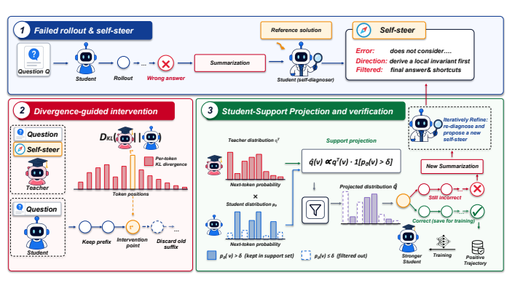
Figure 2 :Overview of the SSR framework.1. Given a very hard question Q, we sample failed rollouts from the student model. The failed rollout is then summarized and diagnosed against the reference solution to produce a self-steer. The self-steer describes the error and provide fixing di- rections while avoiding directly offering the answer. 2. The self-steer is then used to construct the privileged self-teacher. The KL-divergence between teacher and student is calculated on the failed rollout to determine the proper intervention point. Everything after that point is discarded. 3. After the intervention point, for every decoding prefix, the student first calculate its support-set by retain- ing every token with a student possibility above a certain thresholdδ. The teacher then rewights these tokens and choose the next token. For each new trajectory generated, it will be stored for further training if correct, and send back to a new round of refinement if incorrect. After the iterative refinement succeeds, the saved positive trajectory can be used to improve the student model.
Original paper · CC BY 4.0 · Zijian Wu, Lingkai Kong, Lin Yang, Haiteng Zhao, Kuikun Liu, Kai Chen, Dahua Lin, Wenwei Zhang · Steer, Don't Tell: Breaking Reasoning Plateaus with Reachability-Aligned Self-Distillation · Original paper figure · Extracted the figure area from page 3 of the original PDF.From the intervention point, each continuation token is sampled from the projected distribution in equation 3. The guided teacher redirects probability within the student's local action set, and the retained prefix keeps the reasoning already present. If masking leaves no teacher probability at a step, the step is sampled from the unguided student.
Projected decoding then resumes right after that step. The verifier checks each completed continuation, so correct ones are stored for SFT and incorrect ones re-enter the loop.
Does projection reduce privileged dependence?
With the first-round inputs fixed, the authors change only how each continuation is sampled. So any difference in output comes from the continuation distribution alone.
The authors read this as a trade, since each projected continuation succeeds less often but the ones that succeed carry less privileged content. Projected decoding recovers 63 of the 197 problems in this single-round comparison. Lexical anchoring fell from 76.46% to 41.97%, and average leakage fell from 25.44 to 0.02 matches per rollout. Probabilistic anchoring fell from 10.94% to 4.25% across all problems.
On the 60 problems that both decoders solved, mean probabilistic anchoring dropped from 8.41% to 5.58%. The median on those 60 problems dropped from 5.20% to 3.36%. The authors conclude that projection yields verified positive trajectories with lower privileged dependence even before iterative refinement.
Iterative refinement recovers more problems than one correction per failure
Under the same budget of 64 projected continuations per problem, SSR spends its calls over refinement rounds instead of one correction per failure. The full procedure starts 16 independent lineages from an initial pool of 64 failed trajectories. Each lineage gets one projected continuation per round, and unresolved lineages move on to the next round.
The single-correction allocation instead gives one projected correction to each of the 64 initial failures. Its recovery reached 51.8%, or 102 of 197 problems, under the same budget.
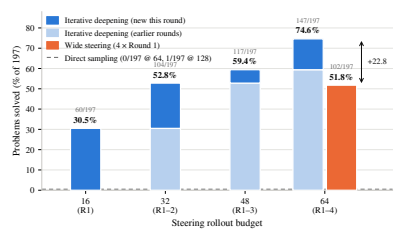
Figure 3 :Equal-budget search allocation.Iterative refinement recovers 147/197 problems, compared with 102/197 when all 64 initial failures receive one correc- tion.
Original paper · CC BY 4.0That gives 147 of the 197 Qwen3-8B hard problems, against 102 for the single-correction allocation. The authors explain the gap by noting that one correction can expose an error that the original failure hid. Each new round diagnoses the latest failed trajectory, so SSR can correct errors that surface only after an earlier fix. SSR keeps the prefix before the intervention point and regenerates only the suffix, which keeps useful reasoning in place.
Direct sampling from the plateau checkpoint solved none of the 197 problems in 64 rollouts. It solved one problem in 128 rollouts, so the search gains come from projected steering rather than from more sampling. The authors didn't test allocations beyond the four-round budget in this comparison.
Which search parts matter, and what the traces contain
The ablations change one search component at a time while projected decoding and 16 continuations per problem stay fixed. The full design yields 166 verified trajectories across 60 problems. Uniform intervention, which samples a position without KL disagreement, drops this to 72 trajectories across 38 problems. Masked-reference guidance, which replaces the steer with the reference solution minus its final answer, reaches 27 problems.
Regenerating from the start, with no retained prefix, reaches seven problems. Each removal lowers coverage, so the authors credit the KL-selected intervention point, the error-specific steer and the retained prefix together.
SSR's lexical anchoring is 71.13%, compared to 77.83% for the next-lowest method. SSR's average leakage is 0.015 matches per rollout, compared to 22.44 for the next-lowest baseline. SSR's probabilistic anchoring is 6.64%, compared to 13.57% for the next-lowest baseline. DASD's generated trajectories fell into repetition, so the authors sampled four at random and measured only leakage.
The SFT sets use four traces per problem, so SSR's 147 problems contribute 588 examples. Answer-conditioned generation, Hinted Decode and DAIL each give 788 SFT examples on the 197-problem Qwen3-8B hard set. When SSR had fewer than four positives for a problem, the authors duplicated its positive traces instead of dropping the problem.
Resumed RL beyond the plateau
SSR turns the recovered traces into SFT data, and the authors then resume the original RL recipe from the plateau checkpoint. Each explicit-trajectory method is trained with the same SFT and resumed-RL hyperparameters, so the comparison isolates the data. For Qwen3-8B, SSR contributed 588 SFT examples, while Answer-conditioned generation, Hinted Decode and DAIL each used 788.
SSR's 588 examples come from 147 recovered problems with four traces each, and the rest are duplicated positives.
Vanilla RLVR continues RL directly from the plateau checkpoint, and it is the reference for every delta in Table 1. On Qwen3-8B, SSR reaches 66.8 aggregate accuracy, which is 4.9 points above continued Vanilla RLVR at 61.9. The gain appears on all three benchmarks, and Pass@8 rises from 78.9 to 80.1. The best baseline, OPSD, reaches 64.1 aggregate accuracy, but its performance declines quickly with continued training.
Answer-conditioned generation and Hinted Decode reach 62.0 and 62.8, while DAIL and DASD stay below the continued RLVR reference.
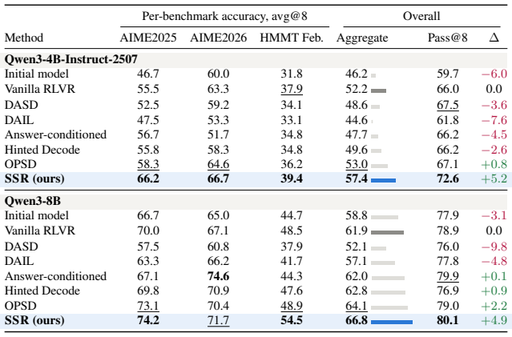
Table 1 :Peak post-plateau performance, reported in percent. Aggregate is the unweighted mean over AIME2025, AIME2026, and HMMT February 2026. Both model blocks use eight samples per problem.∆is the aggregate difference from Vanilla RLVR.
Original paper · CC BY 4.0The same pattern holds on Qwen3-4B-Instruct-2507, where SSR improves aggregate accuracy from 52.2 to 57.4. OPSD reaches 53.0, while the other self-distillation baselines stay below Vanilla RLVR. Those baselines include DASD at 48.6 and DAIL at 44.6 on this model.
Where the results stop
The hard-set recovery, leakage, and ablation experiments all run on the Qwen3-8B hard set of 197 problems. For Qwen3-4B-Instruct-2507, the paper reports only the peak comparison in Table 1, where SSR reaches 57.4 aggregate accuracy. Table 1 reports each method's best checkpoint by aggregate accuracy, so its figures are peaks rather than final values.
The text gives no confidence intervals for the gaps between methods, including the 4.9 point gain over Vanilla RLVR. The paper also doesn't report variance across repeated runs of the search, so the single-correction comparison rests on one setting. SSR uses at most 64 projected continuations per problem, so its recovery depends on sampling many continuations.
The support threshold δ is fixed at 0.02 in all experiments, and its tuning is deferred to the appendix. DASD's generated trajectories fell into repetition, so the paper sampled four trajectories at random instead of verified positives. For DASD, only leakage is reported, because its outputs are incomplete for trajectory-level anchoring. The DASD row in Table 3 therefore carries no probabilistic anchoring value.
Privileged dependence is measured with three metrics from Peng et al., so the analysis covers only the signals those metrics capture.
The ablations in Table 4 use the first-round protocol with 16 continuations per problem, not the full four-round search. The full design verified 166 trajectories across 60 problems, so these counts don't map directly onto the 147 recovered problems. The paper doesn't test whether the same ablation ordering holds on Qwen3-4B-Instruct-2507.
Paper info
- Authors
- Zijian Wu, Lingkai Kong, Lin Yang, Haiteng Zhao, Kuikun Liu, Kai Chen, Dahua Lin, Wenwei Zhang
- Venue
- arXiv · Preprint
- First published
- 2026-10-31
- Added
- 2026-11-7
- Updated
- 2026-10-31
- Version
- v1
- arXiv
- 2611.00796
- Category
- cs.CL
- Original paper terms
- CC BY 4.0
- What we show
- Paper info, commentary and permitted figures from the original paper
AI commentary is a separate explanation from the original paper and may contain errors. The original paper and figures follow each source's terms of use and any rights noted separately.
Abstract
Post training for large reasoning models remains insufficient on challenging problems, whose correct trajectories are hard to sample. Though prior works address this difficulty by integrating supervised fine tuning on expert trajectories with reinforcement learning, such external experts are not always available. Existing self improvement methods instead use reference solutions to create a privileged self-teacher. Yet privileged teacher correctness does not imply student reachability. Solution conditioning shifts the teacher distribution toward actions unlikely under the unprivileged student, producing seemingly "correct" trajectories that are unreachable or even mal-formed learning targets. Accordingly, we identify reachability alignment as the key to self constructed supervision and propose Self-Steered Reasoner (SSR). SSR realizes this principle through student support projection, which transforms the privileged teacher distribution into a directional signal only over reasoning actions locally reachable under the unguided student. Verification then retains correct trajectories sampled from this reachable space. To further boost the sampling efficiency, an iterative refinement framework is adopted, using diagnostic guidance based on current trajectories. On problems with pass@64 = 0 even after extensive RL, SSR recovers correct and learnable trajectories for 74.6% without parameter updates. Fine tuning on these trajectories followed by resumed reinforcement learning improves aggregate accuracy by 4.9 percentage points on AIME25/26 and HMMT26. These results show that privileged guidance becomes effective self-improvement data when aligned with the reasoning actions the student can reach.
Quote from the paper
Zijian Wu, Lingkai Kong, Lin Yang, Haiteng Zhao, Kuikun Liu, Kai Chen, Dahua Lin, Wenwei Zhang (2026). Steer, Don't Tell: Breaking Reasoning Plateaus with Reachability-Aligned Self-Distillation. arXiv:2611.00796v1. https://arxiv.org/abs/2611.00796v1
BibTeX
@misc{wu2026steer,
  title = {{Steer, Don't Tell: Breaking Reasoning Plateaus with Reachability-Aligned Self-Distillation}},
  author = {Zijian Wu and Lingkai Kong and Lin Yang and Haiteng Zhao and Kuikun Liu and Kai Chen and Dahua Lin and Wenwei Zhang},
  year = {2026},
  eprint = {2611.00796},
  archivePrefix = {arXiv},
  url = {https://arxiv.org/abs/2611.00796v1}
}