Paper commentary
Compositional Self-Improvement: Promises and Pitfalls
Composed labels enable self-improvement on harder tasks
- Problem Self-generated labels for harder, out-of-distribution inputs are often unreliable, because models must predict the full harder problem in one step. Those errors leave self-improvement stuck where extra supervision is most needed.
- Method Compositional self-improvement combines the model's answers to simpler subproblems into a label for the harder problem. The model trains on the accepted labels, then repeats the loop with its improved predictions.
- Results On grid navigation, a starting model with 99.4% one-room accuracy reached 80.9% mean accuracy on 2 to 13 rooms. The authors also find that coverage gaps can keep the method from fully succeeding.
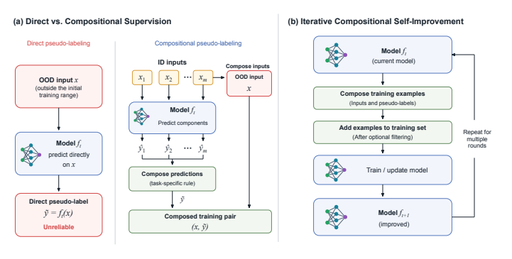
Figure 1 : Overview of compositional self-improvement. Direct pseudo-labeling can be unreliable on harder instances. Compositional self-improvement constructs targets by combining predictions on simpler subproblems, filters the resulting examples, and trains the model to solve larger problems directly. Updated predictions provide supervision for subsequent rounds.
Original paper · CC BY 4.0 · Changho Shin, Daiwei Chen, Brenden Lake, Frederic Sala, Ramya Korlakai Vinayak · Compositional Self-Improvement: Promises and Pitfalls · Original paper figure · Extracted the figure area from page 3 of the original PDF.Where self-improvement stalls
Self-improvement usually means training on labels the model writes for itself, such as pseudo-labels or model-generated feedback. Those labels get weakest on harder, out-of-distribution inputs, which is exactly where extra supervision is needed. Direct pseudo-labeling asks the model to predict the full harder instance in one step, and those predictions can be unreliable.
The authors argue that a model may still solve the components of a hard problem even when it cannot solve the whole. Earlier work hasn't settled when composed supervision can keep the loop going. Once the component answers are model-generated, their errors propagate into whatever is composed from them. A composition rule can also fail even when every component answer is correct.
Filtering those failures can leave important regions without any supervision.
The authors name three bottlenecks: weak component predictions, structural errors in composition, and sparse supervision coverage. Each bottleneck needs its own fix, so the right remedy depends on which one is binding. A stronger base model cuts down the errors it passes into composed labels. Fixing or narrowing the composition rule targets errors that the rule itself creates.
Better composed labels alone won't carry self-improvement forward, the authors argue. On coding and reasoning tasks, labels built by composing predictions beat labels the model writes directly for itself.
The key idea: compose the easier answers
The model needs its answers to the simpler pieces of a problem, plus a rule that joins those answers into a target for the whole problem. The paper calls this iterative setting compositional self-improvement, because the model builds supervision for harder instances, trains on it, and repeats as its capabilities expand. A composition rule A then combines the component answers, and the composition counts as valid when correct component answers yield the correct parent answer.
Algorithm 1 runs this loop for T rounds, with the model ˆf0 as the starting point. In each round, the current model follows the decomposition π to predict the component answers ŷ1 to ŷm, using earlier predictions where needed. The rule A turns those predictions into a candidate target ỹ, which is added to the round's training set only if the filter G accepts it.
The filter doesn't consult reference answers for the parent problems, so it decides from structure or predicted answers alone. The model then trains on the accepted examples with task-specific replay and becomes the predictor for the next round.
The broader literature recombines existing examples or their parts to build training data, usually to improve generalization to novel compositions. Prior work leaves open when such compositional supervision can sustain genuine self-improvement, since component solutions are themselves model-generated. This study asks the narrower question of when predictions on simpler components give reliable supervision in a self-improvement loop.
One round, step by step
A round starts from a parent problem with a decomposition that lists its subproblems, their order, and any dependence on earlier answers. The current model answers those subproblems, and later queries reuse earlier predictions when the decomposition requires it. The composition rule then combines those answers into one candidate label for the parent problem.
The authors write the candidate target as a rule applied to the decomposition and the predicted answers, so the rule can be a fixed program or a model. An optional filter then decides whether each example is kept, and it looks only at the example's structure or its predicted answers. It never consults reference answers for the parent problems, which keeps the loop free of human labels.
Kept examples are mixed with replay at the initial training levels, which helps the model preserve skills it learned before. The model trains on this set and becomes the predictor for the next round, so each round's improved model supplies the component answers for the next.
A composition rule is valid when correct component answers produce the correct parent answer. Validity matters because a rule that fails this test writes wrong labels even when every component answer is correct. The addition task shows this failure: a carry across a block boundary makes the concatenated sum wrong. Filtering such parents removes the wrong labels, but it also removes every parent with a carry across its block boundary.
Controlled tasks: does the range grow?
Grid navigation, addition and max run length test whether composed labels stretch what the model solves reliably. Each task has its own composition rule, so the authors could vary component accuracy, composition errors and coverage separately. Grid navigation inserts corridor moves between predicted routes, while addition concatenates blockwise sums.
All three tasks use 14.2M-parameter character-level Transformers, and each starts from a model trained on the initial difficulty range. The seed ranges are one room, 3 to 7 digits and lengths 6 to 10.
Each round, the model trains on composed examples alongside replay at the initial training levels, which helps it keep earlier skills. The grid navigation schedule adds one room per round for 12 rounds, reaching 13 rooms. The heatmaps show reliable prediction extending past the starting range in all three tasks.
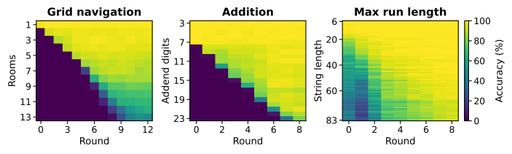
Figure 2 : Compositional self-improvement expands the range of instances solved by the model. Each heatmap shows accuracy across self-improvement rounds. From left to right: grid navigation by the number of rooms, addition by addend digit length, and max run length by string length. In all three tasks, reliable prediction extends beyond the initial model’s reliable range.
Original paper · CC BY 4.0The authors then varied the starting model's one-room accuracy and reran the same twelve-round schedule. The starter at 79.9% one-room accuracy reached 19.4% mean accuracy on 2 to 13 rooms, while the starter at 99.4% reached 80.9%. The 79.9% starter had 3,000 initial-training updates, while the 99.4% starter had 30,000. Under a valid rule, component errors pass straight into the composed label, which the authors tie to Proposition B.2.
Where composition and coverage break
Structural errors show up in addition, where concatenating blockwise sums goes wrong when a carry crosses the block boundary. Without filtering, the model's accuracy improves at first and then degrades across rounds.
Coverage failures appear in max run length, where a valid rule can't supervise outputs outside a restricted output set. Concatenating 01111 and 11200 requires 1|6, but the rule produces 1|4. Filtering removes such errors, but it leaves longer runs without correct supervision. Accuracy on boundary-crossing runs drops sharply as excess run length grows, approaching zero at an excess of three symbols, with or without filtering.
Overall max run length accuracy stays high in Figure 2, so this aggregate result hides the coverage gap.
The authors formalize the coverage limit with a closure argument on a restricted output set C. If all correct component answers lie in C, the composed answer also lies in C. Selecting the longer of two component runs can't produce a run longer than either component. Accurate composed labels alone therefore don't guarantee coverage of the patterns needed for further improvement.
Training on these labels is the step that turns label quality into model improvement. The bound in Theorem B.5 separates composed-label error, finite-sample estimation error, and optimization error. It guarantees improvement over the current model whenever the combined error term stays below the current model's true-label error.
Program generation and multi-hop reasoning
Bash pipeline generation is the first real-task test, since many programs are built from smaller programs. The model reads a natural-language description of text-processing steps and writes a pipeline that implements them. Composed supervision joins the commands predicted for each step with the pipe operator, which passes one command's output to the next.
Direct self-improvement instead predicts the full pipeline, and both methods keep a label only if it parses. On pipelines of seen commands, composed supervision substantially improves accuracy, including five- and six-command pipelines longer than those used for training, while direct self-improvement makes little progress.
The coverage test uses 30 commands that were left out of multi-command training but kept in single-command training and replay. It drops to 46% when all commands are held out, even though the individual commands are still learned. So the gap comes from what composed supervision covers, not from whether single commands were learned.
For multi-hop reasoning, the authors use MuSiQue, which provides 2- to 4-hop questions with annotated decompositions. Each model first trains on single-hop questions with gold answers, then runs three rounds on 2-, 3-, and 4-hop questions. Later steps depend on earlier predictions, so the model answers sub-questions in order and substitutes each answer into the next.
The direct method answers the original question in one step, while filters check answer format and passage presence without reference answers.
The 2B model's components are least reliable, so it gains least, because errors in intermediate answers propagate through composition.
Warm start for RL
Learning can be extremely inefficient, however, when correct samples are rare. The authors test whether a short SFT warmup on composed targets, even imperfect ones, can accelerate RL.
The string transformation setup uses the tasks from Yuan et al., and the Python setup uses programs built from type-compatible functions in MBPP+ and HumanEval+. In string transformations, each predicted output becomes the next operation's input. Both use GRPO with binary outcome rewards, and token usage counts warmup label generation, warmup targets, and all RL samples.
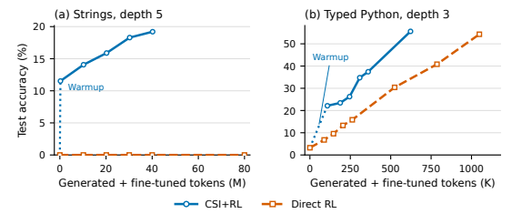
Figure 8 : A compositional SFT warmup improves subsequent RL on five-operation string transfor- mations and three-function Python programs. CSI+RL first fine-tunes on labels from compositional self-improvement (CSI), then runs RL, using half the token budget of direct RL. Curves show mean test accuracy over three seeds; dotted segments mark the SFT warmup. Token counts include label generation, RL samples, and warmup targets.
Original paper · CC BY 4.0RL after a short compositional SFT warmup, by contrast, improves steadily. On typed Python, where direct RL also makes progress, the warmup run reaches 55.6% with half the generation budget. Direct RL needs the full budget to reach 54.3%, so the warmup run is ahead at lower cost. Only 77% of the string warmup labels are correct, and the warmup still helps subsequent RL.
The composed targets play a different role here than in Sections 3 and 4. They don't need to be the final training signal. Because the warmup needs only enough correct samples, imperfect labels are acceptable.
What the bounds say
The authors define three error rates on the accepted examples, where the filter G equals 1. The composed-label error ρk measures the overall error of the label, while ξk captures errors that remain even with correct components. Proposition 6.1 bounds the gap between ρk and ξk by the component error ϵk. It also caps ρk at the smaller of 1 and ϵk plus ξk.
The authors compare composed labels against direct self-labels, whose error is ρdirect k from the current model. Composed labels are more accurate whenever ϵk plus ξk falls below ρdirect k, as Equation (4) states. This is a sufficient condition, so composed labels don't need to be perfect to beat direct labels. Their combined component and composition errors only need to stay below the model's direct error on the harder problems.
Better component accuracy can't remove errors that the composition rule itself introduces. Proposition 6.1 gives ρk at least ξk minus ϵk, so ρk equals ξk when components are perfectly accurate. Fixing such errors means correcting the rule or excluding invalid compositions, though filtering also shrinks the training set.
The authors then ask whether training on these labels actually lowers the true-label error of the model. They assume a finite hypothesis class H that contains the target f star, and an optimization error τ of at least zero. Under those assumptions, the updated model's true-label error is at most 2ρk plus a finite-sample term and τ. The bound separates composed-label error, estimation error, and optimization error.
Combined with Proposition 6.1, it shows improvement over the current model whenever the bound term falls below the model's true-label error.
Limitations
The study depends on supplied decompositions and composition rules, so finding such structure in messier settings stays open. The controlled experiments train 14.2M-parameter character-level Transformers on three algorithmic tasks. The real-task runs use Qwen3.5 models, with program generation starting from Qwen3.5-2B and multi-hop reasoning testing 2B, 4B, and 9B.
Coverage gaps remain in max run length, where accuracy on runs with an excess of three symbols approaches zero. For held-out commands, mean accuracy on two- to six-command pipelines falls from 88% when all commands are seen to 46% when all are held out. The authors state that more rounds or stricter filtering don't close these gaps. They name expanding coverage without adding composition errors as an open direction.
Errors in intermediate multi-hop answers propagate through composition, so component reliability caps the gains. First-round composed-label accuracy rises from 45% for 2B to 65% for 9B, and the 2B model gains least. Only 77% of the string warmup labels are correct, so the RL warm start works with imperfect targets. The multi-hop filters check answer format and passage presence without reference answers.
Program generation results average four seeds, which leaves the variance across pipelines unmeasured. The grid navigation curves average three seeds, so the spread across runs stays narrow in the sample.
Paper info
- Authors
- Changho Shin, Daiwei Chen, Brenden Lake, Frederic Sala, Ramya Korlakai Vinayak
- Venue
- arXiv · Preprint
- First published
- 2026-10-30
- Added
- 2026-11-7
- Updated
- 2026-10-30
- Version
- v1
- arXiv
- 2611.00452
- Category
- cs.LG
- Original paper terms
- CC BY 4.0
- What we show
- Paper info, commentary and permitted figures from the original paper
AI commentary is a separate explanation from the original paper and may contain errors. The original paper and figures follow each source's terms of use and any rights noted separately.
Abstract
Although self-improvement is becoming increasingly important as tasks become more complex, models struggle to generate reliable supervision for harder, out-of-distribution instances. One way to address this challenge is to exploit compositional structure: models often solve simpler subproblems more reliably than full problems, so their subproblem predictions can be composed into supervision for harder ones. We systematically study when this kind of composed supervision supports self-improvement and when it fails. Our controlled experiments identify three failure modes: unreliable subproblem predictions, errors introduced by composition, and limited supervision coverage. Beyond controlled settings, these findings carry over to more realistic coding and reasoning tasks: composed labels are more accurate than direct self-generated labels and improve performance even on compositions longer than those seen during training, while the failure modes remain visible. Further, although these failure modes often keep compositional self-improvement from fully succeeding on its own, a short SFT warmup with compositional self-improvement can bootstrap reinforcement learning on tasks that require composing skills the model already has, particularly when direct exploration rarely succeeds. Together, these findings characterize when compositional self-improvement can provide sufficiently reliable supervision to expand model capabilities.
Quote from the paper
Changho Shin, Daiwei Chen, Brenden Lake, Frederic Sala, Ramya Korlakai Vinayak (2026). Compositional Self-Improvement: Promises and Pitfalls. arXiv:2611.00452v1. https://arxiv.org/abs/2611.00452v1
BibTeX
@misc{shin2026compositional,
  title = {{Compositional Self-Improvement: Promises and Pitfalls}},
  author = {Changho Shin and Daiwei Chen and Brenden Lake and Frederic Sala and Ramya Korlakai Vinayak},
  year = {2026},
  eprint = {2611.00452},
  archivePrefix = {arXiv},
  url = {https://arxiv.org/abs/2611.00452v1}
}