Paper commentary
Functional Dependency beyond Similarity: Hierarchical Decomposition of Training Data Attribution in Music Generative Models
Attribution scores for music models mix three scopes of dependency
- Problem Training data attribution scores for a generated output mix influence shared by all outputs with influence specific to that output. Payments based on raw scores would keep flowing to the same few training instances.
- Method The authors split each standardized attribution score into three levels: global, group, and specific. The three parts add back up to the original score, so the split is exact.
- Results Global and group influence is above its random baseline in every model and method tested. For GradDot on MusicGen-S, the global share is 0.106, against a random baseline of 0.002.
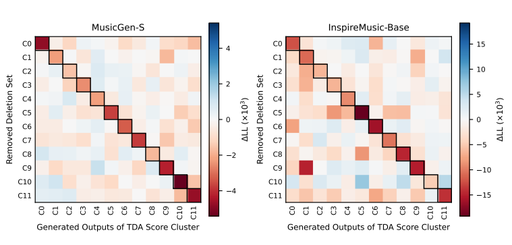
Fig. 3 . Results of thegroup-level deletion test forTrakwith 𝜆= 1in MusicGen-S (left) and InspireMusic-Base (right). Each row is the removed deletion set of a TDA score cluster, and each column is the generated outputs of a TDA score cluster. Each entry is the mean ΔLL(×10 3) over the generated outputs of the column and three retraining seeds. Outlined cells are the diagonal.
Original paper · CC BY 4.0 · Changheon Han, Hugh Xuechen Liu, Ashkan Panahi, Kıvanç Tatar · Functional Dependency beyond Similarity: Hierarchical Decomposition of Training Data Attribution in Music Generative Models · Original paper figure · Extracted the figure area from page 11 of the original PDF.Why one TDA score is hard to use as a payment basis
Copyright analysis asks about similarity, but generative models use training data through functional relations that reach past it. A payment tied only to similarity between a training work and an output may miss how that work actually contributes. Training Data Attribution, or TDA, estimates the influence of each training instance on a model's generated output and is one candidate basis for remuneration.
Turning those estimates into transparent payments is not straightforward, and the interpretation needs legal, economic, and ethical discussion. Current TDA methods return one score per training instance and per generated output, which gives too little information to read what the score means.
Earlier studies report global influence, where a few training instances stay among the most influential for almost any generation. That pattern is attributed to large gradient norms, outliers, and instances the model predicts poorly during training. So one score for one output mixes this shared, model-level part with influence particular to that output.
If such scores set payments, part of the payment would keep flowing to the same instances whatever the model generated.
The authors therefore want TDA scores examined at a resolution that separates influence particular to one output from influence shared by a group or by the whole model. The global level is the average of a training instance's scores over all generated outputs, so it reflects the model itself rather than any single output. The group level clusters generated outputs with k-means, using each column of scores as a feature vector after the global level is removed.
The specific level is what remains after the global and group levels are removed, so it captures one output's dependency on the instance.
Peeling a score into global, group and specific parts
The decomposition starts from a standardized score matrix, where each TDA score becomes a z-score over the N training instances. Standardization uses the mean and standard deviation of each generated output's scores, so offsets and scale differences across outputs disappear. It keeps the ranking of training instances inside each output, and the later levels depend on that ranking.
The global level of training instance i is its mean standardized score over all T generated outputs. The global part is subtracted first, so the model-wide influence isn't counted again at the group level. Each generated output is then represented by its vector of global-removed scores over the N training instances. Those T vectors are clustered with k-means into TDA score clusters, and the group score averages the global-removed scores within each cluster.
The specific score is the residual, computed as the standardized score minus the global score and the group score of the output's cluster. The three parts add back up to the standardized score, so the split is exact for every entry of the matrix. Within one TDA score cluster, the specific part still differs across outputs, because the same group score is subtracted from all of them.
The share of each level is its sum of squared parts divided by the total sum of squared scores.
The steps use only the TDA scores that a method outputs, so the same decomposition can be applied to any TDA method. The authors apply the decomposition to four music generative models, MusicGen-S, MusicGen-L, InspireMusic-Base and InspireMusic-1.5B.
Models, training data and TDA methods
The authors test the decomposition on two pretrained autoregressive music models, each in two sizes. MusicGen-S and MusicGen-L form one pair, while InspireMusic-Base and InspireMusic-1.5B form the other. Both pairs are fine-tuned on the MTG-Jamendo dataset, and fine-tuning updates all transformer parameters. The other components stay frozen, so they aren't attributed.
Each training instance is one ten-second segment, drawn from 10,000 sampled MTG-Jamendo tracks. Figure 2 shows that the genre tag distribution of this fine-tuning set resembles that of all 55,525 tracks.
Each model fine-tuned with three random seeds, and the hyperparameters appear in Appendix A.1. After fine-tuning, each model generates T = 480 outputs from text prompts built from tracks not used in fine-tuning. The first tag of each prompt sets its genre, so the 12 genres each receive 8 prompts. Each prompt yields one output for each of m = 5 random seeds.
Autoregressive models give the exact log-likelihood of an output, so the output gradient doesn't change over timesteps.
The authors compute TDA scores with six existing methods and three Trak variants for each model. GradDot takes the dot product of a training gradient and an output gradient. Grad-Cos replaces that dot product with a cosine, which removes the effect of the gradient norms. TracIn sums GradDot-style scores over the four checkpoints saved during fine-tuning.
Trak adds a weighting to the GradDot product of randomly projected training gradients, controlled by a constant λ. LoGra and FactGraSS approximate the inverse Hessian with the covariance of training gradients within each layer.
How large the global and group shares are
This section asks whether the global and group shares exceed chance, and how the scoring method changes that picture. Table 2 reports the global and group proportions for each model and each of the six methods and three Trak variants. For GradDot on MusicGen-S, the global share is 0.106 and the group share is 0.212. The random baseline for the global share is 1/T, about 0.002, which the mean over T outputs gives regardless of the model.
The group baseline is about 0.02, the share expected when outputs are assigned randomly to k=12 groups of equal size.
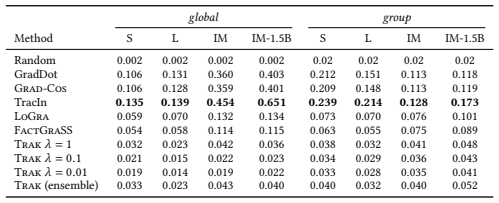
Table 2 . Proportion of theglobalandgrouplevels (groupby TDA score clusters, 𝑘= 12). S, L, IM and IM-1.5B denote MusicGen-S, MusicGen-L, InspireMusic-Base and InspireMusic-1.5B.
Original paper · CC BY 4.0Every entry in Table 2 lies above its random baseline, so both levels appear in every model and method. The shares are largest for GradDot, Grad-Cos and TracIn in each model. These three methods compute their scores from an unweighted dot product of gradients. LoGra, FactGraSS and the Trak variants weight that dot product, and they hold smaller global and group shares.
For example, the global share of TracIn on InspireMusic-1.5B reaches 0.651, against 0.134 for LoGra on the same model.
The shared parts appear in every case, but the scoring method sets how much weight they carry. The authors read this as a sign that TDA scores mix levels, so a raw score can't be read as one kind of contribution. The proportions alone don't show how strongly each level changes the model, which the deletion test checks.
Does removing each level's top instances change the model?
The deletion test asks whether the top-scoring instances of each level change the model within that level's scope. For each level, the highest-scoring training instances are removed in deletion sets of 3,000 instances (10%) each, for GradDot and Trak with λ = 1. For each generated output, ΔLL_t is the LL without the deletion set minus the LL without the random set.
The global deletion value D^glob averages ΔLL_t over all T generated outputs. The group and specific sets are compared with the other outputs in the same scope, with k = 12 TDA score clusters and 12 targeted prompts drawn from the 96 prompts.
Because of that cost, the authors selected GradDot and Trak with λ = 1 for these sets.
Figure 3 shows the Trak group-level results for MusicGen-S and InspireMusic-Base, with each row being one removed deletion set. In InspireMusic-Base, the diagonal is the lowest in 10 of the 12 rows, so the group effect is present but not uniform. Removing the deletion set of one TDA score cluster lowers the LL of that cluster's outputs more than the outputs of the other clusters.
Where the global level comes from
Gradient-based TDA methods score each training instance with an inner product, so a high global score could come from a large training gradient or from strong alignment with the output gradients. The authors write the inner product as the product of the two norms and the cosine similarity, which splits each score into two separate parts. Each training instance's alignment is the cosine between its training gradient and d, and the authors correlate it with the global score using Spearman rank correlation.
A Spearman correlation is 1 for identical rankings, 0 for unrelated rankings, and -1 when one ranking is the reverse of the other. For every method and model, the alignment correlation rho_align stays positive, as Table 4 shows. The norm correlation rho_norm stays close to zero, at most 0.18 in absolute value, except for TracIn. TracIn reaches a norm correlation of 0.32 on InspireMusic-Base and 0.31 on InspireMusic-1.5B.
In those same two models, TracIn's alignment correlation is 0.90 and 0.85, so its global scores follow alignment more closely than norm.
The norm of the common direction, ∥d∥, is 0.208 for MusicGen-S and 0.192 for MusicGen-L, so the output gradients share a direction. The same norm reaches 0.290 for InspireMusic-Base and 0.282 for InspireMusic-1.5B. For GradDot and Grad-Cos, the alignment correlation is 1.00 in three of the four models, largely because their scores come directly from the output gradient.
For these two methods, the authors say the weak norm correlation should guide the interpretation rather than the strong alignment correlation.
Prior studies link globally influential training instances to large gradient norms, and this section tests that link against alignment instead.
Do the clusters match genre or audio features?
The authors ask whether the TDA score clusters place the same generated outputs together as genre or audio features do. They compare the clusters with the Wallace coefficient W, which is the probability that two outputs in the same TDA score cluster also share a feature cluster. Genre and three audio features, MFCCs, the log-mel spectrogram and chroma, each form 12 feature clusters, matching the 12 TDA score clusters.
A value of W equal to 1 would mean every pair in a TDA score cluster also shares a feature cluster.
Table 5 reports W for each model and method, with a random baseline in the column Random. FactGraSS gives the highest genre values, 0.201 for MusicGen-S and 0.194 for MusicGen-L. For MusicGen-S, W for genre is 0.103 for GradDot, which is well below FactGraSS. The authors note that this genre relation partly appears in the audio features too.
Figure 4 shows MusicGen-S outputs in the CLAP embedding space, coloured by genre on the left and by GradDot clusters on the right. Outputs of the same genre lie close together in that space. Outputs of the same GradDot cluster, by contrast, are spread across the embedding space. Given the low W in every model and method, they read the clusters as a criterion the model itself forms, not genre or audio characteristics.
They suggest the model relates its outputs to training data through functional relations beyond musical similarity.
How sensitive the specific level is to grouping
The specific level is a residual, so its contents depend on which grouping is subtracted first. For each output, the authors take its 50 highest specific-level instances under genre grouping and count how many drop out under TDA score clusters.
For GradDot, Grad-Cos and TracIn, the fraction that changes runs from 0.49 to 0.57 across models. For MusicGen-S with GradDot, 0.55 of the instances change, while the other methods range from 0.20 to 0.36. So a payment based on specific-level scores also depends on how the group criterion is chosen.
What the levels can mean for remuneration
The global level describes how the model itself depends on each training instance, not any single output. That makes it closer to a general payment for training than to a fee for one generated output. A remuneration built on raw TDA scores would keep sending part of every payment to the same instances. Splitting the score removes that shared part before any payment is tied to a specific output.
The group level is formed by the model and doesn't coincide with genre or simple audio features. The authors don't yet identify what the TDA score clusters represent, and they leave that to future work. The specific level depends on the grouping, so its contents change when the criterion changes.
Reading each level as a contribution requires legal, economic and ethical discussion. The authors' decomposition gives that discussion distinct forms of influence to examine. The authors aim to bridge legal and socio-economic research on copyright with technical estimates at each scope of dependency. The paper doesn't test any payment rule, so the mapping from each level to a payment stays open.
The generated music is used only for this analysis and isn't released or distributed.
Scope limits of the results
The authors studied only autoregressive music generative models, which leaves other architectures untested. Diffusion-based models produce an output over iterative denoising steps, so their attribution changes with the timestep. Each of the four models is a size of MusicGen or InspireMusic, and each was fine-tuned on MTG-Jamendo.
Only GradDot and Trak with λ = 1 were retrained for the deletion test, because each deletion set needs its own retraining. The deletion test used 25 deletion sets of 3,000 training instances (10%) each. The other methods and variants weren't put through the deletion test. Each model generated 480 outputs, with 8 prompts for each of 12 genres and 5 random seeds.
The number of TDA score clusters, k = 12, was set equal to the number of genres so the clusters could be compared with genre labels.
Nothing in the study pins down what each TDA score cluster stands for, so their meaning stays open. The specific level depends on the criterion that forms the group level, so its scores shift when that criterion changes. About half of the 50 top specific-level instances change for GradDot, Grad-Cos and TracIn, from 0.49 to 0.57. They didn't test other clustering choices for the group level, only k-means on the score vectors.
The paper doesn't decide how each level should be read as a contribution for remuneration. Reading the levels that way needs legal, economic and ethical discussion beyond this technical study.
Paper info
- Authors
- Changheon Han, Hugh Xuechen Liu, Ashkan Panahi, Kıvanç Tatar
- Venue
- arXiv · Preprint
- First published
- 2026-11-6
- Added
- 2026-11-9
- Updated
- 2026-11-6
- Version
- v1
- arXiv
- 2611.08839
- Category
- cs.CY · cs.LG
- Original paper terms
- CC BY 4.0
- What we show
- Paper info, commentary and permitted figures from the original paper
AI commentary is a separate explanation from the original paper and may contain errors. The original paper and figures follow each source's terms of use and any rights noted separately.
Abstract
Copyright analysis focuses on the similarity between two works. However, generative AI models learn from training data through functional relations beyond similarity. Training Data Attribution (TDA) estimates the influence of each training instance on a generated output and may serve as a basis for remuneration. However, prior studies find global influence, where a few training instances rank as the most influential for almost every generation. Used directly, TDA scores would distribute part of every remuneration to these instances regardless of what was generated. To address this, we propose a new approach in which TDA scores are decomposed into three levels of influence, namely global indicating the influence of a training data to a trained model, group for its influence on a group of generated outputs (that could be clustered together), and specific for its influence on a single generated output. Our study finds that, across several music generative models and TDA methods, global- and group-level influence is non-negligible in every case. Based on these observations, we propose the term functional dependency for the relation of training data to a trained model or to its outputs. This notion both encompasses and distinguishes dependencies of different scopes, allowing TDA scores to be interpreted as distinct forms of contribution in legal, economic and ethical discussions on remuneration.
Quote from the paper
Changheon Han, Hugh Xuechen Liu, Ashkan Panahi, Kıvanç Tatar (2026). Functional Dependency beyond Similarity: Hierarchical Decomposition of Training Data Attribution in Music Generative Models. arXiv:2611.08839v1. https://arxiv.org/abs/2611.08839v1
BibTeX
@misc{han2026functional,
  title = {{Functional Dependency beyond Similarity: Hierarchical Decomposition of Training Data Attribution in Music Generative Models}},
  author = {Changheon Han and Hugh Xuechen Liu and Ashkan Panahi and Kıvanç Tatar},
  year = {2026},
  eprint = {2611.08839},
  archivePrefix = {arXiv},
  url = {https://arxiv.org/abs/2611.08839v1}
}