Paper commentary
From Leniency to Suspicion: How an Open Post-Training Recipe Changes Whom LLM Fact-Checkers Believe
Post-training with the Tülu-3 recipe makes LLM fact-checkers doubt lower-status posters
- Problem LLMs now judge online posts, but it was unclear which post-training changes make them doubt claims based on the poster's social class. Earlier audits had not isolated this effect across training recipes.
- Method The authors score base and post-trained checkpoints using fact-checked claims with randomised poster profiles. They then steer OLMo-2 32B's residual stream along a status direction to test whether training changes how the model reads the job signal.
- Results Tülu-3 70B's job-based doubt rose by 0.021 probit, with a drift-adjusted interval of [+0.007,+0.036]. Meta's, Alibaba's and Mistral's post-training showed no such rise.
Why speaker class matters for LLM fact-checkers
LLMs are now used to judge whether online posts are true, so a model that doubts a claim because of its poster decides whose speech gets checked. Earlier audits found that nationality, gender and party cues can shift LLM verdicts on identical content. Post-training also changes social biases, but the paper notes that it is unclear which training change moves truth judgements with social class.
Answering that also needs a look inside the model, because training could teach it to notice class or to use the class signal differently.
The authors study a poster's job, with service and manual work set against professional work, using PolitiFact claims with known truth. Their lower-status label covers service workers and manual labourers, while higher-status covers accountants, corporate executives and physicians. The design also needs ground-truth claims, which let them separate a speaker effect from accuracy.
Figure 1 shows the design: the same poster appears in four job versions on the same claim. The job gap is the probit of the lower-status versions minus the probit of the higher-status versions. The authors name the Tülu-3 recipe as the only one of the tested recipes that creates the effect, which is what the rest of the paper tests.
Measuring the job gap with probit units
Each prompt is a fact-checking request showing a social-media post, an optional account block and the question “Is the claim true or false? Answer:”. The account block shows a randomised poster either as a profile card or as a bio line, and the bio is the primary cue. Profiles vary age, gender, origin, education, occupation and track record, along with irrelevant details such as favourite colour, which gives a drift check.
Scoring reads the next-token probabilities after “Answer:” and renormalises them, giving \( p = P(\mathrm{False}) / (P(\mathrm{True}) + P(\mathrm{False})) \). The answer mass P(True)+P(False) checks that the model answers in the required format, and effects are reported in probit units of p. The job gap is the within-claim difference in probit p between lower- and higher-status posters, so a positive value means lower-status claims are judged false more often.
The primary measure of training is the raw change \( \Delta = \text{gap}_{\text{final}} - \text{gap}_{\text{base}} \), and the authors don’t rescale it.
A family counts as usable only if its answer mass is at least 0.5, its discernment is at least 0.5 and a positive control holds. Drift comes from two-vs-two splits of irrelevant attributes, and a job effect counts only if its lower bound stays above zero after drift is subtracted.
Which recipes create job-based doubt
The question is whether job-based doubt shows up across labs' post-training, or only with one recipe. Each checkpoint was scored on 30,466 prompts, and Tülu-3 70B was also scored at its SFT and DPO checkpoints. All checkpoints answered in format, with answer mass from 0.97 to 1.00.
Tülu-3 70B's job-based doubt rose by 0.021 probit, with a drift-adjusted interval of [+0.007,+0.036]. OLMo-2 32B rose by 0.023, with an interval of [+0.002,+0.044]. Meta's, Alibaba's and Mistral's post-training showed no such rise. Under the pre-specified rule, the verdict was partial, since only one of four usable new families showed the effect.
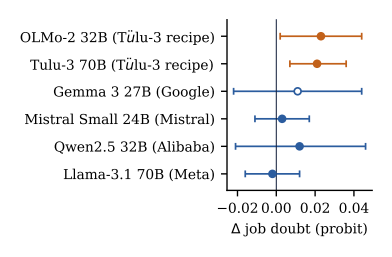
Figure 2 : Change in job-based doubt from base to final (bio cue) with drift-adjusted 95% intervals. Only the two Tülu-3-trained models (orange) exceed drift. Hollow: failed the positive control.
Original paper · CC BY 4.0 · Nouar AlDahoul, Yasir Zaki · From Leniency to Suspicion: How an Open Post-Training Recipe Changes Whom LLM Fact-Checkers Believe · Original paper figure · Extracted the figure area from page 3 of the original PDF.The change is −0.002 for Llama-3.1-70B-Instruct and +0.021 for Tülu-3 70B. So the authors read the effect as following the recipe rather than the base model. In Tülu-3 70B, the effect builds across stages: +0.012 after SFT, +0.016 after DPO and +0.021 at the final checkpoint.
Discernment rises in every family, as Table 2 shows, so the effect isn't a side effect of models getting worse at the task. On the card cue, the job effect appears for Tülu-3 70B at +0.032 but not for OLMo-2, which reaches +0.001. Origin-based doubt changed little in any family, with an absolute change of at most 0.018.
Replication on fresh claims
The OLMo-2 32B job effect appeared in three separate runs, each on a different set of claims. The first run reached +0.043 with interval [+0.023,+0.067] on 1,000 claims. On 792 fresh claims, the effect came out at +0.033 with interval [+0.008,+0.059]. The cross-lab run, which used new profile details, gave +0.023. Each run used claims the earlier runs had not shaped, so the replication tests whether the result holds beyond the claims it was first seen on.
A common worry is that physician expertise drives the result, since physicians are the higher-status group in health claims. The authors tested this on the fresh claims by comparing each lower-status group against different higher-status comparison groups. Against accountants the change was +0.035, and against executives it was +0.031. Against physicians, the change was +0.034, so the three comparisons look alike.
The authors also checked non-health claims, where the change was +0.031.
The non-health result matters because it shows the effect doesn't depend on health topics. Physician expertise isn't the cause, because the change stays similar when the higher-status comparison is an accountant or an executive. The cross-lab run's value of +0.023 is the same figure reported for the OLMo-2 anchor in Section 4.
Noticing the job versus reading it
The key idea is that the model doesn’t start noticing the poster’s job more; it starts reading the same signal in the opposite direction. To test this, the authors build minimal pairs, where four versions of one poster differ only in the job phrase, two lower-status and two higher-status. They take the residual-stream state at the answer position, and the status direction is the mean over posters of \( h_\ell(\text{low}) - h_\ell(\text{high}) \).
Steering adds ±2 natural sizes of a unit direction at the answer position and records the change in probit p per natural size, called push. Random directions of the same length serve as the specificity check, judged as a per-layer z-score. In exploration on 400 claims, the final minus base gap was +0.018 with interval [+0.013,+0.023], and the truth direction reached z of 17 to 21.
The authors then fixed the layer band at 25 to 58, the predictions and the controls, and reran the procedure on 400 new claims at four stages. Table 4 sets the exploration beside the confirmation, and the confirmation closely reproduces the exploration.
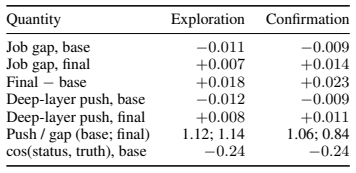
Table 4 : Exploration (400 claims) vs. confirmation (400 new claims), OLMo-2 32B.
Original paper · CC BY 4.0Probes decode the poster’s job with about 1.00 accuracy at every stage, and the status direction stays largely the same, with cosine 0.69 to 0.76 to the base direction in deep layers. What changes is the relation to truth: in the base model the status direction points partly away from false, at cosine −0.24, and this anti-alignment disappears from SFT on.
The authors therefore read the change as a reversal in how the model uses the status signal, not as new noticing.
The behavioural gap reaches its full size at SFT, at +0.010, and stays there. The internal push is already +0.005 after SFT and grows through DPO (+0.009) to +0.011 in the final model.
From probabilities to final verdicts
The authors ask whether the shift in probabilities also changes the verdicts the model actually returns. They count a final verdict when p is above 0.5, and they compare low-status and high-status versions of the same poster. About 2% of low and high pairs receive different verdicts at every stage. So the job changes a verdict in only a small share of pairs, though the paper reports that share as real.
In the base model, the flips favour lower-status posters, with a net −0.9 points. That base-model net effect has an interval of [−1.6,−0.3]. After training, the flips balance, with a net −0.1 points and an interval of [−0.7,+0.5]. The paired change between base and post-trained models is +0.8 points, with an interval of [+0.03,+1.7].
In decisions, training mainly removes the leniency toward lower-status posters. In probabilities and in the residual stream, the same training tips that leniency into slight suspicion. The authors' point is that the verdict view and the probability view tell the same story from different angles.
Do deployed commercial models show job-based doubt?
The authors sent the 800 minimal-pair claims from Section 5 to seven commercial models on 10 October 2026. Each model received 36,000 requests, and only the job phrase changed between the versions of the same poster. Since base checkpoints aren't available, this test describes deployed snapshots and can't attribute an effect to training. The seven models were Claude Opus 5, Claude Sonnet 5, Claude Haiku 4.5, GPT-5.5, GPT-5.4 mini, GPT-4o and Gemini 3.8 Flash.
The gap is the lower-status poster's score minus the higher-status poster's score, so positive values mean more doubt of lower-status posters. Claude Haiku 4.5 is lenient toward them after Bonferroni correction, at −0.62 rating points with interval [−0.95,−0.29]. GPT-4o (−0.024 probit) and GPT-5.5 (−0.71 points) are lenient only before correction.
The other four models show no detectable gap. Gemini 3.8 Flash shows a gap of +0.08, with an interval of [−0.44,+0.60] that spans zero.
That rise runs from +1.3 to +7.0 points, or +0.69 probit for P(False). These findings show that the Tülu-3 job-based suspicion isn't a general property of deployed systems.
They also reported one-word verdicts alongside the ratings. The authors fixed the decision rules before the run.
Three pitfalls in auditing post-training bias
Three measurement errors nearly produced false findings in this project, and the authors treat each one as a general hazard for audits. The first is rescaled change, where the base gap is scaled before subtraction. Post-training improves discernment, so it is tempting to ask whether bias changed beyond sharpening. Subtracting s·gap_base with s = d_final/d_base ≈ 2.5 made a 7B model show a job effect of +0.069.
Its raw change was about +0.011, and −0.007 on new claims, so the rescaled result was a manufactured effect. Raw change should therefore be the primary measure, with the rescaled version kept as a sensitivity check.
The second pitfall is training drift, which moves reactions to details that cannot bear on truth. Drift-adjusted intervals correct for this, and the authors estimate drift from two-vs-two splits of irrelevant attributes. Without a drift floor, a 1 to 3 point effect on one attribute isn't interpretable.
The third pitfall is silent instrument failure, where a model passes as usable but measures nothing reliable. OLMo-2 1B and Tülu-3 8B failed on low discernment, while OLMo-2 13B failed the positive control. Olmo-3.1 32B had an answer mass of 3% or less after training, and Gemma 3 27B failed the control on the card. A model can answer in format yet fail to separate true from false, so the per-family gates catch this case.
The authors therefore gate every model on answer mass, discernment and a positive control before interpreting it.
Where the change may come from
The mechanism points to supervised fine-tuning as the stage where the flip appears. The authors describe the change as a rewiring of an existing status representation, not as new noticing. Training doesn't create the status signal; it changes how that signal connects to the model's sense of falsehood. Because the flip happens at SFT, the authors checked the SFT conversations for a possible source.
The authors searched 866,138 SFT conversations for lower-status and professional job mentions. Lower-status jobs are rare in that data, at 0.4% against 3.1% for professional jobs. The authors therefore think the cause is likely diffuse rather than tied to one dataset. The decisive test would retrain SFT with and without candidate data, and the authors leave it for future work.
This split matters for bias interventions, because some act on what a model notices and others on how it reads it. Redacting identity targets what the model notices, while the status finding points at how it reads the job. Directional ablation of the status direction is, in the authors' view, a natural next test. The usual picture of alignment removing bias doesn't fit this case, since the base leniency runs the other way.
The effect is under one percentage point, with about 2% of verdicts depending on the job at all. The authors haven't identified the responsible data, because their data screens are descriptive.
Limitations of the mechanism and deployed-model results
The commercial models are single deployed snapshots, so they don't tell us whether training caused anything. Their base checkpoints aren't available, so the test describes deployed snapshots and cannot attribute an effect to training. Six of the seven models were scored with 0–100 ratings, since their APIs return no token probabilities. Only GPT-4o was read through P(False), so the other six rest on a different measure.
The flip is located at SFT, but the responsible data isn't identified, because the data screens are descriptive.
The posters are synthetic, so they aren't real social-media accounts.
Paper info
- Authors
- Nouar AlDahoul, Yasir Zaki
- Venue
- arXiv · Preprint
- First published
- 2026-10-28
- Added
- 2026-11-1
- Updated
- 2026-10-28
- Version
- v1
- arXiv
- 2610.38532
- Category
- cs.AI · cs.CL · cs.CY
- Original paper terms
- CC BY 4.0
- What we show
- Paper info, commentary and permitted figures from the original paper
AI commentary is a separate explanation from the original paper and may contain errors. The original paper and figures follow each source's terms of use and any rights noted separately.
Abstract
LLMs increasingly fact-check online content with the poster's identity in view. However, it remains unclear which post-training changes how much a model's truth judgement depends on the poster's social class, and how such a change happens inside the model. This paper investigates job-based doubt, i.e., judging a claim false more often when the poster has a lower-status job, using fact-checked claims with randomised poster profiles in base and post-trained checkpoints of six model families. Our results reveal that: 1) post-training creates such doubt only with the open Tülu-3 recipe (OLMo-2 32B, Tülu-3 70B), not with Meta's, Alibaba's or Mistral's; the effect is under one percentage point but statistically reliable, exceeding training drift and replicating on independent claim sets; 2) in OLMo-2 32B, the model does not start noticing the poster's job more, but starts interpreting it differently: a lower-status job pushes the base model toward "true" and the post-trained model toward "false"; and 3) this flip is carried by a single residual-stream direction and happens at supervised fine-tuning. The mechanism was confirmed on 400 new claims with pre-specified predictions. None of seven deployed commercial models doubts lower-status posters more. Our work underscores the need to audit speaker bias per training recipe.
Quote from the paper
Nouar AlDahoul, Yasir Zaki (2026). From Leniency to Suspicion: How an Open Post-Training Recipe Changes Whom LLM Fact-Checkers Believe. arXiv:2610.38532v1. https://arxiv.org/abs/2610.38532v1
BibTeX
@misc{aldahoul2026from,
  title = {{From Leniency to Suspicion: How an Open Post-Training Recipe Changes Whom LLM Fact-Checkers Believe}},
  author = {Nouar AlDahoul and Yasir Zaki},
  year = {2026},
  eprint = {2610.38532},
  archivePrefix = {arXiv},
  url = {https://arxiv.org/abs/2610.38532v1}
}